Every gardener has pulled a dandelion and wondered why it keeps coming back. Those stubborn plants are more than nuisances. Many common weeds grow best under specific soil conditions, so where they appear and how they look can give you useful clues about compaction, moisture, fertility, and pH. Learning to read those clues helps you stop fighting the same weeds every season and start fixing the reasons they are there.
In this guide, you will learn what eight familiar weeds tend to signal, what to check in your own beds, and how to act on what you find. We will also cover simple home tests and the mistakes that lead gardeners to chase symptoms instead of causes. Think of this as a field guide that turns your weeding time into a diagnostic tool.
The Core Principle: Weeds Indicate Conditions, Not Guarantees
Weeds are opportunists. They sprout where seeds land, but they establish and thrive where conditions suit their roots. A plant that loves compacted soil will often outcompete more sensitive plants there, while a plant that prefers low fertility may fade once nutrients improve. This is why weed patterns are useful: a cluster of one species in one corner often tells you more than a single plant does.
Keep in mind that weeds are indicators, not proof. A plant that prefers acidic soil may simply have arrived in a patch of seed-rich mulch. Use weeds to form a hypothesis, then confirm it with a soil test, a simple probe, or a water test before you change your fertilizer or amendment plan.
The 8 Weeds and What They Often Signal
1. Dandelion (Taraxacum officinale)
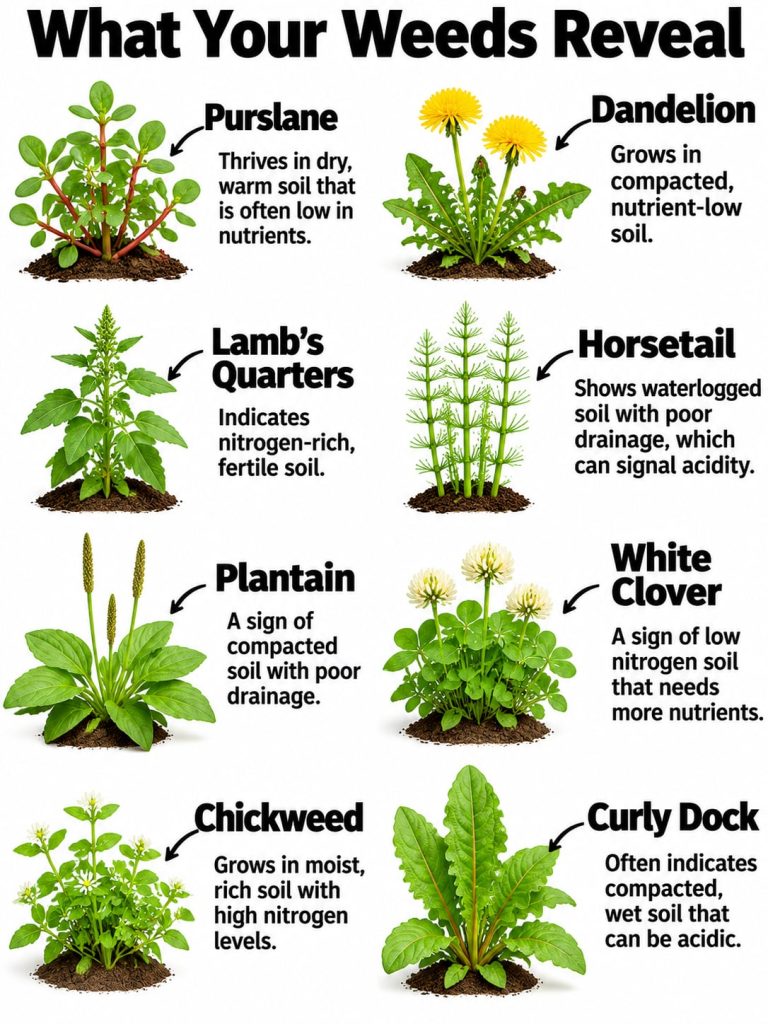
Dandelion is a hardy perennial that grows across much of the United States, roughly USDA zones 3 through 10. Its deep taproot can push through compacted layers, and it often appears in lawns and beds that get heavy foot traffic or sit in dense, poorly aerated soil. Dandelions are also common where fertility is modest.
Practical tip: pull dandelions when the soil is moist, and try to remove the entire taproot, which can be several inches long. Shallow chopping leaves regrowth. Then test for compaction and add organic matter before you reseed bare patches.
2. Broadleaf Plantain (Plantago major)
Broadleaf plantain is a low, rosette-forming perennial found in many U.S. climates, generally zones 3 through 9. It tolerates foot traffic well and often colonizes compacted paths, driveway edges, and lawns. Its presence frequently points to compacted, heavy soil that holds moisture near the surface.
Practical tip: check whether water pools after rain or soaks in slowly. If it does, loosen the top few inches with a digging fork and mix in compost rather than working wet clay, which can harden further.
3. Lamb’s Quarters (Chenopodium album)
This annual weed grows fast and often shows up in vegetable beds and freshly turned soil. It tends to thrive in fertile, nitrogen-rich ground, especially where manure or compost has been added generously. Lamb’s quarters is also edible when young and cooked, though you should identify it carefully before harvesting.
Practical tip: if lamb’s quarters thrives in one bed but struggles in another, compare the two soils. The vigorous bed may have more nitrogen, so reduce high-nitrogen inputs before adding more.
4. Common Chickweed (Stellaria media)
Chickweed is a cool-season annual that often germinates in fall and grows through the cooler months in USDA zones 6 through 10, and can behave as a winter annual farther north. It favors moist, fertile soil and shady spots, and it frequently appears in beds that stay damp longer than surrounding areas.
Practical tip: if chickweed covers a bed, check your irrigation pattern and drainage. Water less often but more deeply, and make sure the area gets some air movement, since dense, damp mats can encourage fungal problems in nearby plants.
5. Purslane (Portulaca oleracea)
Purslane is a warm-season succulent annual that spreads flat across the soil. It handles heat and drought well and often appears in sunny, dry, or compacted areas where water drains quickly or does not penetrate well. It is also edible, with a tangy flavor, and is commonly harvested in salads.
Practical tip: if purslane takes over a sunny bed, test your soil moisture by pushing a screwdriver into the ground after watering. If it stops easily only at the surface, the soil may be crusted or compacted, and adding organic matter will improve water holding.
6. White Clover (Trifolium repens)
White clover is a low perennial legume found in lawns and pastures across much of the country. It partners with bacteria that fix nitrogen from the air, so it can grow in soil that is short on available nitrogen. Its presence often suggests your soil may need more nitrogen for grasses and vegetables, although mowing and compaction can also favor it.
Practical tip: do not spray clover automatically. It can supply nitrogen to nearby plants, and it stays green in dry spells. Consider a soil test and feed grasses or vegetables with a balanced organic fertilizer if test results confirm low nitrogen.
7. Sheep Sorrel (Rumex acetosella)
Sheep sorrel is a small perennial that grows in acidic, sandy, or nutrient-poor soil. It is one of the more useful pH indicators, often appearing in soils with a low pH, commonly below about 6.0, though exact thresholds vary by soil type. Its arrowhead-shaped leaves are easy to spot once you know them.
Practical tip: run a pH test using a reliable kit or submit a sample to your local extension service. If the soil is acidic, add lime based on the test recommendation rather than guessing, since over-liming can cause its own problems.
8. Field Bindweed (Convolvulus arvensis)
Field bindweed is a perennial vine with deep roots and a tendency to spread aggressively. It often appears in disturbed, compacted, or dry soils, and it can be difficult to control because its roots regrow from fragments. It is considered a serious weed in many areas.
Practical tip: pull new shoots as soon as you see them, and avoid tilling pieces of root, which can spread the plant. Use a barrier such as mulch on bare soil and monitor the bed closely for several seasons. Persistent infestations may need a targeted, label-directed approach.
How to Check Your Soil Yourself
Start with a simple squeeze test. Moisten a handful of soil and squeeze it. If it forms a sticky ball that does not crumble, it may be clay-heavy. If it falls apart immediately, it may be sandy. Next, dig a small hole about 8 inches deep. Look for roots that bend sharply or stop abruptly, which often signals compaction.
For a more accurate picture, collect samples from several spots in the same bed at a depth of 4 to 6 inches, mix them in a clean bucket, and send the blend to your local Cooperative Extension office or a certified lab. Ask for pH, nutrient levels, and organic matter. Testing in fall or early spring gives you time to amend before planting.
Common Mistakes to Avoid
- Treating every weed as a sign of the same problem. Patterns across the whole garden matter more than one plant.
- Adding fertilizer before testing. Extra nitrogen can make some weeds more vigorous and may harm nearby crops.
- Working wet soil. Tilling clay when it is soggy can create hard clods and worsen compaction.
- Pulling weeds with the top growth only. Taprooted and creeping weeds regrow quickly from broken roots.
- Relying on lime without a pH test. Adding lime to soil that is already near neutral can throw nutrients out of balance.
Adjusting Your Approach by Region
Weed patterns vary across the country. In cooler northern areas, USDA zones 3 through 5, many weeds are active mainly in spring and early fall, so timing your pulling and mulching matters. In zones 6 through 8, which cover much of the Midwest, Mid-Atlantic, and Southeast, rainfall and humidity can drive rapid regrowth. In zones 9 through 11, especially in the Southwest and parts of Florida and Texas, heat and dry spells favor purslane and other drought-tolerant weeds.
Remember that USDA zones describe winter cold, not summer heat, rainfall, or soil. Your local Cooperative Extension office can tell you about frost dates, common regional weeds, and recommended soil testing services. Microclimates in shaded corners, sunny slopes, and irrigated beds can also change which weeds show up.
Turning Weeds Into a Soil Action Plan
Begin with one bed and walk it once a week for a month. Note which weeds appear, where they cluster, and how the soil feels after rain. Pair those observations with a soil test, then choose one or two changes: add compost to loosen dense ground, mulch bare patches, adjust irrigation, or correct pH as the test recommends. Give each change a full growing season to show results.
Healthy soil rarely looks perfect, and a few weeds will always appear. The goal is not a weed-free garden but a garden where you understand what is happening underground. Once you start reading your weeds, you will spot problems earlier, spend less time chasing symptoms, and build richer soil for the plants you actually want to grow. Start this week by pulling one weed, checking its roots, and asking what the soil is trying to tell you.