Want to get more from your workouts? Focusing on key movements for your core and legs is a practical way to build strength, improve daily movement, and support long-term fitness. Whether you are just starting out or returning to exercise after a break, the principles below can help you train with more confidence.
Why Movement Quality Comes First
Many people focus on how many repetitions they complete. However, research on resistance training consistently highlights that technique, controlled tempo, and a full range of motion are central to training safely and effectively. Good form helps distribute the work across the right muscles and reduces unnecessary strain on joints.
Key principles of proper form
- Keep your movements slow and controlled, especially on the way down.
- Breathe steadily instead of holding your breath.
- Stop a set when your form starts to break down.
- Choose a difficulty level you can complete with good control.
Core Training: Building a Stable Foundation
Your core includes the muscles of the abdomen, lower back, hips, and pelvis. These muscles help stabilize your spine and support nearly every movement you make, from lifting groceries to climbing stairs. Core training is commonly associated with better posture and balance, and it is a useful part of many fitness routines.
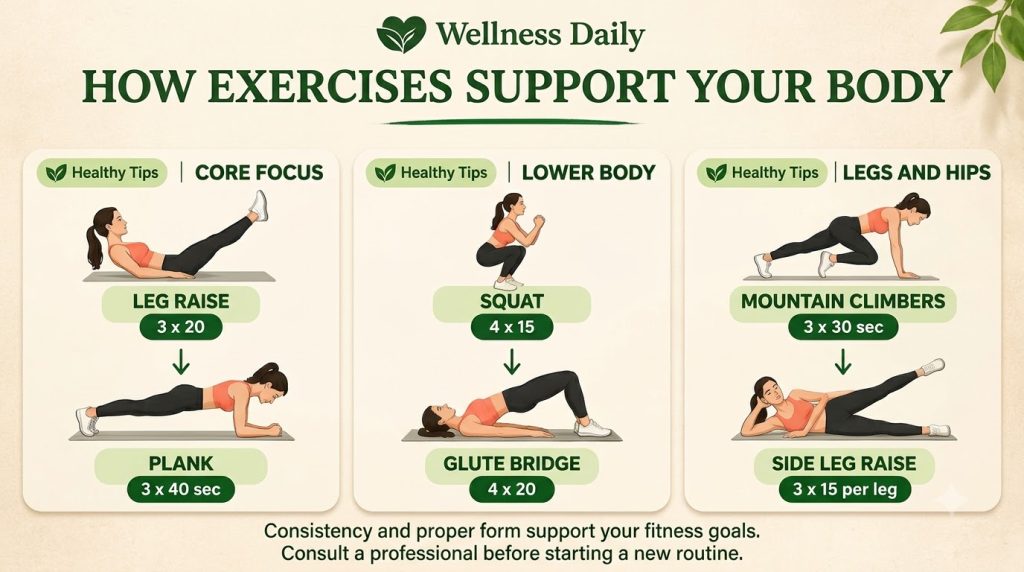
- Plank: Hold a forearm plank with your body in a straight line, from head to heels. Start with shorter holds and build up gradually.
- Dead bug: Lying on your back, slowly extend opposite arm and leg while keeping your lower back gently pressed to the floor.
- Bird dog: On hands and knees, extend one arm and the opposite leg while keeping your hips level.
Leg Training: Strength for Everyday Life
Strong legs support walking, standing, climbing stairs, and getting up from a chair. Lower-body exercises also engage the glutes and hips, which play an important role in knee and lower-back alignment during movement.
- Bodyweight squat: Sit back as if reaching for a chair, keeping your chest up and knees tracking over your toes. Try 2 to 3 sets of 10 to 15 repetitions.
- Glute bridge: Lying on your back with knees bent, lift your hips while squeezing your glutes at the top. Try 2 to 3 sets of 12 to 15 repetitions.
- Side leg raise: Lying on your side, lift the top leg with control. Try 2 sets of 10 to 15 repetitions per leg.
How to Build a Simple Weekly Routine
Consistency usually matters more than intensity. A balanced plan for beginners might look like this:
- Train core and legs two to three times per week, with at least one rest day between sessions.
- Begin with 1 to 2 sets per exercise and add sets gradually as your technique improves.
- Include a short warm-up of walking or light mobility work before each session.
- Recover well with sleep, hydration, and balanced meals.
Tips for Staying Safe
Progress should feel challenging but manageable. Mild muscle soreness is common when you start a new routine, but sharp or persistent pain is a signal to stop and seek professional advice. If you have a medical condition, are pregnant, or are recovering from an injury, speak with a qualified healthcare provider before starting or changing your exercise plan.
For general guidance on physical activity, you may wish to review the World Health Organization’s recommendations on physical activity for adults.
Final Thoughts
Building a stronger foundation takes time, patience, and proper technique. By focusing on core stability and leg strength, and by prioritizing good form, you can create a training habit that supports your long-term wellness goals. Start with small, manageable steps and build from there.
This article is for educational purposes only and is not a substitute for medical advice, diagnosis, or treatment. Always consult a qualified healthcare professional before starting a new exercise program.