Imagine your garden not just as a space for cultivated plants, but as a hidden treasure chest filled with nutrient-rich superfoods. Many plants we commonly dismiss as ‘weeds’ are, in fact, incredibly valuable edible greens, herbs, and flowers that can add flavor, vitamins, and minerals to your diet—all for free! Learning to identify and safely harvest these wild edibles transforms your gardening perspective, connecting you more deeply with the natural abundance around you. It’s a journey into sustainable living, resourcefulness, and discovering the surprising bounty beneath your feet.
This guide will introduce you to twelve common garden plants often overlooked, revealing their culinary potential and how to incorporate them into your kitchen. Get ready to rethink what belongs in your garden and discover a whole new world of fresh, wholesome ingredients.
Embracing Your Wild Garden Pantry
Before you start foraging, remember that accurate identification is paramount. Only consume plants you are 100% certain of their identity. Avoid plants growing near roadsides, industrial areas, or anywhere they might have been sprayed with pesticides or herbicides. Always wash foraged plants thoroughly. Start with small quantities to ensure no adverse reactions, and be mindful of sustainable harvesting practices, leaving plenty for the plant to recover and for wildlife.
Dandelion (Taraxacum officinale)
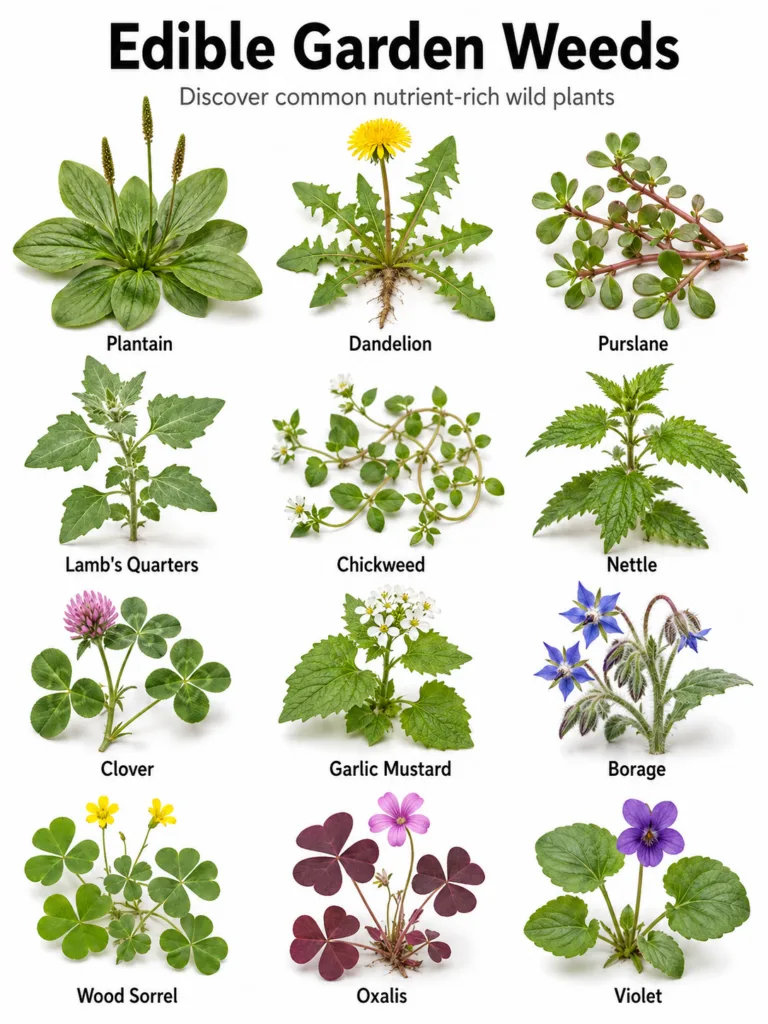
Perhaps the most famous ‘weed’ in the garden, every part of the dandelion is edible and packed with vitamins A, C, and K, as well as calcium and potassium. The young leaves are less bitter and can be added to salads, stir-fries, or sautéed like spinach. Flowers make a beautiful garnish, wine, or fritters. The taproot can be roasted and ground as a coffee substitute.
- Hardiness: Perennial, Zones 3-10
- Plant type: Herbaceous perennial
- Exposure: Full sun to partial shade
- Height: 6-18 inches
- Spread: 6-12 inches
Care Tip: Harvest young leaves in spring for the mildest flavor. As leaves mature or as the plant flowers, they become more bitter.
Purslane (Portulaca oleracea)
This succulent-like plant is a nutritional powerhouse, rich in Omega-3 fatty acids, vitamins A and C, and minerals. Its slightly tart, lemony flavor and crunchy texture make it an excellent addition to salads, sandwiches, and even cooked dishes. Purslane thrives in warm weather and can spread rapidly.
- Hardiness: Annual (but often self-seeds), Zones 2-11
- Plant type: Succulent annual
- Exposure: Full sun
- Height: 2-6 inches (spreading)
- Spread: 12-24 inches
Care Tip: Harvest stems and leaves regularly to encourage bushier growth and prevent it from taking over. It’s delicious fresh.
Chickweed (Stellaria media)
A low-growing, delicate annual with small white flowers, chickweed is a cool-season edible that prefers moist, shaded areas. It’s high in vitamins A, C, and B, and minerals like iron, calcium, and magnesium. Its mild, grassy flavor makes it perfect for salads, pestos, or juicing.
- Hardiness: Annual (prolific self-seeder), Zones 3-9
- Plant type: Herbaceous annual
- Exposure: Partial shade to full sun
- Height: 2-8 inches
- Spread: 6-12 inches
Care Tip: Enjoy chickweed fresh in early spring before temperatures rise, as it tends to disappear in summer heat.
Plantain (Plantago major)
Broadleaf plantain is a common sight in lawns and pathways. Its young, tender leaves are edible, though they can become fibrous with age. They’re a good source of calcium, vitamins K, A, and C. Use them in salads, sautéed, or as a nutritious addition to soups. Plantain also has traditional medicinal uses, often applied externally for minor wounds and insect bites.
- Hardiness: Perennial, Zones 3-9
- Plant type: Herbaceous perennial
- Exposure: Full sun to partial shade
- Height: 4-12 inches
- Spread: 6-12 inches
Care Tip: Seek out younger, smaller leaves from the center of the rosette for a more palatable texture and milder flavor.
Red Clover (Trifolium pratense)
While often grown as a cover crop, red clover frequently appears in gardens and lawns. Both the leaves and the vibrant pinkish-purple flower heads are edible. Leaves can be added to salads in moderation, and the sweet flowers are lovely in teas, garnishes, or infused into vinegar. Red clover is known for its high protein and mineral content.
- Hardiness: Perennial, Zones 3-8
- Plant type: Herbaceous perennial
- Exposure: Full sun
- Height: 1-2 feet
- Spread: 1-2 feet
Care Tip: Enjoy clover flowers fresh or dried in teas. Limit consumption of raw leaves, as large quantities can be difficult to digest for some.
Violet (Viola spp.)
Wild violets, with their heart-shaped leaves and charming purple, blue, or white flowers, are a delightful edible. Both the leaves and flowers are edible and rich in vitamins A and C. The leaves have a mild, slightly mucilaginous texture, good for thickening soups or adding to salads. The flowers are beautiful garnishes, candied, or used to make syrups and jellies.
- Hardiness: Perennial, Zones 3-9
- Plant type: Herbaceous perennial
- Exposure: Partial shade to full shade
- Height: 4-8 inches
- Spread: 6-12 inches
Care Tip: Harvest leaves and flowers in spring. They add a delicate touch and nutritional boost to fresh dishes.
Wood Sorrel (Oxalis stricta)
Often mistaken for clover due to its three-leaflets, wood sorrel (also known as sourgrass or common yellow woodsorrel) is easily identified by its distinct sour, lemony taste. It contains oxalic acid, so consume in moderation. The leaves, stems, and small yellow flowers are edible, excellent in salads, as a tart garnish, or in refreshing drinks. It’s a good source of vitamin C.
- Hardiness: Annual/Perennial, Zones 3-11
- Plant type: Herbaceous annual/perennial
- Exposure: Partial shade to full sun
- Height: 4-12 inches
- Spread: 6-18 inches
Care Tip: Enjoy the bright, citrusy flavor in small amounts. Avoid if you have kidney stones or gout due to oxalic acid content.
Lamb’s Quarters (Chenopodium album)
This fast-growing annual is related to quinoa and spinach, and its leaves are remarkably nutritious, high in vitamins A, C, and K, as well as calcium and iron. The young leaves have a powdery-white coating on their undersides. Use them raw in salads or cooked like spinach. The seeds are also edible and can be ground into flour.
- Hardiness: Annual, Zones 3-10
- Plant type: Herbaceous annual
- Exposure: Full sun to partial shade
- Height: 1-6 feet
- Spread: 1-3 feet
Care Tip: Harvest young leaves before the plant flowers for the best flavor and tenderness. Cook larger leaves to reduce oxalic acid.
Mallow (Malva neglecta)
Common mallow, sometimes called cheeseweed for its cheese-wheel-shaped seed pods, is a demure but delicious edible. Its leaves have a mild flavor and a mucilaginous texture, similar to okra, making them great for thickening soups and stews or adding to salads. The flowers are also edible and can be used as garnishes.
- Hardiness: Annual/Biennial, Zones 4-9
- Plant type: Herbaceous annual/biennial
- Exposure: Full sun to partial shade
- Height: 6-24 inches
- Spread: 12-36 inches
Care Tip: The entire plant, especially young leaves and flowers, is edible. The mucilaginous quality makes it an interesting addition to smoothies or stews.
Stinging Nettle (Urtica dioica)
Don’t let the ‘stinging’ deter you! Once cooked or dried, stinging nettle loses its sting and becomes a highly nutritious leafy green, rich in iron, calcium, and vitamins A and C. Harvest with gloves, then blanch, steam, or sauté the young leaves like spinach. It makes excellent soups, teas, and pestos.
- Hardiness: Perennial, Zones 3-9
- Plant type: Herbaceous perennial
- Exposure: Partial shade to full sun
- Height: 2-7 feet
- Spread: 1-3 feet
Care Tip: Always wear gloves when harvesting. Cooking or drying eliminates the sting, making it safe and delicious to eat.
Garlic Mustard (Alliaria petiolata)
An invasive species in many parts of North America, garlic mustard is identifiable by its garlicky aroma when leaves are crushed. All parts are edible: young leaves in salads, flowers as a garnish, and roots can be grated like horseradish. It’s best harvested in spring before it flowers and sets seeds, helping to control its spread.
- Hardiness: Biennial, Zones 4-8
- Plant type: Herbaceous biennial
- Exposure: Partial shade to full shade
- Height: 1-3 feet
- Spread: 6-12 inches
Care Tip: Harvest extensively in spring, especially before it flowers, to both enjoy its flavor and help manage its invasive tendencies.
Borage (Borago officinalis)
While often cultivated for its beautiful blue star-shaped flowers, borage can readily self-seed and appear as a ‘volunteer’ in your garden. The young leaves and flowers have a refreshing cucumber-like flavor. Leaves are best used raw when young or lightly cooked. The stunning blue flowers are fantastic garnishes for salads, drinks, and desserts.
- Hardiness: Annual, Zones 2-11
- Plant type: Herbaceous annual
- Exposure: Full sun
- Height: 2-3 feet
- Spread: 1-2 feet
Care Tip: Harvest young leaves for the best flavor; mature leaves can become hairy. The flowers are a beautiful edible garnish.
Common Foraging Mistakes to Avoid
- Misidentification: The most critical mistake. Always use multiple identification guides and consult with experienced foragers if unsure. When in doubt, leave it out.
- Foraging in Contaminated Areas: Avoid plants from roadsides, industrial sites, conventional farms (pesticides), or areas with heavy foot traffic (pet waste).
- Over-harvesting: Only take what you need and never strip an area. Leave plenty for the plant to recover and to provide food for wildlife.
- Ignoring Plant Conditions: Avoid plants that look sickly, are covered in pests, or have unusual growths.
- Not Washing Thoroughly: Always wash foraged plants to remove soil, insects, and any potential contaminants.
Transform Your Garden & Plate
Stepping into the world of edible weeds is an enriching experience that deepens your connection to nature and provides a sustainable source of nutrition. By learning to identify and appreciate these wild edibles, you transform your garden into a dynamic, productive space where every plant, cultivated or wild, has a role to play.
So, the next time you spot a ‘weed’ peeking out from your garden bed, pause and take a closer look. You might just be looking at your next superfood ingredient. Happy foraging, and enjoy the unexpected bounty your garden has to offer!