Rosemary has a way of looking easy right up until it becomes leggy, woody, and uneven. One side stretches toward the light, the center gets bare, and the plant starts looking more like a bundle of stiff sticks than the full, fragrant herb you wanted. The good news is that rosemary responds well to thoughtful pruning. The key is not harsh cutting. It is light, regular shaping that keeps green growth active and prevents the plant from aging into a hollow shell. Rosemary is an evergreen shrub with aromatic needle-like leaves, typically hardy outdoors in USDA Zones 8–10, though some selections can be grown in colder areas with winter protection.
Once you understand how rosemary grows, pruning becomes much less intimidating. This is not a plant you shear hard into old wood and expect to bounce back. It performs best when you work with its natural shape, trim the outer green growth, and keep every cut connected to living foliage. Done properly, pruning improves density, airflow, harvest quality, and the long-term health of the plant.
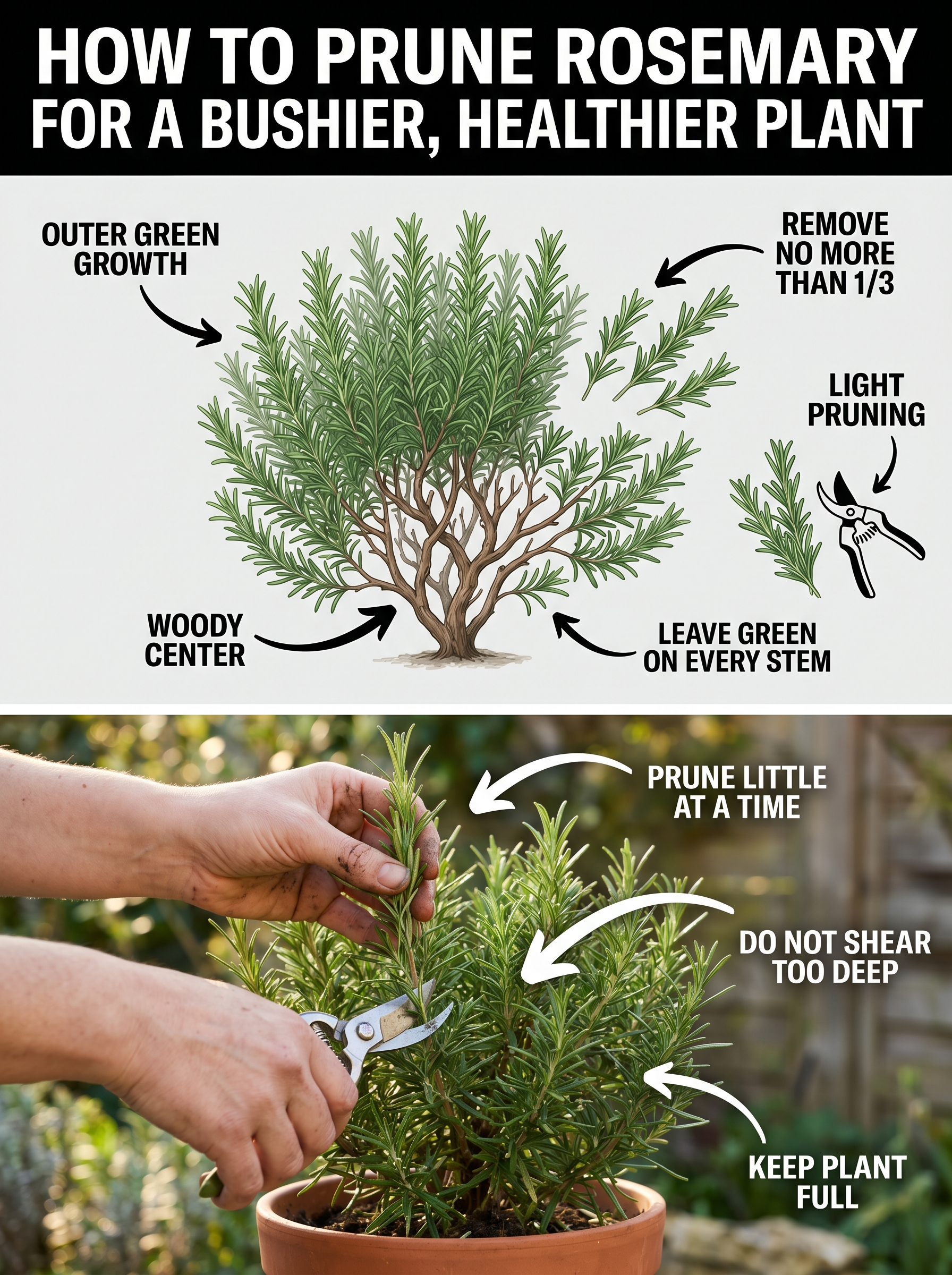
Why rosemary gets woody and sparse
Rosemary is naturally a woody subshrub. That means it produces fresh green shoots on the outside while older stems harden and brown over time. If it is never trimmed, the outer shell keeps stretching while the interior becomes more bare and twiggy. This is normal aging, but it becomes a problem when too much of the plant is old wood and not enough is active green growth. Wisconsin Extension notes that cutting into woody parts can hinder development, which is why shaping the plant while it is still green and vigorous matters so much.
This is also why the timing and depth of your cuts matter. If you prune lightly and consistently, you encourage branching and keep the plant leafy from the outside in. If you ignore it for too long, then cut hard into the bare center, recovery becomes much less reliable because old wood often does not push new growth strongly.
The best time to prune rosemary
The most reliable pruning window is after flowering, in late spring to early summer, when the plant is actively growing and can recover quickly. Missouri Botanical Garden notes that rosemary often flowers from winter into spring in warm climates, and additional bloom may follow if plants are trimmed after the late winter to spring bloom. Gardener’s Path likewise recommends pruning in late spring to midsummer and avoiding late autumn or winter pruning, since tender growth needs time to harden before cold weather.
That means the practical rule is simple: prune when the plant is growing, not when it is stressed by cold. If frost is still possible, wait. Gardeners’ World notes that pruning just before frost can damage cut ends before they seal properly.
The golden pruning rule: never strip rosemary too hard
If you remember only one guideline, make it this one: do not remove more than about one-third of the plant at a time. Several gardening references echo this limit, and Wisconsin Extension is even more conservative for harvest cutting, recommending no more than about 20% at a time. The reason is simple: rosemary stores energy in its living canopy. Cut too much at once and you stress the plant, slow recovery, and risk leaving too little active foliage to support new branching.
This is where many gardeners go wrong. They try to “reset” a neglected plant in one heavy session. Rosemary rarely thanks you for that. It does much better with light shaping repeated over time.
How to prune rosemary step by step
Start by standing back and looking at the overall form. You want a full, balanced plant with green growth on every branch tip and no severe hollowing in the center. Then work in this order.
First, remove anything broken, weak, or obviously dead. This clears the structure and helps you see the plant’s shape. General pruning guidance from UMN Extension recommends removing unwanted and unhealthy growth while preserving the plant’s natural form rather than shearing it into something artificial.
Next, trim the outer green growth. Focus on the fresh leafy tips, cutting just above a node or side shoot. This encourages branching and keeps the plant compact. If one stem is much taller than the rest, shorten it gradually instead of chopping the whole plant flat. That small, selective approach is what produces a bushier rosemary rather than a blunt, thinned-out shrub.
Then check each stem before cutting deeper. Leave green on every stem. This is critical. Wisconsin Extension specifically warns against cutting into woody parts unless you are shaping the plant, because that can hinder development. In practice, that means never diving so deep that you are left with bare brown sticks and no active foliage.
Finally, prune a little at a time. Step back often. Rotate the pot if it is container-grown. The goal is not perfect symmetry. The goal is a full, healthy structure with enough foliage left to drive regrowth.
What not to do
Do not shear rosemary like a hedge unless you are maintaining a formal topiary or clipped edge. UMN Extension advises against shearing shrubs into tight geometrical forms unless they need that specific treatment, and rosemary usually looks and performs better when its natural shape is preserved.
Do not cut into the woody center expecting lush regrowth. Rosemary can become bare inside as it ages, but old wood is not reliably regenerative. Heavy cuts into brown, leafless stems often leave permanent gaps.
Do not do major pruning in late fall or winter. New soft growth produced too late in the season is more vulnerable to cold damage, and winter pruning can slow recovery.
Pruning rosemary in pots versus in the ground
Container rosemary often needs more frequent light shaping than in-ground plants because potted plants dry faster, lean toward light, and can become top-heavy. Missouri Botanical Garden notes that container-grown rosemary should be moved outdoors in mid-spring after the last frost, and overwatering is a major risk. That combination matters for pruning too: a potted rosemary should be kept full enough to shade its root zone lightly, but not so dense that airflow drops and the center gets weak.
In-ground rosemary, especially in warm zones, can get much larger – often several feet tall and wide. University of Georgia describes it as drought tolerant, easy to grow, and capable of becoming quite large, which is exactly why periodic shaping matters before size turns into disorder.
Aftercare: what helps rosemary recover well
After pruning, give rosemary what it likes most: sun, drainage, and restraint. It does not need pampering. It needs a bright position, soil that drains quickly, and watering that is thorough but not constant. Missouri Botanical Garden repeatedly warns that overwatering leads to root rot, and Arizona Extension notes rosemary generally needs little supplemental water except in especially hot, droughty periods.
This is also a good time to use your cuttings well. Fresh pruned sprigs can go straight to the kitchen, be dried for storage, or be used for propagation. Young rosemary stems are often the easiest to root.
A practical pruning rhythm for a better plant
The healthiest rosemary plants are rarely the ones that get one dramatic haircut each year. They are the ones that get small harvest cuts, seasonal shaping after bloom, and gentle correction before problems become structural. Think of rosemary pruning as part harvest, part maintenance, part long-term design.
If you trim the outer green growth, remove no more than one-third, leave green on every stem, avoid cutting deep into old wood, and shape the plant little by little, you will usually get exactly what you want: a fuller, bushier, healthier rosemary that looks good and gives you better stems for cooking.
A well-pruned rosemary does more than look neat. It becomes easier to harvest, less prone to thinning out, and much more enjoyable to grow. That is the kind of plant care that quietly upgrades your whole gardening routine.