Some home remedies do not look medicinal at all.
They sit quietly in pots, grow thick fleshy leaves, and seem more like ornamental plants than anything else. But this plant which looks like Kalanchoe pinnata, also widely known as Bryophyllum pinnatum, life plant, or miracle leaf has a much longer traditional history than most people realize. Kew describes it as a succulent subshrub with fleshy leaves and coarsely crenate margins, widely naturalized across the tropics. (Plants of the World Online)
That is probably why it still shows up in remedies for wrist pain, swelling, and general inflammation. In many traditional systems, the leaves are crushed into a fresh poultice or made into a simple herbal drink. Modern research has also looked at Bryophyllum pinnatum for anti-inflammatory effects, although most of that evidence is still preclinical rather than strong human clinical proof.
So the honest version is this: this is a traditional inflammation-support herb with real scientific interest behind it, but it is not a miracle cure for wrist pain, arthritis, or nerve problems.
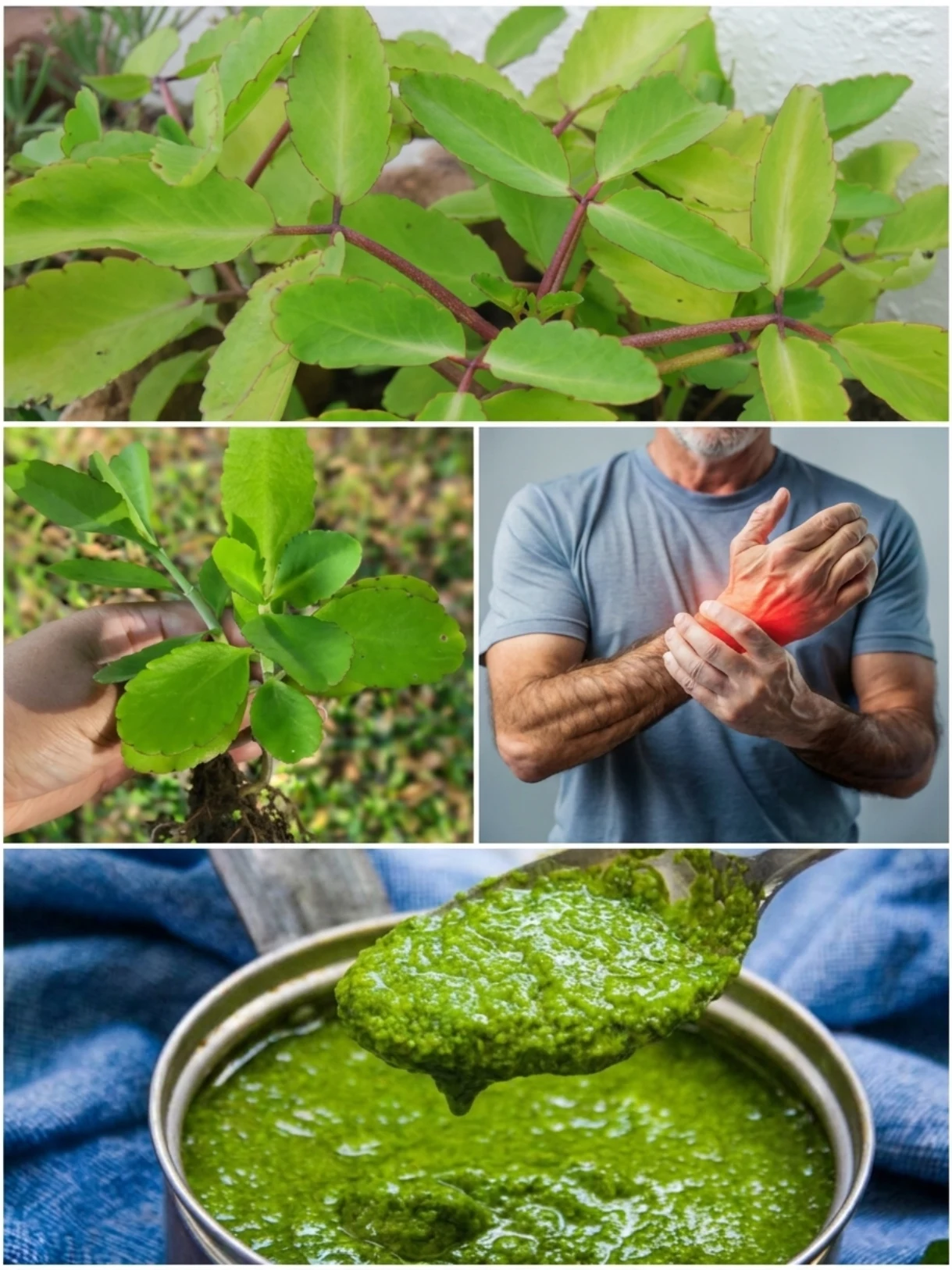
Why People Use Life Plant for Wrist Discomfort
When this plant is used for pain, it is usually because of its reputation for cooling irritation and easing swelling.
That makes sense. Wrist pain often comes with tightness, puffiness, or that dull sore feeling that follows repetitive movement, lifting, typing, or overuse. Folk remedies tend to reach for herbs that feel soft, moist, and calming, and Bryophyllum pinnatum fits that style of use well.
A PubMed-indexed study found that an ethanol extract of Bryophyllum pinnatum leaves showed topical anti-inflammatory effects in mouse ear edema models. Broader reviews of the Bryophyllum group also note that these plants have been used traditionally for inflammation, infections, gynecological complaints, and other chronic conditions.
That does not prove a leaf paste will fix every sore wrist. But it does explain why this plant keeps its reputation.
Ingredients
For a simple traditional-style life plant poultice for wrist pain, you only need a few things:
- 4 to 6 fresh Bryophyllum pinnatum leaves
- a few drops of clean water, if needed
- a mortar, pestle, or spoon for crushing
- a clean cloth or gauze
Some people also make a mild tea from the leaves, but the image and traditional use here fit better with a fresh leaf paste.
How to Prepare It
This kind of remedy works best when the leaves are fresh.
Step 1: Wash the leaves well
Rinse the leaves thoroughly to remove dust and residue.
Step 2: Crush into a paste
Place the leaves in a mortar and crush them until they become soft and juicy. If needed, add just a few drops of water to help form a smooth paste.
Step 3: Spread onto cloth
Spoon the paste onto a clean cloth or gauze.
Step 4: Apply to the wrist
Lay the poultice over the sore area.
Step 5: Leave on briefly
Use it for a short session at first, especially if you have never used the plant before.
The paste is usually cool, moist, and soothing against the skin, which is one reason people find it comforting.
How to Use It
This remedy is generally used externally, not aggressively.
Best time to use it
Most people would use it:
- after work or repetitive hand use
- when the wrist feels mildly swollen
- in the evening, when the joint feels tired and stiff
What to expect
The most realistic benefit is not some dramatic overnight change. It is more likely that the wrist feels:
- cooler
- less tight
- a bit calmer
- more comfortable after resting with the poultice on
You may notice that kind of support the same day. But if the pain is from a fracture, carpal tunnel syndrome, tendon tear, inflammatory arthritis, or nerve compression, a plant paste is not going to solve the real cause.
Why This Plant Still Gets Attention
Part of the reason is tradition.
Part of it is the plant itself.
This is a succulent, which means the leaves naturally hold moisture. That alone makes them feel different from dry herbs when used as a fresh poultice. They seem more “alive,” softer, and more cooling.
There is also real scientific curiosity around the plant. Reviews describe Bryophyllum pinnatum as rich in phenolic compounds and bufadienolides, and newer studies continue to explore antioxidant, anti-inflammatory, and other biological activities.
So while the internet often overstates what it can do, the plant is not random folklore either. It genuinely has enough pharmacological interest to understand why people still use it.
Safety Notes
This part matters.
Although Bryophyllum pinnatum is widely used traditionally, the safety picture is still not fully settled. A review on the plant notes that the extent of both the beneficial and toxic effects of crude extracts remains unclear. Another review of the Bryophyllum group points to biologically active compounds, including bufadienolides, which is a reminder that natural does not always mean harmless. (PMC)
A few practical precautions:
- do not apply it to broken or infected skin
- patch-test first if your skin is sensitive
- avoid assuming every Kalanchoe-type plant is interchangeable
- be cautious with oral use unless you know the plant and source well
- do not self-treat severe or persistent wrist pain with poultices alone
And if the wrist is badly swollen, numb, weak, visibly deformed, or painful after a fall, that needs proper medical care.
Final Thoughts
Bryophyllum pinnatum, or life plant, is one of those herbs that sits right between garden plant and folk remedy. It looks gentle, and in many ways it is. People keep using it because the fresh leaves are easy to crush, easy to apply, and naturally suited to a simple cooling poultice.
That does not make it a miracle. But it does make it understandable.
Used carefully, it may be one of those small traditional remedies that helps an overworked wrist feel a little less irritated at the end of the day. And sometimes, that kind of modest relief is exactly what people are looking for.