Imagine a garden where every plant is bursting with vitality, laden with more flowers, or overflowing with a richer harvest. This isn’t just a gardener’s dream; it’s an achievable reality with one of the most transformative skills in plant care: pruning. While it might seem intimidating at first, strategic pruning is simply a conversation with your plants, guiding their energy to where it serves them best. It’s about shaping their growth, promoting health, and encouraging them to produce more of what you love.
This guide will demystify the art of pruning, focusing on nine common garden favorites. You’ll learn the ‘why’ behind each snip and discover how a little thoughtful intervention can lead to significantly fuller, more productive plants. Get ready to transform your garden with confidence and watch your green companions flourish!
Understanding how to prune effectively is like having a secret language with your plants. It’s not about randomly cutting, but rather making informed decisions that trigger specific responses in the plant. When you remove certain parts, you’re redirecting the plant’s growth hormones (auxins) and energy to other areas. This often encourages lateral branching, which results in a denser, bushier form, more flower buds, or larger fruits. It also improves air circulation, reduces disease risk, and helps maintain plant vigor over time.
Essential Pruning Techniques for Your Garden
1. Basil (Ocimum basilicum): Pinching for Bushiness
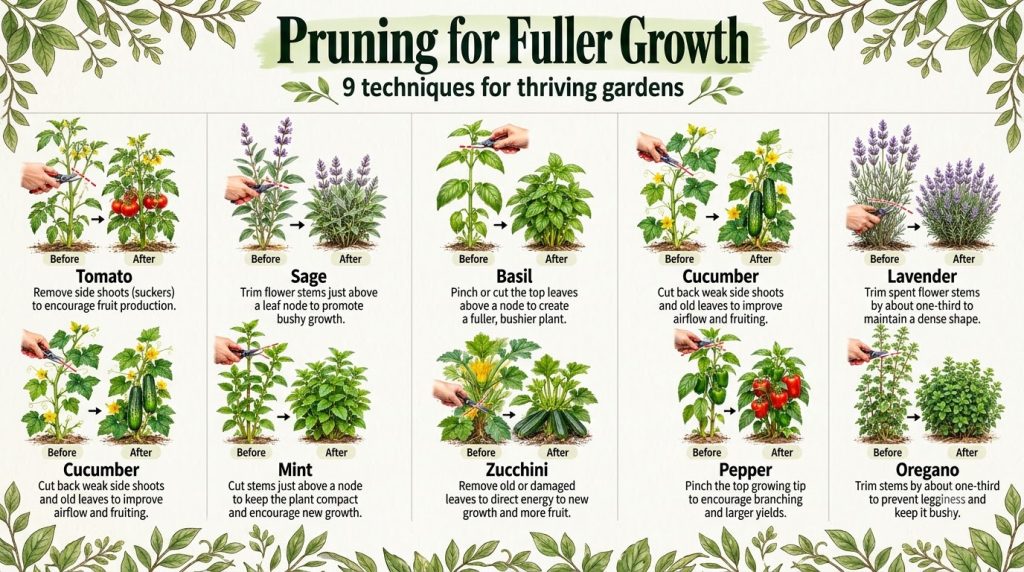
Basil is a beloved annual herb, treasured for its aromatic leaves. Without intervention, it tends to grow tall and leggy, quickly going to flower and ending its leafy production. Pinching is the key to a continuous, abundant harvest.
- Technique: When your basil plant has grown 6-8 inches tall and developed 3-4 sets of true leaves, locate the main stem and identify the smaller leaves (nodes) emerging from the main stem just above another set of leaves. Pinch off the top two leaves, along with the very tip of the main stem, just above a set of healthy leaves or a leaf node.
- Benefit: This encourages the plant to branch out from the nodes below the pinch, creating two new stems where there was one. Regular pinching every 2-3 weeks will result in a much fuller, bushier plant with a higher yield of flavorful leaves.
- Care Tip: Always prune basil before it flowers to maintain its best flavor and encourage leaf production. If it does flower, simply pinch off the flower stalk.
2. Marigold (Tagetes spp.): Deadheading for Continuous Blooms
Marigolds are cheerful annual flowers, known for their bright, long-lasting blooms and their ability to deter certain garden pests.
- Technique: As marigold flowers fade, their petals will shrivel and turn brown. To deadhead, locate the spent flower and follow its stem down to the first set of healthy leaves or a side shoot. Snip the stem just above this point.
- Benefit: Deadheading prevents the plant from expending energy on seed production. Instead, it redirects that energy into producing more flowers, leading to a prolonged blooming period and a tidier appearance.
- Care Tip: Make deadheading a regular task, perhaps once a week, to keep your marigolds blooming profusely throughout the growing season.
3. Rosemary (Salvia rosmarinus): Shaping for Fuller Growth
Rosemary is a fragrant, woody perennial herb (USDA Zones 7-10, often grown as an annual or container plant elsewhere) that can grow into a substantial shrub. Regular trimming keeps it compact and encourages fresh growth.
- Technique: After the plant has finished flowering, or any time it starts to look leggy, use clean, sharp pruners to snip back stems by about 1/3 of their length, always cutting just above a leaf node or a side branch. Avoid cutting into old, woody stems that have no green leaves, as these may not regrow.
- Benefit: This encourages new branching from dormant buds along the stems, leading to a denser, more rounded plant. It also promotes the growth of tender, flavorful new foliage.
- Care Tip: Harvest rosemary frequently for culinary use, as this acts as a form of pruning and encourages the plant to become bushier.
4. Lavender (Lavandula spp.): Pruning for Vigor and Shape
Lavender is a popular perennial herb (USDA Zones 5-9, species dependent) valued for its fragrant flowers and calming properties. Proper pruning ensures a compact, floriferous plant rather than a leggy, woody one.
- Technique: After the main flush of flowers has faded, deadhead by cutting off the spent flower stalks, along with about 1-2 inches of the leafy stem, just above a healthy set of leaves. For established plants, a more substantial prune can be done in early spring, removing up to one-third of the plant’s overall size, again cutting above new green growth. Avoid cutting into very old, woody stems that have no leaves.
- Benefit: Deadheading encourages a second bloom. The spring prune maintains a rounded, bushy shape, prevents woodiness, and promotes vigorous new growth and abundant flowering in the coming season.
- Care Tip: Ensure good air circulation around your lavender by not planting it too closely to other plants, as this helps prevent fungal issues.
5. Tomato (Solanum lycopersicum): Removing Suckers for Larger Fruit
Tomatoes are classic annual garden vegetables that benefit immensely from strategic pruning, especially indeterminate varieties.
- Technique: “Suckers” are small shoots that grow in the “axil” – the point where a side branch meets the main stem. These suckers will grow into new fruiting stems if left unchecked. For larger fruits and better air circulation, simply pinch off or snap these suckers when they are small (2-4 inches long).
- Benefit: Removing suckers directs the plant’s energy towards developing the main stems and existing fruits, leading to larger, more concentrated fruit production. It also improves air circulation, reducing the risk of fungal diseases.
- Care Tip: For determinate (bush) tomato varieties, little to no sucker removal is needed, as they grow to a predetermined size and ripen their fruit all at once. For indeterminate (vining) varieties, consistent sucker removal is crucial.
6. Hydrangea (Hydrangea spp.): Deadheading for New Blooms (and specific pruning)
Hydrangeas are stunning perennial shrubs (USDA Zones 3-9, depending on species) known for their large, showy flower heads. Pruning needs vary significantly by type.
- Technique: For Bigleaf (H. macrophylla) and Oakleaf (H. quercifolia) hydrangeas that bloom on old wood, deadhead spent flowers by cutting the flower stalk just above the first set of large, healthy leaves. For Panicle (H. paniculata) and Smooth (H. arborescens) hydrangeas that bloom on new wood, you can deadhead similarly, or prune more aggressively in late winter/early spring to encourage larger blooms and a stronger framework.
- Benefit: Deadheading tidies the plant and can encourage more blooms if the plant is a rebloomer. For new wood bloomers, proper pruning in late winter ensures strong stems to support the large flowers.
- Care Tip: It is critical to know your hydrangea type. Pruning a Bigleaf or Oakleaf hydrangea at the wrong time (e.g., late summer or fall) can remove next year’s flower buds.
7. Zinnia (Zinnia elegans): Pinching for Bushier Plants and More Flowers
Zinnias are vibrant annual flowers, perfect for attracting pollinators and brightening garden beds.
- Technique: When young zinnia plants are about 6-8 inches tall and have several sets of leaves, use clean snips or your fingers to pinch off the top 2-3 inches of the main stem, just above a set of leaves or a leaf node. Repeat this deadheading technique as flowers fade throughout the season.
- Benefit: This initial pinch encourages the plant to put out side shoots, creating a bushier, stronger plant with more flowering stems. Deadheading spent blooms channels the plant’s energy into producing new flowers instead of seeds, extending the bloom period significantly.
- Care Tip: For continuous blooms, check your zinnia plants every few days and remove any faded flowers.
8. Mint (Mentha spp.): Pinching for Prolific Growth
Mint is an incredibly vigorous perennial herb (USDA Zones 3-11), famous for its refreshing aroma and flavor. Its enthusiasm for growth often needs to be managed through regular pinching.
- Technique: Similar to basil, when mint stems reach about 6-8 inches, pinch off the top two leaves and the growing tip, just above a leaf node. Repeat this process regularly throughout the growing season, harvesting stems for culinary use.
- Benefit: Pinching prevents mint from becoming leggy and encourages it to branch out horizontally, creating a much denser, more productive patch. Consistent harvesting also keeps the plant from flowering, which can diminish leaf flavor.
- Care Tip: Mint can be invasive. Consider growing it in containers or in a dedicated bed with root barriers to prevent it from taking over your garden.
9. Rose (Rosa spp.): Deadheading for Repeat Blooms
Roses are iconic perennial flowering shrubs (USDA Zones 4-10, depending on cultivar) known for their exquisite blooms. Deadheading is vital for continuous flowering.
- Technique: Once a rose bloom fades and wilts, locate the spent flower and follow its stem down to the first set of five leaves (rather than three, which are typically found on younger, weaker growth). Make a clean cut about 1/4 inch above this five-leaf junction, at a 45-degree angle, slanting away from the bud.
- Benefit: This method encourages the rose to produce a new flowering stem from the healthy bud just below the cut, leading to successive flushes of blooms throughout the season. It also keeps the plant looking tidy and prevents seed formation.
- Care Tip: Use sharp, clean bypass pruners to avoid crushing stems, which can invite disease. For more complex structural pruning of roses, consult resources specific to your rose type (e.g., hybrid teas, floribundas, climbers).
Common Pruning Mistakes to Avoid
Even seasoned gardeners can make mistakes. Here are a few to watch out for:
- Over-Pruning: Removing too much foliage at once can shock a plant and reduce its ability to photosynthesize, weakening it. Aim to remove no more than 25-30% of the plant’s total mass in a single session.
- Using Dull or Dirty Tools: Dull pruners can tear and damage stems, leaving jagged wounds that are more susceptible to disease. Always use sharp, clean tools. Sterilize them between plants with rubbing alcohol or a bleach solution to prevent disease transmission.
- Pruning at the Wrong Time: This is especially critical for flowering shrubs and trees. Pruning a spring-blooming plant in fall, for instance, can remove all of next year’s flower buds. Always research the best pruning time for specific plants.
- Ignoring Plant-Specific Needs: As seen with hydrangeas, a one-size-fits-all approach to pruning rarely works. Understand whether your plant blooms on “old wood” or “new wood,” and adjust your timing accordingly.
Regional and Seasonal Considerations
While the principles of pruning remain consistent, the timing can vary significantly based on your local climate and USDA Hardiness Zone. For annuals and herbs like basil, mint, marigolds, and zinnias, you’ll generally prune throughout their active growing season, from spring to fall. For perennials, the timing is more nuanced:
- Cooler Zones (USDA Zones 3-5): Most dormant pruning for woody plants is done in late winter before new growth begins. Deadheading can extend bloom times into late summer or early fall.
- Temperate Zones (USDA Zones 6-8): Similar to cooler zones, but the window for spring pruning may be earlier. Many perennials can be cut back after their first flush of blooms for reblooming.
- Warmer Zones (USDA Zones 9-11): Pruning can sometimes be done almost year-round for certain plants, but it’s still best to avoid heavy pruning during the hottest parts of summer or before any unexpected cold snaps.
Always consult your local extension service for specific recommendations tailored to your microclimate and plant varieties. Paying attention to your region’s typical last frost date in spring and first frost date in fall is crucial for successful pruning.
Cultivate a Thriving Garden
Pruning is more than just a chore; it’s an art that empowers you to guide your plants toward their full potential. By understanding these nine essential techniques for common garden plants, you’re not just making cuts; you’re cultivating stronger, healthier specimens that will reward you with an abundance of foliage, flowers, and fruit. Grab your clean, sharp pruners, observe your plants, and engage in this rewarding practice. Your garden will thank you with beauty and bounty!