Dreaming of a productive vegetable patch but your garden lacks abundant sunshine? Don’t let limited light dim your gardening ambitions! Many delicious and nutritious vegetables thrive beautifully even in shadier spots, especially when grown in containers. Whether you have a small patio, a balcony overshadowed by a building, or just a corner of your yard that doesn’t get full sun, container gardening opens up a world of possibilities for fresh, homegrown produce. With the right plant choices and a few smart techniques, you can transform those less-sunny areas into thriving edible landscapes. Let’s explore how to cultivate a bountiful harvest, even when the sun isn’t always shining bright.
Understanding Shade for Optimal Growth
Before diving into specific plants, let’s clarify what ‘shade’ means in gardening. It’s not a one-size-fits-all term! While ‘full sun’ generally means 6+ hours of direct sunlight per day, ‘shade’ can be broken down:
- Partial Shade: 3-6 hours of direct sun, often morning sun with protection from intense afternoon rays. This is ideal for many ‘shade-tolerant’ vegetables.
- Dappled Shade: Filtered sunlight all day, like under a tree canopy. Similar to partial shade, it provides consistent, gentle light.
- Full Shade: Less than 3 hours of direct sun, usually bright indirect light. Only a few specific plants will truly thrive here.
The key for success in container gardening in lower light is to choose plants that prefer cooler temperatures or are grown for their leaves rather than fruits or large roots. In warmer climates (USDA Zones 7+), partial shade is often beneficial for leafy greens, preventing them from bolting (going to seed) too quickly in the summer heat.
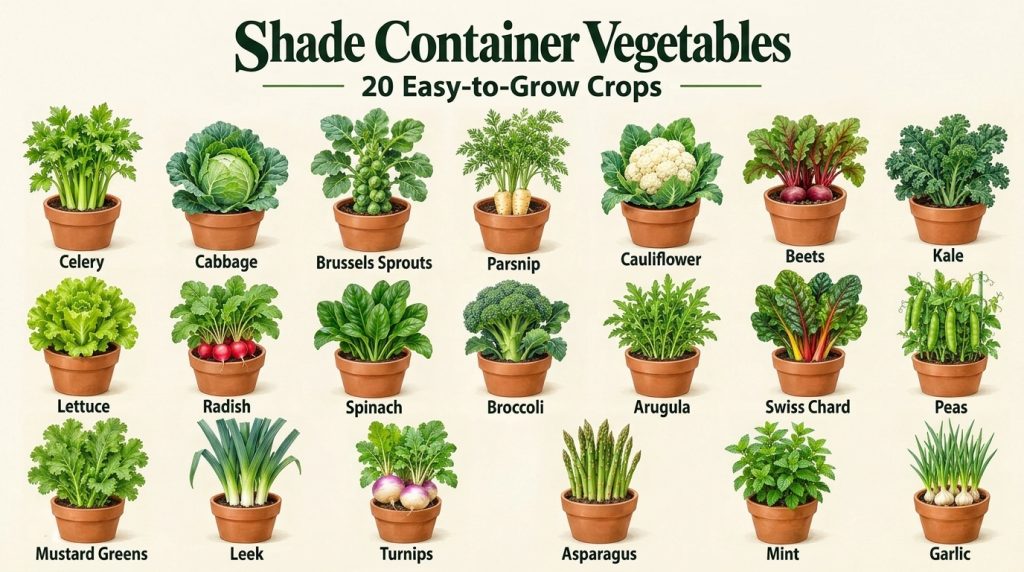
Top 20 Vegetables for Your Shade Container Garden
Let’s look at a fantastic selection of vegetables that can bring fresh flavors to your table, even in less-than-sunny spots.
Leafy Greens: The Shade Champions
These are your go-to plants for reliable harvests in partial to dappled shade. They thrive on consistent moisture and cooler temperatures, which shade provides.
-
1. Arugula (*Eruca sativa*)
Hardiness: Annual (can overwinter in Zones 7-10).
Plant type: Leafy green.
Exposure: Partial shade to full sun (prefers partial shade in hot climates).
Height: 6-12 inches.
Spread: 6-9 inches.Arugula’s peppery leaves grow quickly. In partial shade, its flavor can be milder, and it’s less prone to bolting. Use a container at least 6 inches deep and wide. Keep soil consistently moist for tender leaves. Harvest outer leaves regularly to encourage new growth.
-
2. Kale (*Brassica oleracea* var. *sabellica*)
Hardiness: Annual to biennial (perennial in Zones 7-9).
Plant type: Leafy green.
Exposure: Partial shade to full sun (tolerates partial shade well).
Height: 1-3 feet.
Spread: 1-2 feet.Kale is a nutritional powerhouse that tolerates partial shade beautifully, yielding slightly smaller but still robust leaves. Opt for a container at least 10-12 inches deep and wide. Water deeply when the top inch of soil feels dry. Harvest outer leaves from the bottom up.
-
3. Lettuce (*Lactuca sativa*)
Hardiness: Annual.
Plant type: Leafy green.
Exposure: Partial shade to full sun (prefers partial shade in warm weather).
Height: 6-12 inches.
Spread: 6-12 inches.Loose-leaf varieties are particularly good for shade. They grow slower and are less likely to become bitter or bolt. Plant in a container at least 6 inches deep. Water frequently, especially in warmer weather, to keep leaves crisp. Snip outer leaves as needed.
-
4. Spinach (*Spinacia oleracea*)
Hardiness: Annual.
Plant type: Leafy green.
Exposure: Partial shade to full sun (thrives in partial shade).
Height: 6-12 inches.
Spread: 6-10 inches.Spinach is a cool-season crop that truly benefits from shade, which extends its harvest season. Use a container 6-8 inches deep. Keep the soil consistently moist. Harvest leaves young for best flavor; you can take the entire plant or just outer leaves.
-
5. Swiss Chard (*Beta vulgaris* subsp. *vulgaris*)
Hardiness: Biennial (often grown as annual).
Plant type: Leafy green.
Exposure: Partial shade to full sun.
Height: 1-2 feet.
Spread: 1-1.5 feet.Visually striking and highly productive, Swiss chard tolerates partial shade very well. Its vibrant stems add color. Plant in a container at least 10 inches deep. Water deeply and regularly. Harvest outer leaves or entire plant when desired.
-
6. Mustard Greens (*Brassica juncea*)
Hardiness: Annual.
Plant type: Leafy green.
Exposure: Partial shade to full sun (benefits from partial shade in heat).
Height: 1-2 feet.
Spread: 6-12 inches.For a spicy kick, mustard greens are excellent. Shade helps keep their flavor from becoming too pungent and delays bolting. Use a container 6-8 inches deep. Keep soil moist. Harvest outer leaves or entire young plants.
-
7. Mizuna (*Brassica rapa* var. *nipposinica*)
Hardiness: Annual.
Plant type: Leafy green.
Exposure: Partial shade to full sun.
Height: 8-16 inches.
Spread: 6-12 inches.A delicate, feathery Japanese mustard green with a mild, peppery flavor. Mizuna thrives in cooler, shadier conditions, producing tender leaves. Plant in containers at least 6 inches deep. Keep well-watered for continuous harvest.
-
8. Tatsoi (*Brassica rapa* subsp. *narinosa*)
Hardiness: Annual.
Plant type: Leafy green.
Exposure: Partial shade to full sun.
Height: 6-12 inches.
Spread: 8-12 inches.Another excellent Asian green, Tatsoi forms beautiful, spoon-shaped leaves in a compact rosette. It’s cold-tolerant and appreciates partial shade, especially in warmer areas. Use containers 6-8 inches deep. Water consistently to maintain lush growth.
-
9. Bok Choy (*Brassica rapa* subsp. *chinensis*)
Hardiness: Annual.
Plant type: Leafy green.
Exposure: Partial shade to full sun (prefers partial shade in heat).
Height: 6-18 inches.
Spread: 6-12 inches.Similar to other Asian greens, Bok Choy benefits from partial shade, which prevents premature bolting. It requires consistent moisture to produce crisp, tender stalks. A container 8-10 inches deep is suitable. Harvest whole plants or outer leaves.
-
10. Beet Greens (*Beta vulgaris*)
Hardiness: Annual.
Plant type: Leafy green (from a root vegetable).
Exposure: Partial shade to full sun.
Height: 10-18 inches.
Spread: 6-12 inches.While beets typically need sun for robust root development, their delicious, nutritious greens grow very well in partial shade. Focus on harvesting the young, tender leaves. Plant in a container at least 8 inches deep, and snip outer leaves as they mature.
Root and Other Vegetables: Managing Expectations in Shade
These plants often prefer more sun for their primary harvest (roots, fruits, or heads), but can still provide smaller yields or greens in partial shade. Adjust your expectations accordingly.
-
11. Radish (*Raphanus sativus*)
Hardiness: Annual.
Plant type: Root vegetable.
Exposure: Partial shade to full sun.
Height: 4-12 inches.
Spread: 3-6 inches.Radishes primarily need sun for developing large, crisp roots. In partial shade, they will still grow greens, which are edible and spicy. Root development will be slower and produce smaller radishes. Use a container at least 6 inches deep. Ensure consistent watering.
-
12. Carrots (*Daucus carota* subsp. *sativus*)
Hardiness: Biennial (grown as annual).
Plant type: Root vegetable.
Exposure: Partial shade to full sun.
Height: 6-18 inches.
Spread: 3-6 inches.Like radishes, carrots need ample sunlight for good root growth. In partial shade, you can still harvest their feathery greens for salads or as a garnish. Root formation will be significantly reduced, resulting in smaller, thinner carrots. Use deep containers (10-12 inches for most varieties, even deeper for long types). Keep soil consistently moist.
-
13. Potatoes (*Solanum tuberosum*)
Hardiness: Tender perennial (Zones 3-10, usually grown as annual).
Plant type: Tuber.
Exposure: Full sun (can tolerate partial shade).
Height: 1-3 feet.
Spread: 1-2 feet.Potatoes typically require at least 6-8 hours of direct sun for good tuber development. In partial shade (4-6 hours), you can still get a harvest, but yields will be significantly lower, and tubers will be smaller. Plant in very large containers, grow bags, or specialized potato towers, hilling up the soil as plants grow. Keep well-watered.
-
14. Bush Beans (*Phaseolus vulgaris*)
Hardiness: Annual.
Plant type: Legume.
Exposure: Full sun (can tolerate partial shade).
Height: 1-2 feet.
Spread: 1-1.5 feet.Bush beans prefer full sun for the best pod production. However, they can produce a reasonable (though smaller and later) harvest in partial shade, especially if it’s morning sun. Use a container at least 10-12 inches deep and wide. Provide consistent moisture, especially during flowering and pod development.
-
15. Peas (*Pisum sativum*)
Hardiness: Annual.
Plant type: Legume.
Exposure: Full sun (can tolerate partial shade).
Height: 2-6 feet (bush varieties shorter).
Spread: 1-2 feet.Peas are a cool-season crop. While they prefer full sun, partial shade can extend their growing season, especially in areas with warm springs. Yields will be reduced. Bush varieties are best for containers. Provide a trellis or support for climbing varieties. Keep soil moist.
-
16. Broccoli (*Brassica oleracea* var. *italica*)
Hardiness: Biennial (usually grown as annual).
Plant type: Cole crop.
Exposure: Full sun (can tolerate partial shade).
Height: 2-3 feet.
Spread: 1.5-2 feet.Broccoli needs consistent moisture and cool temperatures to form large heads. Partial shade can help keep plants cool in hot climates, but it will result in smaller main heads and fewer side shoots. Use a large container (at least 12-15 inches deep). Fertilize regularly and water deeply.
-
17. Cauliflower (*Brassica oleracea* var. *botrytis*)
Hardiness: Annual.
Plant type: Cole crop.
nExposure: Full sun (can tolerate partial shade).
Height: 1-2 feet.
Spread: 1.5-2 feet.Similar to broccoli, cauliflower is a cool-season crop that struggles with heat and needs plenty of sun for large, dense ‘curds.’ Partial shade might help prevent bolting in warm weather but expect smaller, looser heads. Requires a large pot (12-15 inches deep) and blanching (tying leaves over the developing head) for white varieties.
-
18. Cabbage (*Brassica oleracea* var. *capitata*)
Hardiness: Biennial (usually grown as annual).
Plant type: Cole crop.
Exposure: Full sun (can tolerate partial shade).
Height: 1-2 feet.
Spread: 1-2 feet.Cabbage needs 6+ hours of sun to form large, tight heads. In partial shade, heads will be smaller and may be less dense. However, the outer leaves are still edible and nutritious. Choose compact varieties for containers (10-12 inches deep). Ensure consistent moisture to prevent splitting.
Herbs & Alliums: Easy-to-Grow Additions
These fragrant and flavorful plants are often very adaptable to lower light conditions in containers.
-
19. Scallions (Green Onions, *Allium fistulosum*)
Hardiness: Perennial (Zones 6-9, often grown as annual elsewhere).
Plant type: Allium/Herb.
Exposure: Partial shade to full sun.
Height: 12-18 inches.
Spread: 6-12 inches.Scallions are incredibly easy to grow and thrive in partial shade, producing tender green shoots. You can plant them from seed or by purchasing a bunch from the grocery store and rooting the white ends. Use a container at least 6 inches deep. Harvest by snipping greens as needed; they will regrow.
-
20. Mint (*Mentha spp.*)
Hardiness: Perennial (Zones 3-11, depending on species).
Plant type: Herb.
Exposure: Partial shade to full sun.
Height: 1-2 feet.
Spread: Spreading (can be invasive in ground).Mint is a classic choice for containers precisely because it loves partial shade and its vigorous spreading habit is contained. Choose a large pot (at least 8-10 inches wide) to give its roots room. Keep the soil consistently moist. Pinch back regularly to encourage bushy growth and prevent flowering.
Essential Tips for Shade Container Gardening Success
Choosing the Right Containers and Soil
Good drainage is crucial for container plants, especially in shadier spots where soil dries slower. Use pots with drainage holes and a high-quality potting mix that drains well but retains moisture. Terracotta pots look lovely but can dry out faster; plastic or glazed ceramic pots retain moisture longer. Always size up your containers – larger pots offer more soil volume, which means more consistent moisture and nutrients, and less frequent watering.
Watering Wisely
Shaded containers generally need less frequent watering than those in full sun, but they still need consistency. Check soil moisture daily by sticking your finger about an inch into the soil. Water when the top inch feels dry, ensuring water drains from the bottom. Overwatering in shade can lead to root rot and fungal issues.
Nutrition and Fertilization
Container plants rely entirely on you for nutrients. Start with a good quality potting mix enriched with compost. As plants grow, especially leafy greens which are heavy feeders, supplement with a balanced liquid fertilizer every 2-4 weeks. Follow package directions to avoid over-fertilizing.
Pest Management in Shady Spots
Lower light and higher humidity in shaded areas can sometimes create conditions favorable for slugs, snails, and certain fungal diseases. Regularly inspect your plants for signs of pests or disease. Good air circulation is vital, so ensure plants aren’t too crowded. Hand-picking slugs/snails, using neem oil, or introducing beneficial insects can help keep problems at bay.
Embrace Your Shady Spaces
Don’t let a lack of full sun deter you from the joys of growing your own food. With these 20 versatile vegetables, you have an incredible palette of options to create a vibrant and productive container garden in partial or dappled shade. Remember, successful gardening is about understanding your unique growing conditions and matching the right plants to them. So grab some containers, choose your favorite shade-loving greens, and start cultivating your own delicious harvest. Happy growing!