Imagine your garden as a thriving community, where every plant contributes to the health and vitality of its neighbors. Just like in any good neighborhood, some residents simply get along better than others. Understanding these dynamics, often called companion planting, is a secret garden farm trick that can dramatically boost your harvest, deter pests, and improve soil health. But what about the pairings that don’t quite mesh? Planting certain vegetables, herbs, or fruits too close together can lead to stunted growth, increased disease, or even pest infestations.
For gardeners using raised beds, where space and soil are precious resources, knowing which plant combinations to avoid is just as crucial as knowing which ones thrive together. This guide will walk you through six common incompatible pairings, explaining why they’re not a match made in garden heaven and offering practical alternatives to ensure your raised beds are a picture of productivity and harmony.
The Principles of Garden Harmony (and Discord)
Companion planting isn’t just folklore; it’s rooted in horticultural science. Plants can interact in various ways:
- Resource Competition: Some plants are heavy feeders or have extensive root systems that outcompete nearby plants for water and nutrients.
- Shared Pests and Diseases: Members of the same plant family often share common pests and diseases. Planting them together creates a superhighway for these issues to spread rapidly.
- Allelopathy: A few plants release biochemicals (allelochemicals) into the soil or air that can inhibit the growth or germination of other species.
- Physical Dominance: Aggressive growers can physically shade out or smother more delicate neighbors.
By understanding these dynamics, you can make informed decisions about your garden layout, especially in the confined space of a raised bed.
Plant Pairings to Reconsider in Your Raised Beds
Let’s delve into specific plant combinations that are best kept apart for the health of your garden.
1. Carrots (Daucus carota) and Dill (Anethum graveolens): A Hidden Rivalry
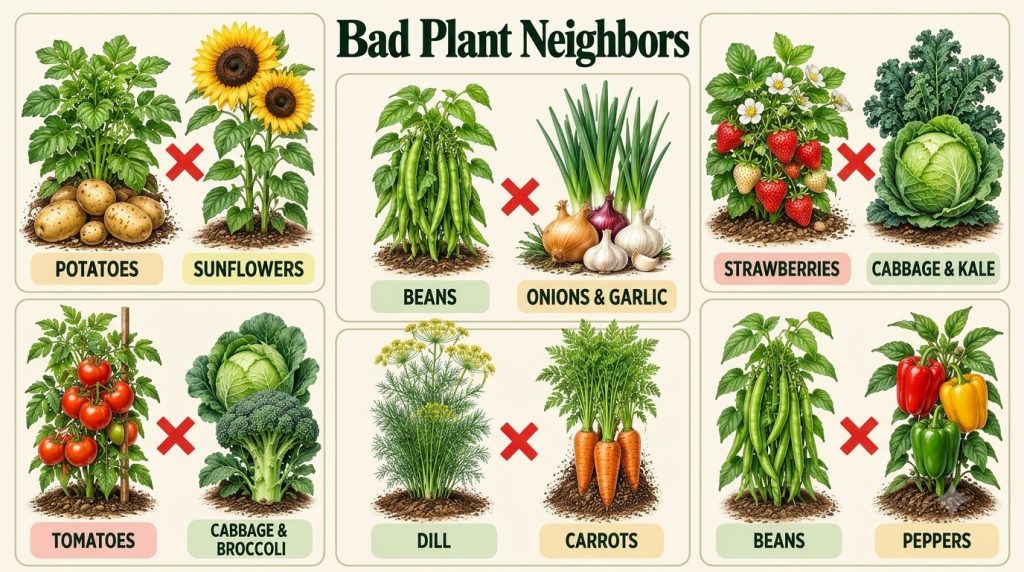
While dill is a wonderful herb in many garden settings, it’s not the best companion for carrots. Dill can attract spider mites, which are a notorious pest for carrots, potentially damaging foliage and reducing crop vigor. Some gardeners also observe that dill can inhibit the germination and early growth of carrot seeds, leading to a patchy stand.
- Why to separate: Dill can attract spider mites and may inhibit carrot growth.
- Practical Tip: Plant carrots with rosemary, lettuce, or radishes instead. Keep dill in a separate bed or container, or at a significant distance from your carrot patch.
2. Potatoes (Solanum tuberosum) and Tomatoes (Solanum lycopersicum): A Family Feud
This is one of the most critical separations in the garden. Both potatoes and tomatoes belong to the Solanaceae (nightshade) family. They are highly susceptible to the same fungal diseases, most notably early and late blight, as well as Verticillium wilt. Planting them close together creates an ideal breeding ground for these pathogens to spread rapidly between crops, potentially wiping out both harvests. They also compete intensely for similar nutrients in the soil.
- Why to separate: High risk of shared diseases (e.g., blight) and intense nutrient competition.
- Practical Tip: Always plant potatoes and tomatoes in different areas of your garden, ideally rotating their location each year to minimize disease buildup in the soil. Good companions for tomatoes include basil and marigolds; for potatoes, consider beans or corn.
3. Beans (Phaseolus vulgaris) and Onions (Allium cepa): Nitrogen Blockers
Beans, like other legumes, are celebrated for their ability to ‘fix’ nitrogen in the soil through a symbiotic relationship with specific bacteria on their root nodules. This process enriches the soil naturally. However, plants from the *Allium* family, which includes onions, garlic, chives, and leeks, can inhibit this beneficial nitrogen-fixing process in beans and peas. This means your beans might not grow as vigorously, and the soil won’t get the nitrogen boost you expect.
- Why to separate: Onions can interfere with the nitrogen-fixing capabilities of beans.
- Practical Tip: Plant beans with corn, carrots, or cucumbers. Keep your onions separate, perhaps with lettuce or cabbage.
4. Cabbage (Brassica oleracea) and Strawberries (Fragaria × ananassa): Conflicting Needs and Pests
While not a strict allelopathic incompatibility, this pairing often proves problematic. Cabbage and other brassicas are heavy feeders and appreciate consistent moisture. Strawberries, especially established patches, are vigorous growers that can quickly spread and outcompete young cabbage plants for nutrients, light, and water in a raised bed. Both can also be attractive to similar pests, like slugs and snails, increasing the challenge of pest management. Some sources suggest strawberries might make brassicas more prone to root diseases.
- Why to separate: Competition for resources and potential for shared pests and diseases.
- Practical Tip: Give strawberries their own dedicated space where they can spread without inhibiting other crops. Plant cabbage with potatoes (since potatoes shouldn’t be with tomatoes, this works well), dill, or mint (in a container).
5. Mint (Mentha spp.) and Parsley (Petroselinum crispum): The Dominator
The issue here isn’t a chemical incompatibility but rather mint’s aggressive growth habit. Mint is a highly invasive plant that spreads rapidly via underground runners (rhizomes). If planted directly in a raised bed with other herbs like parsley, it will quickly outcompete and smother them, taking over the entire space. Parsley, being a relatively delicate herb, stands no chance against mint’s vigorous expansion.
- Why to separate: Mint is extremely invasive and will quickly outcompete and overwhelm parsley.
- Practical Tip: Always grow mint in its own container, whether on the patio or sunk into the raised bed with a barrier to prevent root escape. Parsley thrives alongside carrots, chives, or tomatoes.
6. Lettuce (Lactuca sativa) and Broccoli (Brassica oleracea var. italica): Overlapped Preferences, Uneven Growth
Both lettuce and broccoli prefer cooler growing conditions, but their growth habits make them less than ideal neighbors. Broccoli is a heavy feeder that grows into a large, sprawling plant, easily shading out smaller, more delicate lettuce plants. This competition for light and nutrients can stunt lettuce growth. Furthermore, if broccoli takes a long time to mature, the lettuce might bolt (go to seed) prematurely due to the stress of competition or prolonged heat exposure under the broccoli’s canopy.
- Why to separate: Broccoli will shade out and outcompete lettuce for light and nutrients.
- Practical Tip: Plant lettuce with radishes, carrots, or spinach, which have similar growth rates and needs. Give broccoli ample space and plant it with herbs like chamomile or dill (kept away from carrots!).
General Principles for Raised Bed Success
Beyond avoiding specific bad neighbors, here are some overarching gardening tips for raised beds:
- Strategic Spacing: Always check mature sizes. Ensure enough room for air circulation to prevent fungal diseases.
- Nutrient Management: Raised beds excel with rich, well-draining soil. Understand each plant’s nutrient needs and amend the soil accordingly, perhaps with compost or balanced organic fertilizers. Heavy feeders may need more.
- Crop Rotation: Even in raised beds, rotate your crops annually to prevent the buildup of pests and diseases specific to certain plant families.
- Container Gardening in Beds: For aggressive growers like mint, consider burying a bottomless container in your raised bed to limit root spread while still integrating it into your garden aesthetic.
Common Mistakes to Avoid
Gardeners sometimes make these errors when thinking about companion planting:
- Overcrowding: Believing more plants in less space is always better. Good spacing is crucial, especially in raised beds where plants are already in close proximity.
- Ignoring Growth Habits: Forgetting that a small seedling will become a large plant that might shade out its neighbors or have an invasive root system.
- Solely Relying on Companion Planting: While powerful, companion planting is one tool among many. It doesn’t replace good soil health, proper watering, or diligent pest management.
Regional Considerations for U.S. Gardeners
Gardening advice often needs to be adapted to your specific climate. In cooler regions (USDA Zones 3-6), where growing seasons are shorter, maximizing efficiency and preventing disease spread through smart companion planting is even more vital. In warmer zones (USDA Zones 7-10), managing heat stress and consistent moisture for closely planted crops becomes a bigger factor. Always consult your local extension office for specific planting dates and cultivar recommendations suited to your microclimate.
Cultivate a Thriving Ecosystem
Building a successful raised bed garden is about creating a balanced and resilient ecosystem. By understanding which plant pairings to avoid, you’re not just preventing problems; you’re actively promoting stronger plant health, richer soil, and more abundant harvests. Take these insights to your garden beds this season, observe how your plants interact, and enjoy the journey of becoming a more intuitive and effective gardener. Happy planting!