A room does not need a wall of sunny windows to feel green and alive. Many houseplants can adapt to north-facing windows, shaded corners, offices, and rooms where daylight is filtered by buildings or trees. The important word, however, is adapt. “Low-light tolerant” does not mean a plant can live indefinitely in darkness.
Every plant needs light for photosynthesis. In a truly windowless room, ordinary ceiling lights are rarely sufficient; a properly positioned LED grow light is necessary for sustained growth. Low-light plants usually grow more slowly, use less water, and need less fertilizer than the same plants grown in brighter conditions.
The best results come from choosing forgiving foliage plants, adjusting watering to the slower growth rate, and recognizing when a plant is merely surviving rather than thriving.
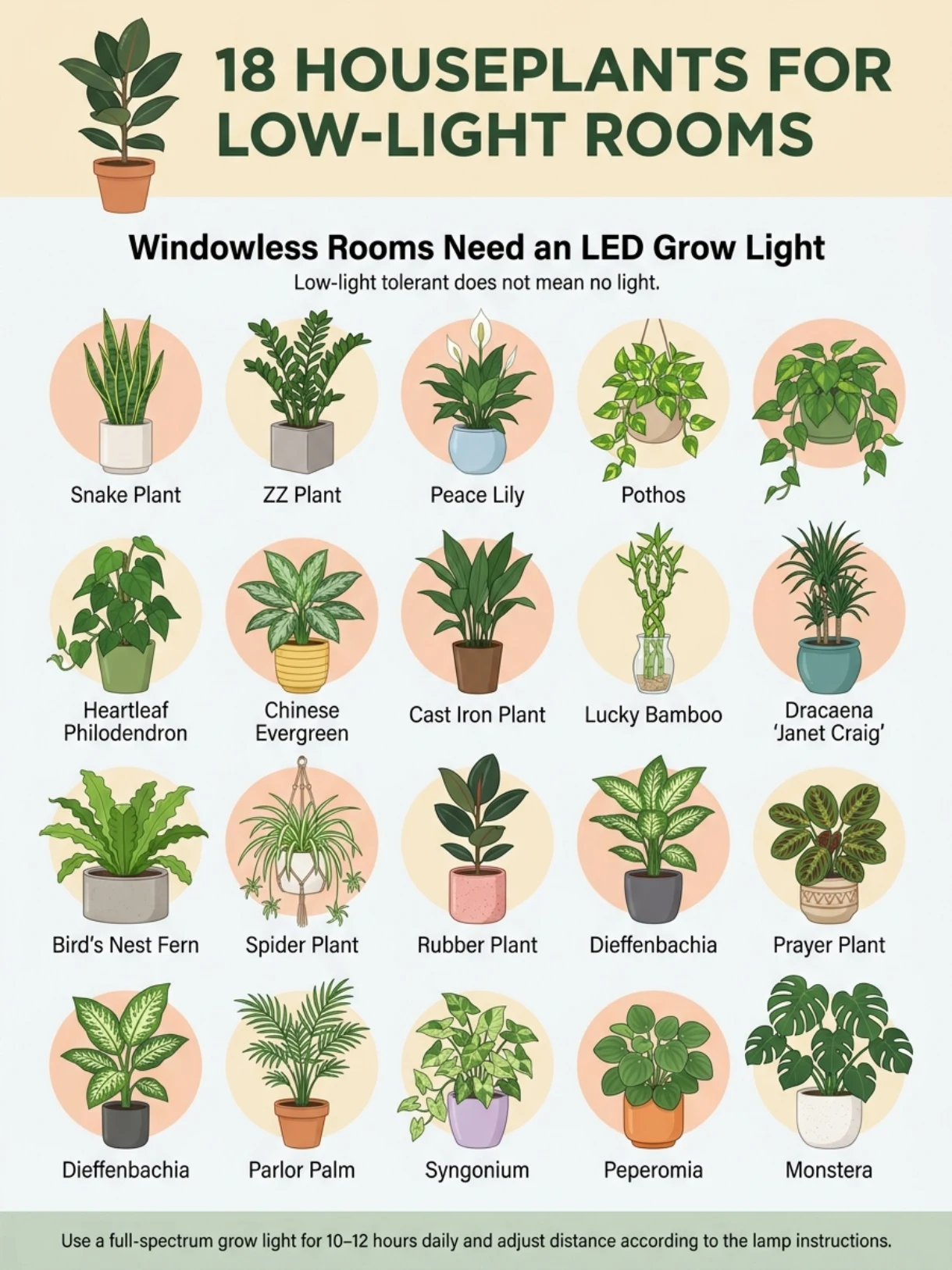
What does “low light” actually mean?
Indoors, low light generally means a place with no direct sun but still enough ambient daylight to see comfortably without switching on a lamp. Examples include:
- close to a north-facing window
- several feet from an east- or west-facing window
- the interior of an otherwise bright room
- a location shaded by an overhang, tree, or neighboring building
Light intensity drops sharply as you move away from a window. A plant positioned eight feet into a room receives far less usable light than one sitting beside the glass, even though both appear visible to the human eye.
A windowless bathroom, hallway, or office is different. It has no natural plant light, so use a full-spectrum LED grow light on a timer. A starting schedule of roughly 12–14 hours daily works for many foliage plants, but follow the lamp manufacturer’s distance and intensity instructions. Plants also need a dark period; leaving the light on continuously is unnecessary.
The toughest plants for genuinely dim rooms
These plants are the strongest starting choices when natural light is limited.
1. Snake Plant
Snake plant is one of the most dependable options for dim rooms. Its upright leaves take little floor space, and its thick underground structures allow it to tolerate missed waterings.
Let at least the upper portion of the potting mix dry before watering again. Low light slows moisture use, so frequent watering is far more dangerous than temporary dryness.
Best feature: Architectural growth with minimal maintenance
Outdoor hardiness: Generally USDA Zones 9–11; keep indoors elsewhere
2. ZZ Plant
ZZ plant tolerates low light and irregular watering exceptionally well, although it grows more strongly in bright indirect light. Its swollen rhizomes store moisture, making overwatering the primary risk.
Use a container with drainage and wait until much of the mix has dried before watering. Yellowing stems combined with wet soil usually point to excessive moisture rather than thirst.
Best feature: Excellent for offices and infrequently used rooms
Outdoor hardiness: Approximately Zones 9–11
3. Cast Iron Plant
Cast iron plant earns its name through durability. Its broad, dark leaves tolerate shade, fluctuating indoor conditions, and occasional neglect.
It prefers consistent care but does not demand constant attention. Avoid strong direct sun, which can scorch its foliage, and do not keep the soil permanently saturated.
Best feature: Long-lived foliage for dark corners
Outdoor hardiness: Commonly Zones 7–11, depending on cultivar
4. Chinese Evergreen
Chinese evergreen is a reliable low-light foliage plant, especially varieties with predominantly green leaves. Highly variegated or pink cultivars generally need more light to maintain their markings.
Keep it warm and away from cold drafts. Water when the upper layer of soil begins drying, rather than following a rigid weekly schedule.
Best feature: Decorative leaves with manageable growth
Outdoor hardiness: Usually Zones 10–11
5. Dracaena ‘Janet Craig’
This dracaena has deep green leaves and an upright form suited to offices, bedrooms, and narrow spaces. It accepts low light better than many variegated dracaenas, but brighter filtered light encourages fuller growth.
Allow some drying between waterings. Persistently wet roots can cause yellowing and decline.
Best feature: Adds height without needing direct sun
Outdoor hardiness: About Zones 10–11
6. Lucky Bamboo
Lucky bamboo is actually a dracaena rather than true bamboo. It can grow in water or potting mix and adapts well to filtered indoor light.
When growing it in water, refresh the water regularly and clean the container to prevent buildup. In soil, maintain light moisture without waterlogging it.
Best feature: Compact, sculptural, and easy to display
Outdoor hardiness: Approximately Zones 10–11
Trailing plants for shelves and hanging displays
Trailing plants help soften shelves, cabinets, and hanging planters without taking up much floor space.
7. Pothos
Pothos is one of the easiest pass-along houseplants. It tolerates low light, but growth becomes faster and variegation stronger in bright indirect light. Penn State recommends bright indirect light for its best performance, so use low light as a tolerated condition rather than its ideal.
Let the surface dry before watering, and prune long bare vines to encourage a fuller appearance.
Best feature: Fast, forgiving trailing growth
Outdoor hardiness: Zones 10–12
8. Heartleaf Philodendron
Heartleaf philodendron produces soft, heart-shaped leaves on flexible vines. It grows acceptably in lower light but may develop wider spacing between leaves when illumination is inadequate.
Pinch vines just above a node to encourage branching. A moss pole or small trellis can also turn it into a climbing display.
Best feature: Adaptable as either a trailer or climber
Outdoor hardiness: Approximately Zones 10–11
9. Syngonium
Syngonium, or arrowhead plant, begins with arrow-shaped leaves and becomes increasingly vine-like as it matures. Green varieties are more tolerant of low light than heavily variegated ones.
Prune regularly for a compact plant or provide support if you prefer a climbing form.
Best feature: Changing leaf form as it matures
Outdoor hardiness: Zones 10–12
Plants that tolerate low light but prefer something brighter
These choices can live in dimmer rooms, but they look healthier and grow more attractively with medium or bright indirect light.
10. Peace Lily
Peace lilies tolerate lower light, but blooming usually declines as light decreases. A plant may retain green foliage in a dim corner yet produce few or no white flower structures.
Keep the mix lightly moist but never swampy. If it repeatedly wilts, investigate the roots and watering routine rather than relying on dramatic drooping as a watering signal.
Best feature: Elegant foliage with possible indoor blooms
Outdoor hardiness: Zones 10–11
11. Rubber Plant
Rubber plants can adjust to moderate or moderately low light, but very dim conditions often produce slow growth, leaf loss, or a leaning stem.
Place it closer to a window than snake plant or ZZ plant. Rotate the pot regularly so the canopy develops evenly.
Best feature: Large, glossy leaves and tree-like structure
Outdoor hardiness: Zones 10–12
12. Monstera
Monstera may survive in low light, but it generally needs brighter indirect light to produce larger leaves and stronger fenestration. In poor light, growth may become stretched and leaves may remain smaller.
Give it a support pole, leave enough room for mature growth, and avoid placing it deep inside a dark room.
Best feature: Dramatic tropical foliage
Outdoor hardiness: Zones 10–12
13. Dieffenbachia
Dieffenbachia tolerates lower light, particularly greener cultivars, but variegation becomes less distinctive in very dim conditions.
Keep it away from cold air and allow the surface to dry slightly before watering. If lower leaves yellow one after another while the soil remains wet, reduce watering frequency.
Best feature: Bold patterned foliage
Outdoor hardiness: Zones 10–12
14. Peperomia
Peperomia species vary considerably, but many compact green-leaved types adapt to moderate or lower indirect light. Their relatively small root systems make oversized pots and heavy soil risky.
Use a breathable mix and water only after the upper soil has dried appropriately.
Best feature: Compact size for desks and shelves
Outdoor hardiness: Usually Zones 10–12
Humidity-loving choices that need thoughtful placement
The list of “low-light plants” often includes ferns and prayer plants, but these are not always the easiest options for a dark, dry room.
15. Bird’s Nest Fern
Bird’s nest fern prefers filtered light, warmth, and moderate humidity. It may tolerate gentle light, but tropical ferns generally perform poorly in truly dark locations.
Water the potting mix around the plant rather than repeatedly pouring water into the central crown, where trapped moisture may encourage rot.
Best feature: Fresh, wavy foliage with a compact form
Outdoor hardiness: Zones 10–11
16. Prayer Plant
Prayer plant is valued for patterned leaves that fold upward at night. It prefers medium indirect light, although it can adapt to somewhat lower levels.
Protect it from dry heating vents, hard direct sun, and prolonged soggy soil. Brown edges do not automatically mean the plant needs more water; inconsistent moisture, mineral buildup, or dry air may also contribute.
Best feature: Moving, richly patterned foliage
Outdoor hardiness: Zones 11–12
17. Parlor Palm
Parlor palm is among the more shade-tolerant indoor palms. It grows slowly and works well where a soft, upright silhouette is needed.
Allow slight surface drying before watering, and avoid letting the root ball remain saturated. Low humidity may lead to brown leaflet tips, but excessive watering is not the solution.
Best feature: Classic palm form at an indoor-friendly scale
Outdoor hardiness: Approximately Zones 10–12
18. Spider Plant
Spider plant adapts to a range of indoor light levels, though bright indirect light produces fuller growth and stronger striping. In very dim conditions, it may become thin and produce fewer plantlets.
It works especially well in hanging baskets where its arching leaves and offsets have space to fall naturally.
Best feature: Easy propagation from plantlets
Outdoor hardiness: Zones 9–11
How to water low-light houseplants correctly
The biggest low-light care mistake is watering on the same schedule used for plants near a bright window.
Less light means slower photosynthesis and slower water use. Before watering:
- Test the soil rather than the calendar.
- Check moisture below the surface, not only the top crust.
- Water thoroughly when needed.
- Let excess water drain completely.
- Empty the saucer or decorative cover pot.
Most houseplants prefer steady but aerated root conditions, not permanently wet soil. Low-light plants also need less fertilizer because they grow more slowly; extra feeding cannot compensate for inadequate light.
Signs that the room is too dark
Watch for:
- new leaves becoming noticeably smaller
- long gaps between leaves
- stems leaning strongly toward a window
- loss of variegation
- little or no new growth for months
- soil remaining wet for an unusually long time
- repeated lower-leaf yellowing
Thin, stretched growth and strong leaning are classic signs of inadequate illumination. Move the plant closer to natural light or add a grow light rather than increasing water or fertilizer.
A practical grow-light setup for windowless rooms
Use a full-spectrum LED fixture positioned above the foliage, not across the room. The lamp’s power determines the correct distance, so follow its instructions rather than applying one universal measurement.
Connect it to an inexpensive timer and begin with a consistent daily schedule. Observe the plant for two to three weeks. Pale or stretched new growth suggests the lamp may be too weak or distant; bleached patches or unusually warm leaves suggest excessive intensity or proximity.
Final thoughts
The best low-light houseplants are not plants that need no light. They are plants that remain attractive and stable with less light than most species.
Snake plant, ZZ plant, cast iron plant, Chinese evergreen, and ‘Janet Craig’ dracaena are the strongest choices for genuinely dim locations. Pothos, heartleaf philodendron, and syngonium bring trailing growth. Peace lily, rubber plant, Monstera, dieffenbachia, peperomia, ferns, prayer plant, parlor palm, and spider plant can also work—but most will perform better when moved closer to filtered daylight or supported by a grow light.
Match the plant to the actual light, reduce watering as growth slows, and stop treating “low light” as “no light.” That small shift turns a dark-room plant collection from a cycle of replacement into a healthy, sustainable indoor garden.