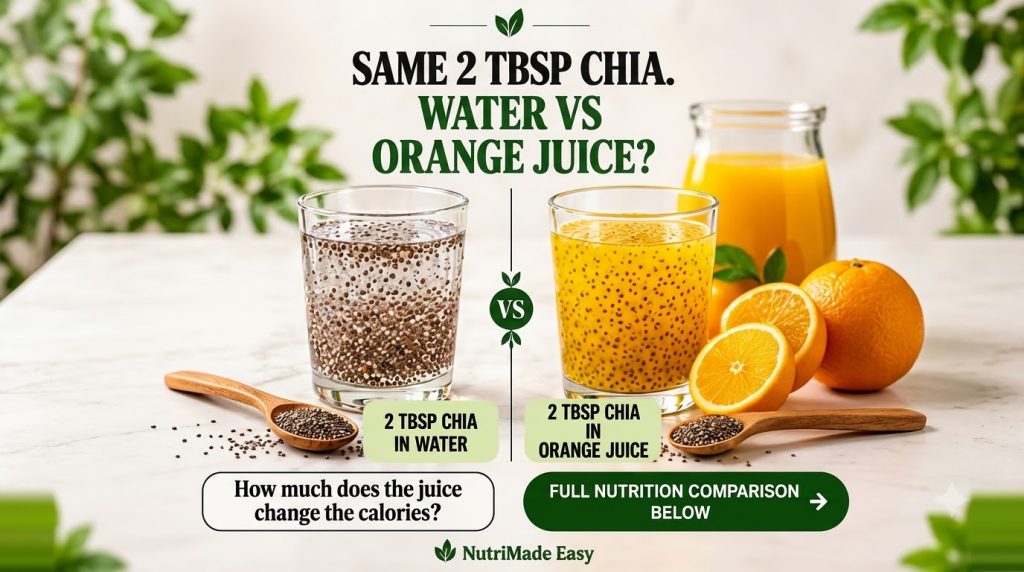
Same two tablespoons of chia seeds. One glass contains plain water. The other contains orange juice. But how different are they nutritionally?
Orange juice and chia seeds make a colorful combination, especially when the seeds absorb the liquid and form a gel-like texture.
But replacing water with orange juice does more than change the taste.
It also adds calories, naturally occurring sugars, vitamin C, and other nutrients.
Here’s the complete comparison, along with two easy recipes.
1. The Nutrition in 2 Tablespoons of Chia
A typical 28-gram serving of dried chia seeds provides approximately:
- Calories: 138
- Protein: 4.7 g
- Fiber: 9.8 g
- Fat: 8.7 g
- Carbohydrates: 11.9 g
Chia seeds are especially notable for their fiber content.
They also contain plant-based omega-3 fatty acids (ALA), magnesium, calcium, and other nutrients.
The nutritional values of the seeds remain essentially the same whether they are soaked in plain water or orange juice.
The main difference comes from what you add to them.
2. Chia Water vs Chia Orange Juice: Nutrition Comparison
For this comparison, both recipes use 2 tablespoons of dry chia seeds and 1 cup of liquid.
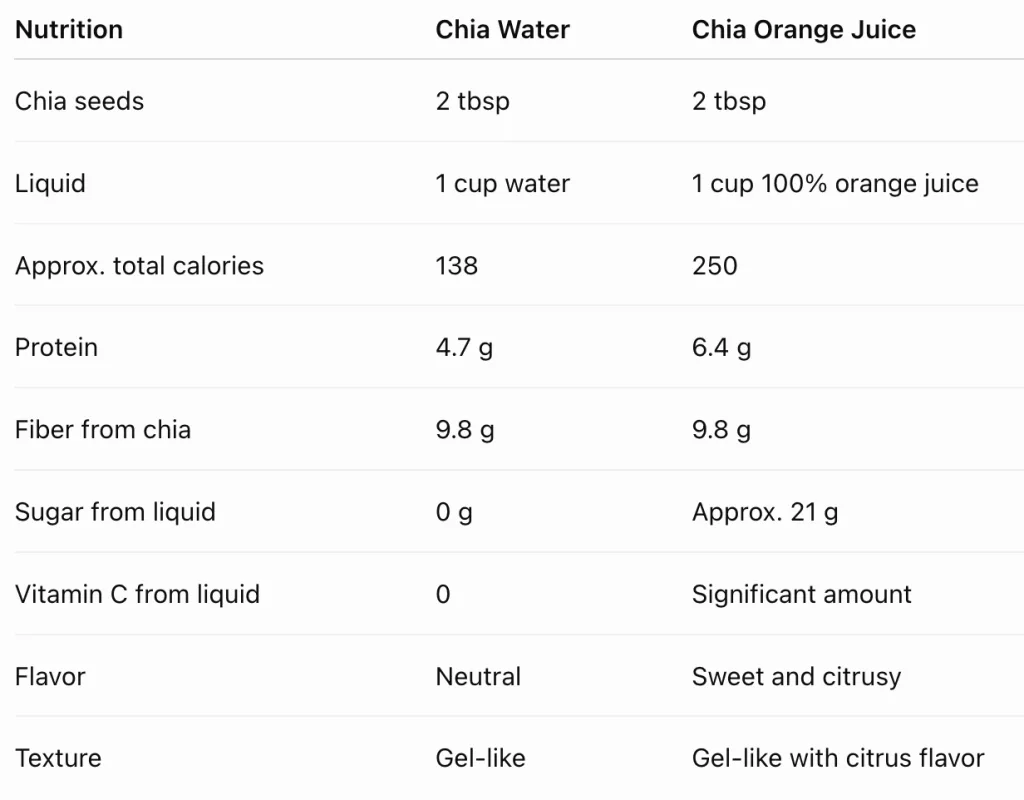
Estimates are based on typical unsweetened orange juice. Actual values vary by product and chia serving weight.
Which version has fewer calories?
Chia water has fewer calories.
Plain water adds no calories, whereas one cup of 100% orange juice typically provides around 112 calories.
Does orange juice contain vitamin C?
Yes.
Orange juice naturally contains vitamin C, a nutrient involved in normal immune function and collagen formation.
This is a nutritional advantage of orange juice compared with plain water, which does not provide vitamin C.
However, adding orange juice to chia does not make the drink a treatment for skin conditions or produce guaranteed cosmetic benefits.
What about sugar?
One cup of orange juice typically contains around 21 grams of naturally occurring sugars.
This is not the same as adding 21 grams of table sugar to a drink, but the total sugar and carbohydrate content still matter, especially for people who monitor their blood glucose.
Whole oranges provide an additional advantage: their intact fruit structure and fiber.
3. Recipe: Simple Chia Water
Ingredients
- 2 tablespoons dried chia seeds
- 1 cup drinking water
- Optional fresh mint leaves
Instructions
- Pour the water into a glass.
- Add the chia seeds.
- Stir thoroughly.
- Wait 5 minutes and stir again.
- Continue soaking until the chia seeds are fully hydrated.
- Add mint if desired.
Result: A simple chia drink without calories or sugar from the added liquid.
4. Recipe: Orange Juice Chia Drink
Ingredients
- 2 tablespoons dried chia seeds
- 1 cup 100% orange juice, with no added sugar
- Optional fresh orange slice
- Optional ice cubes, added after soaking
Instructions
- Pour the orange juice into a glass or jar.
- Add the chia seeds.
- Stir thoroughly to separate the seeds.
- Let the mixture rest for 5 minutes.
- Stir again to prevent clumping.
- Cover and refrigerate until the chia seeds are fully hydrated.
- Stir before serving.
- Add a fresh orange slice or ice if desired.
Result: A naturally sweet, citrus-flavored chia drink containing vitamin C.
5. Bonus Recipe: Half Water, Half Orange Juice
Can’t decide between the two?
Try combining them.
Ingredients
- 2 tablespoons dried chia seeds
- 1/2 cup water
- 1/2 cup 100% orange juice
Instructions
- Combine the water and orange juice.
- Stir in the chia seeds.
- Stir again after 5 minutes.
- Refrigerate until fully hydrated.
- Serve chilled.
This version provides a citrus flavor while using less juice than the full orange juice recipe.
For the same amount of chia, it contains approximately 194 calories before toppings, compared with around 250 calories for the full-juice version.
6. Which Option Should You Choose?
Choose chia water if you:
- Want the simplest preparation.
- Prefer fewer calories.
- Want no additional sugar from the liquid.
- Enjoy neutral-flavored drinks.
Choose chia orange juice if you:
- Prefer a sweeter citrus taste.
- Want vitamin C from the liquid.
- Enjoy combining fruit juice with fiber-rich foods.
- Are comfortable including the additional calories and naturally occurring sugars.
Choose half water, half juice if you:
- Want orange flavor without using a full cup of juice.
- Prefer a less sweet drink.
- Want a practical middle ground.
7. Frequently Asked Questions
Is chia orange juice better for weight loss?
Not necessarily. It contains more calories than chia water, and neither drink guarantees weight loss.
Does chia remove the sugar from orange juice?
No. Chia adds fiber, but it does not eliminate the naturally occurring sugars in orange juice.
Can I prepare orange juice chia overnight?
Yes. Use a covered container and refrigerate the mixture.
Should I use fresh or packaged orange juice?
Either can work. Choose 100% orange juice and check the nutrition label for added ingredients and serving size.
Can I add honey?
You can, but orange juice is already naturally sweet, so additional sweetener may not be necessary.
Final Verdict
For fewer calories and no sugar from the liquid: choose chia water.
For citrus flavor and vitamin C: choose chia orange juice.
For a balanced flavor compromise: try half water and half orange juice.
The chia seeds are identical in every recipe, but the liquid changes the calories, sugars, micronutrients, and taste.
That is why two glasses containing the same quantity of chia can have very different nutritional profiles.
NutriMade Easy — Real Food. Brighter You.
Nutrition and safety note: Values are approximate. Fully soak chia seeds before consumption. If you have swallowing difficulties or a medical condition requiring dietary restrictions, seek advice from a qualified health professional.