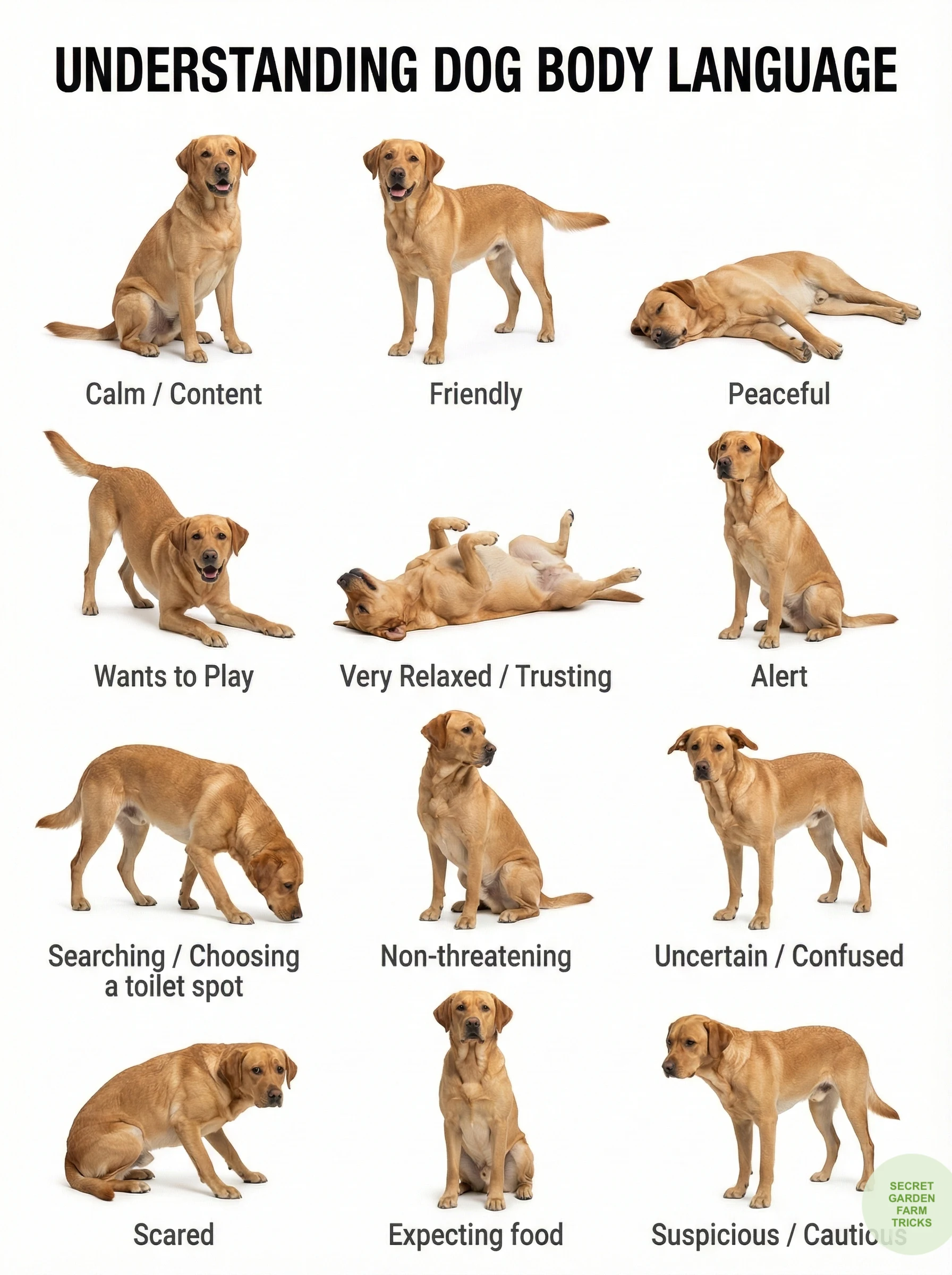
There are 12 common dog’s body language states, mainly based on body posture, ear position, tail carriage, head position, facial expression, and overall muscle tension or relaxation. It is a very useful guide for understanding whether a dog feels calm, playful, alert, uncertain, fearful, or cautious.
The most important thing to remember is this: never read just one signal on its own.
For example, a wagging tail does not always mean a dog is happy. You need to look at the whole body.
1. Calm / Content
In the image, the dog is sitting comfortably with a soft body, slightly open mouth, and relaxed expression.
Common signs:
- Body is loose, not stiff
- Ears are in a natural position
- Eyes look soft
- Mouth may be slightly open
What it means:
The dog feels safe, comfortable, and emotionally settled.
What you should do:
- Keep interactions gentle and calm
- This is a great state for training, petting, or quiet companionship
2. Friendly
The dog is standing in a relaxed way, facing forward with an open, easy expression.
Signs:
- Weight is evenly balanced
- Tail is neutral or softly wagging
- Face looks relaxed
Meaning:
The dog is open to interaction, fairly confident, and not feeling threatened.
Best response:
- You can greet the dog calmly
- Avoid rushing in or reaching over the head too quickly
3. Peaceful
The dog is lying on its side with the whole body relaxed.
Signs:
- Belly, legs, shoulders, and neck are loose
- Head is resting on the ground
- No visible tension in the body
Meaning:
The dog is truly resting and feels safe in the environment.
Helpful note:
- Avoid startling a sleeping dog
- Speak softly before touching
4. Wants to Play
This is the classic play bow: front end down, rear end up.
Signs:
- Front legs lowered
- Rear stays raised
- Tail usually wagging
- Body looks bouncy and playful
Meaning:
The dog is inviting interaction and wants to play.
What to do:
- Offer a toy, toss a ball, or engage in light play
- If the dog gets overly excited, add short breaks between play sessions
5. Very Relaxed / Trusting
The dog is lying on its back with its belly exposed.
Signs:
- Body is fully open
- Legs are loose and relaxed
- Facial expression is soft
Meaning:
In this image, the dog appears deeply relaxed and trusting.
Important reminder:
Showing the belly does not always mean a dog wants belly rubs. Sometimes it can also be a calming or conflict-avoidance behavior. Always look at the whole body, not just the position.
6. Alert
The dog is sitting upright and focusing on something.
Signs:
- Head is raised
- Ears are listening and engaged
- Body is organized and attentive
- Eyes are focused in one direction
Meaning:
The dog has noticed a sound, person, animal, or environmental change.
Best response:
- Do not force interaction
- Give the dog time to observe
- If needed, redirect calmly with a known cue or reward
7. Searching / Choosing a Toilet Spot
The dog is lowering its head and sniffing the ground carefully.
Signs:
- Slow, deliberate movement
- Nose close to the ground
- May circle or stop frequently to sniff
Meaning:
The dog is looking for the right place to eliminate.
Practical care tip:
- Take your dog out on a regular schedule
- Use a consistent potty area if possible
- Reward the dog after going in the right place
8. Non-threatening
The dog is slightly turned away, with a softer, less direct posture.
Signs:
- Body is angled rather than directly facing forward
- Eyes are not staring hard
- Posture is soft and socially polite
Meaning:
The dog is trying to show it is not a threat and may be using calming signals.
Why it matters:
This is often a good sign in dog-to-dog or dog-to-human communication. The dog is trying to reduce tension.
9. Uncertain / Confused
The dog appears hesitant and not fully sure how to respond.
Signs:
- Body is not fully relaxed
- Eyes are watchful
- Ears, head, and tail may look undecided or mixed
Meaning:
The dog does not fully understand the situation or is not yet sure what to do.
Best response:
- Do not add pressure
- Speak calmly
- Give the dog more space and time to process
10. Scared
In the image, the dog is lowered and pulled inward.
Signs:
- Body carried low
- Weight shifted back
- Ears may be pinned back
- Tail lowered or tucked
Meaning:
The dog feels afraid or unsafe.
What you should do:
- Do not force the dog to “face” the fear
- Never punish fear
- Increase distance from the trigger
- Create a safe exit and use food rewards if the dog is still able to eat
11. Expecting Food
The dog is sitting with focused attention, waiting hopefully.
Signs:
- Eyes locked onto food, bowl, or person
- Body is still but highly attentive
- Expression looks expectant
Meaning:
The dog is anticipating a meal or reward.
Training opportunity:
This is a great moment to reinforce behaviors like:
- sit
- wait
- eye contact
- impulse control
12. Suspicious / Cautious
The dog is standing but looks guarded and watchful.
Signs:
- Body appears slightly tense
- Dog is observing carefully
- Not fully retreating, but not relaxed either
Meaning:
The dog is unsure and evaluating whether something is safe.
Best response:
- Do not approach aggressively
- Let the dog choose whether to move closer or away
- Reward calm behavior
- Increase distance if tension grows
How to Read Dog Body Language More Accurately
If you want to understand a dog correctly, look at these five things together:
1. Tail
- Soft wag at a neutral height: often friendly or relaxed
- High, stiff tail: arousal or alertness
- Tucked tail: fear or insecurity
2. Ears
- Natural position: calm
- Forward: focused
- Pulled back: stress, fear, or appeasement
3. Eyes
- Soft eyes: relaxed
- Hard stare: pressure or warning
- Whale eye (showing a lot of white): stress
4. Mouth
- Soft, slightly open mouth: comfortable
- Closed, tight mouth: tension
5. Whole body
- Loose body: safe and relaxed
- Stiff body: caution needed
- Lowered body: fear
- Bouncy, forward-flexing body: playfulness
What Makes This Image So Useful?
This chart helps people understand that dogs are not simply “happy” or “aggressive.” They move through many in-between emotional states, including:
- alert
- uncertain
- calming
- cautious
- expectant
- trusting
Understanding these subtle differences helps you:
- reduce the risk of bites caused by misunderstanding
- train more gently and effectively
- build trust with your dog
- recognize stress earlier
Final Thought
If I had to reduce the whole image to one core lesson, it would be this:
Look at the whole dog, not just the tail.
A calm dog looks soft through the eyes, mouth, shoulders, legs, and tail.
A stressed dog will usually show it through the entire body, even before growling starts.
Understanding dog body language does not just help you care for dogs better. It helps you build trust, prevent conflict, and create a safer, more peaceful relationship between people and dogs.