Most people think eating healthy is just about choosing the right foods.
But here’s the part almost no one talks about:
You can eat all the “right” foods and still get very little benefit — just because of how you prepare them.
Small mistakes in cooking, pairing, or timing can:
-
Reduce nutrient absorption
-
Affect digestion
-
Increase bloating or blood sugar spikes
Here are 20 common foods people eat incorrectly — and how to fix them.
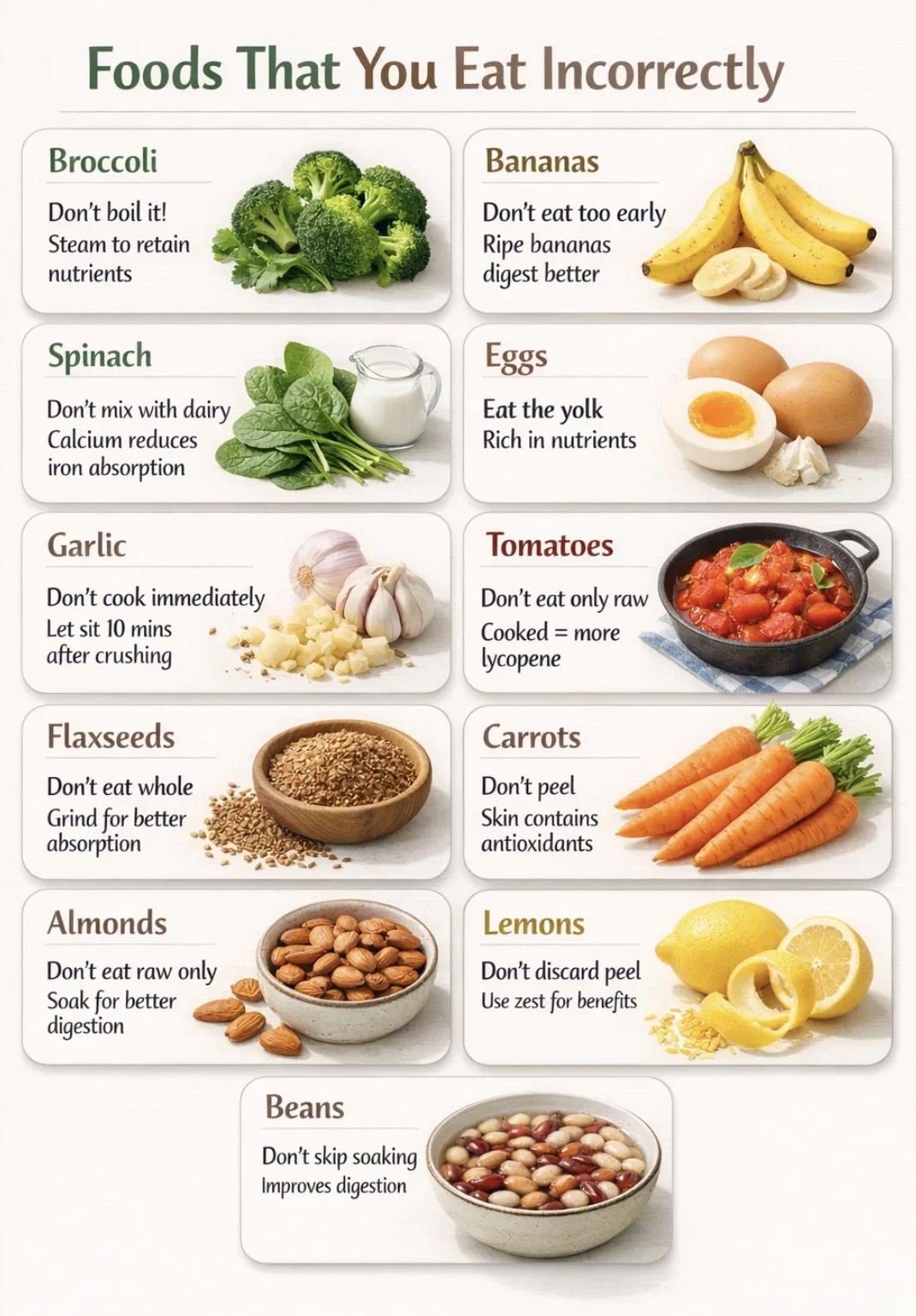
1. Broccoli — Don’t Boil It
Boiling causes nutrients like vitamin C to leach into water.
Better: Steam or lightly sauté to preserve nutrients.
2. Bananas — Don’t Eat Too Unripe
Unripe bananas are harder to digest.
Better: Choose ripe bananas (yellow with small brown spots).
3. Spinach — Don’t Mix with Dairy
Calcium reduces iron absorption.
Better: Pair with vitamin C (like lemon or tomatoes).
4. Eggs — Don’t Skip the Yolk
Most nutrients are in the yolk, not the white.
Better: Eat whole eggs unless medically restricted.
5. Garlic — Don’t Cook Immediately
Cooking right away destroys allicin.
Better: Crush → wait 10 minutes → then cook.
6. Tomatoes — Don’t Only Eat Raw
Cooking increases lycopene absorption.
Better: Eat both raw and cooked versions.
7. Flaxseeds — Don’t Eat Whole
Whole seeds pass through undigested.
Better: Grind before eating.
8. Carrots — Don’t Over-Peel
Peeling removes antioxidant-rich layers.
Better: Wash and lightly scrub.
9. Almonds — Don’t Eat Only Raw
Raw almonds can be harder to digest.
Better: Soak 8–12 hours before eating.
10. Lemons — Don’t Discard the Peel
Peel contains beneficial compounds.
Better: Use zest (prefer organic).
11. Beans — Don’t Skip Soaking
Skipping soaking leads to bloating and poor digestion.
Better: Soak 8–12 hours, rinse, then cook.
12. Potatoes — Don’t Always Eat Hot
Hot potatoes spike blood sugar faster.
Better: Let them cool to increase resistant starch.
13. Rice — Don’t Always Eat Fresh
Fresh white rice raises glucose quickly.
Better: Cook → cool → reheat to improve digestion.
14. Meat — Don’t Overcook
Overcooking reduces nutrients and forms harmful compounds.
Better: Cook at moderate heat.
15. Yogurt — Don’t Heat It
Heat destroys probiotics.
Better: Eat cold or at room temperature.
16. Apples — Don’t Peel
Most fiber and antioxidants are in the skin.
Better: Wash well and eat whole.
17. Watermelon — Don’t Eat After Heavy Meals
Can cause bloating due to fast digestion.
Better: Eat separately or between meals.
18. Honey — Don’t Add to Boiling Water
High heat destroys enzymes.
Better: Add to warm (not hot) liquids.
19. Cucumbers — Don’t Fully Peel
Skin contains fiber and nutrients.
Better: Wash and keep the peel.
20. Leafy Greens — Don’t Eat Only Raw
Some nutrients are better absorbed when cooked.
Better: Mix raw and lightly cooked forms.
The Pattern Most People Miss
This isn’t about avoiding foods.
It’s about understanding:
How you prepare food directly affects what your body absorbs.
Two people can eat the same meal —
but get completely different benefits.
Simple Rules to Remember
-
Avoid overcooking
-
Don’t assume raw is always better
-
Use soaking, grinding when needed
-
Combine foods strategically
-
Pay attention to timing
Final Takeaway
You don’t need a completely new diet.
You just need to use your current foods more intelligently.
Fix these small mistakes, and you’ll likely notice:
-
Better digestion
-
More stable energy
-
Less bloating
-
Better overall results
Sources
-
Harvard T.H. Chan School of Public Health
-
NIH Office of Dietary Supplements
-
USDA FoodData Central
-
Journal of Nutrition & Metabolism
-
Cleveland Clinic