Smoothies don’t keep you full because your body digests liquids faster, requires no chewing, and triggers weaker satiety signals compared to solid foods.
Why You Feel Hungry After a Smoothie
If you’ve ever had a smoothie and felt hungry again shortly after, it’s not about calories.
It’s about how your body processes structure.
Even when a smoothie contains the same ingredients as whole food, your body responds differently.
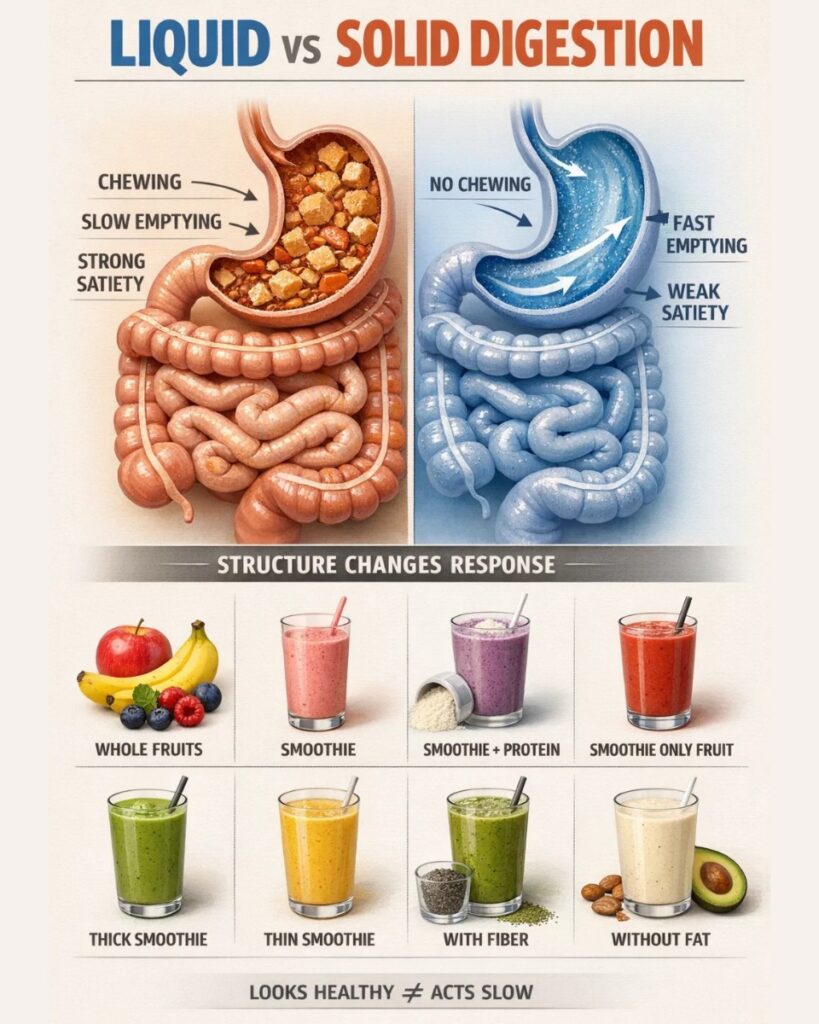
Liquid vs Solid Digestion: What Actually Changes
1. Chewing vs No Chewing
Solid food requires chewing.
This does two important things:
- Slows down eating
- Activates satiety signals in the brain
Liquids skip this step entirely.
👉 Result: You consume energy faster, with less awareness and weaker fullness signals.
2. Gastric Emptying Speed
Solid meals stay longer in the stomach.
Liquids pass through much faster.
👉 Result:
- Solid → slow energy release
- Liquid → quick digestion → faster hunger
3. Satiety Hormones
Your body releases hormones (like GLP-1 and ghrelin) based on food structure.
Solid food → stronger satiety response
Liquid food → weaker response
👉 This is why smoothies often feel “light,” even when calorie-dense.
Structure Changes Everything (Not Just Ingredients)
The same food can behave very differently depending on form.
Whole Fruits
- Fiber intact
- Requires chewing
- Slower digestion
- Strong satiety
Smoothie (Blended Fruit)
- Fiber partially broken
- Faster absorption
- Less fullness
Why Most Smoothies Fail (Common Mistakes)
❌ 1. Fruit-Only Smoothies
High natural sugar + low protein/fat
👉 Leads to:
- Quick energy spike
- Fast crash
- Hunger returns quickly
❌ 2. Thin Smoothies
Low viscosity = faster gastric emptying
👉 Less time in stomach → weaker satiety
❌ 3. No Protein or Fat
Missing key components that slow digestion
👉 Energy becomes unstable
How to Make a Smoothie That Actually Keeps You Full
You don’t need to avoid smoothies—you need to build them correctly.
✔ Add Protein
Examples: protein powder, Greek yogurt
👉 Slows digestion + improves satiety
✔ Add Healthy Fats
Examples: nuts, seeds, avocado
👉 Extends energy release
✔ Increase Thickness
Thicker smoothies digest slower
👉 More similar to solid food behavior
✔ Keep Fiber Intact
Use whole ingredients like:
- chia seeds
- oats
- leafy greens
👉 Helps regulate glucose release
Smoothie vs Whole Food: Which Is Better?
It depends on your goal.
Choose Whole Food if you want:
- Longer fullness
- Better appetite control
- Slower energy release
Choose Smoothies if you want:
- Convenience
- Faster digestion (e.g., post-workout)
- Easy calorie intake
The Real Insight Most People Miss
Smoothies don’t fail because they’re “unhealthy.”
They fail because they are too easy for your body to process.
Less chewing
Less resistance
Less signaling
→ Less satisfaction
A Simple Rule to Remember
The less your body has to work, the less full you feel.
Who This Matters Most For
You’ll benefit from adjusting smoothies if you:
- Feel hungry soon after drinking them
- Experience energy crashes
- Use smoothies as meal replacements
- Struggle with overeating later
What to Expect When You Fix It
Once you improve structure, you may notice:
- Longer-lasting fullness
- More stable energy
- Fewer cravings
- Better meal control
Often within just a few days.
Final Takeaway
Smoothies can be part of a healthy diet.
But structure matters just as much as ingredients.
Once you understand how your body responds to liquid vs solid food,
you stop guessing—and start eating with intention.
Do your smoothies actually keep you full—or just delay hunger?