There is something almost magical about growing a new plant from a single leaf. It feels small at first, almost too simple to matter. Then roots appear. A tiny plantlet forms. And suddenly, one healthy leaf has turned into a brand-new plant.
That is one of the great joys of propagation. It teaches patience, observation, and trust in the growing process. It also makes plant care more practical. Instead of replacing favorite houseplants, you learn how to multiply them. A single healthy mother plant can become a tray of new starts for your home, your patio, or your friends.
Leaf propagation is especially rewarding because it works well with many compact indoor plants, especially succulents and certain soft-leaved tropicals. But there is one important truth every smart gardener should know: not every plant that can be “propagated from a leaf” does it the same way. Some form babies from a full leaf. Some root best from leaf sections. Some technically can start from a leaf, but do much better from a stem cutting or offset.
Once you understand those differences, your success rate rises quickly.
What “single leaf propagation” really means
In the simplest sense, leaf propagation means using a leaf, or part of a leaf, to create a new plant. But there are three main patterns:
1. Full leaf propagation
A complete leaf is removed and allowed to produce roots and a baby plant at the base. This is common with many succulents.
2. Leaf-and-petiole propagation
The leaf is taken with its small stem attachment, called the petiole. This is common with African violets and some peperomias.
3. Leaf section propagation
A leaf is cut into sections, and those sections form roots and shoots. This works with plants like snake plant, rex begonia, cape primrose, and gloxinia.
That means success depends on using the right method for the right plant.
The easiest true single-leaf propagators
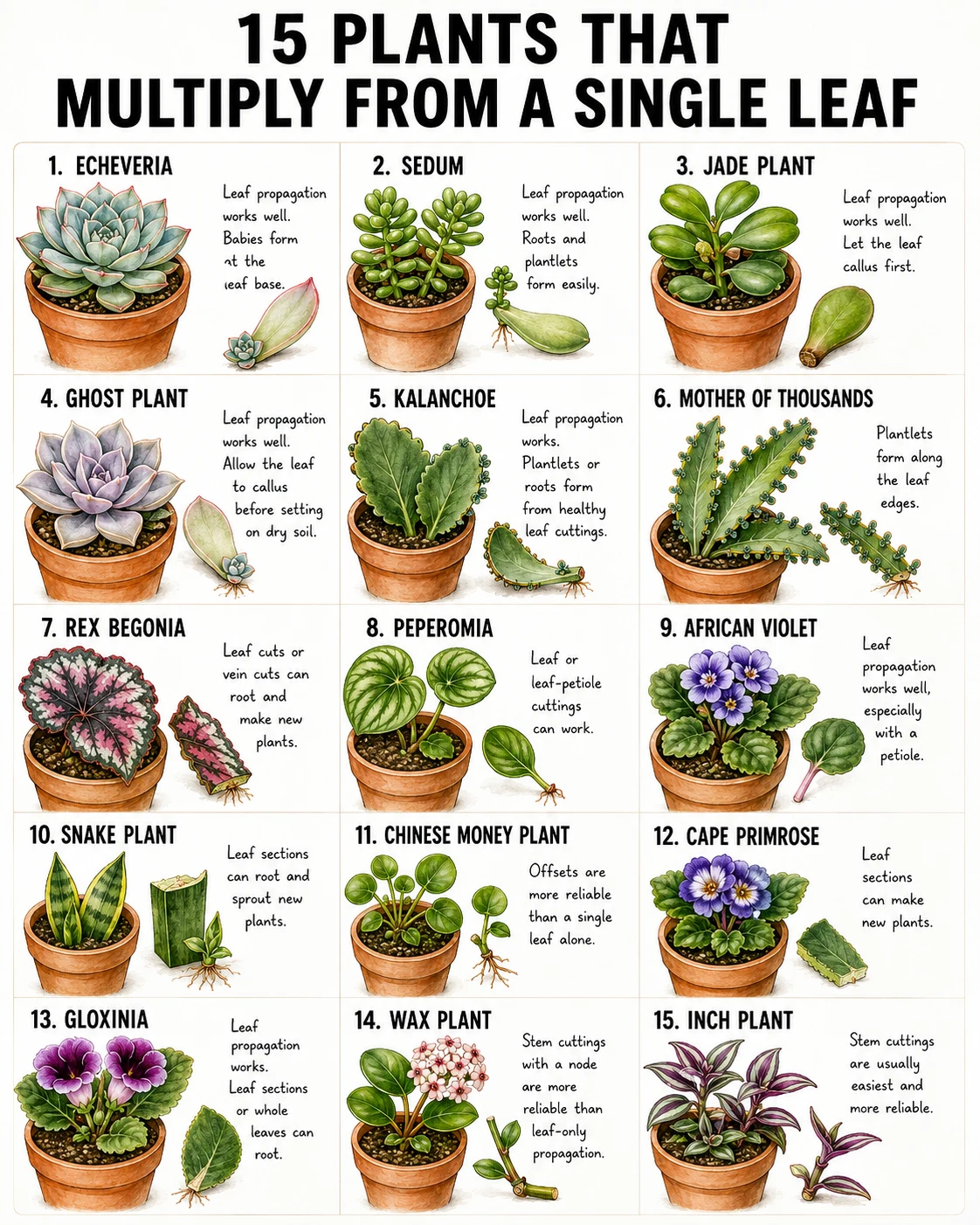
1. Echeveria
Echeveria is one of the best plants for beginners because leaf propagation is simple and visible. A gently removed, whole healthy leaf can callus and then form roots and a tiny rosette at the base.
Why it works
The leaf stores water and energy, which helps support new growth while roots form.
Best care tip
Twist the leaf off cleanly from the stem. A torn or damaged leaf base usually fails. Let the leaf dry for a day or two before placing it on dry or lightly moist succulent mix.
2. Sedum
Many sedums root easily from individual leaves and are among the most forgiving plants for learning propagation.
Why it works
Like echeveria, sedum leaves hold moisture and can support new plantlets with very little fuss.
Best care tip
Do not bury the whole leaf. Simply lay it on top of the soil and give it bright indirect light. Too much water is one of the fastest ways to ruin a good sedum leaf.
3. Jade Plant
Jade plant leaves can often root well, though patience is important. They do not always move as quickly as soft succulent leaves, but they are reliable when healthy.
Why it works
The thick leaf contains enough stored energy to support rooting and new growth.
Best care tip
Always let the leaf callus first. A fresh, wet jade leaf placed directly into damp soil is much more likely to rot than root.
4. Ghost Plant
Ghost plant is another strong succulent for full-leaf propagation. It behaves a lot like echeveria and is especially satisfying because the baby plantlets are easy to spot once they start.
Why it works
Healthy succulent leaves contain the moisture reserves needed to fuel early development.
Best care tip
Use only plump, undamaged leaves. Thin or bruised leaves rarely have enough stored energy for strong propagation.
Plants that form babies or roots from leaf pieces
5. Kalanchoe
Some kalanchoes propagate well from healthy leaf cuttings, forming roots or small plantlets depending on the type.
Why it works
Kalanchoe tissues are often very willing to regenerate when warm and lightly moist.
Best care tip
Use a mature leaf, not an aging yellow one. Keep the mix airy and do not keep it constantly wet.
6. Mother of Thousands
This plant almost seems designed to multiply. Tiny plantlets form along the leaf margins and can drop off and root on their own.
Why it works
The leaf edges naturally produce ready-made babies.
Best care tip
This is one of the easiest propagation plants, but also one of the easiest to let spread farther than intended. Handle it thoughtfully if you like tidy indoor collections.
7. Rex Begonia
Rex begonia is not a “drop one leaf and wait” type of propagator like echeveria. Instead, it often roots from leaf cuts or vein cuts.
Why it works
The leaf veins can produce new roots and shoots when placed correctly against moist propagation medium.
Best care tip
Press the leaf gently onto the soil and pin it in place if needed so the veins stay in contact with the medium. Humidity helps a lot here.
8. Peperomia
Some peperomias propagate well from a leaf or from a leaf with petiole attached. They are compact, attractive, and rewarding for indoor growers.
Why it works
The fleshy leaf tissue and petiole can generate roots and new plant growth under the right conditions.
Best care tip
Different peperomia types behave differently. A leaf with a short petiole is usually more dependable than a leaf blade alone.
9. African Violet
African violets are classic leaf-propagation plants. One healthy leaf with petiole can become an entire new plant.
Why it works
They root readily in a moist, airy medium and produce new crowns from the base of the leaf stem.
Best care tip
Use a young but mature leaf from the middle row of the plant, not the oldest outer leaf or the smallest center leaf. Those middle leaves usually root and grow best.
Plants that root from leaf sections
10. Snake Plant
Snake plants are excellent for leaf-section propagation. A single leaf can be cut into several pieces, and each section can root and sprout.
Why it works
The thick leaf tissue is sturdy and capable of regeneration.
Best care tip
Keep the top and bottom orientation correct. If you plant the section upside down, it will not work. Let the cut edges dry before inserting them into the mix.
11. Cape Primrose
Cape primrose can produce new plants from leaf sections, which makes it a very useful plant for patient propagators.
Why it works
The leaf tissue is capable of forming roots and shoots when cut and placed properly.
Best care tip
Humidity helps, but overwatering hurts. Think lightly moist, not wet.
12. Gloxinia
Gloxinia can also be propagated from whole leaves or leaf sections, which makes it a good candidate for growers who enjoy flowering indoor plants.
Why it works
The leaf can root and eventually form new growth when kept warm and sheltered.
Best care tip
Use clean tools and avoid crowding the propagation tray. Good airflow matters even in humid conditions.
Plants in the list that are better from offsets or stem cuttings
This is where smart gardening becomes better than copy-and-paste advice.
13. Chinese Money Plant
Chinese money plant is famous for multiplying, but it usually does so most reliably from offsets or baby plants from the base, not from a leaf alone.
Best care tip
Wait until the offset has a little size and its own roots starting, then separate and pot it up.
14. Wax Plant
Wax plant, or hoya, is a beautiful propagator, but stem cuttings with a node are much more reliable than single leaves.
Best care tip
A rooted hoya leaf may survive for a long time without ever producing a full vine if no node is present. Always choose a stem section with at least one node.
15. Inch Plant
Inch plant is one of the easiest houseplants to multiply, but again, stem cuttings are the real winner.
Best care tip
Cut just below a node and root the stem in water or moist mix. It grows far faster and more reliably than leaf-only attempts.
The best setup for leaf propagation success
No matter which plant you choose, a few habits make a huge difference.
Start with healthy material
Use leaves that are firm, mature, and undamaged. Weak leaves make weak starts.
Let succulent leaves callus
For jade, sedum, ghost plant, and echeveria, this step prevents rot.
Use the right moisture level
Most leaf propagations fail from too much water, not too little. Succulents want very light moisture. Tropical leaf cuttings want gentle, even moisture with airflow.
Give bright indirect light
Strong direct sun can scorch unrooted leaves. Very dark conditions slow or stop development.
Be patient
Some leaves root quickly. Others sit still for weeks before doing anything visible. A leaf that looks inactive may still be preparing roots.
Common mistakes that ruin leaf propagation
Taking a damaged leaf
A torn base, bruised succulent leaf, or diseased tropical leaf often fails.
Watering too early
Especially with succulents, watering before callusing is a common mistake.
Using heavy soil
Dense, soggy mix suffocates new roots. Use a light, breathable medium.
Expecting every plant to behave the same way
African violet, snake plant, and echeveria are all “leaf propagators,” but they do not follow the same rules.
Final thoughts
Leaf propagation is one of the most satisfying ways to grow your plant collection because it teaches you how different plants truly live and multiply. Echeveria, sedum, jade plant, ghost plant, kalanchoe, mother of thousands, rex begonia, peperomia, African violet, snake plant, cape primrose, and gloxinia all offer real potential from a single leaf or leaf section. Chinese money plant, wax plant, and inch plant still multiply beautifully, but they usually do better with offsets or stem cuttings.
That distinction matters.
Because once you stop treating every plant the same way, propagation becomes less frustrating and far more successful. And that is when a single leaf stops being just a leaf. It becomes the beginning of a whole new plant.