Ever looked at your plants and wondered what they’re trying to tell you? Decoding their signals is easier than you think! Just like us, plants need a balanced diet to thrive, and when they’re missing essential nutrients, they’ll show it through visible symptoms.
Instead of guessing and risking fertilizer burn, observing leaf discoloration, leaf patterns, and where symptoms appear (new vs. old foliage) provides an immediate diagnosis. Understanding the four most common plant nutrient deficiencies helps you restore your houseplants and garden vegetables to peak health with targeted organic fixes.
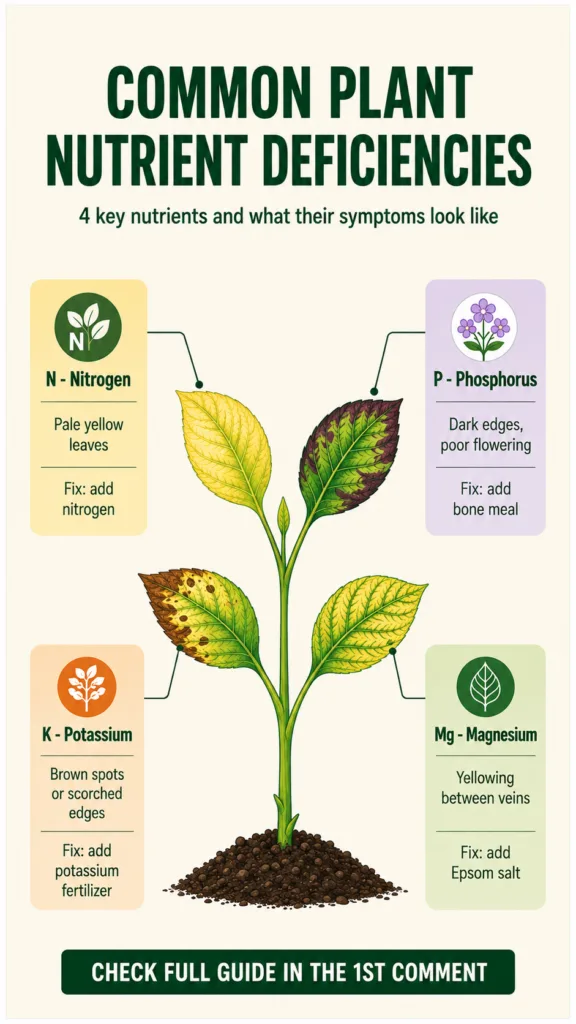
1. Nitrogen (N) Deficiency: Overall Pale Yellow Leaves
Nitrogen is a mobile macronutrient responsible for rapid vegetative growth, stem structure, and chlorophyll synthesis. It’s the building block for lush, green foliage!
Visual Symptoms:
- Older, lower leaves turn completely pale green to uniform yellow (generalized chlorosis) as the plant mobilizes remaining nitrogen toward new top growth.
- Stems become thin and spindly.
- Overall plant growth stalls significantly.
Why It Happens:
- Rapid growth spurts deplete available nitrogen quickly.
- Heavy rain can leach nitrogen from porous soil.
- Prolonged periods without fertilizing.
How to Fix:
Apply high-nitrogen organic liquid feeds such as diluted fish emulsion, blood meal, or compost tea for an immediate foliar and root boost. Top-dress beds with well-rotted compost or manure to slowly release nitrogen over time.
2. Phosphorus (P) Deficiency: Dark Green or Purplish Leaves
Phosphorus is crucial for energy transfer, strong root development, and successful flower and fruit production. It helps plants harness and store energy.
Visual Symptoms:
- Stunted growth is common.
- Older leaves, especially on the undersides, may develop a dark green or purplish discoloration.
- Leaves might curl downwards or become stiff and brittle.
- Poor flowering and fruiting.
Why It Happens:
- Cold soil temperatures inhibit phosphorus uptake.
- Soil pH imbalance (phosphorus becomes unavailable at very high or very low pH).
- Compacted soil can restrict root access to nutrients.
How to Fix:
Incorporate bone meal or rock phosphate into the soil. Ensure good drainage and maintain optimal soil temperature. Amending with compost can also help stabilize pH and improve soil structure, making phosphorus more available.
3. Potassium (K) Deficiency: Scorched Leaf Edges
Potassium is the