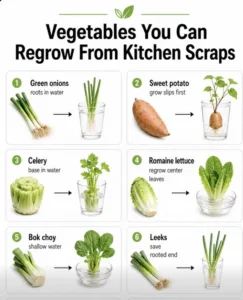
Before you toss vegetable ends into the trash, take another look! Many common kitchen scraps can be encouraged to grow fresh leaves, shoots, or roots with just water, sunlight, and a little patience.
It’s an easy gardening project for beginners, a fun experiment for kids, and a simple way to get a little more use from food you already bought.
Here are 8 vegetables you can try regrowing at home.
1. Green Onions
Green onions are one of the easiest vegetables to regrow.
What You Need
- Green onion bottoms with roots attached
- A small glass
- Fresh water
How to Regrow Them
- Cut off the green tops, leaving about 1–2 inches of the white base.
- Place the root ends upright in a glass.
- Add enough water to cover the roots, but don’t completely submerge the whole stalk.
- Put the glass near a bright window.
- Change the water every 1–2 days.
You should begin seeing new green growth within a few days.
Harvesting
Once the greens are several inches tall, snip off what you need and leave the base behind so it can continue growing.
2. Sweet Potato
Sweet potatoes are a little different because you’re trying to grow slips, which are shoots that can later be planted in soil.
What You Need
- One healthy sweet potato
- A jar or glass
- Water
- Toothpicks, if needed
How to Grow Sweet Potato Slips
- Place the sweet potato partly in water, with roughly the lower portion submerged.
- Keep it somewhere warm with plenty of indirect light.
- Replace the water regularly.
- Wait for green shoots to appear.
Once the shoots grow several inches long, gently remove them.
Place the slips in clean water until they develop roots.
Next Step
Plant the rooted slips into soil once conditions are warm enough.
Sweet potatoes need significantly more time and space than green onions or lettuce, but watching the slips develop is a fun project.
3. Celery
Don’t throw away the bottom of a celery bunch!
What You Need
- Celery base
- A shallow bowl
- Water
Directions
- Cut the celery stalks off about 2 inches above the base.
- Place the base cut-side-up in a shallow dish.
- Add a small amount of water around the bottom.
- Keep it near a bright window.
- Replace the water every day or two.
Tiny new leaves should begin appearing from the center.
For Longer Growth
After roots and fresh leaves begin developing, transfer the celery base into a pot filled with soil.
Keep the soil evenly moist.
4. Romaine Lettuce
Romaine lettuce can produce fresh center leaves from the leftover base.
It probably won’t grow back into a giant supermarket-sized head, but you can still get some new leaves.
What You Need
- Romaine lettuce base
- Shallow bowl
- Water
How to Regrow It
- Leave about 1–2 inches of the lettuce base intact.
- Place it upright in a shallow bowl.
- Add about half an inch of water.
- Put it in bright indirect light.
- Replace the water frequently.
Fresh leaves will begin emerging from the center.
Harvesting
Harvest the young leaves once they’re large enough to use.
For stronger growth, move the lettuce into soil after roots begin developing.
5. Bok Choy
Bok choy regrows in almost the same way as lettuce.
What You Need
- Bottom section of a bok choy plant
- Shallow bowl
- Water
Directions
- Cut off the bok choy leaves, leaving the base intact.
- Place the bottom in a shallow bowl.
- Add enough water to cover only the lower portion.
- Keep it in a bright area.
- Refresh the water every couple of days.
New green growth should emerge from the center.
Optional
Once roots appear, plant the base in soil for continued growth.
6. Leeks
Leeks are another easy kitchen scrap to regrow.
What You Need
- Leek base with roots attached
- Glass
- Water
How to Regrow Leeks
- Leave about 2 inches of the white root end.
- Place it upright in a glass.
- Add enough water to cover the roots.
- Place near a sunny window.
- Change the water regularly.
New green leaves will begin growing upward.
You can trim these young greens for cooking or transfer the leek to soil.
7. Cabbage
Cabbage scraps can sometimes produce new leafy growth from the center.
Don’t expect a completely new full-sized cabbage head from a small kitchen scrap, but it can still make an interesting regrowing project.
What You Need
- Cabbage base
- Shallow container
- Water
- Potting soil for later
Directions
- Save the thick bottom portion of the cabbage.
- Place the base in a shallow dish with a little water.
- Keep it somewhere bright.
- Change the water often.
- Watch for fresh leaves emerging from the middle.
Once you see healthy roots and growth, transfer the base into soil.
8. Lettuce
Many types of leafy lettuce can be regrown from the remaining base.
What You Need
- Lettuce base
- Small bowl
- Water
Directions
- Leave the bottom 1–2 inches of the lettuce intact.
- Place it cut-side-up in a bowl.
- Add a shallow layer of water.
- Keep the container somewhere bright.
- Replace the water frequently.
New leaves should appear from the center.
Harvest them while they’re young and tender.
Important Tips for Regrowing Kitchen Scraps
Use Fresh Scraps
The healthier the original vegetable, the better your chances of getting new growth.
Avoid pieces that are:
- Moldy
- Slimy
- Rotten
- Badly damaged
Don’t Use Too Much Water
One of the most common mistakes is completely submerging vegetable scraps.
Usually, only the roots or bottom portion should sit in water.
Too much water can encourage rot.
Change the Water Frequently
Fresh water helps prevent bad odors, slime, and bacterial buildup.
Aim to change it every 1–2 days for most water-regrowing projects.
Give Them Plenty of Light
A bright windowsill usually works well.
However, newly regrowing scraps don’t necessarily need intense midday sun all day. Bright indirect light is often a good starting point.
Move Strong Plants Into Soil
Water is excellent for starting new shoots and roots, but it doesn’t contain all the nutrients plants need for long-term growth.
For stronger and longer-lasting plants, move rooted scraps into good-quality potting soil.
Common Problems
The Base Starts Rotting
If the scrap becomes soft, brown, slimy, or smells unpleasant, throw it away and start again.
Make sure you’re using less water next time.
Nothing Is Growing
Give it a little more time and check that the vegetable has:
- A healthy base
- Enough light
- Fresh water
- Some roots or growth points remaining
Not every kitchen scrap will successfully regrow.
New Leaves Are Small
That’s normal.
Regrowing scraps usually produces small amounts of fresh growth, not a completely new supermarket-sized vegetable.
Think of it as getting a bonus harvest rather than an unlimited food supply.
Which Vegetables Are Easiest for Beginners?
If you’re trying this for the first time, start with:
Green onions → Leeks → Romaine lettuce → Bok choy
These usually show visible new growth relatively quickly and don’t require complicated equipment.
Sweet potatoes take more time but are especially satisfying if you eventually want to move the slips into a garden.
Final Thoughts 🌱
Kitchen scraps don’t always have to go straight into the trash or compost bin.
With a little water and sunlight, scraps from green onions, celery, lettuce, bok choy, leeks, cabbage, and sweet potatoes can produce fresh new growth.
You probably won’t replace your weekly grocery shopping this way, but it’s a simple, inexpensive gardening experiment that makes your kitchen feel a little greener.
Start with one vegetable, put it near your window, and see what happens.
🌿 Save this guide and try regrowing your next batch of kitchen scraps instead of throwing them away!