Attract 16 Mosquito-Eating Birds for Natural Garden Pest Control
Are buzzing mosquitoes turning your beautiful garden into a no-go zone? Many gardeners dream of enjoying their outdoor spaces without constantly swatting away biting insects. While chemical sprays offer a quick fix, they often harm beneficial insects, pollinators, and even local wildlife. What if there was a natural, beautiful, and sustainable solution?
Enter our feathered friends! By intentionally creating a bird-friendly habitat, you can invite a team of natural pest controllers right into your backyard. Many common bird species are voracious insect eaters, and some even specialize in dining on mosquitoes, particularly when feeding their young. This guide will introduce you to sixteen amazing birds that can help keep your mosquito population in check and show you practical ways to welcome them to your garden.
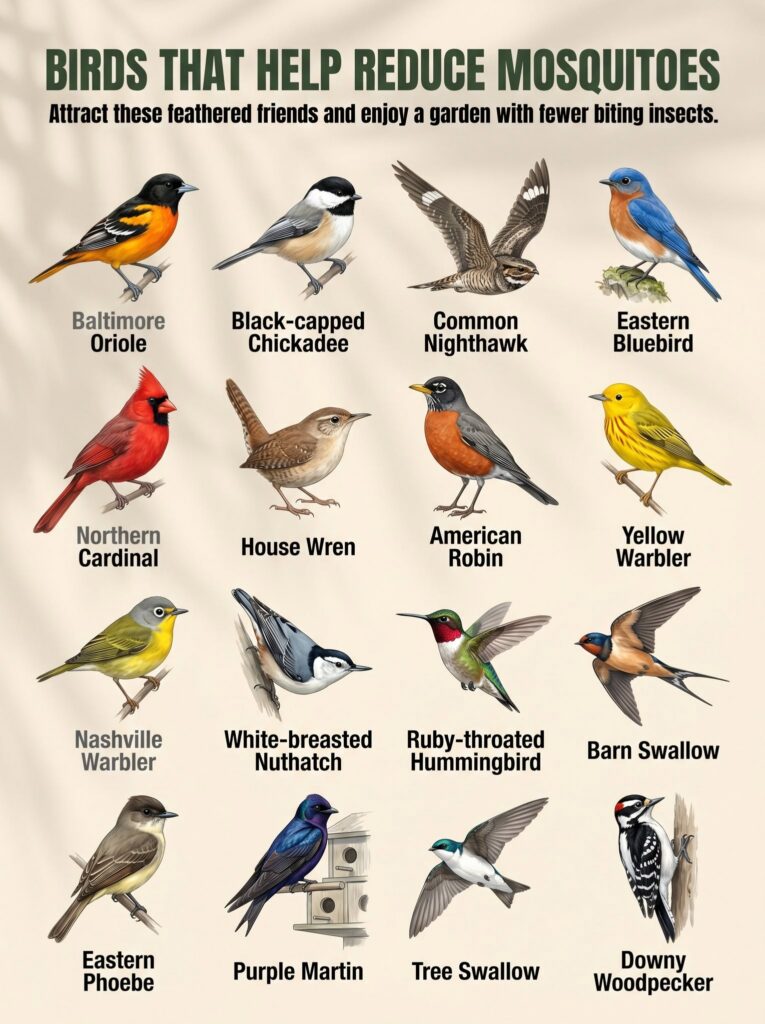 Meet some of your garden’s best natural pest controllers.
The Power of Birds in Pest Management
Birds play a vital role in maintaining ecological balance, especially in urban and suburban landscapes. During breeding season, many species switch their diet almost entirely to insects to provide protein for their rapidly growing chicks. This includes mosquitoes, their larvae (if accessible), gnats, flies, caterpillars, and other common garden pests.
Attracting birds means creating a diverse ecosystem that supports not just the birds, but also a healthy balance of insects. Instead of eradicating all insects, you foster a system where predators like birds help keep pest populations from spiraling out of control. It’s a key principle of integrated pest management (IPM) that works with nature, not against it.
Your Feathered Mosquito Patrol: Sixteen Key Species
Let’s explore some of the specific bird species that can help you reduce mosquitoes and how to invite them to your garden:
Northern Cardinal (Cardinalis cardinalis)
- Hardiness: Zones 4-9
- Plant type: Year-round resident across much of its range.
- Exposure: Prefers dense shrubs and small trees for nesting and shelter.
- Height: 8-9 inches
- Spread: Up to 12 inches
While known for their seed-eating habits, cardinals also consume a variety of insects, especially during nesting season. Attract them with sunflower seeds, dense thorny shrubs for nesting (like hawthorn or roses), and a reliable water source.
Eastern Bluebird (Sialia sialis)
- Hardiness: Zones 4-9
- Plant type: Migratory in northern parts, year-round in southern.
- Exposure: Open woodlands, orchards, suburban areas with scattered trees.
- Height: 6.5-8.5 inches
- Spread: 11-14 inch wingspan
Bluebirds are insectivores, frequently snatching insects from the air or ground. They love open grassy areas for foraging and readily use nest boxes designed specifically for them. Plant berry-producing shrubs like dogwood or sumac for winter food.
Tree Swallow (Tachycineta bicolor)
- Hardiness: Migratory, breeding across most of the US and Canada.
- Plant type: Migratory aerial insectivore.
- Exposure: Open areas near water.
- Height: 5-6 inches
- Spread: 14-15 inch wingspan
These acrobatic flyers are superb mosquito hunters, catching insects in mid-air. Provide nest boxes in open fields or near water, mounted on poles to prevent predation. They prefer a clear flight path.
Purple Martin (Progne subis)
- Hardiness: Migratory, breeding across the eastern US.
- Plant type: Migratory colonial aerial insectivore.
- Exposure: Large open areas, preferably near water.
- Height: 7-8 inches
- Spread: 15-16 inch wingspan
Purple Martins are famous for consuming vast numbers of flying insects, including mosquitoes. They are colonial nesters and rely entirely on human-provided housing (multi-compartment martin houses). They need large, open flyways without tall trees nearby.
House Wren (Troglodytes aedon)
- Hardiness: Zones 3-9
- Plant type: Migratory across much of its range.
- Exposure: Shrubby areas, open woodlands, suburban gardens.
- Height: 4.5-5.5 inches
- Spread: 6 inch wingspan
Tiny but mighty, House Wrens actively forage for insects and spiders in dense vegetation. Attract them with small birdhouses (with a 1 1/8-inch entrance hole), brush piles, and plenty of shrubs and thickets for cover.
Chickadee (Poecile atricapillus / carolina)
- Hardiness: Zones 3-9 (depending on species)
- Plant type: Year-round resident.
- Exposure: Wooded areas, suburban yards.
- Height: 5 inches
- Spread: 7-8 inch wingspan
Chickadees are constant foragers, gleaning insects and insect eggs from tree bark and leaves, including mosquitoes and their larvae if found near water. Offer black oil sunflower seeds, suet, and small nesting cavities or boxes. Plant native trees like oaks and maples.
Nighthawk (Chordeiles minor)
- Hardiness: Migratory, breeding across most of North America.
- Plant type: Nocturnal aerial insectivore.
- Exposure: Open country, urban areas (flat rooftops).
- Height: 9-10 inches
- Spread: 23-24 inch wingspan
Common Nighthawks are incredible insectivores, especially active at dusk and dawn when mosquitoes are most prevalent. They catch insects in flight with their wide mouths. While hard to ‘attract’ to a typical garden, you can help by preserving open spaces and reducing light pollution. They often nest on flat, gravel rooftops in urban areas.
Wood Thrush (Hylocichla mustelina)
- Hardiness: Migratory, breeding in eastern US.
- Plant type: Ground foraging insectivore.
- Exposure: Moist deciduous or mixed forests with dense understory.
- Height: 7-8.5 inches
- Spread: 13-15 inch wingspan
These melodious birds primarily forage for insects like beetles, ants, and caterpillars on the forest floor. Create a mini-forest environment with native understory plants and leaf litter to encourage them. A shallow bird bath is also a draw.
American Robin (Turdus migratorius)
- Hardiness: Zones 2-9
- Plant type: Migratory in northern areas, year-round in southern.
- Exposure: Lawns, open areas, trees, and shrubs.
- Height: 9-11 inches
- Spread: 12-17 inch wingspan
Robins are primarily ground foragers, famous for pulling earthworms, but they also eat a wide array of insects, including mosquitoes, especially during breeding season. They appreciate open lawns for foraging, tall trees for nesting, and bird baths.
Eastern Phoebe (Sayornis phoebe)
- Hardiness: Migratory, breeding across eastern US.
- Plant type: Flycatcher.
- Exposure: Open woodlands, near water, often near human structures.
- Height: 6-7 inches
- Spread: 10-11 inch wingspan
Eastern Phoebes are active flycatchers, perching and darting out to snatch flying insects, including mosquitoes, in mid-air. They often nest under eaves, bridges, or rock ledges. Providing a sheltered ledge or an open-front nest shelf might attract them.
Barn Swallow (Hirundo rustica)
- Hardiness: Migratory, breeding across most of North America.
- Plant type: Aerial insectivore.
- Exposure: Open country, farms, rural areas.
- Height: 5.5-7 inches
- Spread: 11-13 inch wingspan
Like Tree Swallows and Purple Martins, Barn Swallows are graceful aerial insectivores that consume many flying pests. They prefer to nest on vertical surfaces like barn rafters, porch eaves, or open sheds. Encourage them by keeping suitable structures available.
Yellow Warbler (Setophaga petechia)
- Hardiness: Migratory, breeding across most of North America.
- Plant type: Insectivore.
- Exposure: Shrubs, thickets, wetlands, riparian areas.
- Height: 4.5-5 inches
- Spread: 6-7 inch wingspan
Yellow Warblers are active foragers in shrubs and small trees, gleaning insects and larvae. Plant native shrubs like dogwood, willow, or elderberry, especially near a water source, to provide foraging and nesting opportunities.
Baltimore Oriole (Icterus galbula)
- Hardiness: Migratory, breeding in eastern US.
- Plant type: Omnivore.
- Exposure: Tall deciduous trees, open woodlands, suburban areas.
- Height: 7-8.5 inches
- Spread: 9-12 inch wingspan
Orioles eat a mix of insects (including caterpillars and beetles), fruit, and nectar. They can be attracted with orange halves, grape jelly, and native trees like elms, maples, and oaks for nesting. They’re not primary mosquito predators but contribute to general insect control.
Red-Eyed Vireo (Vireo olivaceus)
- Hardiness: Migratory, breeding across eastern US.
- Plant type: Insectivore.
- Exposure: Deciduous and mixed forests.
- Height: 4.5-5.5 inches
- Spread: 9-10 inch wingspan
Red-Eyed Vireos spend their time foraging high in the canopy of trees, eating mostly caterpillars and other insects. While not ground-level mosquito hunters, they help control arboreal insect pests. Encourage them by planting a diversity of native deciduous trees.
Ruby-Throated Hummingbird (Archilochus colubris)
- Hardiness: Migratory, breeding in eastern North America.
- Plant type: Nectivore/insectivore.
- Exposure: Gardens with nectar flowers, woodlands.
- Height: 3-3.5 inches
- Spread: 4-4.5 inch wingspan
While famous for nectar, hummingbirds also consume small insects, including gnats, aphids, and even tiny mosquitoes, to get protein. Attract them with a continuous supply of native tubular flowers (e.g., salvia, bee balm, cardinal flower) and hummingbird feeders.
Common Grackle (Quiscalus quiscula)
- Hardiness: Zones 3-9
- Plant type: Omnivore.
- Exposure: Open woodlands, parks, suburban areas, agricultural fields.
- Height: 11-13 inches
- Spread: 14-18 inch wingspan
Grackles are opportunistic omnivores that eat a wide variety of insects, including grubs and grasshoppers, as well as seeds and berries. While sometimes seen as a nuisance due to their large numbers, they do contribute to general insect control. Provide open areas for foraging and a water source.
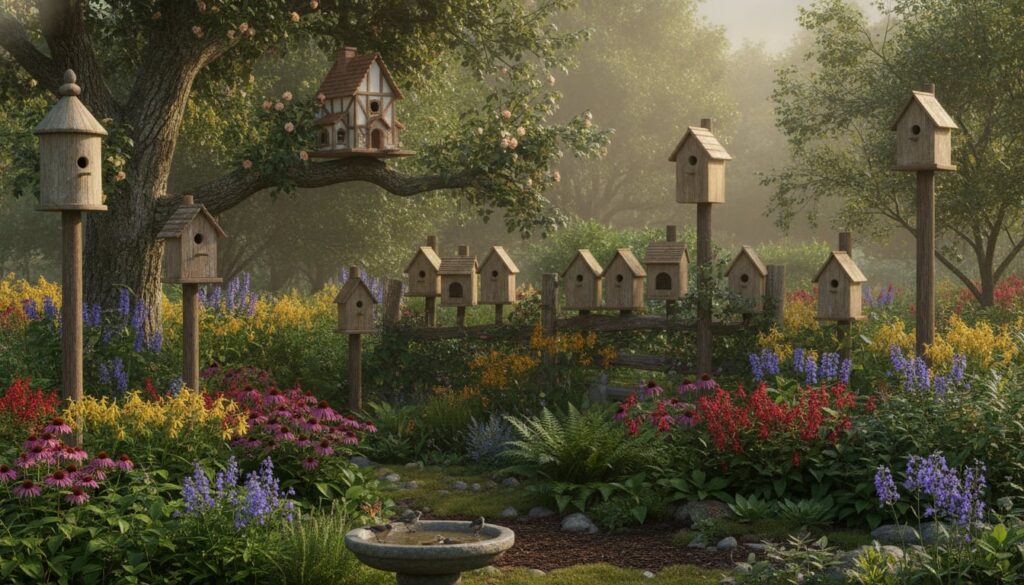 Different birds require different types of nesting structures.
Creating a Bird-Friendly Garden Habitat
To truly attract and sustain these mosquito-eating marvels, focus on providing the four key elements birds need:
1. Water Sources
A reliable water source is crucial. Bird baths should be shallow (1-2 inches deep) and have a rough surface for grip. Clean them frequently to prevent mosquito breeding. A dripper or mister can make the water more appealing and keep it moving, further deterring mosquitoes and attracting birds.
2. Food Sources
- Native Plants: The most sustainable food source is native plants. They host native insects that birds evolved to eat, provide seeds and berries, and offer nectar for species like orioles and hummingbirds. Examples include coneflowers, asters, sunflowers, elderberry, serviceberry, and oaks.
- Insect Habitat: Avoid using pesticides. A healthy garden with diverse plant life will naturally support a variety of insects, providing ample food for birds without relying on artificial feeders.
- Feeders (Use with Caution): Seed feeders can supplement natural food, especially in winter. However, for mosquito control, focus on attracting insectivores with habitat. Consider suet feeders for insect-eating birds like chickadees and wrens.
3. Shelter and Nesting Sites
- Native Trees & Shrubs: Plant a variety of native trees and shrubs to provide dense cover for roosting, protection from predators, and nesting sites. Evergreens offer crucial winter shelter.
- Brush Piles: A simple brush pile in a corner of your yard can provide invaluable shelter for wrens, sparrows, and other ground-dwelling birds.
- Birdhouses & Nest Boxes: Research specific birdhouse designs for species like bluebirds, wrens, swallows, and martins. Proper placement (height, direction, predator guards) is vital for success.
4. Safety from Predators
Keep domestic cats indoors, especially during peak bird activity. Place feeders and bird baths away from dense cover where predators could ambush birds. Provide thorny shrubs as natural refuges.
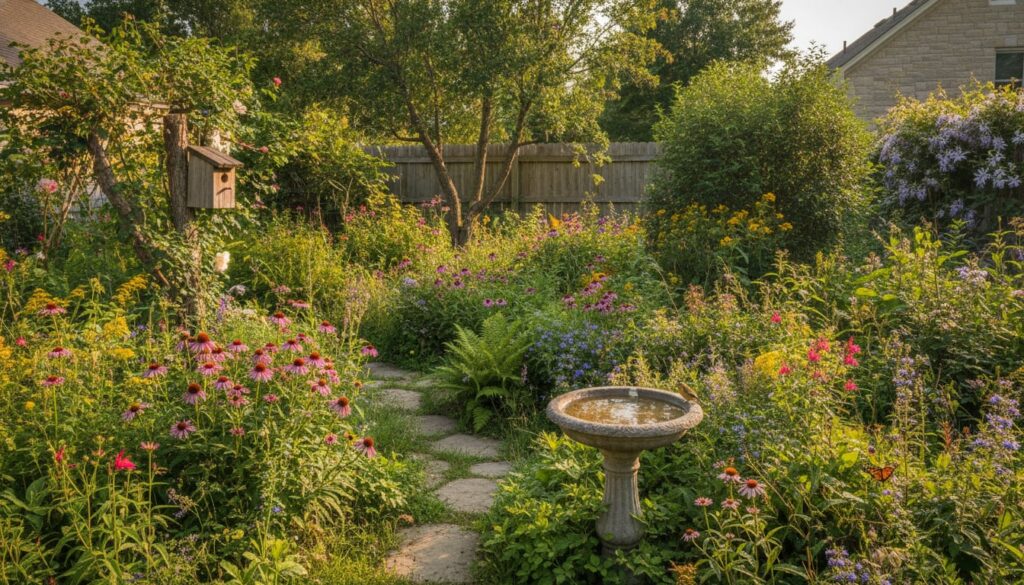 A diverse garden with native plants and water sources creates an inviting bird habitat.
Common Mistakes to Avoid
- Using Pesticides: This is the biggest deterrent. Pesticides kill the insects that birds rely on for food, directly harming bird populations and negating your efforts to attract them. Opt for organic and natural pest control methods.
- Lack of Diverse Habitat: A lawn-dominated yard offers little to birds. Introduce layers of vegetation: groundcover, shrubs, small trees, and large trees.
- Dirty Bird Baths: Stagnant water in bird baths can become a breeding ground for mosquitoes. Clean them thoroughly every few days.
- Ignoring Native Plants: Non-native plants often don’t support the insect life that local birds need. Prioritize native species whenever possible.
- Improper Birdhouse Placement: Placing birdhouses too close to human activity, without predator guards, or at the wrong height can lead to nesting failure.
Regional and Seasonal Considerations
Bird populations and their feeding habits vary across the United States. In warmer USDA Zones (9-11), many birds may be year-round residents, while in colder zones (3-5), you’ll see more migratory species during spring and summer. Mosquito activity peaks in warm, humid months, which often coincides with bird breeding season when insect consumption is highest.
- Zones 3-5: Focus on attracting migratory insectivores during summer. Provide shelter for hardy winter residents.
- Zones 6-8: A good mix of year-round and migratory birds. Ensure continuous food sources from spring to fall.
- Zones 9-11: Emphasize year-round habitat and water. Consider plants that flower and fruit throughout the mild winters.
Always consult your local extension services or birding organizations for species-specific advice relevant to your exact location and microclimate.
Cultivate a Living Garden
Transforming your garden into a haven for mosquito-eating birds is a rewarding endeavor. It’s an investment in a healthier, more vibrant ecosystem that provides natural pest control and endless opportunities for observing beautiful wildlife. By providing food, water, and shelter, you’ll not only reduce the mosquito population but also foster a deeper connection to the natural world. Start small, observe which birds visit, and gradually expand your efforts. Your garden – and your comfort – will thank you.