Are you a home gardener or small farmer who dreams of healthier plants, fewer weeds, and a more abundant harvest? The secret to achieving these goals often lies beneath the surface – in your soil. Healthy soil is the bedrock of a thriving garden, but it faces many challenges, from compaction and nutrient loss to persistent weeds and disease.
Instead of relying solely on synthetic fixes, imagine harnessing nature’s own solutions to restore balance and vitality to your growing space. This guide will walk you through how to pinpoint common soil problems and select the perfect cover crop to transform your garden, leading to more productive and resilient plants. Get ready to cultivate not just crops, but truly vibrant soil!
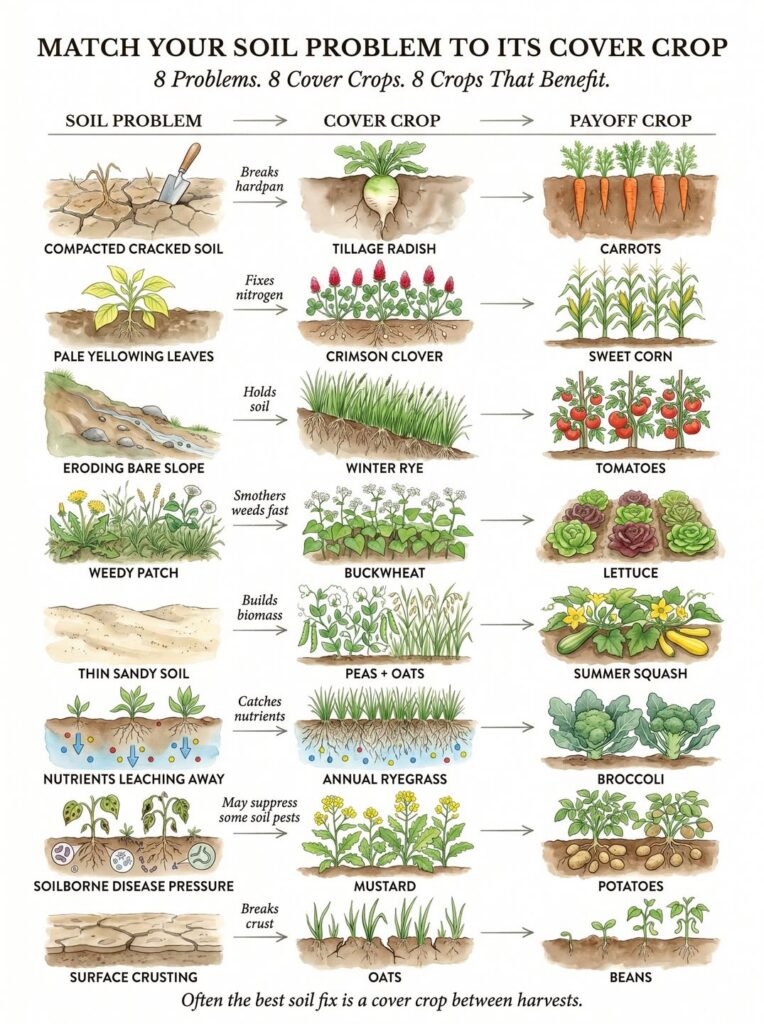 Choosing the right cover crop can address specific soil challenges.
The Power of Cover Crops: Your Soil’s Best Friend
Cover crops are plants grown primarily to benefit the soil rather than for direct harvest. Think of them as living mulches and underground workers that enrich your garden’s foundation. They protect bare soil from erosion, suppress weeds, add organic matter, improve soil structure, and even provide essential nutrients. By planting cover crops between your main harvest cycles, you actively participate in a sustainable gardening practice that builds long-term soil health.
Solving Common Soil Problems with Targeted Cover Crops
Understanding your soil’s specific needs is the first step. Once you identify a challenge, you can select a cover crop that acts as a natural remedy, paving the way for healthier future plantings.
1. Compacted Soil & Hardpan
Problem: Soil that feels hard, drains poorly, or prevents roots from penetrating deeply often indicates compaction, sometimes forming a ‘hardpan’ layer below the surface.
Cover Crop: Tillage Radish (Raphanus sativus var. longipinnatus), often called Daikon or Forage Radish. These aren’t your typical salad radishes. Tillage radishes develop incredibly deep, thick taproots that can break through compacted soil layers. As they grow, their roots create channels, and when they decompose, they leave behind pathways for air, water, and subsequent crop roots.
Payoff Crop: Carrots, which need loose, stone-free soil for straight, uniform growth, greatly benefit from the improved soil structure.
Practical Tip: Plant tillage radishes in late summer or early fall. Allow them to grow until a hard frost kills them back. Their decomposing roots will do the work over winter, creating a friable seedbed for spring planting.
2. Nutrient Deficiency (Nitrogen Boost)
Problem: Pale, stunted plants, especially those that are heavy feeders like corn, can signal a lack of essential nutrients, particularly nitrogen.
Cover Crop: Crimson Clover (Trifolium incarnatum). As a legume, crimson clover works with beneficial soil bacteria to ‘fix’ atmospheric nitrogen into a form plants can use. When the clover is tilled or cut into the soil, this nitrogen becomes available to your next crop.
Payoff Crop: Sweet Corn, a notorious nitrogen guzzler, thrives after a crimson clover cover crop, reducing the need for synthetic nitrogen fertilizers.
Practical Tip: Sow crimson clover in early fall for a spring nitrogen boost. It grows quickly in cool weather and produces beautiful red blooms before being incorporated into the soil in spring, ideally a few weeks before planting your main crop.
3. Poor Soil Drainage & Structure
Problem: Soil that stays waterlogged after rain or feels like dense clay can suffocate roots and hinder plant growth due to poor drainage and structure.
Cover Crop: Cereal Rye (Secale cereale). Often simply referred to as ‘rye,’ this is a robust cool-season grass. Its extensive fibrous root system dramatically increases the organic matter content when tilled in, improving soil aggregation and creating better pathways for water to percolate and excess moisture to drain away.
Payoff Crop: Summer Squash benefits from well-draining yet moisture-retentive soil, preventing root rot and promoting vigorous growth.
Practical Tip: Plant cereal rye in the fall after your summer harvest. It establishes quickly and continues to grow even in cold temperatures. Terminate it in early spring by mowing and tilling it into the top few inches of soil before it produces seed to prevent it from becoming a weed.
4. Erosion Control & Winter Protection
Problem: Bare soil is vulnerable to wind and water erosion, especially during harsh winter months, leading to nutrient loss and soil degradation.
Cover Crop: Hairy Vetch (Vicia villosa). This vining legume forms a dense mat of foliage that effectively covers and protects the soil surface. Beyond erosion control, hairy vetch is an excellent nitrogen fixer, adding valuable fertility to your garden.
Payoff Crop: Lettuce and other leafy greens appreciate the enriched, protected soil that hairy vetch leaves behind, especially for early spring plantings.
Practical Tip: Sow hairy vetch in late summer or early fall. It overwinters reliably in many climates (USDA Zones 4-9), resuming growth in spring. Incorporate it into the soil when it starts to flower but before it sets seed, typically a few weeks before planting your desired crop.
5. Low Organic Matter
Problem: Lifeless, hard-to-work soil that lacks vitality and retains little moisture or nutrients is often deficient in organic matter.
Cover Crop: Buckwheat (Fagopyrum esculentum). A fast-growing warm-season annual, buckwheat rapidly produces a lush canopy of foliage and a dense, shallow root system. It’s a fantastic biomass producer, quickly adding organic material to the soil when incorporated. It also attracts beneficial pollinators.
Payoff Crop: Tomatoes, which are heavy feeders and benefit from rich, humus-filled soil, thrive after a buckwheat cover crop.
Practical Tip: Plant buckwheat in late spring or summer. It matures in just 6-8 weeks. Mow or till it into the soil just as it begins to flower, before seeds can set, then you can plant your next crop immediately or allow it to decompose for a few weeks.
6. Heavy Weed Pressure
Problem: An ongoing battle with aggressive weeds can outcompete your desired plants for water, nutrients, and sunlight.
Cover Crop: White Clover (Trifolium repens). This low-growing, perennial legume spreads readily, forming a dense, living mat that effectively smothers weeds by blocking sunlight. Like other clovers, it also fixes nitrogen, enriching the soil.
Payoff Crop: Cabbage and other brassicas benefit from reduced weed competition and improved nitrogen availability.
Practical Tip: White clover can be undersown between established crops or planted in fall or spring in an empty bed. If using it to smother weeds, allow it to grow for at least one full season. For future plantings, you can mow it closely and plant directly, or lightly till it in. Be mindful that perennial white clover can be persistent and may require management to prevent it from outcompeting main crops.
7. Nematode Management
Problem: Microscopic parasitic nematodes can damage plant roots, leading to stunted growth, wilting, and reduced yields (e.g., in potatoes).
Cover Crop: French Marigolds (Tagetes patula). Specific varieties of French marigolds, when grown densely for a full season, release root exudates that are toxic to certain types of harmful nematodes, such as root-knot nematodes. This is a biological approach to pest management.
Payoff Crop: Potatoes, which are highly susceptible to nematode damage, show marked improvement when planted after a marigold cover crop.
Practical Tip: Plant a solid stand of French marigolds in an affected area for an entire growing season. Do not harvest the flowers if your goal is nematode suppression, as the effect comes from the roots. At the end of the season, you can till them into the soil or remove them. Rotate with other crops to continue breaking the nematode life cycle.
8. Suppressing Soil-Borne Diseases
Problem: Pathogens in the soil can cause diseases like damping-off, fusarium wilt, or verticillium wilt, impacting plant health and yield.
Cover Crop: Biofumigant Mustard (e.g., Brassica juncea, Brassica nigra). Certain mustard varieties contain compounds called glucosinolates. When their plant tissue is chopped and incorporated into moist soil, these compounds convert into isothiocyanates, which have biofumigant properties, helping to suppress a range of soil-borne pathogens and some weed seeds.
Payoff Crop: Beans and other vegetables susceptible to soil diseases can benefit from the pathogen-suppressing effects of a mustard cover crop.
Practical Tip: Plant biofumigant mustard densely in spring or late summer. Allow it to grow vigorously, usually until just before flowering. Then, chop the plants finely and immediately incorporate them into the top 4-6 inches of moist soil, sealing the soil surface to trap the biofumigant gases. Wait at least 2-4 weeks before planting your next crop.
Common Mistakes to Avoid with Cover Crops
Even with the best intentions, a few missteps can lessen the impact of your cover crops:
- Incorrect Timing of Termination: Allowing cover crops to go to seed can turn them into weeds. Terminate them (mow, crimp, or till) before they set viable seeds.
- Ignoring Your Climate: Choose cover crops suited to your local USDA hardiness zone and seasonal conditions. Some cover crops are winter-hardy, while others winter-kill, which can be a desired outcome for easy spring planting.
- Improper Incorporation: Simply chopping and leaving cover crop residue on top might not be enough for some benefits, like nitrogen release or biofumigation. For maximum benefit, residue often needs to be worked into the top layer of the soil.
Seasonal & Regional Considerations for Cover Cropping
The timing of your cover crop planting and termination will vary significantly depending on your specific region and local climate. In colder USDA Zones (e.g., 3-5), you might focus on quick-growing summer cover crops or very hardy winter annuals. In more moderate zones (6-8), you have a wider window for both cool-season and warm-season options. Gardeners in warmer zones (9-11) can often grow cover crops through much of the winter.
Always consult your local extension service for specific planting dates, variety recommendations, and termination advice tailored to your microclimate and average first and last frost dates. Paying attention to soil temperature rather than just calendar dates is also crucial for successful germination and growth.
Cultivate a Healthier Garden, Season After Season
Embracing cover crops is more than just a gardening technique; it’s a commitment to nurturing your soil as the living foundation of your garden. By addressing specific problems like compaction, nutrient deficiencies, or pest issues with nature’s own solutions, you’re building a more resilient, productive, and sustainable growing space. Start small, observe your soil’s response, and watch as your garden flourishes with renewed vitality. Your plants and your future harvests will thank you!