There’s a special kind of magic in watching a new plant emerge from a simple cutting. It’s an incredibly rewarding process that not only expands your indoor greenery but also deepens your connection to the natural world. Imagine turning one beloved houseplant into many, sharing them with friends, or simply filling your home with more lush life, all for free!
Propagation isn’t just a cost-effective way to grow your plant collection; it’s a hands-on lesson in resilience and growth. Starting with a small piece and nurturing it into a thriving plant builds confidence and sharpens your observational skills. Whether you’re a seasoned gardener or just beginning your green journey, diving into the world of plant propagation can transform your gardening experience, offering endless opportunities for learning and enjoyment.
This guide will walk you through the exciting process of propagating 15 popular houseplants, highlighting the best methods for each, whether it’s a simple leaf cutting or a stem section. Get ready to multiply your green haven and cultivate your own thriving oasis!
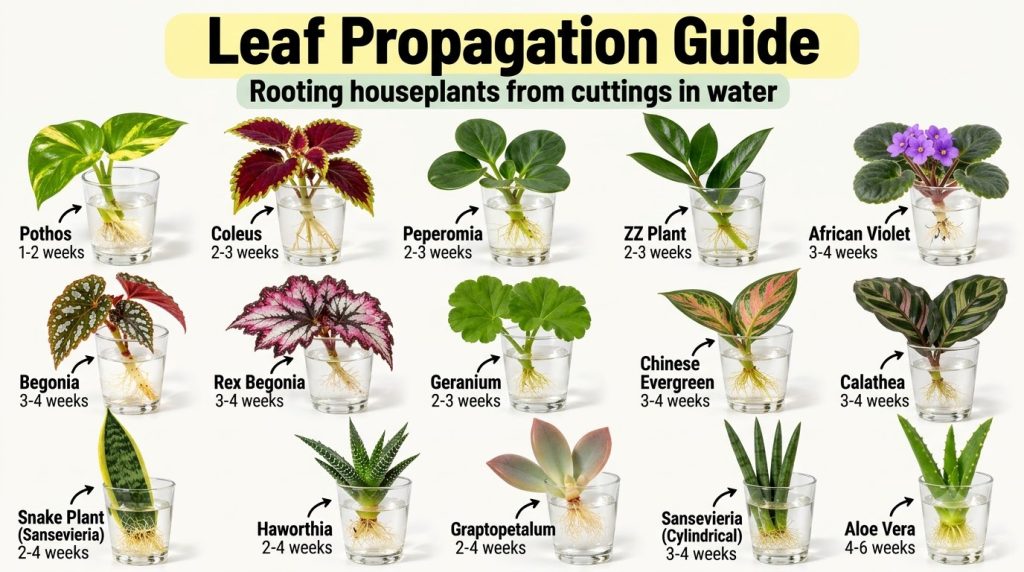
The Art of Water Propagation: Core Principles
Water propagation is a straightforward and often successful method for rooting many plants. It allows you to visibly track root development, which is incredibly satisfying. The basic principle involves placing a plant cutting into water, where it will develop roots before being transplanted into soil. However, it’s important to understand that not all plants root identically, and some require specific types of cuttings.
For successful water propagation:
- Choose Healthy Cuttings: Always select vibrant, disease-free leaves or stems from a mature plant.
- Cleanliness is Key: Use clean, sterilized scissors or a knife for your cuts to prevent disease.
- Water Quality: Fresh, room-temperature water is best. Change the water every few days to a week to keep it oxygenated and free of fungal growth.
- Light & Temperature: Place your cuttings in a spot with bright, indirect light. Avoid direct, harsh sunlight, which can cook delicate new roots. Maintain consistent room temperature.
- Patience: Rooting times vary greatly by plant species and environmental conditions. Some plants root in weeks, others take months.
While many plants can root from just a leaf, others, especially vining plants, require a piece of stem with a ‘node.’ A node is the point on a stem where a leaf, branch, or bud emerges, and it contains the growth hormones necessary for new roots and shoots to form.
Your Propagation Journey: 15 Plants to Grow
Let’s explore some fantastic plants you can propagate and how to do it right:
1. Begonia (Begonia spp.)
Many fibrous-rooted and rhizomatous begonias propagate beautifully from leaf cuttings. Take a healthy leaf, and for larger leaves, you can even cut it into wedge-shaped sections, ensuring each section includes a piece of a main vein. Place the stem or vein-side down in water. Rooting typically occurs within 2-4 weeks, followed by tiny plantlets.
- Plant type: Annual/Perennial/Tropical perennial
- Exposure: Bright, indirect light
- Propagation Tip: High humidity can aid success. Cover the glass with a plastic dome or bag (with air holes) to maintain moisture.
2. African Violet (Saintpaulia spp.)
African violets are classic candidates for leaf propagation. Choose a healthy, medium-sized leaf and cut its stem (petiole) to about 1-1.5 inches long. Place the petiole into water. You’ll see roots in 2-3 weeks, but new plantlets usually emerge from the base of the petiole after several more weeks or even months. Patience is crucial for these beauties!
- Plant type: Perennial houseplant
- Exposure: Bright, indirect light
- Propagation Tip: Ensure the petiole doesn’t sit too deep in the water; just the very end is sufficient.
3. Pothos (Epipremnum aureum)
While often shown as a leaf, Pothos is best propagated from a stem cutting. Select a section of vine that has at least two or three leaves and a node (a small bump) where roots will form. Cut just below a node. Remove the bottom leaf or two so that the node is exposed and can be submerged in water. Roots usually form quickly within 2-4 weeks.
- Plant type: Tropical perennial vine
- Exposure: Low to bright, indirect light
- Propagation Tip: Pothos is one of the easiest, making it great for beginners.
4. Hoya (Hoya carnosa, spp.)
Hoya leaves will readily root in water (typically 3-5 weeks), but here’s a crucial detail: a single leaf cutting without a piece of stem containing a node will often only grow roots and never develop into a full plant. For a successful plant, always include a node or even a small piece of stem with the leaf. Look for ‘single-node cuttings’ for best results.
- Plant type: Tropical perennial vine
- Exposure: Bright, indirect light
- Propagation Tip: Be patient; Hoya can be slow to show new shoot growth even after rooting.
5. Peperomia (Peperomia spp.)
Most Peperomia varieties are excellent for leaf cuttings. Take a healthy leaf, with or without a short petiole, and place the cut end in water. Roots typically form in 2-4 weeks, followed by tiny new plantlets from the base of the leaf. You can also root stem cuttings with ease.
- Plant type: Tropical perennial houseplant
- Exposure: Medium to bright, indirect light
- Propagation Tip: Use small glasses or jars to keep the leaves upright.
6. Geranium (Pelargonium spp.)
Similar to Pothos, Geraniums are best propagated from stem cuttings, not just leaves. Take a tip cutting about 4-6 inches long from a healthy stem, cutting just below a node. Remove any leaves from the bottom 2 inches of the stem. Roots typically appear in 3-4 weeks. Geraniums are known for quick rooting in water or soil.
- Plant type: Annual/Tender perennial
- Exposure: Full sun to partial shade (outdoors), bright indirect light (indoors)
- Propagation Tip: Allow the cut end to ‘callus’ for a few hours before placing in water to prevent rot.
7. Sedum (Sedum spp.)
Sedums, especially the succulent types, root very easily from individual leaves. Gently twist a healthy leaf from the main stem, ensuring you get a clean break. Let the leaf sit in a dry, shaded spot for 1-2 days to allow the cut end to callus over. Then, place the callused end in a shallow dish of water, or simply lay it on top of moist soil. Roots and tiny plantlets will form in 2-4 weeks.
- Plant type: Succulent perennial
- Exposure: Full sun to partial shade
- Propagation Tip: Don’t bury the entire leaf; just let the base touch the water.
8. Echeveria (Echeveria spp.)
Like Sedum, Echeveria propagates readily from leaf cuttings. Carefully remove a healthy leaf from the mother plant, ensuring the entire leaf base is intact. Allow it to callus for 2-3 days in a dry, shaded location. Then, place the callused end in a shallow dish of water or on top of moist soil. Roots will emerge in 3-6 weeks, often followed by a tiny rosette.
- Plant type: Succulent perennial
- Exposure: Bright direct to indirect light
- Propagation Tip: Avoid overwatering once roots appear; succulents prefer drier conditions.
9. ZZ Plant (Zamioculcas zamiifolia)
The ZZ Plant can be propagated from individual leaflets, though it’s a slow process. Select a healthy leaflet and place its base in water. Roots may take 6-8 weeks to form, but the development of the small potato-like rhizome (which stores water and nutrients) and subsequent new shoots can take several months. Be very patient!
- Plant type: Tropical perennial houseplant
- Exposure: Low to bright, indirect light
- Propagation Tip: Don’t give up! ZZ plants are notoriously slow but reliable propagators.
10. Sansevieria (Dracaena trifasciata, formerly Sansevieria)
Also known as Snake Plant, Sansevieria propagates well from leaf sections. Cut a healthy leaf into 2-4 inch segments. Mark the bottom end of each section to ensure you plant them in the correct orientation (they won’t root if upside down). Place the bottom end in water. Roots form in 4-8 weeks. Note: Variegated varieties propagated this way may revert to all green.
- Plant type: Tropical perennial houseplant
- Exposure: Low to bright, indirect light
- Propagation Tip: Change the water frequently to prevent rot.
11. Kalanchoe (Kalanchoe spp.)
Many Kalanchoe varieties, especially those with fleshy leaves, can be propagated from leaf cuttings. Take a healthy leaf and let it callus for a day or two. Then, place the cut end into water. Roots typically form in 3-5 weeks, and new plantlets will soon follow. Stem cuttings also work beautifully.
- Plant type: Succulent perennial
- Exposure: Bright indirect light
- Propagation Tip: Avoid overwatering, as Kalanchoe is prone to rot in excessively wet conditions.
12. Jade Plant (Crassula ovata)
Jade plants are incredibly easy to propagate from leaves. Gently twist a healthy, mature leaf from the stem, ensuring the entire base is intact. Allow the leaf to callus in a dry, shaded spot for 2-3 days. Then, place the callused end in a shallow dish of water. Roots will appear in 3-6 weeks, and tiny new plantlets will grow from the base.
- Plant type: Succulent shrub
- Exposure: Bright direct to indirect light
- Propagation Tip: Don’t move the leaf too much once roots start to form.
13. String of Hearts (Ceropegia woodii)
This charming trailing plant can be propagated from single leaves, but you’ll get faster, more robust results from a ‘butterfly’ cutting, which is a leaf with a small section of stem and a node attached. Place the node/stem section in water. Roots typically form in 2-4 weeks. You can also root small sections of the vine.
- Plant type: Trailing succulent perennial
- Exposure: Bright, indirect light
- Propagation Tip: Ensure the tiny tubers often present on the nodes are submerged for best rooting.
14. Bromeliad (Bromeliaceae family)
Bromeliads are not typically propagated from leaf cuttings. Instead, they produce ‘pups’ or ‘offsets’ at their base, which are miniature versions of the mother plant. When these pups are about one-third to one-half the size of the mother plant, you can carefully remove them with a clean knife. Allow the pup to callus for a day or two, then place its base in water. Roots usually form within a few weeks, making it ready for potting.
- Plant type: Tropical perennial
- Exposure: Bright, indirect light
- Propagation Tip: Wait until the pup has started to develop its own root system and is robust enough to survive on its own before removing it.
15. Succulents (Various species)
This category encompasses many popular succulent genera like Graptopetalum, Pachyphytum, and some Sedums, all of which propagate well from leaf cuttings. The method is largely the same as for Echeveria and Jade: gently remove a healthy leaf, allow it to callus for a few days, then place the callused end in shallow water. Roots typically form in 2-4 weeks, leading to delightful new rosettes.
- Plant type: Various succulent perennials
- Exposure: Bright direct to indirect light
- Propagation Tip: A shallow dish or tray with just enough water to cover the base of the leaf works best.
Setting Up for Success
Once you’ve selected your cuttings, proper setup will ensure the best chance of success:
- Container Choice: Clear glass jars, bottles, or small vases are ideal. They allow you to monitor root development and easily spot any issues like rot or algae growth.
- Water Maintenance: Replace the water every 3-5 days. This keeps the water fresh and oxygenated, preventing bacterial growth that can cause cuttings to rot. If the water becomes cloudy or green, change it immediately.
- Placement: Position your containers in a spot that receives bright, indirect light. A north or east-facing window is often perfect. Avoid direct sunlight, which can cause the water to heat up excessively and harm the cuttings.
- Transition to Soil: Once roots are about 1-2 inches long, your cutting is ready for planting. Prepare a small pot with well-draining potting mix. Gently transfer the cutting, ensuring the roots are carefully placed in the soil. Water lightly and keep the soil consistently moist (but not soggy) for the first few weeks as the plant adjusts.
Avoid These Common Propagation Pitfalls
Even experienced gardeners can make mistakes. Here are some common issues and how to avoid them:
- Not Changing Water: Stagnant water quickly depletes oxygen and harbors pathogens. Regular water changes are crucial.
- Too Much Direct Sun: Intense direct sunlight can burn tender new roots and stress the cutting. Bright, indirect light is key.
- Planting Too Soon: Transplanting a cutting with underdeveloped roots can lead to transplant shock and failure. Wait until roots are substantial (1-2 inches).
- Using Unhealthy Cuttings: Cuttings from stressed, diseased, or pest-ridden plants are unlikely to root successfully. Always start with vigorous, healthy plant material.
- Forgetting About Nodes: For plants like Pothos, Geranium, and many vining Hoyas, a node is essential for root and shoot development. A leaf alone will not suffice for creating a full new plant.
- Overwatering After Transplant: While cuttings need moisture, established plants in soil (especially succulents) can quickly rot if overwatered. Allow the top inch of soil to dry out between waterings.
Cultivate Your Green Thumb
Propagating plants is a deeply satisfying aspect of gardening that transforms a simple interest into a true passion. Each successful rooting is a testament to your nurturing care and the incredible resilience of nature. You’re not just growing plants; you’re growing your skills, your knowledge, and a deeper appreciation for the life around you.
So, choose a plant from this list, gather your supplies, and embark on your propagation adventure. Watch closely, learn patiently, and soon you’ll have a flourishing collection of homegrown greenery, ready to brighten your space or share with loved ones. Happy propagating!