When the days get short and the ground is frozen, a sunny kitchen windowsill can be the most productive spot in your home. A few fresh herb cuttings sitting in clear glasses of water can turn that ledge into a small, cozy green space, and you can do it with little more than a sharp pair of scissors and some patience. Water propagation is one of the easiest ways to keep basil and mint going through winter, and it is a satisfying way to watch new roots form right before your eyes.
In this guide, you will learn which herbs root reliably in water, how to take cuttings that actually root, how to care for them on a cold-season windowsill, and when to move them into soil. Basil and mint are the best starting points, and oregano is worth trying once you have the basics down. Let’s get your sill growing.
Why Water Propagation Works Well Indoors
Many herbs form roots along the stem at the point where a leaf meets the stem, called a node. Roots form from this tissue, so each cutting needs at least one node submerged in water. Water propagation lets you see root development without disturbing the plant, and it works well in winter because you do not need potting soil, drainage holes, or a warm outdoor bed to get started.
Keep in mind that water-rooted cuttings are a bridge, not a permanent home. Roots that form in water are adapted to wet conditions, so they need a transition into soil before they can support a long-term plant.
What You Need
- Clean clear glasses or jars, about 4 to 8 inches tall, so you can watch the roots develop
- Sharp, clean scissors or pruners wiped with rubbing alcohol
- Room-temperature water, ideally filtered or left out overnight to let chlorine dissipate
- A bright windowsill, preferably facing south or east
- Labels or masking tape to mark each jar by herb and date
How to Take Good Cuttings
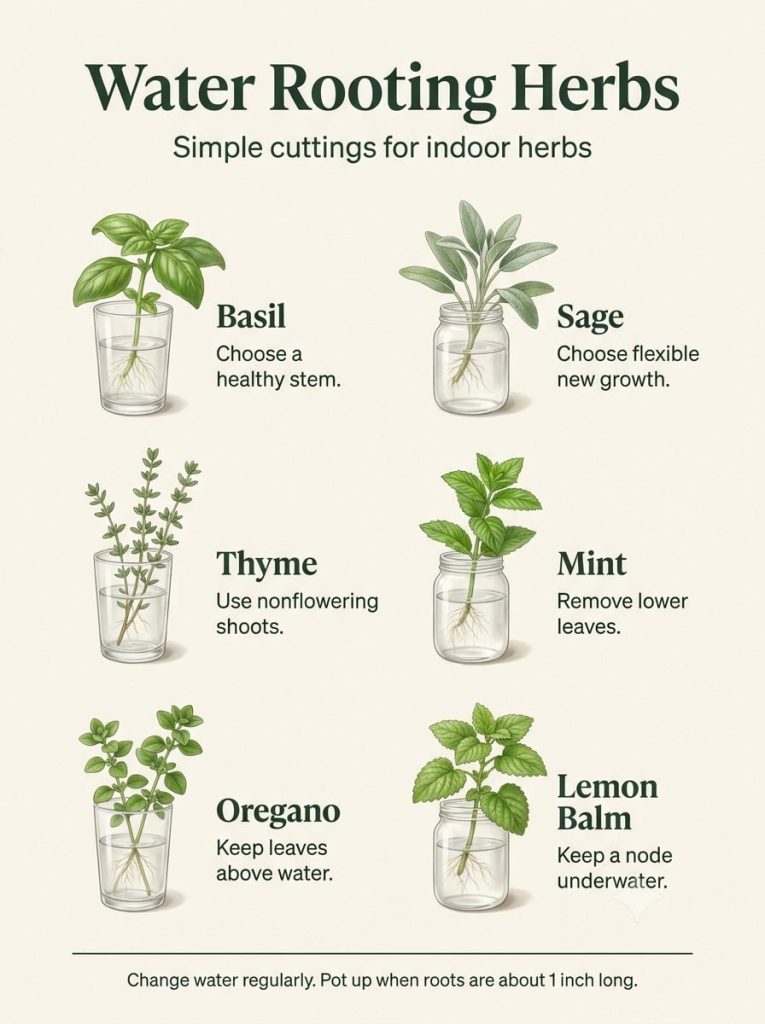
Choose healthy stems from the tips of the plant, not woody or flowering growth. Cut just below a node, which is usually a small bump where leaves attach, to make a cutting about 4 to 6 inches long. Strip the leaves from the bottom third so no foliage sits underwater, because submerged leaves rot and can contaminate the water. Keep two to four leaves at the top.
Place each cutting in its own jar so one rotting stem cannot spoil the others. Make sure at least one node is fully underwater, but do not let the leaves touch the water.
Basil: The Fastest Winter Starter
Basil (Ocimum basilicum) is a tender annual in most of the United States. It cannot survive frost, so it is grown as an annual outdoors in Zones 10 and 11 and as an annual everywhere else. Basil cuttings usually root in roughly 1 to 2 weeks under good light, though timing varies by variety and room temperature. Sweet basil is a dependable choice, and dwarf or Thai types also root well.
Once roots are about 1 to 2 inches long, you can pot the cutting in a 6-inch container with drainage holes and a light, well-draining potting mix. Pinch the top growth regularly to encourage bushy plants rather than tall, leggy stems.
Mint: Quick Roots, but Keep It Contained
Mint (Mentha species) is among the easiest herbs to root in water, often producing roots in about 1 to 2 weeks. Garden mint and spearmint are hardy perennials in roughly Zones 3 to 10, depending on the species. Because mint spreads by underground runners, it is best grown in its own container in the ground or in pots. Do not plant it directly in a mixed bed without a barrier.
Mint tolerates a little less light than basil and will still grow on a bright north window, though it will be leggier. Harvest by cutting stems back to a set of leaves to keep the plant compact.
Oregano: Worth Trying, but Slower
Oregano (Origanum vulgare and related species) is a hardy perennial in roughly Zones 4 to 9, depending on the species and cultivar. Oregano is less reliable than basil or mint in water. Cuttings may take several weeks to root, and some do not root at all in water. Use firm, non-flowering stems, change the water more often, and be patient. If roots do not appear after about four weeks, try a moist soil cutting instead.
Culinary oregano grown indoors often becomes woody and less flavorful over time, so start with a fresh cutting from a healthy plant if you can.
Light, Water, and Winter Care
Windowsill herbs need as much light as you can give them. A south-facing window usually provides the most light in winter, while east or west windows work with some extra light. Keep cuttings away from cold glass on freezing nights, since chilled roots can slow down or rot. If your windowsill feels cold to the touch, move the jars an inch or two back from the glass.
Change the water every 3 to 5 days, or whenever it looks cloudy. Rinse the jars and top them off with fresh water at room temperature. Watch for slimy stems or a sour smell, which signal rot. If that happens, cut the stem back above the affected area and start over with fresh water.
Signs of insufficient light include long, pale stems with large gaps between leaves. If you see this, move the jars to a brighter spot or add a small full-spectrum grow light for 12 to 14 hours a day.
When and How to Move Cuttings to Soil
Once roots are 1 to 2 inches long and look white and fibrous, you can start the transition. Plant the cutting in moist, well-draining potting mix, and keep it in bright indirect light for about a week. Water when the top half-inch of soil feels dry. Roots that formed in water can be fragile, so handle them gently and avoid tugging on the stem.
Healthy water roots are white or cream-colored and branch out. Brown, mushy, or thin, hairy roots that look fuzzy often mean the cutting is rotting.
Common Mistakes to Avoid
- Leaving leaves submerged, which causes rot and cloudy water
- Using dirty jars, which encourages bacteria and mold
- Letting the water go stale for weeks at a time
- Placing jars in a cold draft near a drafty window
- Moving the plant straight from water into dry soil without a transition period
- Expecting oregano to root as quickly as basil or mint
Seasonal Notes Across the United States
Your winter schedule depends on where you live. Gardeners in warmer areas such as Zones 9 to 11 may be able to plant basil outdoors after frost danger passes, while gardeners in Zones 3 to 5 may need to wait until late spring. Indoor propagation is useful in any zone because it lets you start strong plants before outdoor soil warms up. Your local extension service can give you average last frost dates and soil temperature guidance for your area.
USDA zones measure winter cold tolerance. They do not tell you how much indoor light you have, how dry your heating makes the air, or how quickly a windowsill heats up in the afternoon. Use them as a guide for outdoor planting, and use your own window conditions to decide how to care for indoor cuttings.
Start Your Winter Herb Sill Today
Begin with basil and mint, two cuttings in each of two jars, and label them with the date you made the cut. Check them every few days, change the water on schedule, and watch the roots grow. Once you have a few healthy plants, you will have fresh herbs for cooking all winter and a bright green corner that feels like spring. Take your first cuttings this week, and then share your progress with fellow gardeners in the comments.