Your Ultimate At-Home Leg Workout: Build Strength & Tone Without Equipment
Ready to sculpt strong, toned legs and build lower body strength without ever stepping foot in a gym? You’re in the right place! At Remedies Wellness, we believe that achieving your fitness goals should be accessible, convenient, and effective, no matter where you are. This comprehensive guide brings you an ultimate at-home leg workout designed specifically for beginners, focusing on essential movements that will challenge your muscles and empower your healthy lifestyle journey.
Forget about expensive gym memberships or complicated equipment. All you need is your body, a little space, and the motivation to move. We’ll walk you through each exercise with clear instructions, highlight the incredible benefits of strong legs, and provide tips to help you maximize your results safely and sustainably. Let’s get started on building a powerful lower body right from the comfort of your home!

Table of Contents
- Why Lower-Body Strength Matters
- Exercise #1: Bodyweight Squats
- Exercise #2: Reverse Lunges
- Exercise #3: Sumo Squats
- Exercise #4: Calf Raises
- Exercise #5: Glute Bridges
- Exercise #6: Wall Sit
- Muscles Worked in This Workout
- Beginner Workout Schedule
- Progressive Overload for Bodyweight Training
- Warm-Up & Cool-Down
- Recovery Tips for Optimal Results
- Common Mistakes to Avoid
- Frequently Asked Questions
- Final Thoughts
- Disclaimer
Why Lower-Body Strength Matters
Building strong legs isn’t just about aesthetics; it’s about building a foundation for a healthier, more active life. Your lower body muscles – your glutes, quadriceps, hamstrings, and calves – are essential for almost every movement you make throughout the day. Here’s why prioritizing lower body strength is a game-changer:
- Improved Mobility & Balance: Strong legs provide the stability needed to walk, run, climb stairs, and perform everyday tasks with ease. Enhanced balance helps prevent falls, especially as we age.
- Better Posture: A strong core and lower body work together to support your spine, leading to better posture and reduced back pain.
- Enhanced Athletic Performance: Whether you’re into running, cycling, hiking, or any sport, powerful legs translate to more speed, endurance, and explosive power. This is crucial for improving your fitness performance.
- Increased Metabolism: Your leg muscles are among the largest in your body. Working them out burns more calories during exercise and contributes to a higher resting metabolism, which can support fat loss efforts.
- Injury Prevention: Strong muscles and connective tissues around your joints provide better support, reducing the risk of injuries in your knees, hips, and ankles.
- Functional Strength: From picking up groceries to playing with kids, the functional strength gained from leg workouts makes daily activities feel effortless.
Investing time in your lower body strength training is an investment in your overall well-being and longevity. Let’s dive into the exercises!
Exercise #1: Bodyweight Squats
The bodyweight squat is a fundamental movement pattern and one of the best beginner leg exercises. It works multiple muscle groups simultaneously, making it incredibly efficient for building lower body strength and stability.
How to Perform Bodyweight Squats:
- Stand with your feet shoulder-width apart, toes pointing slightly outward. Keep your chest up, shoulders back, and core engaged.
- Initiate the movement by pushing your hips back as if you’re sitting into a chair.
- Bend your knees, lowering your hips until your thighs are parallel to the floor (or as low as comfortable while maintaining good form). Ensure your knees track in line with your toes and don’t collapse inward.
- Keep your weight in your heels and midfoot.
- Push through your heels to return to the starting position, squeezing your glutes at the top.
Muscles Targeted:
- Primary: Quadriceps (front of thighs), Glutes (buttocks)
- Secondary: Hamstrings (back of thighs), Calves, Core
Beginner Modifications:
- Chair Squats: Place a chair behind you and squat until your glutes lightly touch the chair before standing back up. This helps with depth and confidence.
- Partial Squats: Don’t go as deep. Focus on maintaining good form and gradually increase your depth over time.
Sets & Reps:
Aim for 2-3 sets of 10-15 repetitions, with 60-90 seconds rest between sets.
Exercise #2: Reverse Lunges
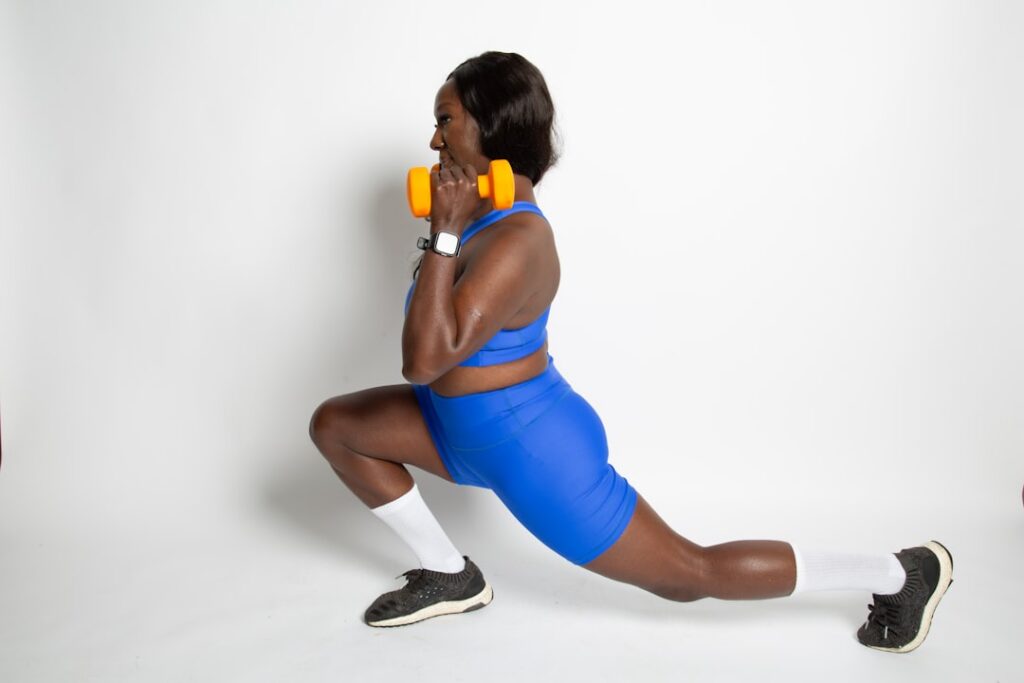
Reverse lunges are excellent for working each leg independently, which helps improve balance and address muscle imbalances. They put less stress on the knees compared to forward lunges, making them a great option for a workout for beginners.
How to Perform Reverse Lunges:
- Stand tall with your feet hip-width apart and your hands on your hips or by your sides.
- Step one leg straight back, landing on the ball of your foot.
- Lower your hips until both knees are bent at approximately a 90-degree angle. Your front knee should be directly over your ankle, and your back knee should hover just above the floor.
- Keep your torso upright and core engaged.
- Push off your back foot to return to the starting position, bringing your feet together.
- Alternate legs with each repetition or complete all reps on one side before switching.
Muscles Targeted:
- Primary: Quadriceps, Glutes, Hamstrings
- Secondary: Calves, Core, Hip Stabilizers (great for balance and stability improvements)
Beginner Modifications:
- Shorter Step: Don’t step back as far, reducing the depth of the lunge until you feel more stable.
- Hold Onto Support: Use a wall or sturdy chair for balance initially.
Sets & Reps:
Aim for 2-3 sets of 8-12 repetitions per leg, with 60-90 seconds rest between sets.
Exercise #3: Sumo Squats
The sumo squat is a variation of the traditional squat with a wider stance, which places more emphasis on the inner thighs (adductors) and glutes, offering a different stimulus to your lower body workout.
How to Perform Sumo Squats:
- Stand with your feet wider than shoulder-width apart, with your toes pointed out at a 45-degree angle.
- Keep your chest up, shoulders back, and core tight.
- Lower your hips down by bending your knees, ensuring your knees track outwards, following the direction of your toes.
- Go as low as comfortable, aiming for your thighs to be parallel to the floor.
- Drive through your heels to push back up to the starting position, squeezing your glutes at the top.
Muscles Targeted:
- Primary: Inner Thighs (Adductors), Glutes, Quadriceps
- Secondary: Hamstrings, Calves, Core
Beginner Modifications:
- Reduced Range of Motion: Don’t squat as deep if flexibility is an issue. Focus on controlling the movement.
Sets & Reps:
Aim for 2-3 sets of 10-15 repetitions, with 60-90 seconds rest between sets.
Exercise #4: Calf Raises
Calf raises are a simple yet effective way to strengthen the muscles in your lower legs, which are often overlooked. Strong calves are vital for walking, running, and overall ankle stability.
How to Perform Calf Raises:
- Stand tall with your feet hip-width apart. You can hold onto a wall or sturdy object for balance if needed.
- Slowly lift your heels off the ground, rising onto the balls of your feet. Go as high as you can.
- Hold briefly at the top, feeling the contraction in your calves.
- Slowly lower your heels back down to the starting position, controlling the movement.
Muscles Targeted:
- Primary: Gastrocnemius (larger calf muscle), Soleus (smaller calf muscle)
Beginner Modifications:
- Seated Calf Raises: If standing is too challenging, perform seated calf raises by resting your hands on your thighs for light resistance, lifting your heels.
- Wall Support: Use a wall for balance until you’re comfortable.
Sets & Reps:
Aim for 2-3 sets of 15-20 repetitions, with 60-90 seconds rest between sets.
Exercise #5: Glute Bridges
The glute bridge is an excellent exercise for targeting the glutes and hamstrings without putting stress on your lower back. It’s fantastic for glute activation and building strength for more complex movements.
How to Perform Glute Bridges:
- Lie on your back with your knees bent, feet flat on the floor hip-width apart, and heels a few inches from your glutes. Your arms can be at your sides with palms down.
- Engage your core and squeeze your glutes, lifting your hips off the floor until your body forms a straight line from your shoulders to your knees.
- Hold the top position for a second, really feeling the glute contraction.
- Slowly lower your hips back down to the starting position with control.
Muscles Targeted:
- Primary: Glutes (maximus and medius), Hamstrings
- Secondary: Lower Back, Core
Beginner Modifications:
- Focus on Squeeze: Concentrate on a strong glute squeeze at the top of the movement to ensure proper muscle activation.
Sets & Reps:
Aim for 2-3 sets of 12-18 repetitions, with 60-90 seconds rest between sets.
Exercise #6: Wall Sit
The wall sit is an isometric exercise that builds incredible quadriceps endurance and strength. It’s a fantastic way to challenge your leg muscles without any dynamic movement, making it a staple in any home fitness routine.
How to Perform Wall Sit:
- Stand with your back flat against a sturdy wall.
- Slide down the wall until your knees are bent at a 90-degree angle, as if you are sitting in an invisible chair. Your thighs should be parallel to the floor, and your knees should be directly over your ankles.
- Keep your core engaged and your back pressed against the wall.
- Hold this position for as long as you can maintain good form.
Muscles Targeted:
- Primary: Quadriceps
- Secondary: Glutes, Hamstrings, Core
Beginner Modifications:
- Higher Position: Don’t go down to a full 90-degree angle immediately. Start higher and gradually lower yourself as your strength improves.
- Shorter Holds: Begin with shorter hold times (e.g., 15-20 seconds) and gradually increase.
Sets & Reps:
Aim for 2-3 sets, holding for 20-60 seconds (or as long as possible), with 60-90 seconds rest between sets.
Muscles Worked in This Workout
This comprehensive bodyweight leg workout targets all major muscle groups in your lower body, ensuring a balanced approach to strength building:
- Quadriceps (Quads): Front of your thighs, responsible for extending the knee (Squats, Lunges, Wall Sit).
- Hamstrings: Back of your thighs, responsible for flexing the knee and extending the hip (Squats, Lunges, Glute Bridges).
- Glutes (Gluteus Maximus, Medius, Minimus): Your buttocks muscles, crucial for hip extension, abduction, and rotation, and for a strong glute workout (Squats, Lunges, Sumo Squats, Glute Bridges, Wall Sit).
- Adductors: Inner thigh muscles, responsible for bringing your legs together (Sumo Squats).
- Calves (Gastrocnemius and Soleus): Back of your lower legs, important for ankle stability and pushing off (Calf Raises).
- Core: Your abdominal and lower back muscles are engaged throughout to stabilize your body during all exercises.
Beginner Workout Schedule
Consistency is key when starting any new fitness routine. For beginners, it’s essential to allow your muscles time to recover and grow. Here’s a sample weekly schedule for your at-home leg workout:
- Days: Perform this leg workout 2-3 times per week on non-consecutive days (e.g., Monday, Wednesday, Friday). This gives your muscles adequate rest and recovery time.
- Frequency: If you’re completely new to exercise, start with 2 sessions per week. As you get stronger, you can increase to 3.
- Combine with Other Workouts: On other days, you can focus on upper body, core, or light cardio activities to ensure a well-rounded fitness regimen. Remember to incorporate active recovery like walking or stretching on your rest days.
Listen to your body. If you’re feeling excessively sore, take an extra rest day.
Progressive Overload for Bodyweight Training
To continue building strength and seeing results, your muscles need to be consistently challenged. This concept is called progressive overload. With bodyweight exercises, you can still achieve this effectively:
- Increase Repetitions: Once 10-15 reps feel easy, try to do 15-20 reps for that exercise.
- Add More Sets: If you’re doing 2 sets, try adding a third set.
- Reduce Rest Time: Shorten the rest period between sets from 90 seconds to 60 or even 45 seconds.
- Improve Form & Range of Motion: Focus on going deeper into squats and lunges with perfect form. A fuller range of motion increases the challenge.
- Slow Down the Tempo: Perform exercises more slowly, especially the lowering (eccentric) phase, to increase time under tension. For example, lower into a squat for 3-4 seconds.
- Add Isometric Holds: Hold the most challenging part of an exercise for a few extra seconds (e.g., holding the bottom of a squat or the top of a glute bridge).
- Try Advanced Variations: Once you’ve mastered the basic movements, you can explore more challenging bodyweight variations (e.g., pistol squats, jump squats, single-leg deadlifts).
The goal is to gradually make the exercises harder over time, ensuring your muscles adapt and grow stronger.
Warm-Up & Cool-Down
Never skip your warm-up and cool-down! These crucial steps prepare your body for exercise and aid in recovery, helping to prevent injury and improve flexibility.
Warm-Up (5-10 minutes):
A warm-up increases blood flow to your muscles, raises your heart rate, and improves joint mobility. Focus on dynamic stretches, which involve movement.
- Light cardio (e.g., marching in place, jumping jacks): 2-3 minutes
- Leg swings (forward/backward, side-to-side): 10-12 per leg
- Torso twists: 10-12 per side
- Arm circles: 10-12 forward, 10-12 backward
- Bodyweight good mornings (hinging at the hips): 10-12 reps
Cool-Down (5-10 minutes):
A cool-down helps bring your heart rate down and promotes flexibility. Focus on static stretches, holding each for 20-30 seconds.
- Quad Stretch: Stand and pull one heel towards your glute.
- Hamstring Stretch: Sit with one leg extended, reach for your toes.
- Calf Stretch: Lean against a wall, one foot back, heel down.
- Glute Stretch (Figure-Four): Lie on your back, cross one ankle over the opposite knee, gently pull knee towards chest.
- Hip Flexor Stretch: Half-kneeling lunge position, gently push hips forward.
Recovery Tips for Optimal Results
Your workout doesn’t end when you finish your last rep. Recovery is where your muscles repair and grow stronger. Neglecting recovery can hinder progress and lead to burnout or injury.
- Prioritize Sleep: Aim for 7-9 hours of quality sleep per night. This is when your body does most of its repair work.
- Nutrition is Key: Fuel your body with a balanced diet rich in whole foods. Ensure adequate protein intake to support muscle repair and growth, along with complex carbohydrates for energy and healthy fats for overall health.
- Stay Hydrated: Drink plenty of water throughout the day, especially before, during, and after your workouts.
- Active Recovery: On rest days, engage in light activities like walking, gentle cycling, or stretching to promote blood flow and reduce soreness.
- Listen to Your Body: Don’t push through sharp pain. Rest when needed, and consider a professional if discomfort persists.
Common Mistakes to Avoid
Even with simple bodyweight exercises, certain mistakes can prevent you from getting the most out of your workout or even lead to injury. Be mindful of these:
- Poor Form: Rushing through reps or sacrificing proper form for speed or more reps is a common pitfall. Always prioritize technique over quantity. Incorrect form can lead to injury and less effective muscle targeting.
- Holding Your Breath: Remember to breathe deeply. Exhale on the exertion (the lifting phase) and inhale on the relaxation (the lowering phase).
- Not Engaging Your Core: A strong, engaged core is vital for stability in almost all leg exercises. Always keep your abs gently braced.
- Neglecting Warm-Up and Cool-Down: Skipping these steps increases your risk of injury and muscle soreness.
- Overdoing It: As a beginner, it’s exciting to jump in, but doing too much too soon can lead to excessive soreness, fatigue, and potential injury. Start slow, be consistent, and gradually increase intensity.
- Comparing Yourself to Others: Everyone starts somewhere. Focus on your progress and celebrate your own milestones.
Frequently Asked Questions
Q: How often should I do this at-home leg workout?
A: For beginners, 2-3 times per week on non-consecutive days is ideal to allow for proper muscle recovery and growth.
Q: Can I build muscle with just bodyweight exercises?
A: Absolutely! Bodyweight exercises are excellent for building foundational strength, improving muscle endurance, and even promoting muscle growth, especially for beginners or those returning to fitness. Progressive overload is key.
Q: What if I feel pain during an exercise?
A: Stop immediately. Distinguish between muscle fatigue/burn and sharp, joint pain. If it’s pain, consult a healthcare professional. Never push through pain.
Q: How long before I see results?
A: Consistency is paramount. You might start feeling stronger and more energetic within a few weeks. Visible changes can take 4-8 weeks or longer, depending on your starting point, diet, and consistency. Remember, building lower body strength is a journey.
Q: Do I need any equipment for this workout?
A: No! This is a pure bodyweight leg workout, meaning you don’t need any gym equipment. A sturdy wall for wall sits and perhaps a mat for glute bridges can be helpful but aren’t strictly necessary.
Q: Can I do this workout every day?
A: It’s generally not recommended for beginners to do intense strength training every day for the same muscle group. Your muscles need time to recover and rebuild. Stick to 2-3 times a week for optimal results.
Q: How do I make these exercises harder as I get stronger?
A: You can apply progressive overload by increasing reps, adding sets, reducing rest time, slowing down the tempo, increasing your range of motion, or trying more advanced variations (e.g., single-leg squats).
Q: Is this workout suitable for weight loss?
A: While strength training burns calories and builds muscle (which boosts metabolism), weight loss is primarily achieved through a combination of consistent exercise and a balanced, calorie-controlled diet. This workout supports a healthy lifestyle conducive to weight loss.
Q: What should I eat after my workout?
A: Focus on a meal or snack containing protein and carbohydrates within an hour or two after your workout. This helps replenish energy stores and aids in muscle repair. Examples include a protein shake, Greek yogurt with berries, or chicken breast with sweet potato.
Q: How important is proper form?
A: Proper form is critical! It ensures you’re effectively targeting the intended muscles, prevents injury, and maximizes the benefits of each exercise. If you’re unsure, watch instructional videos or consider recording yourself.
Q: Can this workout improve my running or cycling performance?
A: Absolutely! Stronger glutes, quads, and hamstrings provide more power and endurance for running and cycling, while improved balance and stability can enhance your efficiency and reduce injury risk in these activities.
Final Thoughts
Building strong, functional legs is an empowering journey that profoundly impacts your overall health and fitness. This at-home leg workout from Remedies Wellness proves that you don’t need a gym or fancy equipment to achieve remarkable results. By focusing on fundamental movements, proper form, and consistent effort, you’re well on your way to a stronger, more mobile, and more confident you.
Remember to listen to your body, celebrate every small victory, and stay committed to your healthy lifestyle goals. Start today, and feel the incredible benefits of a powerful lower body!
Join the Remedies Wellness community for more practical tips, delicious healthy recipes, and motivating content to support your wellness journey.
Disclaimer
The information provided in this article is for general informational purposes only and does not constitute medical advice. Always consult with a qualified healthcare professional or certified fitness trainer before starting any new exercise program, especially if you have any pre-existing health conditions or concerns. Perform all exercises with proper form and discontinue if you experience any pain or discomfort. Remedies Wellness is not responsible for any injuries or health problems that may result from following the information contained herein.