One of the most powerful strategies for managing appetite isn’t strict dieting or calorie counting.
It’s meal volume.
Foods with high volume but lower calorie density can make meals feel larger, more satisfying, and easier to sustain over time.
In other words:
Your stomach responds to size and fullness signals before it responds to calories.
This is why meals built around high-volume foods can help reduce hunger without extreme restriction.
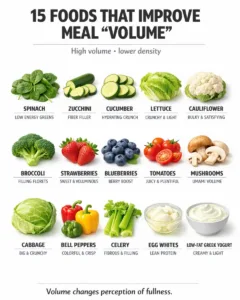
The infographic highlights 15 foods that increase meal volume while keeping calorie density relatively low.
Let’s look at why they work.
What Is “Meal Volume” and Why It Matters
Meal volume refers to the physical size of food relative to its calories.
High-volume foods typically contain:
-
more water
-
more fiber
-
more air or bulk
-
fewer calories per gram
Research on energy density shows that people tend to eat similar food volumes each day, regardless of calorie content.
That means a plate filled with lower-density foods can naturally reduce calorie intake while maintaining satisfaction.
This concept is sometimes called volumetrics eating.
Leafy Greens That Add Volume With Minimal Calories
Spinach
Spinach is extremely low in calories but rich in nutrients such as:
-
vitamin K
-
folate
-
magnesium
Because it contains a high percentage of water, spinach can add significant volume to salads, smoothies, omelets, and grain bowls.
Lettuce
Lettuce is often overlooked nutritionally, but its high water content (over 90%) makes it excellent for creating larger meals without significantly increasing calorie intake.
Using lettuce as a base for meals increases portion size while keeping energy density low.
High-Water Vegetables That Expand Meal Size
Zucchini
Zucchini is often used in:
-
stir-fries
-
roasted vegetable dishes
-
spiralized vegetable noodles
Because zucchini is mostly water and fiber, it can increase meal size while remaining light.
Cucumbers
Cucumbers provide hydration and crunch while contributing very few calories.
They are often used in salads, sandwiches, and grain bowls to increase food volume without adding heaviness.
Bell Peppers
Bell peppers add:
-
fiber
-
vitamin C
-
natural sweetness
Their crisp texture also increases the feeling of fullness during meals.
Celery
Celery contains mostly water and fiber, which makes it one of the lowest-calorie vegetables.
Despite this, its crunchy texture helps slow eating and increase satisfaction.
Vegetables That Provide Fiber and Satiety
Broccoli
Broccoli provides both fiber and plant compounds such as sulforaphane.
Fiber slows digestion and helps extend feelings of fullness after meals.
Cauliflower
Cauliflower is often used as a lower-calorie substitute for:
-
rice
-
mashed potatoes
-
pizza crust
It adds bulk and fiber without significantly increasing calories.
Cabbage
Cabbage is highly versatile and works well in:
-
slaws
-
soups
-
stir-fries
Because it cooks down slowly, it can create very filling meals.
Mushrooms
Mushrooms have a unique advantage.
They contain:
-
high water content
-
natural umami flavor
This makes them excellent replacements for part of the meat in dishes such as pasta sauces or stir-fries while still maintaining richness and volume.
Fruits That Increase Sweet Volume
Strawberries
Strawberries are naturally sweet but relatively low in calories.
They also provide vitamin C and antioxidants, making them a satisfying addition to yogurt bowls or oatmeal.
Blueberries
Blueberries are slightly higher in natural sugars than some fruits but still provide fiber and antioxidants.
Adding berries to meals increases food volume while maintaining balanced energy intake.
Tomatoes
Tomatoes are technically fruits and contain a large amount of water.
They add juiciness and freshness to meals without increasing calorie density significantly.
Protein Sources That Add Volume Without Heavy Calories
Egg Whites
Egg whites provide lean protein with minimal fat.
Protein is one of the most effective nutrients for increasing satiety, which means egg whites can help meals feel more satisfying.
Low-Fat Greek Yogurt
Low-fat Greek yogurt is high in protein while remaining relatively low in calories.
Because protein slows digestion, it can help reduce hunger later in the day.
Greek yogurt also works well as a base for fruit bowls, sauces, and dressings.
Why High-Volume Meals Can Reduce Hunger
High-volume foods work through several mechanisms:
1. Stomach stretch signals
As the stomach fills, stretch receptors send signals to the brain that contribute to feelings of fullness.
2. Fiber slows digestion
Fiber delays gastric emptying, helping food remain in the stomach longer.
3. Water increases physical food size
Water increases the physical size of food without increasing calorie density.
4. Slower eating improves satiety
Bulky foods like vegetables require more chewing, which allows satiety hormones time to activate.
The Real Goal: Larger Plates, Balanced Calories
High-volume foods do not need to replace every ingredient.
Instead, they can expand meals.
For example:
-
add mushrooms to pasta
-
mix zucchini into stir-fries
-
include berries with yogurt
-
fill half the plate with vegetables
These strategies allow meals to remain satisfying without requiring strict portion control.
Final Thought
The stomach often notices size before it notices calories.
By building meals with foods that increase volume—especially vegetables, fruits, and lean proteins—it becomes easier to create satisfying plates without relying on restriction.
Sometimes the simplest strategy is just making the meal bigger in the right way.