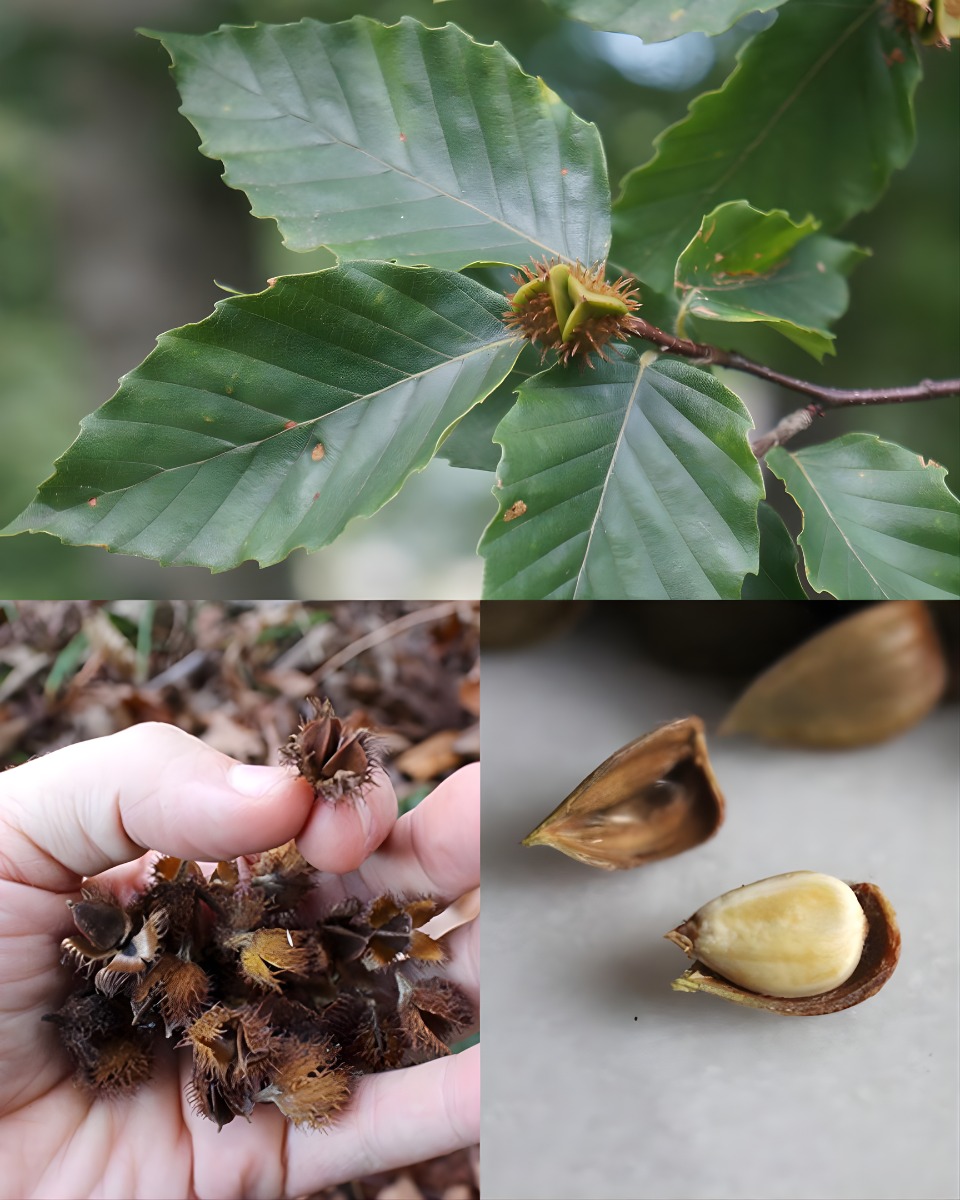
At first glance, this looks like just another forest tree with plain green leaves and prickly seed cases.
But tucked inside those bristly husks are beech nuts, the small triangular seeds of the beech tree. Beech trees produce nuts inside spiny outer cases, and the nuts are edible, though they should be eaten in moderation rather than by the handful. Woodland Trust notes that beech nuts sit in bristly cases and are edible, while also warning that large amounts are not a good idea.
Most people walk past them without realizing they were once a real seasonal woodland food. That is what makes them so interesting. They are not flashy, but they carry a long history of foraging, roasting, and traditional use.
What These Are
These appear to be beech leaves and beech nuts, likely from a beech tree in the Fagus genus. Beech trees are identified by smooth-edged to lightly toothed oval leaves and nuts that develop inside bristly husks. Woodland Trust describes beech fruit as nuts in spiny cases, and National Park Service materials identify beech leaves as oval with serration.
The small pale seed shown outside the opened husk is the edible part people are usually after.
Why People Value Beech Nuts
Beech nuts are one of those old-fashioned wild foods that people appreciate for their rich, slightly sweet, nutty flavor when prepared properly.
Traditionally, people have used them:
As a seasonal foraged food
Beech nuts were once commonly gathered in autumn. Woodland Trust notes that the nuts were historically fed to pigs and were sometimes roasted in France as a coffee substitute. (Woodland Trust)
As a roasted snack
Rather than eating them raw in large amounts, many people prefer them lightly roasted. Roasting improves the taste and makes them feel more like a true nut snack.
As a curiosity for foragers
Foraging guides highlight beech nuts because they are easy to recognize once you know what to look for: a prickly brown case that opens to reveal small triangular nuts.
What Beech Nuts Offer Nutritionally
Like many nuts and seeds, beech nuts are valued mainly for their healthy fats and energy density rather than for being a low-calorie food.
USDA food composition resources are the standard reference for nut nutrition data, and nuts in general are known for providing fat, energy, and trace minerals. USDA’s FoodData Central is the main federal source for food composition information.
That means beech nuts are best thought of as a small, rich wild food, not something to eat in oversized portions.
How to Use Beech Nuts
If properly identified and gathered from a safe area, beech nuts are usually used very simply.
Ingredients
- Freshly gathered beech nuts in their husks
- Clean water for rinsing
Instructions
First, collect only mature nuts that have fallen or are opening naturally.
Remove the nuts from the spiny husks and discard any that look moldy, damaged, or shriveled.
Peel away the thin brown outer skin if desired.
Eat a few raw only if you know they suit you, but many people prefer to lightly roast them for better flavor.
To roast, spread the shelled nuts in a single layer and warm them briefly until fragrant. Let them cool before eating.
They can also be sprinkled in small amounts over porridge, mixed into trail snacks, or used as a woodland garnish.
What the Leaves Tell You
The leaves are useful mainly for identification. Beech leaves are broad, glossy, and strongly veined, which helps distinguish them from some other woodland trees. The real edible focus here is the nut, not the leaf.
That matters because people sometimes confuse interesting-looking tree parts with safe edible parts. In this case, the traditional food use centers on the nuts.
When You’ll Notice the Benefit
Beech nuts are not a remedy in the same way a tea or tonic is. They are more of a wild seasonal food.
So the “benefit” is immediate and practical:
- a rich nutty taste
- a small source of energy
- a more natural, less processed snack
- the satisfaction of using a forgotten woodland food
In other words, this is more about nourishment and traditional foraging than quick relief.
Safety Notes You Should Not Skip
This is the most important part.
Woodland Trust warns that beech nuts can be slightly toxic in large quantities because of compounds such as tannins and alkaloids, so they should be eaten in moderation rather than as a large snack.
A few simple safety rules matter:
Eat small amounts
Treat beech nuts as an occasional wild food, not a bulk nut replacement.
Avoid uncertain identification
Only forage from a tree you can identify confidently as beech.
Choose clean locations
Do not collect nuts from polluted roadsides, contaminated ground, or sprayed areas.
Check for spoilage
Discard any nuts that are moldy, soft, insect-damaged, or smell off.
Use extra caution with children
Because they are small wild nuts with limited modern food-use guidance, they are better handled carefully and in small amounts.
Final Takeaway
Beech nuts are one of those unexpected woodland foods many people never think about. Hidden inside those spiky husks is a small, edible nut with a long history of seasonal foraging and roasting. Woodland Trust describes them as edible nuts from bristly cases, while also cautioning against eating large quantities.
That balance is the real story. They are interesting, traditional, and surprisingly useful, but they are best enjoyed with respect, correct identification, and moderation.