PART 1: THE DOG WHO HELD A BROKEN FAMILY TOGETHER
The first thing Bracken did after Emily died was sleep outside Lily’s bedroom.
He had never done that before. For ten years, he had slept wherever he pleased: beside the old radiator in the kitchen when winter came hard against the windows, under the table when Emily baked bread, or with his chin on my slipper while I worked late and pretended I was not waiting for my wife to call me upstairs. But after the funeral, when the house still smelled faintly of lilies and rain-damp coats, Bracken dragged his heavy old body to the top of the stairs and lay down across Lily’s doorway like a folded rug no one was allowed to move.
Lily was three then, too young to understand death as anything more than absence wearing the wrong shoes. She kept asking when Mummy would come back from the hospital. At breakfast, she left half her toast untouched because Emily always cut it into triangles, and I cut it into rectangles without thinking. At night, she woke crying for a voice that was no longer in the house, and before I could reach her, Bracken would already be there, nosing the door open, tail thumping once against the frame.
He did not fix anything. That is what people who have not lost someone imagine comfort does. They think it repairs the hole. Bracken only sat in the hole with us. He let Lily knot her fingers into his greying fur. He let her press her wet face into his neck until his coat smelled of baby shampoo and tears. He let me sit on the floor beside them, one hand on my daughter’s back and the other on the dog’s ribs, feeling the slow, steady proof that something in our home was still breathing.
In the months after Emily’s death, I became the sort of man who forgot milk but remembered mortgage dates, who could answer emails at midnight and then stand in the pantry unable to remember why I had opened the door. I worked from home some days and from the office others, always with the guilt of whichever place I was not in. Lily learned the sound of my laptop closing and would appear in the doorway clutching her stuffed rabbit, asking if I was finished being busy. Most days, the honest answer was no. Most days, I lied and said yes.
Bracken filled the spaces I could not. When Lily refused to nap, he lay beside her little bed until she stopped whispering to herself. When she threw a tantrum because I washed Emily’s blue scarf and it no longer smelled right, he went to the laundry basket, tugged the scarf out with his teeth, and carried it to her as if he had understood the entire argument. When I watched old videos of Emily after Lily went to sleep, Bracken would come and sit beside the sofa, not looking at the screen, only looking at me.
There was one video I watched too often. Emily in the garden, laughing because Bracken had stolen one of Lily’s socks from the washing line. Lily was toddling after him on unsteady legs, shrieking with delight, while Emily called, “Bracken, you old thief, bring that back.” The camera shook because I was laughing too. Sometimes I paused on Emily’s face and stared until the image blurred, as if my eyes could pull her out of the pixels if I was desperate enough.
The summer Lily nearly fell into the neighbor’s pool, Bracken became more than a family dog to everyone around us. We were at the Hendersons’ barbecue, one of those long Edinburgh evenings when the light refuses to leave and adults convince themselves children are safe because there are many of us nearby. Lily had wandered toward the low gate at the side of the garden. I was reaching for a plate. Someone laughed loudly behind me. Then Bracken barked, sharp and furious, the kind of bark I had never heard from him.
By the time I turned, he had thrown himself between Lily and the open pool gate, knocking her backward onto the grass. She cried from fright, not pain. The adults rushed over, everyone talking at once, and Bracken stood trembling with his body pressed against the gate. Later, when I held Lily in the kitchen and tried not to shake, she fed Bracken bits of sausage from her plate. “Good boy,” she said solemnly, patting his nose. “My Brack.”
From then on, nobody questioned his place in our family. He was old, yes. His muzzle had gone white. His hips clicked when he stood too quickly. He snored like an unreliable engine. But if Lily was in the garden, Bracken was at the gate. If Lily was in the bath, Bracken was outside the bathroom. If Lily was sick, Bracken refused to eat unless his bowl was carried upstairs and placed near her door.
That was the version of Bracken I knew when Clara Whitmore came into our lives.
I hired Clara because I was tired in a way sleep did not touch. Lily had started nursery, and I had returned to the office more often because my manager had been kind for as long as kindness was convenient. My mother lived two hours away and had arthritis in both knees. Friends offered help with the bright panic of people who hoped you would not actually ask. I needed someone reliable. I needed someone gentle. I needed, though I would not have admitted it then, someone to stand between me and the feeling that I was failing my daughter every single day.
Clara arrived on a wet Tuesday morning with a navy coat, sensible shoes, and a folder of references in a clear plastic sleeve. She was in her early forties, with soft brown hair pinned at the nape of her neck and a voice that made every sentence sound considered. She crouched when she greeted Lily, but not too close. She offered her hand and waited. Lily hid behind my leg for almost a minute before touching Clara’s fingers.
“That’s all right,” Clara said. “We don’t rush brave things.”
I remember liking that. I remember thinking Emily would have liked that.
Her references were excellent. Two families in Stockbridge, one in Morningside, glowing words about patience and structure and emotional development. She had worked with children after bereavement. She knew about night terrors, food refusal, attachment objects, the importance of routine. She did not flinch when Lily ignored her. She did not look offended when Bracken stood between them with his head lowered, watching.
“And this must be Bracken,” she said, smiling without showing her teeth. “I’ve heard about you.”
“He’s protective,” I said.
“Of course he is.” Clara kept her hands folded. “They know, don’t they? Dogs always know when the house has changed.”
It was exactly the kind of thing people said to me when they wanted to be kind, but from Clara it landed with unusual precision. She seemed to understand the house without asking for a tour. She noticed the shoes by the door, the half-finished sticker book on the table, the framed photo of Emily on the mantel. She did not say too much about my wife. She only paused for a respectful second and moved on.
In the beginning, Clara made life easier. She labeled Lily’s snack boxes. She established a bedtime routine that involved lavender bath foam and two stories, no negotiation. She persuaded Lily to eat peas by calling them tiny green moons. She washed dishes without being asked and folded laundry with the patient accuracy of someone who believed folded things stayed under control.
The neighbors loved her almost immediately. Mrs. Henderson told me over the hedge that I was lucky. “Some people have a gift,” she said, watching Clara walk Lily home from the park, Lily’s hand small inside Clara’s gloved one. “And after all you’ve been through, Arthur, you deserve a bit of help.”
I wanted to deserve it. That was the trouble. I wanted relief so badly that I mistook its arrival for proof of goodness.
Bracken did not warm to Clara. At first, I found it embarrassing. He had always been polite with strangers after a cautious sniff, but with Clara he remained distant. If she entered the kitchen, he lifted his head. If she walked toward the stairs, he followed. Once, when she went into Emily’s old sewing room to fetch a fallen hair clip Lily had supposedly left there, Bracken stood in the hallway and growled low enough that I felt it in my feet.
“Bracken,” I warned.
Clara stepped back with both palms raised. “It’s all right. He’s confused. This room must still feel like hers to him.”
The sewing room had not changed much since Emily died. Her machine sat beneath the window under a dust cover. A tin of buttons rested on the shelf. Her blue scarf, the one Bracken had once rescued from the laundry, hung over the chair because Lily liked to know where it was. I rarely went in. The room smelled of lavender sachets and old cotton, and I hated how peaceful it looked without her.
After that, Clara avoided the room when I was nearby. At least I thought she did.
Small things began to shift. Lily’s nightmares returned, not every night, but often enough that I started leaving my bedroom door open. She stopped wanting the door closed at bedtime, though Clara said closed doors helped children feel contained. Bracken scratched twice at Lily’s door one evening after Clara had put her down, leaving pale marks in the paint. Clara came downstairs looking tired but composed.
“He’s disrupting her sleep,” she said. “I know he means well, but she was nearly settled.”
“He usually calms her.”
“Usually, perhaps.” Clara rinsed a mug in the sink. The kitchen smelled of chamomile tea and the lemon soap she preferred. “But grief changes patterns. Sometimes animals hold children in the anxious stage because they respond to every noise. Lily may be learning that distress brings him.”
It sounded reasonable. Clara was very good at sounding reasonable. She never said Bracken was a problem outright, not then. She only placed concern on the table like a clean napkin and let me decide to pick it up.
One night, I came home late from a client dinner and found Clara standing outside Lily’s room with one finger to her lips. “She’s just gone down,” she whispered. “Rough evening.”
From inside the room came a small hiccupping breath. Bracken stood beside the door, rigid, his old paws planted wide.
“What happened?” I whispered.
“Missing her mum.” Clara’s face softened. “It comes in waves. I told her Mummy would want her to be brave.”
Something in me tightened, but I was too tired to name it. Emily had hated that word when Lily cried. Brave, she used to say, is not the rent children owe adults. But Clara looked so sad for us that I swallowed the objection.
Later, after Clara left, Lily woke and crawled into my bed. Her hair smelled of lavender foam. She put her cold toes against my leg and whispered, “Bracken stay?”
“He’s right outside,” I said.
“No shut.”
“No shut what, sweetheart?”
But she had already tucked her face into my shirt. In the hallway, Bracken sighed heavily and lowered himself against the bedroom door.
PART 2: THE BITE CAUGHT ON CAMERA
The day Clara was bitten began with ordinary rain.
Not dramatic rain, not storm rain, just the steady grey Edinburgh kind that makes windows look tired. I remember because Lily refused her yellow jumper and wanted the red one with the loose cuff. I remember because Bracken would not eat his breakfast, only sniffed the bowl and went to the foot of the stairs. Clara arrived at eight-thirty with damp hair at her temples and a paper bag of warm croissants.
“For morale,” she said, placing them on the counter.
I had a presentation at ten and a headache behind my right eye. Lily was clingy, wrapping both arms around my knee while I tried to find my keys. Clara crouched and offered a choice between painting and building a tower. Lily shook her head. Bracken stood so close to my leg that I nearly tripped over him.
“Everyone’s a bit unsettled today,” Clara said gently. “Go. We’ll find our rhythm.”
I went.
The call came at 11:17.
At first, all I heard was Lily crying in the background and Clara breathing hard. Then Clara said my name in a voice I did not recognize.
“Arthur, I need you to come home. Bracken bit me.”
I drove too fast. The whole way, my mind refused to form a complete picture. Bracken had snapped once at a terrier that rushed Lily’s pram years before, but he had never bitten a person. He had taken biscuits from Lily’s fist with ridiculous care. He had let toddlers at barbecues pat him with jam-covered hands. By the time I pulled into the driveway, an ambulance was already there, and Mrs. Henderson stood on the pavement in slippers, one hand pressed to her mouth.
Inside, the living room smelled of antiseptic and wet wool. Clara sat on the sofa, pale, her sleeve rolled up, a bandage wrapped around her forearm. Lily was in the corner by the bookcase, clutching Emily’s blue scarf. Bracken had been shut in the kitchen. He was barking, not wildly, but in repeated deep bursts that made the cabinet handles tremble.
“What happened?” I asked.
Clara looked at Lily before answering. “I was carrying her downstairs. She was upset. Bracken came out of nowhere.”
“He bit you while you were holding Lily?”
“I turned so he wouldn’t reach her.” Clara’s eyes filled. She seemed ashamed of crying, which made the tears more convincing. “I think he was aiming for her, Arthur.”
“No,” I said, because my body rejected the sentence before my mind could examine it.
Mrs. Henderson touched my arm. “I saw the end through the window. He lunged. Poor Clara screamed.”
The paramedic asked Clara questions. The police came because there was a child present and an animal attack. Someone called animal control. Everything happened with the brisk rhythm of procedure, and I moved through it like a man underwater.
Then the officer asked about cameras.
I had installed two after Emily died, not because of any specific fear, but because grief had turned me into someone who checked locks three times. One camera covered the front door. One sat high in the living room, angled toward the stairs and the sofa. I opened the app with shaking hands.
The footage was short and damning.
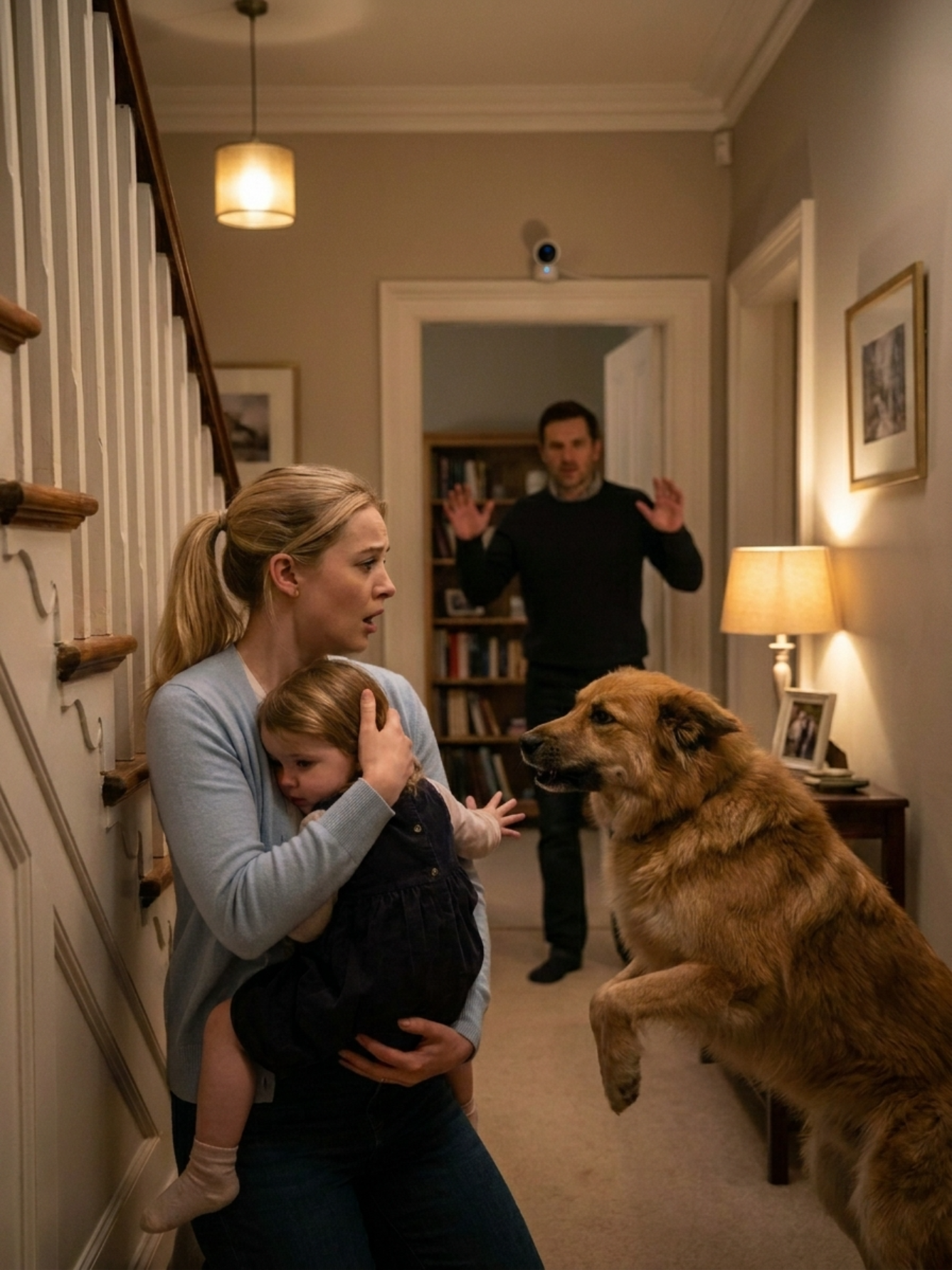
Clara appeared at the top of the stairs carrying Lily on her hip. Lily’s face was turned inward, hidden against Clara’s shoulder. Clara descended carefully. When she reached the bottom, Bracken came from the hallway in a rush. His mouth opened. Clara twisted away. He clamped onto her forearm. Clara screamed. Lily slipped down, crying. The video had no sound, but the violence did not need it.
I watched it once. Then again. The second time hurt worse because I knew what was coming.
Clara did not accuse loudly. She did not demand punishment. She only sat with her bandaged arm and said, “I should have told you sooner that his behavior had changed.”
“What behavior?” the officer asked.
She hesitated, as if reluctant to betray him. “Growling. Blocking doorways. Barking at night. He frightened Lily a few times, but I thought perhaps I could manage it. Arthur loves him. Lily loves him. I didn’t want to add to their losses.”
Mrs. Henderson nodded. “We’ve heard barking at odd hours.”
“He’s old,” Clara added quietly. “Sometimes older dogs become unpredictable when they’re in pain.”
I hated her for saying it. Then I hated myself because she might be right.
A veterinary behavior consultant came that afternoon. Bracken had been taken to a temporary holding kennel by then, dragged away on a lead while he looked back at me with bewildered brown eyes. Lily screamed until she made herself cough. I stood on the front path and did nothing. I told myself I was protecting my daughter. I told myself fathers did hard things. I told myself the video was clear.
The consultant was kind, which made it worse. He explained cognitive decline, pain aggression, territorial guarding. He asked about changes in routine, bereavement, stress in the home. He did not say Bracken should be destroyed, not directly. He said assessment. He said risk. He said child safety. Words with clean edges.
That evening, Lily sat under the kitchen table with Emily’s scarf wrapped around her shoulders. She had not eaten since breakfast. When I knelt beside her, she pressed herself into the corner.
“Sweetheart,” I said, keeping my voice soft, “can you tell me what happened?”
Her lower lip trembled. “Bracken not bad.”
“I know you love him.”
“Not first.”
“What do you mean?”
She looked toward the hallway, then toward the stairs. Clara had gone to urgent care for stitches. The house was quiet except for the hum of the fridge and rain ticking against the back door.
“Bracken didn’t bite first,” Lily whispered.
I leaned closer. “Who did?”
She shook her head hard enough that the scarf slipped off one shoulder. “No shut. No tell.”
I should have listened then. That is the sentence I have carried longer than any other. I should have stopped everything, sat on that cold tile floor, and let the whole world wait until my daughter found her words. But trauma in a child is a confusing thing, and fear in a parent is worse. I had a video. I had a bleeding woman. I had neighbors and professionals and forms. I had the memory of almost losing Lily by a pool. I had the old wound of not saving Emily, and it spoke louder than my daughter’s broken sentence.
So I said, “You’re safe now.”
Lily looked at me as if I had failed a test she had not known how to give.
PART 3: THE HOUSE WITHOUT ITS GUARDIAN
Without Bracken, the house changed shape.
It was not only the silence, though the silence was awful. No nails clicking on the floorboards. No heavy sigh from the landing. No bark when the post came. No warm body blocking the draft beneath Lily’s door. The rooms seemed larger and less inhabited, as if furniture had moved an inch away from everything else.
Clara returned two days later with her arm in a sling and a brave smile. I told her she did not have to come back so soon. She said Lily needed consistency. Mrs. Henderson brought soup and praised Clara’s dedication. Even my mother, over the phone, said, “She sounds like a godsend, Arthur. Don’t let guilt about the dog cloud your judgment.”
The dog. People had started saying it like that. Not Bracken. The dog that bit. The dog that might be dangerous. The dog that had to be assessed.
Lily stopped asking questions in front of Clara. That was the first thing I noticed and then dismissed and then noticed again. When Clara entered a room, Lily’s face did not crumple or brighten. It emptied. She became obedient in a stiff, careful way. She ate when Clara told her to eat but left food packed in her cheeks until I reminded her to chew. She let Clara brush her hair though she had always hated anyone touching the tender spot behind her ear.
“She’s subdued because of the attack,” Clara explained. “Children often attach complicated feelings to animals that hurt them. Love and fear can sit together.”
“But she doesn’t seem afraid of Bracken.”
Clara gave me a patient look. “She’s four. She may not have integrated the event yet.”
I did not know enough to argue. Clara always seemed to have the proper words.
At night, Lily woke crying without sound. That was worse than screaming. I would find her sitting upright in bed, mouth open, eyes wide, hands twisted in the blanket. If I said Bracken’s name, she reached for me. If I played an old video of him snoring, her shoulders lowered. Once, out of desperation, I found a recording on my phone of Bracken barking at fireworks from the previous New Year. Lily listened to it with Emily’s scarf under her chin and fell asleep in less than three minutes.
The next morning I mentioned it to Clara.
Her mouth tightened only briefly. “I’d be careful reinforcing that attachment.”
“She slept.”
“For now.” Clara poured milk into Lily’s cereal, though Lily had not asked for milk. “But if the goal is to help her feel safe without him, using his bark as a comfort object may slow healing.”
Lily stared into the bowl. The cereal softened and sank.
That afternoon, I visited Bracken at the kennel.
The place sat beyond a row of industrial units on the edge of the city, all chain-link fencing and concrete, smelling of disinfectant, damp bedding, and anxious animals. Bracken was in the assessment block. When he saw me, his entire body changed. His ears lifted. His tail struck the plastic bed behind him. Then he tried to stand too quickly and his back legs slipped.
“Easy, old man,” I said, crouching by the gate.
He pressed his nose through the wire. I put my fingers against it and felt his breath, warm and familiar. There was a shaved patch on his leg where the vet had taken blood. His eyes looked tired but clear.
A kennel worker named Moira stood beside me with a clipboard. “He’s reactive to certain triggers,” she said. “Not all. He’s gentle with staff once settled. Food manners are good. No resource guarding we’ve seen.”
“What triggers?”
“Raised voices. Sudden movement near doorways. And…” She checked her notes. “A woman came yesterday to provide a statement. The injured party.”
“Clara came here?”
“Said she wanted to help us understand his recent behavior.” Moira’s face was professional, but something in her tone shifted. “He reacted strongly before she entered the block. Barking, lunging at the kennel front. Took a while to settle.”
Shame rose in me because my first thought was not poor Clara. It was, why did she come?
I called Clara from the car park. She answered on the third ring, her voice low. Lily was napping, she said.
“Moira told me you went to see Bracken.”
A pause. “I went to speak with them, yes.”
“Why?”
“To make sure they had context. Arthur, I know this is painful, but if he comes back without proper assessment and something happens to Lily…”
“You didn’t need to see him.”
“I didn’t go to see him.” Her voice softened. “I went because I care about your daughter.”
In the background, faintly, I heard a door close.
I do not know why that sound stayed with me. Doors close in houses all the time. Wind pulls them. Children push them. Adults close them because rooms are messy or private or cold. But that click on the phone made Bracken’s old scratches on Lily’s door appear in my mind, two pale lines at the height of his paws.
When I got home, Lily was awake and sitting on the sofa with Clara beside her. Clara was reading a book about a rabbit who learned to sleep alone. Lily’s hands were folded in her lap. The room smelled of the vanilla candle Clara had started lighting in the afternoons, covering the older scents of our house.
“Daddy,” Lily said, and then stopped.
Clara closed the book. “Someone’s been very brave today.”
There was that word again.
PART 4: THE SIGNS BRACKEN LEFT BEHIND
That night, after Clara left, I sat on the floor outside Lily’s bedroom and looked at the scratches in the paint. There were more than two. Some were older, faint beneath the newer ones. They were not random. They were all beside the latch, as if Bracken had been trying to open the door.
I pulled out my phone and began checking camera clips.
The living room camera kept motion-triggered recordings for thirty days. I had rarely looked at them unless a delivery went missing. Now I scrolled through timestamps with a tightness behind my ribs. Bracken crossing the room at 2:13 a.m. Bracken standing at the foot of the stairs at 2:19. Bracken barking toward the landing at 2:22. Clara descending the stairs at 2:24 on nights she had stayed late. Clara smoothing her hair as she came down. Clara pausing at the bottom step, looking toward the camera, then away.
None of it proved anything. That was the maddening part. A tired caregiver checking on a child. A grieving dog restless at night. A father looking for patterns because he could not bear the simpler truth.
Then I found a clip from the week before the bite.
Clara came downstairs from the direction of the bedrooms carrying Emily’s blue scarf. She folded it and placed it on the back of the sofa. A moment later, Lily appeared at the top of the stairs in her nightdress, crying silently. Bracken rushed past Clara and up the steps toward Lily. Clara turned, and for the first time on camera, her face changed. Not fear. Irritation. Hard and quick, gone almost before I could believe it.
I watched that three-second expression six times.
The next morning I called in sick. Clara arrived at eight-thirty, surprised to find me in jeans instead of a suit.
“Everything all right?” she asked.
“I thought I’d spend the day with Lily.”
A flicker crossed her face, too small to name. “Of course. That will be nice.”
Lily was at the kitchen table pushing toast crumbs into a line. When I said we might go to the park, she looked at Clara before answering me.
That look broke something open.
After breakfast, Clara suggested organizing Lily’s drawers while I took her out. I said no, we would all stay in. The rain had returned. The house smelled of toast, wet pavement through the open window, and the faint medicinal cream Clara used on her bite.
By noon, the politeness between us had become a thin sheet of ice.
“Arthur,” Clara said while Lily colored at the table, “may I speak plainly?”
“Please.”
“You are searching for reasons to undo a painful reality. That is understandable. Bracken connects you to Emily. Losing him feels like losing her again.”
I stood by the sink, rinsing a cup that was already clean. “This isn’t about Emily.”
“Isn’t it?” Her voice was gentle enough that I wanted to knock something over. “You installed cameras after she died. You kept her room untouched. You let a dog sleep outside your child’s door because it comforted you. Now that dog has hurt someone, and instead of helping Lily process it, you’re investigating shadows.”
Lily’s crayon stopped moving.
I turned off the tap. “Don’t discuss this in front of her.”
“I’m trying to protect her from being asked to carry adult grief.”
There it was, her gift: making any resistance sound like damage.
That afternoon, I found the baby monitor in a box in the cupboard under the stairs.
It was old, bought when Lily was an infant and Emily still labeled cables with bits of masking tape. We had stopped using it when Lily moved to a bed. I do not know what made me look for it except memory: Emily using it one afternoon while sewing, the receiver clipped to her waistband as Lily napped. The monitor had a recording function that saved short audio clips when it detected sound. I had forgotten that entirely.
The receiver was dead. I charged it behind a stack of cookbooks so Clara would not see.
For two hours, nothing happened. Clara made soup. Lily refused it. I pretended to answer emails while watching the little battery icon fill. When Clara took Lily upstairs for a rest, Bracken’s absence felt so loud that I nearly called the kennel then and there just to hear whether he was sleeping.
At three-forty, the monitor screen lit.
The audio crackled. At first, I heard only rustling, then Lily’s small voice.
“No.”
Clara answered, but not in the voice she used downstairs. It was flatter. Sharper. “We talked about this.”
“No shut.”
“You want Daddy to send Bracken away forever?”
A sound like a sob pressed into fabric.
“Then you stop saying silly things.” Clara’s voice dropped lower. “Bracken hurt me because he is bad now. If you confuse Daddy, he’ll be angry. Do you want Daddy angry too?”
My hand closed so hard around the receiver that the plastic creaked.
There was a thump, not loud, perhaps a drawer or a toy box. Lily cried once. Clara hissed, “Quiet. Do you want him to hear?”
Then Bracken barked in the recording. Not from that day, I realized, because Bracken was gone. This was an old clip, saved from before the bite. His bark crashed through the tiny speaker, furious and close. Lily cried harder. Clara said something I could not make out. The clip ended.
I stood in the kitchen with the dead quiet after it, tasting metal.
It still was not enough. That seems impossible when I say it now, but at the time I could hear every objection before anyone made it. The audio was old. The context was unclear. Clara would say she was managing a tantrum, using unfortunate words under stress. People had excused worse when they wanted the world to remain tidy.
I needed more. Bracken needed more. Lily needed me to be better than almost convinced.
PART 5: THE PERFECT NANNY BEGINS TO CRACK
Clara came downstairs twenty minutes later and found me sitting at the table. “She’s sleeping,” she said.
“No, she isn’t.”
Her eyes moved to my hand. I had left the receiver on the table between us.
For a second, neither of us spoke. The refrigerator hummed. Rain tapped at the window. Somewhere upstairs, a floorboard creaked beneath a small foot.
Clara’s face did not collapse. That was what frightened me. She looked at the monitor, then at me, and recalculated.
“Recording people without consent is a serious matter,” she said.
“It recorded my daughter in my house.”
“Your daughter having a difficult moment after a traumatic incident.”
“You threatened her.”
“I used language I regret to keep her from spiraling.” Clara placed both hands on the back of a chair. The bandage on her forearm was smaller now, two neat strips beneath the cuff. “You have no idea what it is like to manage a child in that state while the father hovers between denial and grief.”
I almost laughed. Not because it was funny, but because her confidence was so complete it seemed to belong to another species of person.
“Why were you in Emily’s room?” I asked.
Her fingers tightened. “What?”
“The sewing room. Bracken growled when you went in. The camera shows you coming from there more than once. Why?”
“Lily leaves things everywhere.”
“The scarf was in there.”
“Yes. Her mother’s scarf. Which she uses as a crutch because nobody in this house has helped her move forward.”
“You don’t get to talk about Emily.”
That was the first time Clara’s mask cracked enough for anger to show. Her mouth thinned. “Emily is everywhere here. In the rooms, in the routines, in that dog, in your inability to see your living child clearly.”
I stared at her. “You knew a lot about us before you came.”
“I researched an employer. That is not a crime.”
“How much?”
She looked away, and that was answer enough to make my skin go cold.
Later, after she left early with a claim of feeling unwell, I searched her name properly. Not the quick checks I had done before hiring her. Deeper. Old employment records. Local forums. Archived charity pages. It took hours, and none of it unfolded neatly. Real life rarely gives evidence in a clean line. But by midnight, I found a photograph from six years earlier: Emily at a community fundraiser, smiling beside a younger Clara Whitmore.
The caption named Clara as a volunteer coordinator. Emily had done legal aid work for the charity before Lily was born. I remembered the cases only vaguely: housing disputes, benefits appeals, one complaint involving misused donations and a staff member dismissed quietly. Emily had been upset for weeks. She had refused to gossip, but she had said once, while washing dishes, “Some people don’t steal money because they need it. They steal because they can’t stand not being important.”
I searched Clara again with the charity name.
There was no criminal case. No dramatic headline. Only minutes from a board meeting, a resignation, a later post from Clara about being “pushed out by privileged women who confuse suspicion with justice.” Emily’s name did not appear, but I knew. Clara had not entered our house by chance. She had studied my grief, my daughter, my dog, and the dead woman she blamed.
The next day, Clara tried to hurry Bracken’s end.
She arrived with printed information about behavioral euthanasia. She did not call it that at first. She called it “humane decision-making” and “preventing further trauma.” She placed the papers on the kitchen table while Lily sat within earshot, eating dry cereal from a plastic cup.
“I spoke to a specialist,” Clara said. “Given the severity of the bite and Lily’s age, they feel delay may prolong everyone’s distress.”
“You spoke to a specialist about my dog?”
“Our situation affects my safety too.”
“Our situation?”
She inhaled slowly, a practiced breath. “Arthur, I cannot continue working here if Bracken might return. More importantly, I cannot in good conscience support Lily’s recovery while you hold open the possibility of bringing back the animal who attacked in front of her.”
Lily’s cup tipped. Cereal scattered across the table like tiny brown beads. Clara reached to clean it. Lily flinched so hard her elbow hit the chair.
I saw it. Clara saw me see it.
“Lily,” Clara said softly.
My daughter slid off the chair and ran to me. Not to the corner. Not to the scarf. To me. She wrapped both arms around my leg, shaking.
I put my hand on her hair. “It’s all right.”
Clara stood very still. “This is what I mean. She is dysregulated.”
“No,” I said. “She’s scared of you.”
The silence after that sentence was enormous.
Clara’s eyes filled with tears so quickly that for one dizzy second I doubted myself again. “How can you say that?”
“Because I finally watched what happens before she cries.”
She pressed her bandaged arm to her chest. “After everything I’ve done for this family.”
“Tell me about the charity.”
The tears stopped.
It was not a confession. I never got one of those, not the kind stories promise. Clara did not slump into a chair and admit she had come to punish Emily through us. She did not explain every cruelty in a tidy speech. She only said, “You don’t know what your wife did,” in a voice so cold that Lily hid her face against my thigh.
That was enough to call the police.
It was not enough for them to arrest her that minute. Of course it was not. There were procedures, questions, cautious expressions. Clara became the injured caregiver again. She told the officers I was unstable, that I had become fixated on clearing Bracken, that I was exposing Lily to repeated questioning. She showed them her scar. She cried at the correct moments. If all I had possessed was anger, she might have won.
But I had begun building the chain.
I gave them the monitor recording. I gave them the camera clips from nights Clara came downstairs after Bracken barked. I gave them the footage of Lily crying at the top of the stairs and Clara’s expression before she saw the camera. I gave them dates from the kennel, including Clara’s visit and Bracken’s reaction. I gave them the charity connection. I gave them screenshots showing Clara had followed Emily’s memorial page years before applying to work for me. I gave them the specialist documents she had printed before Bracken’s assessment had concluded.
Moira from the kennel agreed to speak to them. So did the veterinary consultant, who had begun to question whether Bracken’s behavior was targeted rather than generally aggressive. Mrs. Henderson, embarrassed and defensive at first, admitted she had only seen the final seconds through the window. The camera from outside showed Clara had told one lie clearly: she claimed Bracken had been agitated in the garden earlier that morning, but he had not left the house.
Then came the bite analysis.
I had not known such things mattered, but the consultant did. Clara said Bracken had leapt toward Lily and she blocked him with her arm. Yet the puncture marks were on the outside of her forearm at an angle consistent with her arm being extended downward or forward, not wrapped protectively around a child. On the video, just before Bracken lunged, Clara’s right shoulder dipped out of frame. The camera could not show her hand. Lily’s face was hidden. It proved nothing alone. With everything else, it became part of the same ugly shape.
Lily gave her truth in pieces.
A child psychologist interviewed her with soft toys and paper cups and no pressure to perform adult certainty. I sat outside the room with my hands clasped so tightly my knuckles hurt. Through the door I heard murmurs, a chair scrape, Lily’s small voice rising once and then fading.
Afterward, the psychologist told me gently that Lily had described being shut in Emily’s room when she cried. Clara told her Mummy’s things would go away if she was bad. Clara pinched her arm once hard enough to leave a mark, then said Bracken would be blamed if Lily told lies because everyone already knew he was naughty. Clara had been carrying Lily downstairs that day after taking the blue scarf from her. Lily had reached for it. Clara had gripped her wrist. Bracken had lunged when Lily made a sound.
“Bracken not first,” Lily had said again, this time to someone who knew how to listen.
PART 6: BRACKEN DID NOT NEED WORDS TO BE BELIEVED
The decision about Bracken was scheduled for Friday morning.
I barely slept Thursday night. Lily slept in my bed with Emily’s scarf in one hand and my sleeve in the other. The house smelled stale, as if fear had soaked into the curtains. I lay awake watching the pale line beneath the door, half expecting to hear Bracken’s breathing there and then remembering, again and again, that he was in a kennel because I had let them take him.
At eight, I drove to the assessment center with a folder on the passenger seat and Lily’s empty booster seat in the back. My mother stayed with Lily. She had cried when I played her the recording. Not delicate tears. Hard ones. “I told you to trust that woman,” she said, and then covered her mouth as if the words tasted bad.
The meeting took place in a small office that smelled of coffee and printer toner. Moira was there. The consultant was there. A council officer joined by video. Clara had submitted a written statement through a solicitor, claiming harassment and emotional instability on my part. Her words were polished, sorrowful, and full of concern for Lily.
I listened until I could not.
Then I told them about the first night after Emily died. About Bracken sleeping outside Lily’s door. About the pool gate. About the scarf. I did not make him a saint. I told them he was old, stubborn, arthritic, fond of stealing toast, and once ate half a packet of crayons. I told them he had bitten Clara. I did not deny the wound. I asked them to look at why.
“He wasn’t guarding territory,” I said. “He was guarding a child. Every behavior that looked like aggression happened when Clara isolated Lily or entered Emily’s room. Every bark had a time. Every scratch had a door behind it. He couldn’t tell us what he saw, so he did the only things he had.”
My voice broke on the last sentence. I hated that, but nobody looked away.
The council officer asked careful questions. The consultant answered with equal care. Targeted defensive aggression, he called it. Context-specific. Serious but explainable. Manageable with restrictions and monitoring, especially now that the trigger had been removed. Moira added that Bracken had shown no aggression toward staff, children passing outside, or other visitors once Clara was not present.
It took forty-three minutes.
At the end, the officer said Bracken would not be destroyed.
For a moment, I did not understand the words. They seemed too small for what they carried. Then Moira touched my arm and said, “Go get your dog.”
Bracken came out slowly.
He looked older than he had two weeks before. His coat had dulled. His hips were stiff. There was a tiredness around his eyes that made guilt rise in me so sharply I had to crouch. He saw me and stopped. For one terrible second, I thought he would not come.
Then his tail moved.
Not much. One sweep. Then another. He walked to me and pressed his head into my chest with the full weight of his old body. I put both arms around him and said his name into his fur. He smelled of kennel soap and damp blankets, not home. I apologized there, on the concrete floor, while Moira pretended to check paperwork.
“I’m sorry,” I said. “I’m so sorry, old man. I should have known.”
Bracken only breathed against me.
When I brought him home, Lily was waiting in the hallway with my mother behind her. She had refused to put on shoes. Her hair was unbrushed on one side. Emily’s scarf trailed from her hand like a piece of sky.
Bracken stepped through the door and froze.
Lily made a sound I had not heard from her since before the bite. Not a word, not quite a laugh. She ran to him, and I almost stopped her out of habit, out of fear, out of the leftover poison of all those warnings. But Bracken lowered himself before she reached him. He made himself small. Lily dropped to her knees and wrapped her arms around his neck.
“My Brack,” she whispered.
He closed his eyes.
That evening, Lily ate scrambled eggs sitting on the kitchen floor beside him. It was not a proper dinner. Emily would have raised an eyebrow at me and then quietly handed Lily a fork. Bracken rested his chin on Lily’s knee and did not beg, though a piece of egg fell inches from his nose. Lily picked it up and held it out.
“Gentle,” she told him.
He took it as if it were glass.
The consequences for Clara unfolded slowly, which is to say they unfolded like real consequences, not the satisfying thunderclap I sometimes wanted. There was an investigation. Her previous employment was reviewed. Other families were contacted. One mother remembered a child becoming frightened of closed doors. Another recalled a missing locket that had belonged to a dead grandmother, found later in a box Clara had packed. None of it was simple. People had to admit they had been fooled, and people hate doing that.
Clara was charged months later with child cruelty and harassment-related offenses. The charity history did not become the center of the case, but it explained enough. She had blamed Emily for the collapse of the life she believed she deserved. After Emily died, Clara found us through an old memorial post and waited until grief made me publicly grateful for help. She did not come into our home swinging a hammer. She came with references, soup recipes, child-development language, and the patience to turn our safest presence into the threat.
I saw her once outside the court building. She wore a grey coat and no expression. For a second, I expected to feel triumph. Instead, I felt tired. She looked smaller without our belief around her, but not sorry. When she noticed me, her eyes moved past my shoulder, searching perhaps for Lily, perhaps for any sign she still had power over what I protected.
I gave her none.
Lily’s healing did not arrive all at once. She still disliked closed doors. She still woke some nights and asked whether the scarf was safe. She sometimes became quiet when women with soft voices crouched too close in shops. But she began to laugh again. She returned to nursery part-time. She drew pictures of our house with three figures in the doorway: Daddy, Lily, Bracken. Sometimes she added Mummy in the window, which hurt and comforted me in equal measure.
Bracken recovered in the ways old dogs recover, incompletely and with dignity. He slept more. His back legs trembled on cold mornings. He barked less, but when he did, I listened. We put a bed in Lily’s room and another outside her door because he liked choices. The scratches in the paint remained for a long time. I could have sanded them, repainted, made the door smooth again. I did not. They were ugly, yes, but they were also a record of someone trying to get in when I had not understood why.
One Sunday, months after Clara’s arrest, I finally opened Emily’s sewing room properly.
Dust lifted in the pale afternoon light. The room smelled of cotton, lavender, and the faint dry scent of old paper. Lily stood beside me with Bracken leaning against her legs. We did not go in like mourners. We went in with a cardboard box, a cloth, and no plan beyond beginning.
Lily touched the sewing machine. “Mummy made my curtains?”
“She did.”
“And my red dress?”
“With the crooked pocket,” I said.
Lily smiled. “I liked that pocket.”
Bracken nosed beneath the chair and emerged with something in his mouth. For one mad second, I thought he had found another clue, another hidden piece of our pain. But it was only a sock. One of Lily’s tiny old socks, blue with white stars, probably trapped there for years. He carried it to us with solemn pride, as if returning treasure.
Lily laughed so hard she hiccupped.
I sat on the floor because my knees had gone weak. The sound filled the room Emily had left behind. It did not erase anything. It did not make justice perfect or grief tidy. It was only a child laughing at an old dog with a dusty sock in his mouth.
But for the first time in a long while, the house knew what to do with that sound. It held it.
That night, Lily fell asleep in her own bed. The door stayed open. Emily’s scarf lay folded beside her pillow. Bracken settled across the threshold, his nose pointed toward the stairs, his body silvered by the hallway light.
I stood there longer than I needed to.
“I’ll listen next time,” I whispered.
Bracken’s ear twitched. He did not lift his head. He did not need to. Some promises are not made for the one who hears the words. They are made for the person saying them, so he remembers who he must become.
Downstairs, the kitchen still had dishes in the sink. My work emails were unanswered. The living room camera blinked its small blue light. Outside, Edinburgh rain tapped gently against the glass, ordinary and patient. I turned off the hall lamp, but I left Lily’s door open.
Bracken stayed where he was, guarding what was left, what had been hurt, and what was finally beginning to heal.