Have you ever dreamed of a garden that practically takes care of itself, offering a bounty of fresh food year after year with minimal effort? Imagine stepping out your door and harvesting juicy apples, sweet blueberries, fragrant herbs, and earthy mushrooms, all from a space no bigger than a small patio. Sound too good to be true? Not with a food forest!
A food forest is a permaculture design concept that mimics a natural woodland ecosystem, but instead of wild plants, it’s filled with edible and useful species. By layering plants strategically, you create a harmonious, productive system that builds healthy soil, attracts beneficial insects, and provides a continuous harvest. And the best part? You don’t need acres of land to start one. Even a modest 100 square feet can become a vibrant, diverse food-producing oasis.
What is a Food Forest and Why Does It Matter?
At its heart, a food forest is about working with nature, not against it. Instead of rows of single crops, you’re building a community of plants that support each other. This approach offers incredible benefits:
- Increased Yield in Small Spaces: By utilizing vertical space and different growth habits, you maximize productivity per square foot.
- Reduced Maintenance: Once established, a food forest is remarkably self-sufficient, requiring less watering, weeding, and pest control than traditional gardens.
- Enhanced Soil Health: Diverse root systems and leaf litter build rich, living soil that retains moisture and nutrients.
- Biodiversity Boost: You create a habitat for pollinators, beneficial insects, and other wildlife, fostering a healthier ecosystem.
- Resilience: A diverse system is more resistant to pests, diseases, and changing weather patterns.
- Beautiful & Relaxing: A food forest is a lush, vibrant space that brings beauty and tranquility to your home.
Ready to turn a small corner of your yard into a food-producing powerhouse? Let’s explore the seven essential layers of a food forest, inspired by a successful 100 sq ft design.
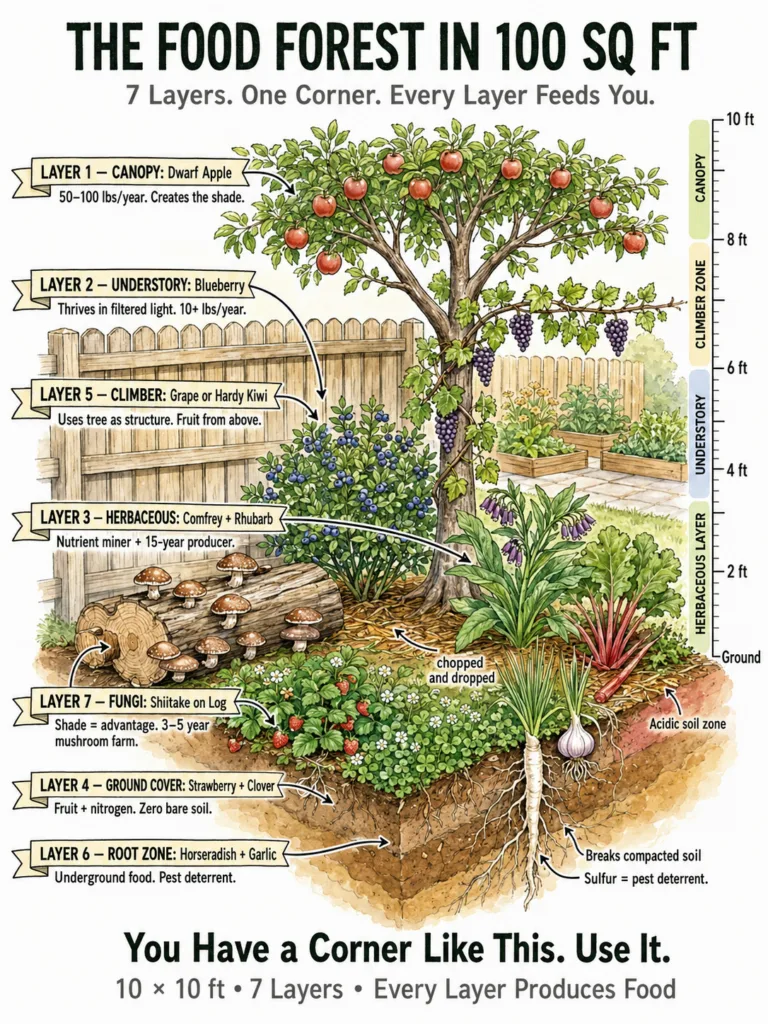 A detailed look at how to layer a food forest for maximum yield in a small space.
The Seven Layers of a Productive Food Forest
Each layer plays a crucial role, mimicking how plants grow in a natural forest. Understanding these layers is key to designing your own abundant space.
1. The Canopy Layer: Your Tallest Producers
This is the uppermost layer, typically consisting of larger fruit or nut trees that provide shade and long-term yields. For a 100 sq ft space, you’ll want to choose dwarf varieties.
- Plant Example: A dwarf apple tree (like ‘Honeycrisp’ or ‘Fuji’ on a dwarf rootstock) is an excellent choice, potentially yielding 50-100 lbs/year once established. Its roots help break up compacted soil.
- Why it Matters: Provides the main structure, long-term harvests, and dappled shade for lower layers.
- Actionable Advice: Select disease-resistant dwarf fruit trees suitable for your USDA hardiness zone. Consider self-pollinating varieties if you only have space for one, or plant two different varieties for better cross-pollination if space allows.
2. The Understory Layer: Smaller Trees & Large Shrubs
Below the canopy, this layer includes smaller fruit trees or large shrubs that tolerate some shade. These often provide earlier harvests than the canopy trees.
- Plant Example: Blueberry bushes thrive in an ‘acidic soil zone’ and offer sweet fruit, as well as beautiful fall foliage.
- Why it Matters: Adds another layer of fruit production and fills in the vertical space.
- Actionable Advice: Research the specific soil pH needs for your chosen understory plants. Blueberries, for instance, love acidic soil, so amending your soil with peat moss or pine needles might be necessary.
3. The Shrub Layer: Bushes and Climbers
This layer is typically made up of berry bushes and other smaller, woody shrubs. This is also where climbing plants come into their own, using the canopy trees or a trellis for support.
- Plant Example: A grape vine, trained to climb a trellis or even up your dwarf apple tree (ensure it doesn’t smother the tree), can yield abundant fruit without taking up much ground space.
- Why it Matters: Provides diverse fruit, uses vertical space efficiently, and adds complexity to the ecosystem.
- Actionable Advice: Choose a sturdy trellis or guide for climbing plants. Prune vigorously to ensure good air circulation and fruit production. For shrubs, consider currants, gooseberries, or elderberries.
4. The Herbaceous Layer: Non-Woody Perennials
This layer includes perennial herbs, flowers, and vegetables that die back to the ground each winter but return in spring. They are often ‘nutrient miners’ and pest deterrents.
- Plant Examples: Comfrey is a fantastic ‘nutrient miner,’ drawing up nutrients from deep in the soil and making them available to other plants when its leaves are chopped and dropped (chop-and-drop mulching). Rhubarb offers delicious stalks for pies and crumbles.
- Why it Matters: Contributes to soil health, attracts pollinators, provides culinary herbs and vegetables.
- Actionable Advice: Integrate plants like comfrey for dynamic accumulation, yarrow for beneficial insects, and perennial herbs like oregano, thyme, and mint (in containers to prevent spreading).
5. The Groundcover Layer: Spreading Plants
These are low-growing plants that spread horizontally, protecting the soil from erosion, suppressing weeds, and keeping moisture in. Many are edible or nitrogen-fixers.
- Plant Examples: Strawberries are perfect for a delicious edible groundcover. White clover is a nitrogen-fixer, improving soil fertility, and can be used as living mulch.
- Why it Matters: Suppresses weeds, conserves soil moisture, prevents erosion, and can add additional harvests.
- Actionable Advice: Choose groundcovers that won’t outcompete your other plants. Consider edible options like wild strawberries, creeping thyme, or perennial spinach.
6. The Rhizosphere (Root) Layer: Underground Treasures
This layer includes root crops that provide food from beneath the soil. These plants also help to aerate and break up compacted soil.
- Plant Examples: Horseradish provides pungent roots, while garlic offers flavorful bulbs. Both have deep roots that can help improve soil structure.
- Why it Matters: Offers underground harvests, improves soil structure, and adds diversity below the surface.
- Actionable Advice: Plant root crops in areas where they won’t disturb the root systems of larger plants. Consider perennial onions, Jerusalem artichokes, or daylilies for edible tubers.
7. The Fungi/Mycelial Layer: Nature’s Decomposers
Often overlooked, the fungi layer is vital for breaking down organic matter, cycling nutrients, and enhancing soil health. Some fungi are also edible.
- Plant Example: Shiitake mushrooms can be grown on logs, turning otherwise unused woody material into delicious food while contributing to the ecosystem’s health.
- Why it Matters: Decomposes organic matter, makes nutrients available to plants, and some varieties provide food.
- Actionable Advice: Introduce mushroom spawn to logs or wood chips. Oyster mushrooms are another easy-to-grow option. Ensure you source spawn from a reputable supplier and understand the specific needs of your chosen fungi.
Beyond the Layers: Building a Thriving Ecosystem
Creating a food forest is more than just planting different layers; it’s about fostering a living, breathing ecosystem. Here are a few more tips:
Start with Healthy Soil
Before you plant, enrich your soil. Add plenty of organic matter like compost, well-rotted manure, and leaf mold. If your soil is compacted, consider a ‘no-dig’ approach with layers of cardboard, compost, and mulch. Test your soil to understand its pH and nutrient levels, especially for plants like blueberries that prefer specific conditions.
Water Wisely
Once established, food forests are surprisingly water-efficient. However, during establishment and dry spells, consistent watering is crucial. Consider installing a simple drip irrigation system or using rainwater harvesting techniques.
Mulch, Mulch, Mulch!
A thick layer of organic mulch (wood chips, straw, shredded leaves) around your plants is your best friend. It suppresses weeds, conserves moisture, regulates soil temperature, and slowly breaks down to feed the soil. This is where your ‘chop-and-drop’ comfrey comes in handy!
Observe and Adapt
Nature is always changing, and so will your food forest. Spend time observing your plants: Are they thriving? Are there signs of pests or diseases? What pollinators are visiting? This observation helps you make small adjustments and learn what works best in your unique microclimate.
Your Small Space, Big Harvest Future
Starting a food forest in just 100 square feet is an empowering step towards self-sufficiency and a deeper connection with nature. It’s a project that evolves, teaches, and gives back for years to come. Don’t be intimidated by the concept; start small, plant a few layers, and enjoy the journey of watching your little edible ecosystem flourish.
With careful planning and a little patience, you’ll be enjoying fresh, homegrown food and the peaceful satisfaction of nurturing a sustainable, abundant garden. Happy growing, neighbor!