“Longevity foods” are not magic ingredients. They are repeatable, nutrient-dense staples that support the systems most tied to long-term health: gut, heart, brain, metabolism, and inflammation balance. The best part is that you do not need a perfect diet. You need a small list you actually use.
Most people never realize this works because they chase rare superfoods, instead of building a boring-but-powerful rotation: whole grains + legumes + colorful produce + nuts + herbs—the same pattern seen in many long-lived populations.
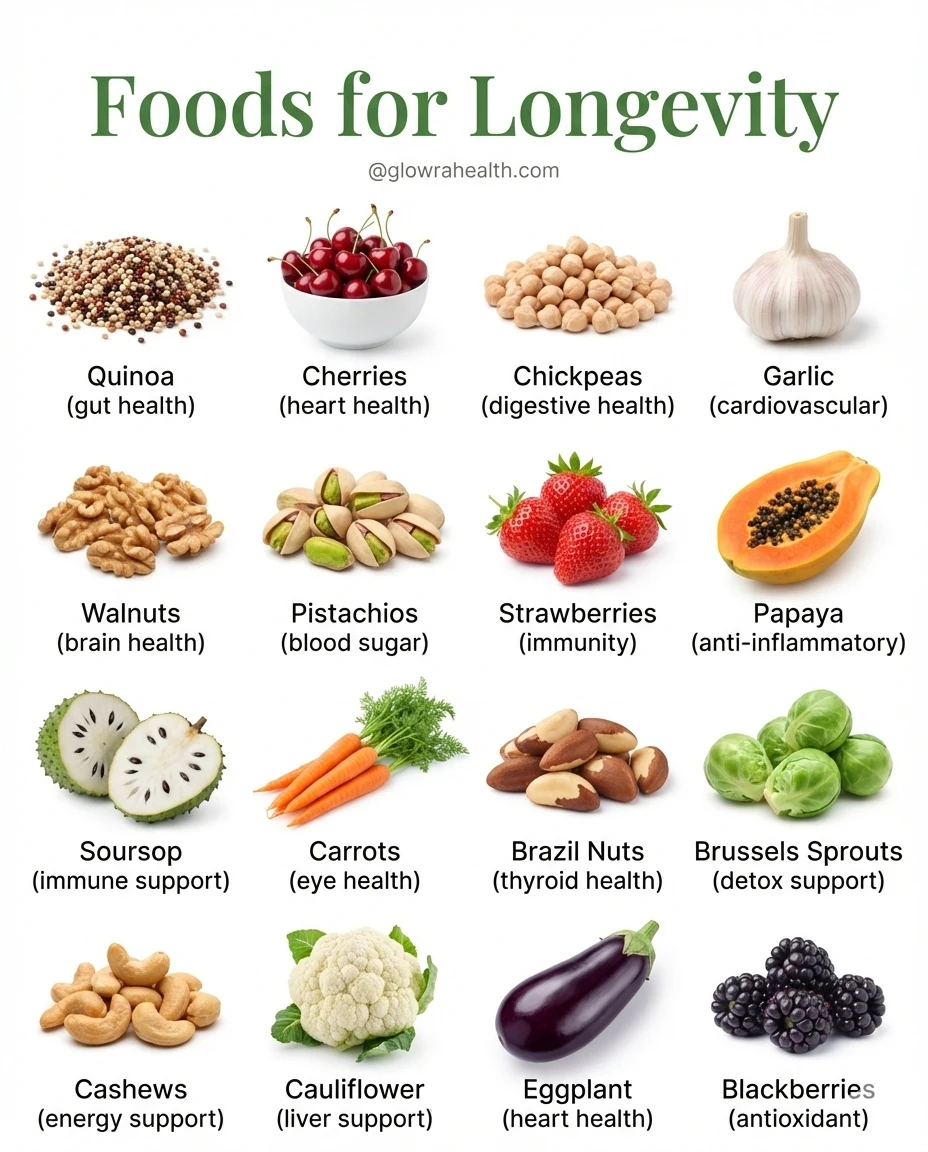
Quinoa (gut health)
Quinoa is a whole-grain–style staple that supports gut health by adding fiber and steady carbs. Whole-grain patterns are consistently linked with better long-term outcomes. (ScienceDirect)
Easy use: cook a batch and use it in bowls, soups, or salads.
Cherries (heart health)
Cherries offer polyphenols (plant antioxidants) that support blood vessel function and recovery. (OUP Academic)
Easy use: frozen cherries in yogurt, oats, or smoothies.
Chickpeas (digestive health)
Chickpeas bring a “longevity combo”: fiber + plant protein. This supports regularity and steadier blood sugar. (Blue Zones)
Easy use: hummus, roasted chickpeas, or chickpeas over quinoa.
Garlic (cardiovascular)
Garlic is widely studied for heart-supportive patterns, often linked to its sulfur compounds (like allicin). (Harvard Health)
Easy use: add to soups, lentils, roasted veg, or sauces.
Walnuts (brain health)
Walnuts provide healthy fats and plant compounds that support cardiovascular health, which also supports brain aging over time. (AHA Journals)
Easy use: sprinkle on oats or salads, or blend into pesto.
Pistachios (blood sugar)
Pistachios are a fiber-and-fat snack that helps meals feel more filling, which can support steadier blood sugar habits. (MDPI)
Easy use: pair a small handful with fruit.
Strawberries (immunity)
Strawberries are rich in vitamin C and polyphenols that help the body manage oxidative stress. (ScienceDirect)
Easy use: fresh or frozen with yogurt.
Papaya (anti-inflammatory)
Papaya provides carotenoids and digestive enzymes (like papain). It can be a gentle fruit option for people who feel heavy after meals.
Easy use: add to breakfast bowls or eat after lunch.
Soursop (immune support)
Soursop is sometimes discussed for “immune support,” but it is also important to note: compounds in Annonaceae plants (including soursop) have been studied for potential neurotoxic risk with heavy, frequent intake. Keep it occasional, not daily. (ScienceDirect)
Easy use: enjoy occasionally as fruit, and avoid high-dose supplements unless your clinician approves.
Carrots (eye health)
Carrots provide beta-carotene, a precursor to vitamin A that supports eye and skin health.
Easy use: roast, add to soups, or shred into bowls.
Brazil Nuts (thyroid health)
Brazil nuts are extremely high in selenium, which supports thyroid function – but too much selenium can be harmful. Many people do best with 1 Brazil nut a day (or a few per week), not handfuls.
Easy use: 1 nut daily, or 2–3 nuts a few times per week.
Brussels Sprouts (detox support)
Brussels sprouts are cruciferous vegetables with glucosinolates, studied for their role in the body’s detox pathways and overall cardiometabolic support. (Frontiers)
Easy use: roast until crispy edges, then add olive oil and salt.
Cashews (energy support)
Cashews add calories, healthy fats, and minerals—helpful when you need sustained energy and satisfaction from meals.
Easy use: blend into creamy sauces or snack in small portions.
Cauliflower (liver support)
Cauliflower is another cruciferous vegetable that fits well into longevity patterns because it is fiber-rich and versatile. (Frontiers)
Easy use: roast, mash, or rice it as a base.
Eggplant (heart health)
Eggplant contains anthocyanins (especially in the skin). It is a great “volume vegetable” for heart-friendly meals when cooked with olive oil. (The Nutrition Source)
Easy use: roast or grill, then top with garlic and herbs.
Blackberries (antioxidant)
Blackberries are rich in polyphenols (including anthocyanins), which are associated with antioxidant support. (ScienceDirect)
Easy use: add to yogurt, oats, or chia pudding.
How to Build a Daily Plate Using These Foods
A simple longevity rhythm:
Breakfast: yogurt + strawberries/blackberries + walnuts
Lunch: quinoa bowl + chickpeas + roasted carrots + garlic dressing
Dinner: roasted Brussels sprouts + cauliflower + eggplant (olive oil + garlic)
Snack: cherries or a small handful of pistachios/cashews
Optional: 1 Brazil nut (not a handful)
This matches the balanced pattern used in many evidence-backed “healthy plate” approaches. (The Nutrition Source)
When You’ll Notice Changes
3–7 days: steadier energy and fewer cravings when you increase fiber + protein consistency.
2–4 weeks: digestion often becomes more regular (go slow if you are sensitive).
6–12 weeks: heart and metabolic markers are typically slower-moving, but this is when habits start to “stack.”
Quick Safety Notes
If you have a nut allergy, avoid nuts entirely.
If you take blood thinners or have surgery planned, ask about garlic supplements (food amounts are usually fine).
Keep Brazil nuts moderate due to selenium. (Văn Phòng Bổ Sung Chế Độ Ăn Uống)
Keep soursop occasional, and avoid high-dose extracts unless supervised. (ScienceDirect)
Final Takeaway
Longevity is built from repeatable meals. If you choose 2–3 foods from this list and eat them consistently each week, you are already doing the real work. Start small, rotate often, and let “simple” be the strategy.
Related Source Science
Harvard T.H. Chan – Healthy Eating Plate (balanced longevity pattern): https://nutritionsource.hsph.harvard.edu/healthy-eating-plate/
NIH ODS – Selenium (Brazil nuts can exceed the upper limit): https://ods.od.nih.gov/factsheets/Selenium-Consumer/
OUP Nutrition Reviews – Berries and cardiovascular protection review: https://academic.oup.com/nutritionreviews/article-abstract/82/7/963/7268825
Frontiers in Pharmacology – Cruciferous vegetables and glucosinolates review: https://www.frontiersin.org/journals/pharmacology/articles/10.3389/fphar.2021.767975/full
Meta-analysis – Whole grain intake and mortality: https://www.sciencedirect.com/science/article/pii/S216183132200789X
ScienceDirect review – Acetogenins in Annonaceae (soursop) and neurotoxicity discussion: https://www.sciencedirect.com/science/article/pii/S2213434422000081