One of the biggest reasons houseplants struggle indoors is not watering, fertilizer, or even humidity. It is light mismatch. A plant that naturally wants strong sun may become weak and stretched in a dim corner. A foliage plant that prefers filtered light may scorch in a blazing west window. When the light is wrong, every other part of care becomes harder.
But once you learn how to match a plant to its light level, indoor gardening becomes far more satisfying. Leaves hold better color. Growth becomes steadier. Watering gets easier to judge. Pest problems often decrease because stressed plants are no longer constantly trying to survive.
This is where real plant confidence begins. Not with complicated tricks, but with better observation. If you know which houseplants belong in full sun, bright indirect light, medium indirect light, or low-light conditions, your home starts to function like a well-planned garden instead of a collection of random pots.
Why light matters more than most indoor gardeners realize
Light is how plants make energy. Indoors, even a bright room can be far dimmer than it feels to human eyes. That is why a plant can look fine for a few weeks in the wrong place, then slowly decline. Growth stretches. New leaves emerge smaller. Variegation fades. Soil stays wet too long because the plant is using less water.
Matching the plant to the light solves several problems at once:
- stronger, more compact growth
- better leaf size and color
- fewer watering mistakes
- lower disease and pest stress
- more predictable plant care routines
If you remember one thing, let it be this: the right plant in the right window is easier than trying to force a plant to tolerate the wrong one.
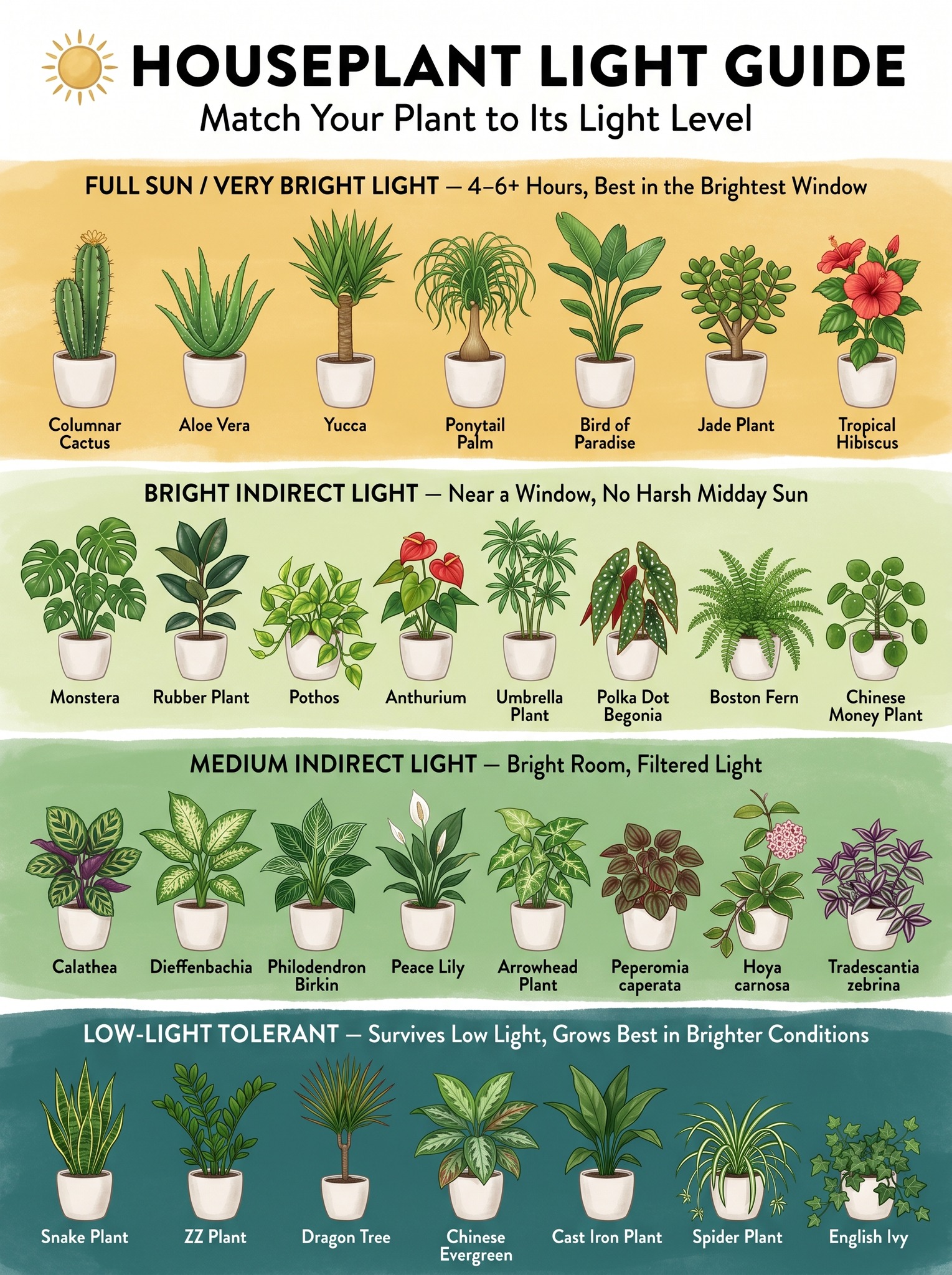
Understanding the four basic indoor light levels
Full sun or very bright light
This usually means 4 to 6 or more hours of direct sun, often from a south-facing or very bright west-facing window in the United States. These are your brightest indoor spots.
Bright indirect light
This means bright conditions near a window, but without harsh midday sun burning the leaves. Many tropical houseplants do best here.
Medium indirect light
This is filtered brightness in a well-lit room, a little farther from the window or in softened light. Many foliage plants are comfortable here.
Low-light tolerant
These plants survive lower light better than most, though many still grow better in brighter conditions. “Low light” does not mean “no light.”
1. Best houseplants for full sun or very bright light
These plants are best for the brightest window in the house.
Columnar cactus and aloe vera
These are natural choices for sunny windows because they are built for strong light and fast drainage. They prefer to dry between waterings and dislike soggy soil.
Practical tip: Use a gritty potting mix and do not water on a schedule. Check the soil fully before watering again.
Yucca and ponytail palm
Both have a sculptural look and handle bright light beautifully. They are excellent for gardeners who want structure indoors without constant fuss.
Practical tip: Rotate the pot every week or two so growth stays balanced instead of leaning heavily toward the window.
Bird of paradise
This plant can become stunning indoors, but only with strong light. In lower light, it may survive but grow slowly and never develop the bold presence people expect.
Practical tip: Clean the leaves regularly. Large leaves collect dust, and dusty leaves use light less efficiently.
Jade plant and tropical hibiscus
Jade thrives in bright sun and rewards restraint. Hibiscus also loves bright light, but unlike jade, it wants steadier moisture and feeding.
Practical tip: Do not treat all bright-light plants the same. A succulent and a flowering tropical may share a window, but their watering needs are very different.
2. Best houseplants for bright indirect light
This is one of the most useful indoor light categories because many popular tropicals thrive here.
Monstera, pothos, and rubber plant
These plants are beloved because they combine beauty with relative ease. They like strong ambient light but usually do not need hours of direct sun.
Practical tip: If the plant becomes leggy or leaf spacing gets wide, it probably needs more light, not more fertilizer.
Anthurium and umbrella plant
These plants perform well near a bright window where the light is filtered or softened. Anthurium especially benefits from brightness if you want better flowering.
Practical tip: Morning sun is usually gentler than harsh afternoon sun. East-facing light often works especially well.
Polka dot begonia, Boston fern, and Chinese money plant
These plants like brightness, but their leaves can react quickly if conditions swing too far toward heat or dry direct exposure.
Practical tip: Watch the leaf edges. Crispy edges often point to a combination of light stress, watering inconsistency, or dry air.
3. Best houseplants for medium indirect light
These are ideal for bright rooms where the plant is not sitting right in the strongest window.
Calathea and peace lily
These are popular because they bring lush foliage to softer indoor spaces. They can adapt to medium light well, but they usually want more stable moisture than drought-tolerant plants.
Practical tip: Do not let them swing from soaking wet to bone dry. That inconsistency often causes more trouble than the light itself.
Dieffenbachia, Philodendron Birkin, and arrowhead plant
These plants offer strong foliage value and tend to fit nicely into medium-bright homes and offices.
Practical tip: If variegated leaves start losing contrast, the plant may be telling you it wants more light.
Peperomia caperata, Hoya carnosa, and Tradescantia zebrina
These are excellent for growers who want interesting texture and manageable size. They do well in bright rooms without requiring the strongest sun.
Practical tip: Keep an eye on internode length. When stems start stretching too much, move the plant closer to the window.
4. Best low-light tolerant houseplants
These are the plants people often call “easy,” but they still deserve smart placement.
Snake plant and ZZ plant
These are among the best choices for lower-light interiors because they tolerate neglect, dry air, and inconsistent routines better than many other plants.
Practical tip: The biggest mistake with low-light tolerant plants is overwatering. Lower light means slower drying soil.
Dragon tree and Chinese evergreen
These bring height and foliage color without needing intense light, making them useful for living rooms, hallways, and offices with decent ambient brightness.
Practical tip: Keep them away from dark corners with no real window exposure. “Tolerant” is not the same as “happy in darkness.”
Cast iron plant, spider plant, and English ivy
These can handle moderate to lower light conditions, though spider plant in particular often grows more strongly with a bit more brightness.
Practical tip: If a low-light plant is surviving but not growing, that may still be acceptable. Survival and vigorous growth are different goals.
How to tell if your plant is getting the wrong light
Plants communicate clearly when you know what to watch for.
Signs of too little light
- leggy, stretched growth
- smaller new leaves
- slow growth
- faded variegation
- soil staying wet too long
Signs of too much direct light
- scorched or bleached patches
- curled or crispy leaves
- sudden drooping despite moist soil
- faded color on sensitive foliage plants
A smart indoor gardener responds by changing placement first, not immediately reaching for fertilizer or extra water.
A practical room-by-room strategy
South-facing or brightest west-facing window
Best for cactus, aloe, jade, yucca, ponytail palm, hibiscus, and bird of paradise.
East-facing bright window
Excellent for pothos, monstera, rubber plant, anthurium, umbrella plant, and many medium-light tropicals.
Bright room a few feet from the window
Good for calathea, peace lily, dieffenbachia, arrowhead plant, hoya, and peperomia.
Lower-light rooms with real ambient daylight
Best for snake plant, ZZ plant, Chinese evergreen, cast iron plant, and dragon tree.
Best houseplant care habits after you match the light
Water by light level, not plant name alone
A pothos in a bright room dries faster than a pothos in a dim room. Light changes water use.
Rotate regularly
Indoor plants often lean. Turning the pot keeps growth balanced and improves shape.
Dust the leaves
Cleaner leaves capture light better, especially on broad-leaved plants.
Move seasonally if needed
A plant that loves a winter south window may need protection from fierce summer afternoon sun.
Do not crowd every corner
Plants need airflow too. A beautiful indoor jungle still works best when leaves are not constantly pressed together.
Houseplant success is really about reading the space
The most successful indoor gardeners do not only memorize plant names. They read windows, seasons, light angles, room brightness, and plant response. They know that a snake plant survives in low light, but a monstera wants more. They understand that basil-like energy belongs to bright spaces, while peace lilies and calatheas prefer softer conditions.
That kind of knowledge changes the whole experience of indoor gardening. You stop guessing so much. You stop blaming yourself for every yellow leaf. And you begin building a home where each plant actually fits.
Final thoughts
A healthy houseplant collection starts with one simple question: How much light does this spot really get? Once you answer that honestly, choosing the right plant becomes much easier.
Put cactus, aloe, jade, hibiscus, and bird of paradise in the brightest windows. Use monstera, pothos, Boston fern, and rubber plant for bright indirect spaces. Let calathea, peace lily, hoya, and peperomia fill the medium-light rooms. Reserve lower-light spots for snake plant, ZZ plant, Chinese evergreen, and cast iron plant.
When plant and light finally match, everything else begins to improve. Growth steadies. Care becomes simpler. And the whole home starts to feel more alive, balanced, and beautifully intentional.