PART 1
The morning of the adoption fair, the shelter smelled of wet concrete, old blankets, and the coffee Marijke had burned because she always forgot the second pot. I remember that smell more clearly than I remember what I ate for breakfast, though I think it was a heel of bread with peanut butter eaten standing beside the medication cabinet. Rain had fallen before dawn, the thin Rotterdam rain that seems less like weather than a mood, and by eight the sky had turned a flat white over the canal. Every dog in the shelter knew something unusual was happening. They could hear folding tables scrape across the courtyard, hear volunteers laughing too loudly because they were nervous, hear the squeak of the yellow gate when I opened it for the first families.
Bruno watched from the far kennel with his head low and one paw resting on the lip of his bed. He was a big brown dog with a torn ear and a face people always misunderstood. If you only looked once, you saw muscle, scars, and a mouth too wide for comfort. If you looked twice, you saw that he tucked his tail whenever someone reached too quickly toward his collar. If you waited long enough, he would press his head against your knee as if asking permission to exist. That was Bruno’s way. He looked dangerous only to people who had decided danger lived in a certain shape.
I had told myself he would not be shown that day. He was not ready for strangers, not really, and I had written that in the binder with a blue pen: no open-yard meeting, no children at fence, controlled introduction only. I can still see the note because I underlined controlled twice. But I also let him sit where he could see the courtyard through the interior gate, because he hated being shut away from all sound. That was my first mistake, or one of them. Looking back now, I know mistakes do not always look like negligence while you are making them. Sometimes they look like kindness pressed too hard into a place where caution should have had the last word.
The shelter was called Tweede Kans, Second Chance, though most people in the neighborhood called it Lena’s place, usually with affection until the new apartments went up. Before that, the street had been a cracked strip of garages, repair shops, storage units, and one bakery that opened at five and made the whole corner smell like yeast and butter. Then the developers came, and glass balconies appeared above us like people leaning over a railing to judge the old city. Complaints began the way mold begins, quietly at first. Too much barking. Too many vans. Too many “unstable animals,” as one resident wrote, as if abandoned dogs were poorly designed furniture.
I was thirty-four then and tired in the way a person becomes tired when she has been holding a door open for years and people keep pushing from the other side. I had been a veterinary technician once, with a steady paycheck and clean scrubs and a supervisor who told me I had “excellent restraint technique,” which is a cold compliment but a useful one. I left after a winter when three elderly dogs were brought in for euthanasia in one month because no one wanted to pay for medication anymore. Maybe that sounds judgmental. Actually, that is not fair. Some people have no money and no help, and shame makes cruel choices look practical. I knew that better than most.
When I was ten, our dog Puck died because my mother could not afford surgery after he swallowed part of a rubber ball. For years I told people he died because the vet could not save him, but that was not the truth I carried. The truth I carried was that I had heard my mother whispering numbers into the telephone and then crying with the receiver still in her hand. I thought if I had loved him better, noticed sooner, begged louder, he might have lived. Children make themselves responsible for things adults cannot fix. Some children grow out of that. I built a shelter around it.
By ten that morning, families moved through the courtyard with paper cups of coffee and damp shoes. A little girl in a purple raincoat asked if the dogs knew Dutch or only dog language, and Marijke laughed so hard she had to wipe her eyes. A father stood too close to the terrier enclosure and pretended not to be afraid when little Momo barked at his shoelace. Someone had brought homemade apple cake, though it was underbaked in the middle, and we ate it anyway because sugar was sugar and no volunteer refused free food. Ordinary details like that stay with me. The wrong cake, the folding chairs with rust on their legs, the smell of wet wool from everyone’s coats.
Victor Smit arrived at eleven fifteen, though he had not been invited. He wore a navy coat that probably cost more than our monthly food bill and leather shoes that did not seem to notice puddles. At his side was a young woman with a phone already lifted, recording little pieces of the courtyard, the peeling sign, the dented food bins, the patched mesh on the old run. Victor smiled as if the shelter belonged to a charming past he respected from a safe distance. He had perfected that smile since the first time I met him, years before, when he came to ask how to calm anxious rescue dogs for his first luxury pet hotel.
Back then, he was still pretending to be humble. He had brought me pastries from a good bakery and asked questions with his head tilted, like a student who wanted to be liked by the teacher. I showed him how to read whale eye, how to stop a greeting before it became panic, how to give a frightened dog an exit instead of forcing obedience. A month later he asked if I would share our adopter list, “only for cross-promotional care packages,” he said. I refused. He stopped bringing pastries after that, and within a year his company was advertising itself as the humane alternative to overcrowded rescue culture.
“Lena,” he said at the fair, spreading his arms a little. “You’ve made the place festive.”
“It is an adoption day,” I said. “That was the idea.”
He glanced toward the kennels. “I hope you have enough staff for the crowd.”
There was nothing openly cruel in the words. That was Victor’s gift. He could wrap a knife in concern so neatly that if you bled, people wondered why you had touched it wrong. I told him we were managing, and he nodded with sympathy that made my face heat. Behind him, the young woman filmed the gate latch, then lowered her phone when I looked at her. Her name was Elise, I later learned. At the time she was just another polished person in Victor’s orbit, smelling faintly of expensive citrus perfume while our dogs smelled of disinfectant and rain.
Bruno barked once from the back, a low warning sound that made several heads turn. I saw his eyes fixed on Victor’s side of the courtyard, but not on Victor himself. He was watching a bicycle leaning against the wall near the entrance, its front wheel shifting in the wind. Bruno hated bicycle bells. No, that is not specific enough. Bruno feared sudden metallic rings because, according to the thin file we had from the old holding facility, his previous owner had trained him with noise punishment. A bell, a clicker, a sharp tone from a phone, and then pain. We had been undoing that one sound at a time for six months.
I stepped toward his kennel, speaking softly, but before I reached him the boy fell.
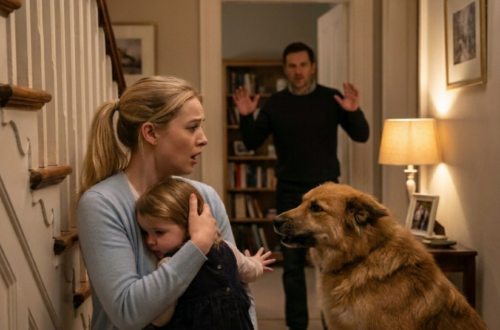
His name was Niels, though I did not know that yet. He was six, maybe seven, with a red scarf that kept slipping from his neck. He had been near the front gate with his mother, kneeling to look at a spaniel mix through the lower bars. I heard a metallic chime, thin and bright, then a scrape, then a child’s cry. When I turned, Niels was on the ground beside the gate with blood on his chin and both hands held out in shock. Bruno was not beside him. Bruno was behind the interior barrier, front paws braced, barking toward the sound.
But memory is not a camera, and what I saw in that first second became tangled with what everyone shouted afterward. Niels’s mother screamed, “That dog went for him!” Someone knocked over a coffee cup. Momo began barking, then three other dogs joined, and the courtyard filled with sound so quickly that thinking became like trying to read underwater. I ran to the boy, but his mother shoved me back with one arm and lifted him against her coat. Blood from his chin smeared her beige sleeve. I remember that sleeve because later the video froze on it again and again, as if fabric could testify.
“Call an ambulance,” I said, though the cut looked small. “Please, give him space.”
“Your dog attacked my son,” she said. Her voice broke on the word son, and for one terrible second I hated her for being wrong while also understanding her fear. That is a hard thing to admit now. I wanted to comfort her and defend Bruno at the same time, and those two instincts collided in me so sharply that I sounded cold. I said, “Bruno was behind the barrier,” and I heard my own voice as if it belonged to someone who cared more about being correct than about a crying child.
Victor was already beside her. He crouched, not too close, and said, “I saw him lunge. Everyone stay calm.” His hand hovered near Niels’s shoulder in the perfect posture of public compassion. The woman with the phone moved behind him, filming from an angle that caught Bruno barking, the boy crying, and me standing there with my hands half-raised. The sound of the bicycle bell, or whatever it had been, was gone. In its place were dogs, rain dripping from the awning, and the thin electronic shutter of phones recording my life as it began to come apart.
The ambulance came because Victor insisted. The police came because Niels’s mother insisted. Animal control came because once a child and a dog appear in the same complaint, the machinery starts moving before anyone has sorted fear from fact. Bruno retreated to the back of his kennel and shook so hard his metal water bowl rattled against the wall. I asked twice if I could sit with him. The animal control officer, a tired man named De Graaf who had known me for years, would not meet my eyes.
“You know I have to take him for assessment,” he said.
“He didn’t reach the child.”
“Lena.”
“He didn’t.”
De Graaf looked past me at the courtyard, where half the visitors had left and the remaining volunteers stood in small frightened groups. “The report says contact was made.”
“The report is wrong.”
“Then prove it,” he said, but not cruelly. He sounded exhausted, as if truth were a form that had to be filed in triplicate by five o’clock.
They led Bruno out with two leashes and a muzzle he did not need but everyone needed to see. He looked back at me once. I have spent years trying not to make animals into symbols, because they are not symbols; they are themselves, hungry or frightened or stubborn or sleepy. But when Bruno looked back, his scarred face framed by that municipal muzzle, I felt the old childhood helplessness rise through me like cold water. Puck on the clinic table. My mother counting money. A living creature becoming a decision made by people who did not love him.
By the time the last table was folded, the video was online. It had been cut to twelve seconds. In it, you saw the boy fall, Bruno barking behind the barrier, me stepping forward with my mouth open, and Victor’s voice saying, “This is exactly what we warned about.” The caption called us an unlicensed danger, though our license had not yet been suspended. That distinction did not matter. Facts rarely win the first hour. The first hour belongs to faces, fear, and whatever sentence is easiest to repeat.
At four, Victor posted his statement. He spoke from the lobby of one of his pet hotels, standing before a wall of framed photographs showing clean dogs on velvet cushions. He said he respected rescue work “when done responsibly.” He said compassion without standards could become negligence. He said Rotterdam owed its children better than “blind kindness.” He did not name me until the end. When he did, he lowered his voice, as if saying my name hurt him.
I watched it on Marijke’s phone because mine had not stopped vibrating. Messages came from strangers first, then donors, then former adopters who wrote, “Please tell me this isn’t true.” One family who had planned to take home an old beagle named Sjaak canceled with a paragraph about needing to protect their daughter. A grocery sponsor paused our monthly food donation. The landlord left a voicemail about “reviewing liability exposure.” Outside, the rain returned, tapping on the plastic roof over the empty courtyard.
That evening I stayed at the shelter after everyone left. The dogs settled uneasily, with little bursts of barking whenever a scooter passed. The place smelled of bleach because I had scrubbed the blood from the concrete myself, though there had only been a few drops. I found Niels’s red scarf hooked on the lower gate hinge, damp and muddy at one end. I held it for a moment, then folded it and placed it in a clean plastic bag because I did not know what else to do with guilt that did not entirely belong to me.
Near midnight, I replayed the twelve-second video until the battery on Marijke’s old tablet dropped to five percent. I watched Bruno’s body, not the boy, because that is what I understood. He did not lower his head to charge. He did not fix on the child. His ears went back before the fall, and his front paws lifted toward the inside latch as if he were trying to get away from something behind him, not reach something ahead. Then, just before Niels stumbled, there was a sound under the barking.
A small, bright chime.
I played it again. It was almost nothing, buried beneath the scrape of shoes and the first shout. A bell, maybe. A phone tone, maybe. I could not be sure. At the time, I did not realize that tiny sound would become the thread I would pull until half the city’s polished story began to unravel. I only knew Bruno had heard something before anyone else did, and that someone had made sure the world saw only what came after.
PART 2
The suspension notice arrived the next morning in an envelope damp at the corners from the mail carrier’s bag. It used careful language, the kind that seems designed to make harm sound temporary. Pending review. Provisional restriction. Public safety concern. We were not ordered to close, not yet, but we could not accept new dogs, host adoptions, or allow public visits. For a shelter, that is not a pause. That is a hand around the throat, squeezing just slowly enough that people can pretend you are still breathing.
Marijke read the notice at the kitchen table while I sorted pills into plastic cups for the old dogs. Her reading glasses sat low on her nose, and her gray hair had escaped its clip in soft frizz from the humidity. She had volunteered at Tweede Kans for nine years and claimed she stayed because retirement was boring, but I knew she paid half our emergency vet invoices when donations ran short. The kettle clicked off twice before either of us poured tea. Outside, a truck reversed somewhere down the street, beeping in slow, indifferent intervals.
“We need a lawyer,” she said.
“We need money for a lawyer.”
“We need both, then.”
I almost laughed, which would have sounded cruel, but exhaustion does strange things to the body. There were twenty-three dogs in our care that week. Seven were seniors on medication, three could not be placed with children, two had court holds, and one had a habit of eating towels if left alone longer than twenty minutes. Their needs did not shrink because the city had opened an investigation. Sjaak still needed his heart pill hidden in liver paste. Lotte still refused to pee in rain unless I walked her under the broken blue umbrella. Ordinary life continued inside disaster with almost insulting confidence.
The first reporter came at nine. She stood outside the gate in a green coat, holding a microphone down by her thigh as if that made her less intrusive. “Lena, do you have a comment on allegations that you ignored previous warnings?” she called. I did not answer. “Can you confirm Bruno had a bite history?” she tried again. Behind me, a dog sneezed, and the smallness of that sound nearly undid me. I wanted to tell her that Bruno’s file said bite under provocation, that his old owner had used fear as discipline, that a history is not a prophecy. Instead I closed the inner door.
By noon, Victor’s campaign had a name: Safe Streets, Safe Pets. His company offered to fund “humane risk assessments” for shelters and provide temporary boarding for dogs removed from unsafe facilities. He gave an interview beside a playroom filled with pastel agility tunnels and bone-shaped cushions. He said public trust required transparency, then released photographs of our cracked kennel floors and patched fences. Some were recent. Some had to be years old. One showed the storage room before we installed shelving, with sacks of food piled near cleaning supplies, a violation if current and merely embarrassing if old. Nobody asked when it had been taken.
The volunteer statement hurt more than Victor’s. It came from Rafi, a new volunteer who had been with us for six weeks. He told a local news site that he had warned me Bruno was unstable around children and that I had dismissed him. I sat in the office, which smelled of toner dust and dog shampoo, and read his quote three times before the words arranged themselves into meaning. Rafi had never worked a child introduction with Bruno. He had cleaned kennels, logged donations, and helped carry crates. The only warning he ever gave me was that the back gate latch stuck in cold weather.
Marijke leaned in the doorway. “Is he answering?”
“No.”
“He was here Saturday.”
“I know.”
She folded her arms, then unfolded them, restless as a person trying not to say what she thinks. “Victor’s people came by when you were at the vet last month. Rafi talked to them for a while.”
“About what?”
“Partnership, he said. Training opportunities.” She looked embarrassed, as if she should have seen danger in the word opportunities. “I thought it was nonsense.”
I thought so too at first. It was easier to believe Rafi had been frightened and exaggerated than to believe he had helped stage something. People lie for many reasons, and most are smaller than evil. They lie to keep a job, to avoid shame, to belong to the winning side before they know it has won. I told myself that then, but it was not true, or not entirely. I was still protecting myself from the uglier possibility that someone had walked through our shelter, fed our dogs, joked over bad coffee, and measured us for destruction.
That afternoon, I drove to the municipal assessment facility where Bruno had been taken. The sky had darkened again, and wind pushed wrappers along the curb like little white birds. I remember the smell inside the building: disinfectant, damp fur, and the metallic tang of stress. Bruno was in a holding room with a rubber floor and a drain in the corner. When he saw me through the observation glass, he stood, then immediately sat as if he had remembered rules no one had spoken.
“He’s reactive to sudden sound,” De Graaf said beside me.
“I told you that.”
“He also recovers quickly when handled by someone he trusts.”
“Then let me handle him.”
He rubbed a hand over his face. “You know I can’t.”
The behaviorist assigned to Bruno was a woman named Dr. Noor van Dijk, calm, precise, and difficult to intimidate. She had silver hoops in her ears and a habit of pausing before answering, not for effect but because she seemed to respect words enough to choose them properly. She told me the assessment would take several days. She also told me, quietly, that the video did not prove contact. I wanted to hug her for that and argue with her for not saying it publicly immediately. Instead I nodded like a reasonable adult while my hands dug half-moons into my palms.
“Was there a bell in the yard?” she asked.
“A bicycle near the gate. Maybe a phone tone.”
“His file mentions aversive sound conditioning.”
“It mentions it badly,” I said. “Two lines. No details.”
“Find details,” she said. “If you can.”
The old holding facility that had transferred Bruno to us was called Havenridge, though there was no ridge and nothing haven-like about it. It had closed two years earlier after funding problems, and its records had scattered through archives, private rescues, and people’s garages. I spent the next day calling everyone who might know anyone who had worked there. Most numbers were dead. One former kennel assistant remembered Bruno as “the brown one who hated bells,” then cried because she had been nineteen and did not know how to stop the trainer from using punishment collars. Another said Havenridge had placed several “rehabilitated” dogs with Victor’s first pet hotel for publicity events.
That was the first connection that made my stomach tighten.
By then the neighborhood had divided itself into people who avoided looking at me and people who looked too hard. At the bakery, the woman who used to save broken croissants for our volunteers told me she hoped the child was recovering. I said I did too. She wrapped my bread more slowly than usual, and when I reached for my card, she asked if the dog would be put down. The question was not cruel. That almost made it worse. Fear had made Bruno into an object everyone felt entitled to discuss as if he were a faulty appliance being recalled.
Niels, according to the news, had needed two stitches under his chin. His mother, Anneke, gave one interview from their apartment balcony, her face pale and furious above a wool scarf. She said her son had nightmares. She said she had trusted the shelter because it looked “community-minded.” She said I had not apologized properly. That last part was true in the way a broken mirror is true. I had said I was sorry he was hurt. I had not said Bruno attacked him. To her, the difference was an insult.
I drafted an email to her five times and deleted each one. Every version sounded defensive or false. What could I write? I am sorry your child was hurt, but I believe your fear has been weaponized by a man trying to take my land. That was not a sentence a mother could receive. So I did nothing for another day, which was another mistake. Silence can be dignity, but it can also look very much like indifference from the outside.
On Thursday night, while rain rattled against the office window, Marijke brought me Rafi’s volunteer file. She had found it in the locked cabinet under a stack of old vaccination certificates. “Look at his emergency contact,” she said.
The name meant nothing to me at first. Elise Kramer. Then I remembered the young woman beside Victor, phone lifted in the courtyard, citrus perfume cutting through the smell of wet dogs. Rafi had listed her as his cousin. My first feeling was not triumph. It was embarrassment. I had let him in. I had given him keys to the food room, shown him the schedule board, told him which dogs were fragile and which donors were late. Trust is not only emotional. Trust is logistical. It hands someone a map.
“We need proof,” Marijke said.
“We have a coincidence.”
“We have a cousin.”
“And a sound on a terrible video.”
She sat across from me and pushed the cold tea aside. “Then we find the sound.”
We spent the next morning searching through every clip posted from the fair. People film everything now: dogs licking children’s faces, volunteers waving, someone laughing because a spaniel stole a biscuit. Most clips had music laid over them, cheerful songs that made the day seem like a party from another universe. One showed Victor arriving. One showed Rafi carrying a crate near the front gate at 10:58. One showed Elise standing near the bicycle with her phone in her right hand and something dark in her left. The clip ended before the fall.
The missing eleven minutes came from our own front camera. It had recorded until 11:06, then resumed at 11:17, three minutes after the ambulance call. I knew the camera sometimes failed when the Wi-Fi dropped, especially in bad weather, but that morning the office connection had been stable. The router log showed a manual restart from the admin panel. The password was written on a label under the desk because I am, in many ways, a fool. Or maybe just overworked. No, both.
I checked the volunteer sign-in sheet. Rafi had been assigned to the office from 10:45 to 11:15 to prepare adoption packets. At 11:02, according to Marijke’s memory, he had asked where we kept extra printer paper. At 11:06, the camera went dark. At 11:12, Niels fell. At 11:18, Rafi appeared in the courtyard video standing beside Victor, looking shocked with one hand over his mouth. I stared at that hand. It looked theatrical to me, but by then everything he did looked guilty.
The city scheduled an emergency hearing for Monday. The notice gave me forty-eight hours to submit evidence. Victor’s company submitted a proposal the same day offering “interim community animal safety services” if Tweede Kans could no longer operate. Attached was a map of our block, including the vacant lot beside us and, in pale blue shading, our leased yard. The proposal date on the cover page was three days before the adoption fair. I found that detail at one in the morning after reading the document so long the letters blurred.
I printed it and carried it into the kennel corridor because I needed to be near breathing creatures. The dogs were asleep or pretending to be. Sjaak snored softly, a whistling little sound through his old nose. Lotte’s paws twitched against her blanket. The air smelled of kibble, warm fur, and the lavender detergent Marijke insisted made the blankets “less institutional,” though I doubt the dogs cared. I stood there with Victor’s map in my hand and felt something in me shift from panic toward anger.
The anger frightened me. I was used to worry, guilt, stubbornness, even despair. Anger felt less noble and more useful. It made me want to call reporters, confront Rafi, post every suspicion online in capital letters. Instead I called Dr. van Dijk and left a message asking whether Bruno’s assessment could include response to recorded tones if I found likely triggers. My voice shook, but I sounded clearer than I felt.
Rafi finally answered my call on Saturday afternoon. There was traffic behind him, and for a second neither of us spoke.
“Lena,” he said. “I can’t talk.”
“You lied.”
He exhaled. “I said what I saw.”
“You never warned me about Bruno and children.”
“I was concerned generally.”
“Do you know what generally costs when people like Victor put it in quotation marks?”
He was silent long enough that I heard a tram bell in the distance on his end. The sound went through me. “You don’t understand,” he said finally. “This is bigger than you.”
That sentence stayed with me because it was exactly what people say when they have made themselves smaller than their choices. I asked if Elise had told him to restart the camera. He hung up. When I called back, it went to voicemail. I sat in the office with the phone in my hand and the radiator clicking beside me, and for the first time since Niels fell, I believed we might be right about the shape of the lie.
But believing is not proving. By Sunday evening we had a map, a cousin, an eleven-minute gap, old rumors from Havenridge, and a dog whose terror made sense to those of us who knew him. Victor had a crying child, a frightened mother, a polished campaign, a volunteer statement, photographs, and a city already embarrassed by years of complaints about our shelter. I could feel the imbalance like weight on my chest.
At dusk, Anneke came to the gate.
She stood under a gray umbrella, Niels beside her, his chin covered by a small white bandage. He held a toy car in one hand and stared at the ground. For a moment I thought she had come to shout, and maybe I deserved some of it, not because Bruno had attacked her son but because I had treated her fear as part of the machinery against me before I treated it as fear. I opened the gate only halfway.
“I found his scarf,” I said stupidly.
She looked at me as if I had offered her a receipt. “He wanted it back.”
“I washed it.” I had not meant to, but I had. It was folded in the office, clean and dry, smelling faintly of soap.
Niels whispered something to her. She put a hand on his shoulder. “He says the dog was loud.”
“Yes,” I said. “He was.”
“He says the bell was louder.”
The courtyard seemed to narrow around that sentence. Rain tapped on Anneke’s umbrella. Somewhere behind me, Lotte whined because she could hear a child and wanted attention. I crouched, slowly, so I was closer to Niels’s height but not too close. “What bell?” I asked.
Niels pressed the toy car against his coat zipper. “The phone bell.”
“Whose phone?”
He looked at his mother, then at the ground. “The lady near the bike. She smiled at me.”
Anneke’s face changed. Not into belief, not yet, but into the first painful uncertainty of someone discovering that her worst moment may have been borrowed for someone else’s purpose. I gave her the scarf. She took it without thanking me, and I did not blame her. As she turned to leave, she said, “If you use my son online, I will make sure you regret it.”
“I won’t,” I said.
She stopped. “Find out what happened,” she said, so quietly I almost missed it. “But don’t make him carry it.”
After she left, I stood in the wet courtyard until the cold came through my shoes. The gate creaked behind me, and the city smelled of rain, bread, and exhaust. Niels had given me a direction, not proof. Still, it was the first true thing from outside our walls, and it pointed not at Bruno, not at me, but at the polished woman beside Victor who had been holding her phone near the bicycle when the world was taught what to fear.
PART 3
The hearing room at city hall had beige walls, bad acoustics, and the faint smell of floor polish trying to cover old dust. I had expected grandeur, maybe because fear makes institutions larger in the imagination, but the room looked like a place where people argued about parking permits. Five council members sat behind a long table. Victor sat at the front row with his lawyer, his communications director, and Elise, who wore cream knitwear and an expression of wounded patience. Anneke sat in the back with Niels’s grandmother, not beside Victor’s group and not beside mine. I noticed that and tried not to hope too much.
I wore the only blazer I owned. There was dog hair on the left sleeve, which Marijke tried to remove with tape in the hallway while whispering that I should stop fidgeting. My hands smelled of the liver paste I had used to give Sjaak his pill before leaving. That smell comforted me in a humiliating way. It reminded me that whatever people said in that room, the dogs still existed in their ordinary bodies, needing food and medicine and someone to clean the drain after breakfast.
Victor spoke first because his lawyer had requested public comment. He did not accuse me directly for most of it. He spoke about standards, trust, children walking safely in their neighborhoods, and the emotional burden on animal lovers who must admit when compassion has failed. He used the phrase evidence-based care three times. He said his company stood ready to support the city “without profit during the transition,” which was technically true only because the profit would come later, after transition had become transfer.
Then his lawyer played the twelve-second video on the wall screen. Even knowing what had been cut away, I felt the old shame rise when Bruno barked and Niels cried. Images do not need to be complete to be powerful. Sometimes incompleteness gives them power because people pour their own fear into the missing spaces. A councilwoman flinched when Bruno’s bark filled the room. Victor lowered his eyes as if in respect, but I saw him glance sideways to measure the effect.
When it was my turn, my prepared statement stuck to my fingers. I had written about Bruno’s trauma history, our safety protocols, the missing camera footage, and Victor’s predated land proposal. It was factual, restrained, and probably too long. I began reading, but halfway through the second paragraph I heard myself sounding like I was asking permission to care. Something in me resisted that. I put the paper down.
“A child was hurt at my shelter,” I said. My voice was rough. “I am sorry for that. I should have written to his mother sooner, and I did not because I was afraid every sentence would be used as an admission. That was cowardly, and it was unkind to her.”
The room shifted. Victor looked up sharply, perhaps because apology was not in the version of me he had prepared to defeat.
“But Bruno did not bite Niels,” I continued. “He reacted to a sound. Someone created or used that reaction, and then a shortened video was spread before animal control finished its first report. I am asking you not to confuse speed with truth.”
I presented the map first. The proposal date. The shaded lot. The offer to replace us if we closed. Victor’s lawyer objected that strategic planning was not evidence of misconduct. He was right, in a narrow way. A map did not ring a phone. But it showed appetite. It showed that Victor had imagined our absence before the city had a reason to consider it.
Then I played the longer clips we had gathered: Victor arriving with Elise, Rafi carrying crates, Elise near the bicycle, the camera blackout window, Rafi reappearing after the fall. The room remained skeptical. I could feel it. People will accept one coincidence, maybe two, but after that they begin to resent you for asking them to see a pattern because patterns require responsibility. The council chair asked if I had direct evidence that Elise played any sound. I had to say no.
Victor stood when allowed to respond. “This is painful to watch,” he said, and for a moment I thought he meant the video. “A child was injured, and Ms. Vos has built an elaborate conspiracy around a phone tone instead of acknowledging that her facility was not secure.”
His tone was gentle. That gentleness made people lean toward him.
“Bruno’s own history includes aggression,” he said. “Her own notes show she knew he reacted unpredictably. Her own volunteer warned her.”
“Rafi lied,” I said before I could stop myself.
The chair warned me to let Victor finish. My face burned.
Victor looked at me with something like pity. “This is exactly the problem. Everyone who raises a concern becomes an enemy. That is not animal welfare. That is ideology.”
It was a good line. I hated him for having good lines.
The hearing ended without a decision. Our suspension remained in place pending further review, and Bruno’s fate would depend on Dr. van Dijk’s final assessment. Reporters met us outside. Victor gave them a measured statement about sadness and responsibility. I pushed through without speaking, which became, by evening, a headline about refusing accountability. Marijke drove us back because my hands shook too hard to hold the wheel. The car smelled of old mint sweets and damp upholstery. Neither of us spoke until we passed the Erasmus Bridge, its cables pale against the low sky.
“You did well,” she said.
“I lost.”
“You don’t know that.”
“I watched their faces.”
“You watched Victor watching their faces,” she said. “That is different.”
She was right, and also I was right. Both things can sit in a car together, making the air heavy.
The next break came from a woman named Sanne, who had worked at Havenridge and now groomed dogs in a converted garage outside Schiedam. She called after seeing a clip from the hearing. Her voice was wary, as if she had learned that helping people often becomes expensive. She said she remembered Bruno, remembered the sound conditioning, and remembered Victor’s company taking three Havenridge dogs for a promotional rehabilitation program. Two had later been returned quietly after “incidents.” One had bitten a staff member when a metal food trolley crashed nearby.
“Was it reported?” I asked.
“To who?” she said. “Victor paid the vet bill. The girl signed something. Havenridge needed the partnership.”
“Do you have records?”
A pause. In the background, water ran and a dog shook itself, collar tags jingling. “Maybe.”
Maybe became a cardboard box in her garage. Inside were photocopied transfer forms, training logs, and a USB drive with videos from Havenridge’s old assessment room. The garage smelled of wet shampoo, clipped fur, and cigarette smoke from the mechanic next door. Sanne would not let me take the originals, but she let me photograph them at a folding table while her elderly pug slept under a towel. I found Bruno’s old ID number in three logs. Beside it, in a trainer’s cramped handwriting, were the words: high response to bell tone, use correction collar, do not place near children until desensitized.
My anger became very quiet then. Not gone. Concentrated. A dog had been hurt into fear, then blamed for having a fear response, then used again because his fear was predictable. There are cruelties of impulse, and there are cruelties of administration. The second kind leaves cleaner paperwork.
On the USB drive was a video of Bruno two years younger, thinner, standing in a small training room. A bell tone sounded from a phone on a chair. Bruno flinched, then bolted to the corner. A man off-camera yanked a line attached to his collar, and Bruno cried out. I stopped the video there. Sanne looked away. For several seconds all I heard was the dryer turning in the next room, buttons or buckles tapping rhythmically against the metal drum.
“Victor knew?” I asked.
“He visited during that program,” Sanne said. “He watched sessions. He wanted dogs that looked transformed quickly. Good before-and-after stories.”
“Will you say that publicly?”
Her mouth tightened. “I have a business.”
“So did I.”
“That’s not fair.”
“No,” I said. “It isn’t.”
I apologized before leaving. She nodded but did not promise anything. In the car, I sat with the box smell of old paper clinging to my coat and hated how often truth depends on people being brave at the exact moment bravery threatens their rent. I wanted to judge Sanne. I also understood her. That was becoming the most exhausting part of the whole thing, understanding people who still failed you.
Dr. van Dijk agreed to review the materials. She also agreed, carefully, to test Bruno with a range of sounds under controlled conditions. I was allowed to observe from behind glass. Bruno stood in the assessment room wearing a loose harness, with De Graaf holding a long line and Dr. van Dijk seated sideways to avoid staring at him. They played a bicycle bell first at low volume. Bruno startled but recovered when given space. A door buzzer. Mild reaction. A standard phone chime. Alert, then sniffing. Then the tone from the Havenridge video, extracted and cleaned as best as possible.
Bruno collapsed.
Not fainted, not dramatically, but folded into himself so fast that De Graaf swore under his breath. He crawled backward, claws skidding on the rubber floor, eyes wide, body curving away from an invisible punishment that was no longer coming. Dr. van Dijk stopped the test immediately. She did not look at me through the glass, which I appreciated because I was crying in a way I did not want anyone to make kind. The room smelled sterile. Bruno’s fear made it feel filthy.
Her preliminary addendum stated that Bruno’s reaction was consistent with conditioned response to a specific aversive tone and that his movement in the adoption fair video appeared oriented away from the sound source rather than toward the child. It did not exonerate us completely. She noted our barrier placement allowed public misinterpretation and that Bruno should not have been within sight of an uncontrolled crowd. She was right. Truth did not make me innocent of every bad choice. It only made me innocent of the lie that mattered most.
We sent the addendum to the city, then to one careful journalist Marijke knew from years ago. Not a loud one. A patient one. His name was Pieter, and he asked for documents before adjectives, which made me trust him more than I wanted to. He interviewed Sanne off the record first. Then the former Havenridge assistant. Then the staff member bitten at Victor’s facility, who had indeed signed a settlement agreement but still had photos of the injury and messages from a manager telling her not to mention the dog’s panic around metal sounds. Pieter moved slowly. The internet did not.
Victor moved fast again. He posted that I was circulating “trauma theater” to excuse unsafe practices. His supporters began sharing photos of Niels with captions about rescue extremists harassing a family. I had not posted Niels’s name or image, but the lie did not need my cooperation. Anneke’s sister sent Marijke a message calling us disgusting. Anneke herself said nothing publicly, which I later learned cost her more than I knew. Silence is sometimes the only shield people have left.
The landlord issued formal notice of breach. We had thirty days to resolve the license suspension or vacate the outdoor yard. Without the yard, we could not meet welfare requirements. Without welfare compliance, Bruno’s case became almost irrelevant because the shelter would die anyway. I sold my car to cover two weeks of payroll and medication. Marijke pretended not to cry when I handed her the keys to cancel insurance. “It was a terrible car,” she said. It was. The heater worked only when it felt morally inspired, and the passenger window whistled at highway speed.
On a Thursday evening, I found Rafi waiting across the street from the shelter. He wore a black hoodie under a rain jacket and looked younger than I remembered. The sky had cleared, leaving the pavement shining under streetlights, and the air smelled of diesel and cold water from the canal. I should have walked past him. Instead I crossed the street.
“If you’re here to apologize without helping, don’t,” I said.
His face crumpled and hardened again. “Victor said no one would get hurt.”
“Niels got hurt.”
“He said the kid would just be startled. That the dog was behind the gate. Elise was supposed to play the tone, the boy would cry, they’d show unsafe conditions.” He swallowed. “He said your shelter would be reviewed, maybe fined. I didn’t know about Bruno being taken.”
I stared at him. A tram passed behind us, windows glowing, faces inside turned toward private destinations. “You restarted the camera.”
“Yes.”
“Why?”
Rafi looked down at his shoes. “He offered me a job. Real training. Paid. My mother’s rent went up. I thought…” He stopped. There was no ending to that sentence that would help him.
“You thought we were small enough.”
He flinched. “I thought he was exaggerating about you. He said you hoarded damaged dogs and called it compassion.”
“Do you believe that?”
“No.”
“Will you say what you just said to the city?”
He wiped his nose with his sleeve, a childish gesture that made me angrier because it made him human. “I signed an NDA.”
I laughed then, once, without humor. “You helped frame a dog for attacking a child, and you’re worried about paperwork?”
“You don’t know what his lawyers are like.”
“No,” I said. “I’m learning.”
He gave me his old phone. Not dramatically. He took it from his pocket and held it out like something contaminated. “Messages are on there. Elise mostly used voice notes, but there are texts about timing. Don’t say I gave it to you until you have to.”
“You understand this doesn’t make us even.”
“I know.”
I wanted to tell him he was a coward. I wanted to tell him he was not beyond repair. The old Lena might have chosen one. The new, tired, angry Lena chose neither. I took the phone with a paper bag from the office because my hands were shaking again, and I did not trust myself not to throw it at him. When I looked back after unlocking the gate, he was still across the street, a dark shape under the streetlamp, waiting for consequences to decide whether they would be worse than guilt.
The messages were not a confession in the neat way stories like to provide. They were fragments: “Restart cam 11:05, no earlier.” “E will trigger near bike.” “VS wants child visible, no contact.” “Use B, known sound issue.” There were payments labeled as freelance event support. There was a photo of our office router with the password visible. There was also a message from Rafi after the incident: “This went too far.” Elise had replied, “Stay aligned and you’ll be protected.”
Protected. That word, after all Victor’s speeches about safety, made me feel almost calm.
Pieter’s article published on Sunday morning under a headline that did not shout. It asked a question: Was Rotterdam’s Dog Shelter Scandal Manufactured? By noon, the question had traveled farther than any answer we had given. The piece included the predated land proposal, the missing camera window, Bruno’s sound assessment, Havenridge documents, and anonymized messages from Rafi’s phone. It did not name Anneke or Niels. It did not claim more than it could show. Because of that, it was harder to dismiss.
Victor denied everything. He said disgruntled former workers and a desperate shelter owner had fabricated a smear. He said the messages were taken out of context. He said his company would cooperate fully with any review. His face on video was still controlled, but something around his eyes had tightened. I had watched enough frightened dogs to recognize the moment when confidence becomes calculation.
Then Anneke walked into Pieter’s office with Niels’s statement.
She did not tell me first. I would not have blamed her if she never spoke to me again. But she gave Pieter permission to report that Niels had heard a phone tone before he fell and had seen Elise standing near the bicycle. She also gave him the medical report showing a chin injury consistent with falling onto the gate hinge, not a bite. “I am angry at Lena Vos for how she handled me that day,” she told him. “I am more angry at anyone who used my son’s fear to sell a story.”
That sentence did what my evidence alone could not. It made room for complexity in public, and public conversations hate complexity until a mother forces them to look at it.
The city reopened the hearing.
This time, Victor did not sit as comfortably. Elise was absent. Rafi was present with a lawyer from a whistleblower organization Pieter had connected him to, and he looked like he had not slept in days. Sanne came too, wearing a black coat and holding a folder with both hands. I will not pretend everyone became brave at once. Some came because the cost of silence had changed. That counts for something, but not everything.
Rafi testified that he had restarted the camera at Elise’s instruction. He admitted he gave a misleading statement about warning me. He said Victor had personally discussed using Bruno’s known trigger to demonstrate shelter risk without physical contact. Victor’s lawyer attacked him as unreliable, compromised, and financially motivated. Rafi accepted most of it with his head down. When asked why he was speaking now, he said, “Because I saw the dog in the muzzle.” It was not eloquent. It was true enough.
Sanne confirmed Victor had observed Havenridge sessions involving aversive tones. The former staff member from Victor’s facility testified behind a privacy screen about an unreported bite and the instruction to keep it quiet before an inspection. Dr. van Dijk explained Bruno’s assessment in language careful enough to survive lawyers and plain enough for the room to understand. She did not make Bruno harmless. She made him legible. That was better.
Victor’s fatal mistake came near the end. He had been patient all morning, but patience is easiest when control remains possible. The council chair asked whether his company had prior knowledge of Bruno’s specific sound trigger. Victor said no. Then Pieter’s attorney submitted a voice note recovered from Rafi’s phone backup, one Elise had deleted from the device but not from cloud storage. Her voice filled the hearing room, crisp and irritated.
“Victor says use the Havenridge tone exactly. If Vos argues trauma, that helps us. Makes her look emotional.”
No one gasped. Real rooms rarely behave like films. Instead, there was a terrible stillness. Papers stopped rustling. A council member removed her glasses and set them down. Victor looked at Elise’s empty chair before he looked at his lawyer, and that small movement told me more than any confession could have. He was not sorry. He was looking for the missing piece in the wall.
PART 4
The investigation took six weeks after that, which is one reason stories about justice usually lie by shortening time. In those six weeks, the shelter remained half-suspended, Bruno remained in municipal care, and Victor continued to deny personal wrongdoing while announcing an internal review of “communications practices.” His company lost two city partnerships but not all its customers. People with money rarely fall through every floor. They hit one, bruise, and call it accountability while someone brings them water.
Still, the campaign turned against him in the way only a campaign built on moral certainty can. Safe Streets, Safe Pets became the phrase reporters used when asking about unreported incidents at his facilities. Former employees came forward with stories of sedation used to keep anxious dogs quiet for promotional visits, of staff told to hide bite logs, of luxury suites cleaned for cameras while overflow dogs waited in crates during holidays. Not every allegation was proven. Some probably never would be. But enough documents surfaced to show a pattern: Victor sold safety while treating risk as something to manage publicly rather than prevent privately.
Elise resigned first. Her statement said she regretted “communications choices made under pressure.” Rafi read it on his phone outside the shelter and said, “That’s not even an apology.” I looked at him until he put the phone away. We were not friends. He came twice a week by then to repair fencing and clean drains without being asked to. Some volunteers refused to work beside him. I let them refuse. Forgiveness, if it comes at all, should not be assigned like a shift.
Anneke came once with Niels to return the washed scarf because he had outgrown his attachment to it, children being both more fragile and more practical than adults. She stood in the courtyard while Lotte sniffed her boot through the fence. The day was cold but bright, and the air smelled of fallen leaves and the bakery’s first batch of bread. For a while we watched Niels push his toy car along the top of a low wall. The silence was not comfortable, but it was not hostile either.
“I should have listened when you said he was behind the barrier,” she said.
“I should have cared more that you were terrified.”
She nodded. “Both can be true.”
“Yes.”
That was the closest we came to reconciliation, and it was enough. She did not become a volunteer or write a glowing post about me. I did not become part of her family’s healing story. We remained two women connected by a bad morning and by the decision not to let Victor own what it meant. Sometimes the corrected record is not warmth. Sometimes it is simply two people standing in the same courtyard without lying.
Bruno’s final assessment did not declare him adoptable to any home, because truth is not magic. He was safe under specific conditions, unsafe under others, and deeply damaged by people who had confused control with training. Dr. van Dijk recommended transfer back to Tweede Kans once our restrictions were lifted, with a behavior plan, sound desensitization protocol, and no public-facing events for him. The city accepted it. I received the decision by email while cleaning vomit from Sjaak’s blanket. That feels important to mention. The greatest relief of my life arrived while I was kneeling on a tile floor with disinfectant burning my nose.
When Bruno came home, he stepped from De Graaf’s van slowly, as if the street might change its mind. The volunteers had wanted to gather, but I asked them not to. No applause, no cameras, no redemption scene for strangers. Just Marijke, De Graaf, Dr. van Dijk, and me in the pale afternoon light. A gull cried somewhere over the canal. Bruno sniffed the gate hinge, the one Niels had fallen against, and then looked back at me.
“Easy,” I said.
He entered the courtyard and went straight to the patch of wall where moss grew between bricks. He lifted his leg, peed for a very long time, and Marijke began laughing so hard she had to turn away. I laughed too, though I was crying. It was a ridiculous homecoming, and therefore a real one.
The shelter did not return to what it had been. That was the part I had to grieve after the crisis passed. We installed new cameras with passwords not written on labels, rebuilt the front barrier, and ended open adoption fairs for dogs with complex histories. A foundation grant covered some repairs after public pressure embarrassed the city into generosity. Several donors returned with apologetic emails, though a few wrote as if they were forgiving me for surviving their doubt. I thanked them anyway when the money helped buy food.
The city created a new review board for animal welfare contracts, which sounded grander than it was but did slow Victor’s land plan. His company withdrew its proposal “to avoid distraction.” Months later, he sold two locations and stepped down as public face of the brand while remaining, according to business filings, financially comfortable. I wish I could tell you he lost everything. He did not. Men like Victor often keep enough to mistake consequence for inconvenience. But he lost the story he had written for himself, and for someone like him, that was not nothing.
At the next council meeting, I was asked to speak about rescue standards. I almost refused. Part of me still wanted only to return to the dogs, to medication charts and laundry and the honest labor of cleaning what is dirty without making speeches about it. But silence had nearly buried us. Silence had let Victor’s version harden around Bruno like concrete. So I went.
I told the council that compassion without structure fails animals, and structure without compassion becomes a business plan with cages. I said shelters like mine needed oversight, funding, and criticism that did not arrive first as a weapon from competitors. I admitted our failures: weak fencing, poor camera security, too much dependence on exhausted volunteers, my own habit of treating help as something I had to earn by never asking loudly. Saying those things publicly hurt. It also freed me from the impossible job of being innocent in every way.
Afterward, De Graaf found me in the hallway near a vending machine humming under fluorescent lights. He handed me a paper cup of terrible coffee. “You sounded like a director,” he said.
“I am a director.”
“You know what I mean.”
I did. For years I had acted like the shelter was a moral apology I had to keep making with my body. If I worked longer, slept less, spent my rent on kibble, answered every accusation softly enough, maybe no one would notice I still felt like the girl who could not save Puck. But responsibility is not the same as self-punishment. I learned that late, and not gracefully.
Bruno’s recovery was uneven. Some days he could hear a bicycle bell from across the street and keep chewing his rubber toy. Other days a spoon dropped in the kitchen and he hid under the desk for an hour. We celebrated small distances. Three seconds of recovery became five, then ten. He learned that the tone from the old video, played softly at first, now meant chicken appeared and no pain followed. I learned that healing is boring to watch from the outside. It is repetition, patience, setbacks, laundry, and the same kind voice used again when you are tired of using it.
One winter evening, almost a year after the adoption fair, a woman named Farah came to meet him. She was a bus driver with a quiet apartment, grown children, and an old scar on her wrist from a dog bite she mentioned without drama. She did not want an easy dog, she said. She wanted a dog who preferred routine and did not need parks full of strangers. Bruno approached her sideways, sniffed her boot, and retreated. She sat on the floor anyway, knees cracking, and talked to Marijke about soup recipes for twenty minutes without looking at him.
“That one understands men who talk too much,” Marijke whispered to me.
“Farah is a woman.”
“I meant Bruno.”
By the third visit, Bruno rested his chin on Farah’s shoe. By the fifth, he followed her to the gate and then panicked when a cyclist rang a bell outside. Farah did not reach for him. She turned her body sideways and waited, humming under her breath, some old song I did not know. He came back on his own. That was the moment I knew he might leave us, and I hated it. Rescue people do not say that enough. We want them adopted, and we ache when they are.
The adoption contract was signed on a clear March morning. The air still had winter in it, but sunlight touched the kennel doors in thin gold rectangles. Farah brought a blue harness, not expensive, but soft at the edges. Bruno wore it solemnly, as if accepting a uniform. I packed his medication, behavior notes, favorite blanket, and the rubber toy with one side chewed nearly flat. Into the folder I placed a copy of his corrected record. Not because Farah needed persuading, but because Bruno deserved paperwork that told the truth.
Before they left, I walked him once around the courtyard. The gate hinge had been replaced. The moss on the wall had spread. From the bakery came the smell of warm bread, and from inside the shelter came the ordinary chaos of morning: metal bowls clanging, Lotte complaining, Marijke telling someone not to put wet towels in the clean bin. Bruno paused by the front gate. A bicycle passed outside, its bell ringing twice, bright and harmless in the cold air.
He flinched.
Then he looked at me.
I did not say, “It’s all right,” because sometimes it is not all right, and dogs know when we lie. I said, “You heard it.” His ears shifted. Farah waited beside the gate, patient, one hand resting open against her coat. Bruno took one step toward her, then another. The bell faded down the street, becoming only part of the city’s noise.
Years later, people still ask me whether I hate Victor Smit. The honest answer is less satisfying than yes. I hate what he did. I hate that he understood fear well enough to sell it. I hate that for a while he made me doubt whether my life’s work was only stubbornness dressed up as mercy. But hate is heavy, and shelters already carry enough weight. Most days, I do not carry him. I carry keys, medication charts, adoption forms, old towels, and the memory of Bruno choosing to walk through a gate after the sound that once broke him.
Farah sent a photo two weeks later. Bruno was asleep on a striped rug beside a radiator, one paw over his nose. In the corner of the picture sat his rubber toy and, beside it, a pair of Farah’s bus-driver gloves drying on the floor. There was nothing dramatic in the image. No victory banner, no apology, no city finally understanding everything it should have understood sooner. Just a dog asleep in a room where no one had to perform kindness for a camera.
I printed the photo and pinned it above the medication cabinet, next to Puck’s old collar. The collar is cracked now, the red leather faded almost brown, and for years I could not look at it without hearing my mother whisper numbers into a telephone. Now I still hear that sometimes. Memory does not obey endings. But I also hear Bruno’s tags tapping softly as he followed Farah out, and the bicycle bell fading, and Marijke laughing because his homecoming had begun with him peeing on the wall.
The shelter still smells of wet concrete when it rains. The coffee still burns if Marijke gets distracted. Dogs still arrive with histories folded inside them like papers no one wants to read. We read them anyway, slowly, imperfectly, with better locks on the gates and fewer apologies for taking up space. And every morning, before I open the front door, I touch Puck’s collar once and then Bruno’s photo, not as a promise that I can save everyone, but as a reminder that the truth, when held carefully enough, can sometimes become a door.