August is the ultimate “pivot month” for home gardeners. As summer crops begin to slow down, late summer offers a prime window to plant cool-weather crops. The warm late-summer soil accelerates seed germination, while the cooling autumn temperatures help produce sweeter, crunchier, and more flavorful vegetables without the risk of heat-induced bolting.
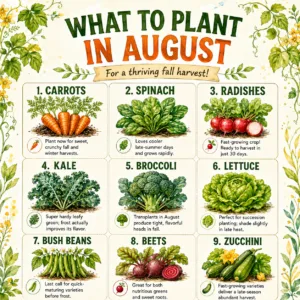
Here is a detailed step-by-step growing guide for 9 fantastic vegetables to plant in August.
1. Carrots
Carrots planted in August accumulate high concentrations of natural sugars as autumn temperatures drop, making fall-harvested roots exceptionally sweet and crunchy.
-
Days to Maturity: 60 – 75 days
-
Sowing Method: Direct sow seeds $0.5 – 1\text{ cm}$ deep into loose, well-drained soil. Avoid transplanting to prevent taproot deformation.
-
Spacing: Space rows $20 – 25\text{ cm}$ apart. Thin seedlings to $5 – 7\text{ cm}$ apart once they reach $3 – 5\text{ cm}$ in height.
-
Care & Moisture: Keep the top layer of soil consistently damp for $10 – 14$ days until germination occurs.
-
Harvesting: Frost actually enhances carrot flavor. You can leave mature roots in the ground throughout light winter freezes.
2. Spinach
A highly nutritious leafy green that thrives in the crisp air of late summer and autumn.
-
Days to Maturity: 35 – 45 days
-
Sowing Method: Soak seeds in lukewarm water for $2 – 3$ hours before sowing $1\text{ cm}$ deep.
-
Spacing: Space plants $7 – 10\text{ cm}$ apart in rows $15 – 20\text{ cm}$ apart.
-
Soil & Light: Prefers rich, nitrogen-dense soil with a pH of 6.5–7.0. Provide $30\%$ shade cloth during intense mid-August heatwaves.
-
Harvesting: Harvest outer leaves individually using the “cut-and-come-again” method to encourage continuous growth from the center stem.
3. Radishes
The fastest-growing crop in the garden, ideal for quick results before cold weather sets in.
-
Days to Maturity: 25 – 30 days
-
Sowing Method: Direct sow seeds $1\text{ cm}$ deep.
-
Spacing: Thin plants to $3 – 5\text{ cm}$ apart with $15\text{ cm}$ between rows.
-
Watering: Provide steady, consistent moisture. Irregular watering causes roots to split and develop a harsh, overly bitter flavor.
-
Harvesting: Harvest promptly when roots reach $2.5 – 3\text{ cm}$ in diameter to prevent woody textures.
4. Kale
Extremely cold-tolerant, kale is a powerhouse green that continues producing long after other garden crops have faded.
-
Days to Maturity: 50 – 65 days
-
Sowing Method: Sow seeds $0.5 – 1\text{ cm}$ deep or set out 3- to 4-week-old transplants.
-
Spacing: Kale requires ample space; plant $30 – 45\text{ cm}$ apart in rows spaced $45\text{ cm}$ apart.
-
Soil & Climate: Heavy feeder—amend soil with rich organic compost. Light frosts break down starches into sugars, turning the leaves sweeter and less bitter.
5. Broccoli
Planting broccoli transplants in August ensures head development occurs during cool, crisp autumn days, preventing premature flowering (bolting).
-
Days to Maturity: 55 – 75 days from transplanting
-
Sowing Method: Best established using robust transplants with 4–5 true leaves in mid-to-late August.
-
Spacing: Space plants $40 – 50\text{ cm}$ apart in rows $60\text{ cm}$ apart.
-
Care: Requires high Nitrogen and Potassium levels. Mulch heavily around the base to retain root moisture and cool soil temperatures.
-
Harvesting: Cut the primary head while florets remain tight and dark green. Side shoots will continue producing smaller secondary heads for weeks.
6. Lettuce
Perfect for succession planting throughout late summer to secure a steady supply of fresh autumn salad greens.
-
Days to Maturity: 30 days (baby leaf) to 50 days (full head)
-
Sowing Method: Sow seeds very shallowly ($0.3\text{ cm}$ deep) as lettuce seeds require light exposure to germinate.
-
Spacing:
-
Baby leaf crop: $5 – 10\text{ cm}$ apart
-
Head lettuce (Romaine, Butterhead): $20 – 25\text{ cm}$ apart
-
-
Heat Management: Lettuce seeds enter dormancy when soil temperatures exceed $29^\circ\text{C}$. Pre-chill seeds in a damp paper towel inside the refrigerator for $24\text{ hours}$ before sowing.
7. Bush Beans
A great final planting call for quick-maturing, non-climbing bean varieties before the first freeze.
-
Days to Maturity: 45 – 60 days
-
Sowing Method: Direct sow seeds $2.5 – 3\text{ cm}$ deep into well-draining soil beds.
-
Spacing: Space plants $10 – 15\text{ cm}$ apart in rows $40\text{ cm}$ apart.
-
Care: Bush beans grow rapidly and set pods simultaneously. Harvest pods frequently while young and tender to encourage continuous blossom production.
8. Beets
A versatile “two-in-one” crop that yields tender greens for fresh salads and sweet root bulbs for roasting.
-
Days to Maturity: 50 – 60 days
-
Sowing Method: Beet seeds are multi-seed clusters. Soak seed clusters in water for $4\text{ hours}$before sowing $1.5\text{ cm}$ deep.
-
Spacing: Thin seedlings to $8 – 10\text{ cm}$ apart when plants reach $5\text{ cm}$ tall to allow adequate bulb formation.
-
Harvesting: Harvest outer leaves early (never remove more than $1/3$ of the foliage). Harvest roots when they reach $4 – 6\text{ cm}$ in diameter.
9. Zucchini
Select short-season or fast-maturing zucchini bush varieties to enjoy an abundant harvest before frost arrives.
-
Days to Maturity: 45 – 55 days
-
Sowing Method: Sow seeds in raised hills or mounds $2\text{ cm}$ deep (2–3 seeds per hill), thinning to the strongest single plant.
-
Spacing: Space hills $80 – 100\text{ cm}$ apart to allow air circulation around mature vines.
-
Care: Water deeply at the base, avoiding foliage wetness in late afternoons to prevent powdery mildew.
-
Harvesting: Pick fruit frequently when young ($15 – 20\text{ cm}$ long) to stimulate continuous flowering.
3 Essential Rules for August Gardening Success
-
Mulch Generously: Apply a $3 – 5\text{ cm}$ layer of organic straw, bark, or leaf mulch over exposed soil to keep root zones cool and conserve moisture.
-
Water Deeply in the Morning: Irrigate soil early in the day ($6:00 – 8:00\text{ AM}$) so root systems absorb moisture before heat evaporates surface water.
-
Monitor Forecasts: Keep shade cloth or floating row covers on hand to protect tender young seedlings from unexpected late-summer heatwaves or early autumn cold snaps.