Tomatoes have a way of teaching gardeners humility.
One year they grow like champions thick stems, glossy leaves, baskets full of fruit. The next year, the same gardener, the same yard, and somehow the plants struggle with pests, poor airflow, weak growth, or disappointing harvests. That is why experienced growers eventually learn this truth: tomatoes do not thrive on fertilizer alone. They thrive in a community.
There are one of the smartest principles in practical gardening: plant tomatoes with the right companions and avoid the crops that compete with them or invite trouble. If you want stronger plants, fewer pests, cleaner fruit, and a more resilient garden, companion planting is not a decoration. It is a strategy.
And for small farmers, homesteaders, and backyard growers, it fits beautifully into a larger system of sustainable gardening, farm care, and livestock-friendly land management.
Let’s walk through what to plant with tomatoes, what to keep away from them, and how to turn one tomato bed into a healthier, more productive ecosystem.
Why Companion Planting Matters for Tomatoes
Tomatoes are heavy feeders, sun lovers, and disease-prone if conditions go wrong. They need strong roots, good airflow, steady moisture, and protection from insects that seem to appear the moment plants begin to flourish.
This is where companion planting becomes useful. The right neighboring plants can help tomatoes by:
- deterring pests,
- attracting pollinators and beneficial insects,
- improving soil use,
- shading the soil surface,
- reducing splash-up from rain,
- and making the whole bed more biologically balanced.
A good tomato patch is not just a row of tomato plants. It is a layered system.
1. Plant Tomatoes With Marigolds for Natural Pest Pressure Relief
Marigolds are one of the most famous tomato companion plants for a reason. They are not magic, but they are useful.
Their scent helps confuse some pests, and their flowers attract pollinators and beneficial insects. In a mixed vegetable bed, marigolds also serve a visual purpose: they remind the gardener that beauty and function belong together.
Plant marigolds around the edges of the tomato bed rather than cramming them tightly at the base of each plant. Give them enough room to flower well. A stressed marigold does not help much.
For practical farm care, marigolds also support biodiversity near food crops, which is especially valuable if you are trying to reduce pesticide use around chickens, ducks, bees, or family food areas.
2. Basil and Tomatoes: A Classic Pair That Still Earns Its Place
If you ask ten gardeners about tomato companions, basil will almost always come up first.
Basil fits well with tomatoes because it enjoys similar growing conditions: warmth, sunlight, and reasonably rich soil. It stays relatively compact, helps fill bare spaces, and is easy to harvest regularly. Whether or not it truly changes tomato flavor in the ground, it definitely belongs nearby in the kitchen later.
More importantly, basil helps create a diverse planting zone that supports healthier airflow and a more varied insect population.
Plant basil close enough to share the bed, but not so close that it gets crowded out by tomato branches. Tomatoes expand fast. If you plant basil too tightly, it disappears into shade by midsummer.
3. Garlic and Onions: Strong-Scented Helpers for the Tomato Patch
Garlic and onions belong in the allium family, and they bring one major advantage to a tomato bed: scent.
Their pungent aroma can help deter certain pests, and their upright growth habit means they use space differently than spreading or leafy crops. They also do not compete for the same shape of space that tomatoes do above ground.
This is a great example of smart gardening design. Tomatoes rise upward and outward. Onions and garlic rise narrow and vertical. That difference matters.
In a practical homestead garden, onions and garlic also earn their keep twice—first in the bed, then in the kitchen. A tomato bed lined with onions is not just productive. It is efficient.
4. Beans: Quiet Soil Builders Beside Tomatoes
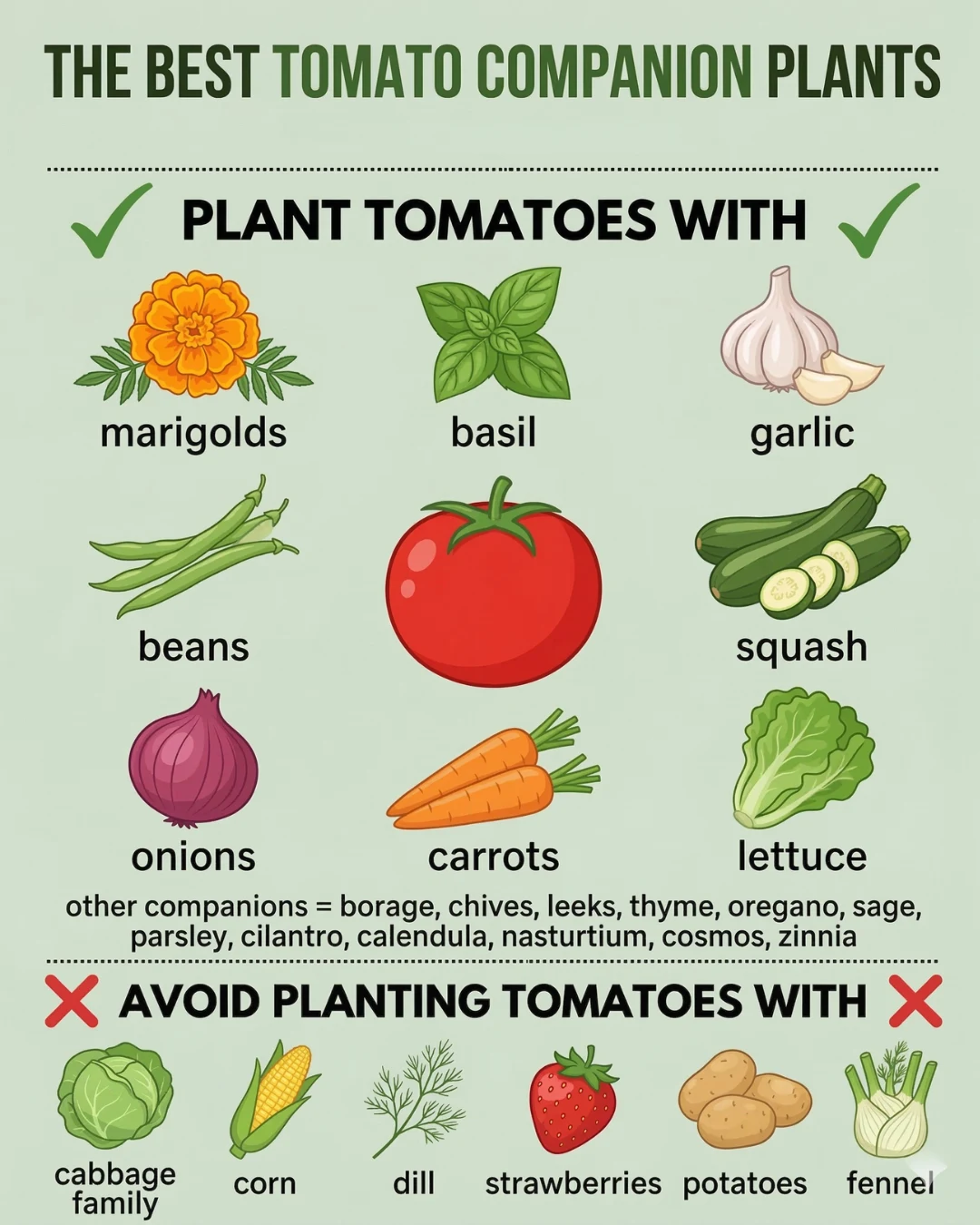
Beans are listed in the image as good tomato companions, and they bring an important ecological benefit to the garden: they are legumes. That means they help support soil fertility through their relationship with nitrogen-fixing bacteria.
Now, this does not mean you can ignore feeding your tomatoes. Tomatoes are still hungry plants. But beans can contribute to a more balanced bed, especially in mixed plantings where soil health matters over time.
Use bush beans rather than aggressive climbing beans if space is tight. Keep the layout sensible. The goal is support, not a jungle.
If you keep poultry, extra bean trimmings and spent plants can often go into compost or controlled animal forage systems, depending on your setup. This is where companion planting starts connecting to the wider farm cycle.
5. Squash, Carrots, and Lettuce: The Soil and Space Managers
These three companions do different jobs, but together they show how clever plant layering can be.
Squash
Squash can act as a living mulch if you have the room. Its broad leaves shade the soil, reduce weed pressure, and help keep moisture from evaporating too quickly. This can be useful in larger gardens, but spacing matters. In small beds, squash can become too competitive.
Carrots
Carrots occupy the root zone differently than tomatoes. They help make use of the soil below without heavily crowding the upper canopy. They are especially useful if you want to maximize production from a single bed.
Lettuce
Lettuce is one of the smartest short-term companions. It grows quickly, covers soil early, and can often be harvested before tomato plants fully dominate the bed. This is one of the best practical gardening tips for small spaces: pair slower, larger crops with quick, shallow-rooted ones.
These companions help turn a tomato patch into a layered system rather than a single-crop row.
What to Avoid Planting With Tomatoes
Cabbage Family
Brassicas often want different growing conditions and can compete in ways that do not support tomatoes well.
Corn
Corn is a heavy feeder and can attract pests that create more pressure in the garden. Tomatoes already ask a lot from the soil. Corn beside them often means more competition, not more benefit.
Dill
Young dill can be a useful insect plant in some gardens, but mature dill may not be the best long-term partner for tomatoes. Companion planting is not always black and white, but if you are keeping it simple, separate them.
Strawberries
Strawberries and tomatoes can share disease concerns and often do better in different zones of the garden.
Potatoes
This is a big one. Tomatoes and potatoes are both in the nightshade family, which means they can share diseases and pests. Planting them close together increases risk.
Fennel
Fennel is famously difficult as a companion plant. It tends to do better in its own area rather than mixed among crops.
A productive garden is not just about what grows together well. It is also about what should stay apart.
How This Fits Into Better Farm Care
A well-designed tomato bed does more than produce fruit. It can fit into the rhythm of a small farm.
Flowers planted near tomatoes support pollinators that help other crops too. Herbs harvested from the same bed reduce trips across the property. Lettuce and thinnings can become compost inputs. Marigolds and basil create beauty near food-growing zones, which matters more than people admit when a space is beautiful, you notice it more. And when you notice it more, you care for it better.
That same principle applies to livestock and poultry.
Chickens, ducks, goats, and other farm animals do best when systems are designed thoughtfully. Secure housing, dry bedding, clean water, shade, proper feed, and calm daily observation matter more than occasional heroic effort. A gardener who learns to read tomato leaves for stress often becomes better at reading a flock for changes in behavior. Good plant care trains good animal husbandry.
On a practical level, keep poultry out of actively growing tomato beds unless the area is fully protected. Chickens scratch, ducks trample, and both will undo careful plant spacing quickly. But once the season ends, those same birds can help clean up spent beds under supervision.
That is sustainable farm care at its best: each part of the system helps another, just not always at the same time.
A Simple Tomato Companion Layout That Works
If you want an easy structure, try this:
Place tomatoes in the center or back of the bed, spaced generously for airflow.
Add basil and lettuce near the base early in the season.
Plant onions or garlic in a loose border.
Tuck in marigolds and calendula along the edges.
Add a few carrots between wider gaps.
Use nasturtium or zinnia at corners where they can spill outward without crowding the main crop.
This gives you height, root diversity, pollinator support, pest confusion, and better ground coverage without turning the bed into chaos.
Final Thoughts: Grow Tomatoes in Community, Not Isolation
Tomatoes are not meant to stand alone in bare dirt, stressed and exposed, waiting for the gardener to solve every problem with a bottle or a bag of fertilizer.
They do better in company.
Plant them with marigolds for insect balance. With basil for function and flavor. With onions and garlic for scent and structure. With lettuce and carrots for smart layering. With beans and flowers for soil and biodiversity. And keep them away from plants that increase disease pressure or drain the bed in the wrong way.
That is how stronger gardens are built not through a single trick, but through thoughtful relationships.
And in the end, that is the real lesson of companion planting: the healthiest gardens, like the healthiest farms, work best when nothing is trying to thrive alone.