PART 1
The first thing I remember about that morning is not Brielle Kane’s voice, though everyone later wanted me to describe it. They wanted to know if she shouted, if she cried, if she looked guilty before she had a reason to. I remember the rain instead. It streaked down the tall glass front of the gym in thin gray lines, making the lobby look like it was underwater, and I remember thinking I should have brought my older shoes because the good ones were going to be ruined on the walk to the bus.
I had been at Haven Ridge Athletic Club since ten the night before, working the quiet hours when the place belonged to people like me. During the day, the gym smelled like vanilla body spray, hot towels, and expensive shampoo. At night, after the steam rooms shut down and the last member forgot a protein cup in the lounge, it smelled like eucalyptus disinfectant and damp rubber mats. That smell stayed in my throat no matter how many peppermint candies I kept in my uniform pocket.
My son Mateo had texted me around five-thirty with a photo of eggs in a pan. They were brown on one side and liquid on the other, and he had written, “Chef life?” I stood in the staff hallway laughing quietly into my glove, careful not to wake the morning yoga instructor sleeping in her car outside. I wrote back, “Lower heat. Also maybe do not poison yourself before school.” Then I put the phone away because I had fifteen minutes to finish the VIP hallway before the first members arrived.
The VIP locker wing was always colder than the rest of the building. I do not know if that was because of the vents or because rich people liked to sweat in private and then pretend they had not. The lockers opened with soft electronic beeps, not metal keys, and the sound carried through the hall like polite little warnings. Beep. Click. Door. Beep. Click. Door. Even empty, that wing sounded watched.
Two weeks before the accusation, they had stopped letting me clean the far end of that hallway. Mr. Corbin, the general manager, said maintenance was touching up the wall panels and that members did not need to see a wet floor sign near premium lockers. I remember his exact words because he said “premium lockers” the way some people say “church.” At the time, I only felt relief. That hallway was long, and my knees had been bad since January.
That morning, though, he told me to do the whole wing. “Quick pass,” he said, not looking up from his tablet. “We open in twenty.”
The air smelled different when I rolled my cart past the towel station. Not eucalyptus. Orange blossom, sweet and heavy, like an old perfume someone sprayed to hide something sour underneath. I noticed it because cleaning teaches you to notice lies in smells. Mold has one kind of sweetness. Old water has another. A room where people pretend nothing happened has its own, though I did not know that yet.
I wiped the benches, emptied the small trash bins, and picked up three hair ties, one gold earring back, and a receipt for a smoothie that cost almost what I used to spend on lunch for two days. I also found a white towel folded so tightly it looked unused, except for a streak of makeup along the edge. I put it in the linen bag and kept moving. Ordinary things. Rich women were messy in the same ways everyone else was messy, only their messes came wrapped in softer fabric.
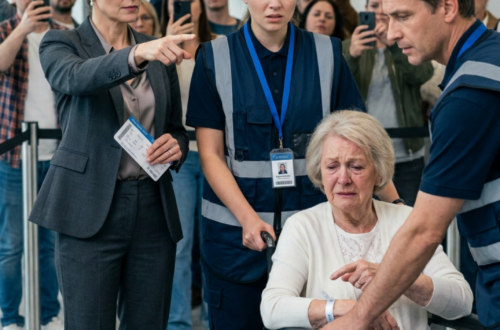
By six-fifteen, the lobby had filled with early members. Men in quarter-zips stood by the juice bar talking about markets. Women in matching sets moved through the front doors with raindrops on their shoulders. The desk staff smiled with their whole faces for them, the kind of smile nobody wasted on us in the basement. I was rolling my cart toward the service elevator when I heard Brielle.
“Check her cart.”
At first, I did not know she meant me. There were other cleaners sometimes, and my mind was on Mateo’s tuition deposit, which was due that Friday. I had been calculating whether I could ask my sister for two hundred dollars without making her angry, because she had her own children and her own tired mornings. Then I looked up and saw Brielle Kane pointing at me from near the front desk, her mouth open, her eyes wet and shining under perfect lashes.
Brielle was not famous like movie people are famous, but in Haven Ridge she might as well have been. Her face had been on banners outside the gym all spring, laughing in sunlight, holding a green juice, promising discipline, balance, and a better body by summer. Two million followers, someone told me once. Maybe more by then. She owned three kinds of beauty that people mistake for honesty: expensive skin, steady posture, and the ability to cry without looking ugly.
“My bracelet was in my locker,” she said. “She was the only one back there.”
I said, “No, ma’am. I only cleaned. I did not touch—”
“Please,” she said, and the word came out soft enough to make me sound cruel for speaking over it. “Please just check.”
Mr. Corbin appeared so quickly he must have been nearby already. He wore a navy suit even at six in the morning, and his hair was wet from the rain or from the kind of product that made men look freshly manufactured. He put one hand in the air, calming everyone except me. “Maria,” he said, “we’re going to handle this simply.”
“Then we can go to the office,” I told him. My voice shook. I hated that. When I am frightened, my accent thickens and people look at my mouth instead of my face.
“This will only take a moment,” he said.
Security came from the side hall, two men I knew by name because I emptied the trash beside their desk every night. Nathan would sometimes ask about Mateo’s soccer games. That morning he would not look at me. The other one, Paul, touched the handle of my cart as if it might bite him.
“Please don’t,” I said, too quickly.
That was my first mistake. Maybe my second, if you count believing anyone in that room wanted the truth. I had a small blue pouch tucked under the clean towels, and inside it was a receipt from the pharmacy for Mateo’s asthma medication. It had my debit card balance printed at the bottom because the machine did that sometimes, and I did not want a lobby full of members seeing how close to empty I was. Poor people have privacy too, though it is treated as suspicious when we try to keep it.
Brielle made a sound then, a small broken inhale. “Why would she say no if she has nothing?”
Someone near the juice bar whispered, “Oh my God.” Another person lifted a phone. I saw the black rectangle pointed toward me and felt my face heat so badly my ears hurt. I wanted to say, Put that down. I wanted to say, I clean your sweat off mirrors. I know which of you leaves hair in the sink and which of you throws away unopened food. But my hands were still in yellow gloves, and there is something about wearing gloves in front of people who are not wearing them. It makes you feel already accused.
Paul moved the towels. The blue pouch slid sideways but did not open. Underneath it was a small velvet bracelet pouch, pale gray, the kind jewelry stores give women who do not need to ask the price.
Brielle covered her mouth.
The lobby changed around me. Not loudly. That was the worst part. There was not a big gasp like in movies. There were little sounds, tiny permissions people gave themselves to believe. A shoe squeaked on marble. Someone said my name in a tone I had never heard from them before. Mr. Corbin closed his eyes for half a second, as if disappointed in me personally.
“I did not put that there,” I said.
Nobody answered.
Paul lifted the pouch with two fingers. It was empty, or at least I think it was. I did not see a bracelet fall out. I did not see anything shine. At the time, all I could look at was Brielle’s face. She was crying, but her eyes kept moving past me, toward my cart, toward Corbin, toward the VIP hallway.
Nathan began checking the side pocket where I kept trash bags, clean rags, and peppermint candies. One candy rolled out, still in its plastic wrapper, and I remember wanting to pick it up because people were stepping too close. Then something else slipped from between the folded black trash liners and hit the marble.
The sound was small.
Not dramatic. Not even loud. A metal click, bright and lonely, like a coin dropped in church. But I remember it better than I remember every face in that lobby. I told people later that I dropped to the floor, but that is not right. I knelt because my legs stopped trusting me.
The object was a brass key with a worn red string looped through its round head. The number stamped into the metal was dark with age.
Mr. Corbin reached for it faster than he had reached for the bracelet pouch.
“Don’t touch that,” someone said.
The voice came from an older man near the juice bar. He was in his sixties, maybe older, with a white towel over one shoulder and the pale, hollow look of someone who had not expected the past to walk into his morning. I knew him by sight because he came twice a week, never spoke to the trainers, and always wiped down his machine before and after using it. Later, I learned his name was Thomas Mercer. That morning, he only looked at the key.
Mr. Corbin said, “Sir, please step back.”
“That was Lily’s locker,” the man whispered.
I looked from him to the key and then to Brielle.
Brielle had stopped crying.
It was so complete, that silence in her face, that for one clear second I forgot I was the one on my knees. Her mouth stayed parted. Her hand was still lifted near her cheek. But the tears had gone still, as if even they were waiting to see what she would do next.
“Lily?” I said.
Nobody answered me. That, more than anything, frightened me. Not the pouch. Not the phones. Not even the key. It was the way the name entered the room and every powerful person suddenly acted as if sound itself had become dangerous.
PART 2
They suspended me before seven. Mr. Corbin used words like “temporary,” “review,” and “standard procedure,” all of them polished smooth from being said to people who did not have the power to argue. He took me into his office only after the lobby had already seen enough to decide. The office smelled like coffee pods and leather chairs, and outside the glass wall I could see members pretending not to look in. Rainwater dripped from umbrellas near the front desk, making dark spots on the floor I had mopped an hour earlier.
“Maria,” he said, folding his hands, “the best thing you can do is cooperate quietly.”
“I am cooperating,” I said. “I am asking you to check who went near my cart.”
“We will conduct an internal review.”
“You searched me in public.”
He sighed. Not angry. Tired, as if my humiliation had inconvenienced him. “The item was found in your possession.”
“The pouch was not mine. The key was not mine.”
At the word key, he looked toward the door. It was quick, but I saw it. Invisible people notice quick looks. We notice when a trash bag is heavier than it should be, when a drain smells different, when a door that is supposed to be locked has dust missing around the handle. I had spent nine years being paid to see what did not belong, and still it took me too long to understand that everyone was more afraid of the key than the bracelet.
“I want to know who Lily is,” I said.
Mr. Corbin’s face shut down. “That is not relevant to your employment matter.”
“An old man said the locker was hers.”
“Mr. Mercer has a history with this club,” he said carefully. “A painful one. It does not make him reliable.”
“Then why did you take the key?”
“I secured an unauthorized object.”
“You knew what it was.”
He leaned back. “Maria, I am trying to help you.”
I almost apologized then. That is a shameful thing to admit. A man had allowed me to be searched like a thief in front of strangers, and still some trained part of me heard his calm voice and wanted to make the room easier for him. Years of keeping jobs can bend your spine in ways no doctor will see.
Instead I said, “I need my paycheck.”
His expression softened in a way that felt worse than anger. “Payroll will process hours worked.”
Hours worked. Not years worked. Not nights spent scrubbing sweat from the sauna tiles, unclogging drains, collecting earrings and wedding rings and phones and returning every one of them to the desk. Just hours worked, as if I had arrived in their building that morning already carrying guilt.
Nathan escorted me out through the side door. He did not hold my arm, which I suppose was meant to be kindness. The rain had slowed to a mist, and the service entrance smelled of wet cardboard from the recycling bins. My bus was not due for twenty minutes, so I stood under the narrow awning in my uniform, holding my plastic bag with my lunch container, phone charger, and the peppermint candies they let me keep.
“I’m sorry,” Nathan said.
I looked at him. “For what?”
He rubbed the back of his neck. “It’s just procedure.”
“No,” I said. My voice was quiet. “Procedure is what people call it when they do not want to choose.”
He looked hurt, and at the time that made me feel guilty. Actually, that is not fair. It still makes me feel a little guilty. Nathan was not the worst person in that building. He was only one of the many who wanted to keep being comfortable.
By nine, Brielle had posted online.
She did not use my name. That was the smart part. She posted a photo of her bare wrist against the steering wheel of her car, rain blurred on the windshield behind it. “When someone you trusted violates your safe space,” she wrote, “it hurts deeper than the value of what was taken. Protect your peace. Protect your energy.” There was a white heart. There was always a white heart.
By noon, someone had put my face in the comments.
It was a blurry screenshot from a member’s video. I was kneeling beside my cart, one gloved hand on the marble, my mouth open in the middle of saying I did not do it. The angle made me look smaller than I felt, and I felt very small. A caption under it said, “This her?” Another said, “These clubs need better screening.” Another said, “I saw it happen. She had a whole stash.”
A whole stash. A pouch and a key, both planted there, became a whole stash before my son came home from school.
Mateo found out before I could tell him. He was seventeen, old enough to understand money and too young to understand how quickly strangers can decide your mother is disposable. When I walked into our apartment, he was standing by the stove with another pan of eggs, these less burned but still not good. The kitchen smelled like oil and the damp towel he had used to wipe the counter.
“Mom,” he said, not like a question.
I put my bag down. “I was going to tell you.”
“They’re saying you stole.”
“I did not.”
“I know that.” He said it too fast, angry that I might think otherwise. Then his face changed. “Can they fire you?”
“They suspended me.”
“That means fired.”
“It means suspended.”
He turned off the burner with too much force. The eggs sat there, pale and trembling. “I can skip the deposit. I can wait a semester.”
“No.”
“It’s not a big deal.”
“It is a big deal.”
We fought then, not loudly, because our apartment walls were thin and the woman next door had a baby who cried when voices rose. He said college could wait. I said I had worked too many nights for him to say that. He said I was treating him like a child. I said he was my child. It was the kind of argument where both people are trying to protect each other and using the sharpest words they have.
After he went to his room, I sat at the kitchen table and unwrapped a peppermint candy even though the taste of chemicals was gone. My phone kept lighting up with numbers I did not know. Some calls were silent. Some people breathed and hung up. One woman left a message saying rich people were too soft and I should be in jail. I deleted it, then regretted deleting it, then hated myself for thinking evidence mattered when nobody had asked for any.
Around seven that evening, my sister Elena came over with soup in a plastic container and anger all over her face. She smelled like rain and the lavender detergent from the hotel where she worked. “You need a lawyer,” she said before taking off her coat.
“With what money?”
“With mine if we have to.”
“You have rent.”
“You have a son.”
“I know I have a son.”
She softened then and put the soup on the stove. There are people who love you by touching your shoulder, and there are people who love you by feeding you while pretending not to be scared. Elena was the second kind. She stirred the soup too hard and said, “Tell me everything.”
So I did. I told her about Brielle, the pouch, the key, Thomas Mercer. I told her how the manager reacted when the number 118 showed. I told her about the orange blossom smell, though I did not know why I told that part. It seemed silly once I said it aloud. My sister did not laugh. Hotel workers understand smells too.
“Maybe the bracelet was never missing,” she said.
“That is what I thought.”
“But the key,” she said.
“Yes.”
“Why would anyone plant something that scares the gym unless they wanted it found?”
I looked at her then. That question stayed with me longer than any comment online. Why would Brielle, if she wanted to make me look like a thief, plant a key that made her own face go white? I still thought she had done it. I wanted it to be that simple. Cruel rich woman frames poor cleaner. There is anger in a clean story. There is comfort in knowing exactly where to put your hate.
The next morning, the harassment had moved from Brielle’s page to mine. My social media was private, mostly photos of Mateo, my sister’s children, and birthday cakes from grocery stores, but people found my name through someone at the gym. A woman messaged me, “Return what you stole and maybe God will forgive you.” Another wrote, “Immigrants like you ruin everything,” though I had been a citizen for eleven years and paying taxes longer than Brielle had been famous.
I called Mr. Corbin three times. He did not answer. The fourth time, a front desk employee named Sasha picked up and whispered, “Maria, I can’t talk.”
“Just tell me if they found the bracelet.”
“I can’t.”
“Sasha.”
There was a pause. In the background I heard the soft beep of lockers opening and closing. “They’re saying you had help,” she whispered.
“Help doing what?”
“I don’t know. Corbin told us not to engage.”
“Who is Lily?”
The line went quiet. Then Sasha said, barely breathing, “Don’t ask me that here,” and hung up.
That afternoon, Thomas Mercer waited outside my apartment building.
I saw him from half a block away and almost turned around. He stood near the front steps wearing a brown rain jacket, holding a manila folder against his chest. He looked smaller outside the gym, less like a member and more like an old father who had run out of official places to stand. A bus hissed at the curb behind me, releasing warm diesel air into the wet street.
“Mrs. Alvarez?” he said.
I tightened my grip on my grocery bag. “How did you find me?”
He looked ashamed. “A woman at the laundromat knows your sister. I’m sorry. I should not have come without calling.”
“No, you should not.”
“I can leave.”
I wanted him to. I also wanted him to say the name Lily again because it had been echoing in my head since the key hit the floor. I shifted the grocery bag to my other hand. It had onions, rice, and a carton of eggs Mateo had insisted he could cook properly now. Ordinary life kept asking to continue, even while everything else cracked.
“You have five minutes,” I said.
We sat on the low concrete wall outside my building because I did not invite him upstairs. The air smelled like wet leaves and someone’s laundry vent. Thomas opened the folder with hands that shook a little and showed me newspaper clippings, printed emails, a missing person flyer softened at the folds. Lily Mercer smiled out from one page with bright eyes and a gym staff badge clipped to her shirt.
She was twenty-two when she disappeared. She had worked the front desk at Haven Ridge and sometimes covered private events when rich members wanted staff who looked “fresh” and “friendly.” Thomas said that word with bitterness, as if it had been used against him too many times. The night she vanished, there had been a private VIP locker-room event after hours, some promotional gathering for investors, trainers, and selected members. Lily had called him at 11:18 p.m. but hung up before he answered.
“Her locker was 118?” I asked.
He nodded. “Staff lockers used to run down the old women’s wing before they remodeled. Lily kept her bag in 118 because the front desk lockers stuck sometimes.”
“The gym said it was removed.”
“The gym says many things.”
He handed me a photo. Lily stood with two other young women in gym uniforms, all of them laughing beside a juice bar display. Her badge was clipped to a red string around her neck, the same faded red as the loop on the brass key.
I stared at it too long.
Thomas saw my face change. “What?”
“The key had red string.”
“Yes,” he said. “I tied it there myself.”
PART 3
Thomas had made the red loop from electrical cord cover, the soft kind used to tag tools on a job site. Lily was always losing things, he told me, not because she was careless exactly, but because she carried too much at once. Phone, water bottle, schedule, other people’s requests. He had tied the red loop through the key so she could find it quickly at the bottom of her bag.
“I asked the club for her locker contents,” he said. “They told me locker 118 had been assigned temporarily and was empty when checked.”
“Was it?”
“I never saw it.”
He had fought them for months. Police reports, calls, meetings, emails that began politely and ended with silence. Haven Ridge’s lawyers framed Lily as unstable. They said she had been written up for tardiness, though Thomas said she was late only twice, both times because buses flooded after storms. They said she had talked about moving away. They said she had taken cash from the petty drawer, though no charge was ever filed. Small stains placed carefully on a missing girl until people stopped wanting to touch the story.
“Why keep going to the gym?” I asked.
The question came out harsher than I meant it. We were still sitting outside my building, and the rain had begun again, soft enough to ignore and cold enough to settle into my sleeves. Thomas looked at the folder in his lap. For a moment I saw Mateo older, sitting somewhere with papers nobody wanted to read, and I had to look away.
“Because if I stop,” he said, “they get to finish burying her.”
I did not promise to help him that day. I wish I could make myself sound braver. The truth is I went upstairs, warmed the soup Elena had left, and told Mateo not to open the door for anyone. I set Thomas’s copied photo of Lily on the kitchen table, then turned it face down because her smile made the apartment feel crowded. I was angry for her, yes, but fear is not polite enough to step aside just because anger arrives.
The next morning, my bank app showed less than I expected. The gym had paid my hours but not the small overnight differential, and I spent forty minutes on hold with payroll listening to smooth jazz that made me want to break my phone. Mateo hovered near the table pretending to study. Outside, the sky was the color of dirty dishwater, and the apartment smelled like burnt toast because he had tried again.
“Don’t look at me like that,” he said.
“Like what?”
“Like you’re deciding whether to tell me you’re fine.”
I almost smiled. “I am not fine.”
“Good. That’s more honest.”
He sat across from me and slid a notebook over. “Write down everything. Like your route. Like who was there. You always remember that stuff.”
“I remember trash.”
“You remember everything.”
That was not true, but it was close enough to hurt. I began with ten p.m. loading dock. Basement laundry. Spin room. Pool deck. Women’s showers. VIP hallway, restricted for one week, then opened that morning. Orange blossom smell. Service panel near the far end, behind a fake plant with white stones in the pot. I wrote Brielle’s arrival time as best I knew, then crossed it out, then wrote maybe 6:05. I wrote Mr. Corbin nearby before accusation? with a question mark.
Mateo watched me fill three pages. “This is good.”
“This is me talking to a notebook.”
“Then talk to someone who can use it.”
Elena found the lawyer through a woman at her hotel whose cousin worked with labor disputes. His name was Daniel Reyes, and his office was above a dentist in a shopping plaza that smelled like coffee, floor wax, and cinnamon from the bakery next door. He had tired eyes and a plant on his windowsill that was almost dead. I trusted him more for the plant. A man too busy to pretend life was perfect seemed useful.
Daniel listened without interrupting, except to ask dates. When I mentioned locker 118, he wrote slower. When I mentioned Lily Mercer, he stopped writing.
“You know the case?” I asked.
“I know enough to know Haven Ridge does not like that name.”
“Can you make them clear me?”
“I can make them understand that public humiliation, unpaid wages, and defamatory insinuation are not free.”
“I don’t want money only.”
“You need money,” he said.
I bristled.
He lifted one hand. “That was not an insult. Money is how people like that measure pain. We will ask for correction, records preservation, and access to any internal review. But Maria, I need you to be careful. Do not go back there alone.”
Of course I went back there alone.
Not inside. I was not that foolish, or maybe I was but did not get the chance. I went near closing and stood across the street under the pharmacy awning, watching the gym glow against the wet dark. Through the glass, I could see the lobby where I had knelt. A woman laughed near the juice bar. A trainer carried white towels stacked to his chin. The world inside had continued without me, polished and lit and warm.
Brielle arrived at eight-thirty wearing a cream coat and sunglasses though it was night. She got out of a black car and paused before entering, turning her face toward the street as if she felt watched. I stepped behind the pharmacy sign. My heart beat too fast, not because I was afraid of her exactly, but because I hated how much power she still had over my body.
A delivery van pulled into the service lane. For a few seconds, when the side door opened, I could see down the staff corridor. The same orange blossom smell seemed to reach me, though that is impossible from across the street. Memory does that sometimes. It invents smells because it knows they matter.
The next day, Sasha called me from a blocked number.
“I can’t talk long,” she said. Her voice sounded thin, and I heard wind around her, so I guessed she was outside. “They told us if anyone speaks to you, it’s termination.”
“Then don’t.”
“The far VIP wall,” she said quickly. “There’s been maintenance. Not listed on the weekly board. Corbin had Vince and a contractor there last week after midnight.”
“Vince from maintenance?”
“Yes. He’s been here forever. Since before Lily.”
“Can you get logs?”
“No. But maintenance keeps old paper copies in the basement cage because the software lost things during the remodel. Maria, please don’t say I called.”
“I won’t.”
She hesitated. “I don’t think you stole.”
It was such a small sentence. It should not have mattered after years of being honest. But I sat on the edge of my bed and cried after she hung up, quietly, because Mateo was in the kitchen making more eggs and swearing at the spatula.
Daniel sent a records preservation letter that afternoon. Thomas sent me scans of old clippings. Elena told me I was not to sneak anywhere, then drove me to Haven Ridge at one in the morning and parked two blocks away. “I am not helping,” she said, turning off the headlights. “I am supervising your bad decision.”
“You said we should not come.”
“I said you should not come alone.”
I still had my old service badge. It should have been disabled, and maybe it was, but the loading dock door had never latched correctly in rain. I knew that because I had reported it three times and nobody fixed things members did not see. The alley smelled like wet cardboard and grease from the restaurant next door. Somewhere a truck backed up with a steady beep, beep, beep that made my nerves jump.
Inside, the basement hallway was dim and humming. I had walked it so many nights that my feet knew where the floor dipped before my eyes adjusted. Elena whispered my name like a warning every ten seconds. I found the maintenance cage behind laundry, locked with a padlock that Vince usually left hooked but open when he was working late. That night it was closed.
“We leave,” Elena whispered.
I looked at the lock. Then I looked at the shelf beside the cage, where old uniform boxes were stacked. On top sat a clipboard with work orders waiting for morning pickup. Not the records we needed, but not nothing. I flipped through quickly.
VIP women’s wing odor complaint. Temporary panel removal. Sealant replacement. Vent access behind former L-118.
Former L-118.
My hands went cold inside my sleeves. Not removed. Former. Still named in the maintenance shorthand even after the gym told Thomas it was gone. I took photos with my phone, every page I could before Elena grabbed my wrist.
“Someone’s coming.”
Voices moved down the hall. Male, one laughing, one lower. We ducked into the laundry room behind bins of towels that smelled of bleach and damp cotton. My knee pressed against a mop bucket. The ordinary embarrassment of hiding in the place I had worked for nine years almost made me laugh. Almost.
Vince passed the open door with Mr. Corbin.
“Daniel Reyes sent the letter,” Corbin said. “We need to know what she has.”
“She doesn’t have anything,” Vince answered.
“She has Mercer.”
Vince was quiet.
Corbin lowered his voice, but the laundry room carried sound strangely. “The Kane situation was supposed to end this.”
“It made it worse.”
“Because someone got sentimental with an old key.”
Vince said nothing. My sister’s fingers tightened around my arm. At the time, I thought his silence meant guilt of the worst kind. Looking back now, I think it meant a man standing at the edge of a thing he had done and a thing he had failed to do, unable to tell which one was heavier.
After they left, Elena and I waited five full minutes before moving. My phone held the work order photos. My body felt made of glass. We slipped out through the loading dock and did not speak until we were in her car with the doors locked.
“You heard that?” I asked.
“I heard.”
“Brielle planned it.”
Elena started the car. “Maybe.”
“No. Corbin said Kane situation.”
“I know what he said.”
“He said someone got sentimental with an old key.”
My sister looked at me in the dashboard light. “Then the person with the key is not Brielle.”
I did not want her to be right. I had built my anger around Brielle because she had pointed at me, because she had cried in a way that made people enjoy hating me, because she had posted her beautiful wounded wrist for strangers to worship. But anger, if you are going to survive it, has to keep making room for facts.
Daniel used the photos to press harder. He did not ask how we got them, which made me like him more. He filed a demand accusing the gym of wage violations, public defamation, and destruction risk related to historical maintenance records. That last part was for Thomas. It made Haven Ridge’s lawyers respond within six hours.
Three days later, Vince asked to meet me.
He chose a diner off Route 9, the kind with cracked red seats and coffee that smelled burnt before it reached the table. Rain had finally stopped, but the sky stayed low and white. Vince sat in the back booth wearing a flannel jacket and a baseball cap pulled down like he thought anyone from Haven Ridge would bother coming somewhere that served toast in plastic baskets.
He had worked maintenance at the club for sixteen years. I knew him, but not well. He fixed drains, replaced bulbs, grumbled about management, and once helped me carry a broken vacuum up the stairs when the service elevator failed. He ordered coffee and did not drink it.
“You put the key in my cart,” I said.
His face tightened. “Yes.”
The word was not a confession like people imagine. It did not solve anything. It landed on the table between us and made every other question sharper.
“You let them think I was a thief.”
“I didn’t know about the bracelet pouch.”
“But you put the key.”
“Yes.”
“Why me?”
He looked toward the window. Outside, a woman in scrubs crossed the parking lot holding a paper bag over her hair against a sudden spit of rain. The diner smelled like bacon grease, coffee, and wet coats. The sugar dispenser near my hand had a crack down one side.
“Because you notice things,” he said.
I laughed once, hard and ugly. “That is your reason?”
“You were the only one who would know it did not belong.”
“I did not know anything.”
“You knew enough to be scared.”
I almost stood up. Daniel had told me to listen, but Daniel was not the one whose face was online. “My son saw people call me a thief.”
Vince closed his eyes. “I’m sorry.”
“No.”
He opened them.
“You do not get to spend sorry that cheap.”
For a while, he said nothing. Then he told us about Lily. Not what happened to her, not fully, because he did not know. That was one of the cruelest parts. He had been working the night of the VIP event six years earlier, called to fix a drain near the old women’s wing. He saw Lily arguing with a young woman near the staff lockers. Not Brielle Kane as she was now, polished and followed and glowing, but Brielle before the brand. Brielle with a cheap gym bag, unpaid class credits, and desperation all over her.
“What were they arguing about?” I asked.
“Access,” Vince said. “Lily was upset. Said Brielle had let someone into the locker wing after hours. Someone not on the event list.”
“Who?”
“I didn’t see.”
He had gone to get a tool. When he returned, the hallway was empty, but locker 118 was open and Lily’s bag was gone. Later that night, management told staff Lily had left upset. The next week, the locker wing remodel schedule moved up by two months. Locker 118 disappeared behind a cosmetic wall panel, sealed but never fully removed because electrical conduit ran through the back and moving it would cost more than hiding it.
“I kept the key,” he said. “Lily dropped it once near the boiler room months before. I meant to give it back. Then she vanished, and I… I kept thinking it might matter.”
“Six years,” Thomas said. His voice was flat. I had not told you he was there, but he was. He sat beside me, his hands folded so tightly his knuckles looked white. “You kept it six years?”
Vince looked at him and seemed to shrink. “I was scared.”
“My daughter was missing.”
“I know.”
“No,” Thomas said. “You knew she was inconvenient.”
The words were harsh, and still not harsh enough. Vince took them without defending himself. That was his one decent act, maybe, not making excuses right away. Then he made them anyway, because people usually do. He had a sick wife then. He needed insurance. Management said the police had everything. The lawyers said staff gossip could damage the investigation. He told himself someone else would speak.
“Why now?” I asked.
“Because they reopened the panel,” he said. “Two weeks ago. Corbin wanted old wiring checked before another remodel. I smelled the wall before I saw it open.”
“Orange blossom.”
He looked at me quickly.
“That was in the hallway,” I said. “The morning they accused me.”
“They used that scent back then,” Vince said. “Old diffuser system. Lily hated it. Said it gave her headaches.”
Thomas covered his mouth.
Vince continued, slower. “I saw the panel open. I saw Corbin panic. Then Brielle started coming in for private meetings. I thought if the key appeared publicly, they couldn’t bury the locker again. I put it in your cart because you worked that wing and because people believe objects found by cleaners. They think we touch everything.”
“They also think we steal everything,” I said.
He flinched.
“I know,” he said. “I knew that too late.”
No, he knew it all along. I believe that now. He simply hoped the truth would be worth what it cost me. That is the kind of arithmetic desperate people do when they have carried guilt too long. They throw the weight toward someone else and call it courage because the direction changed.
Before we left, Vince gave Daniel copies of old maintenance logs, work orders, and a photograph he had taken during the first remodel. In the photo, before the cosmetic panel went up, locker 118 stood open in a half-demolished wall. A strip of red cord hung from the lock, caught on the edge as if pulled in haste. There was no body, no clear answer, nothing that would satisfy people who think truth arrives clean. But there was enough to prove Haven Ridge had lied.
As we stood outside the diner, Thomas turned to me. “I am sorry he chose you.”
I looked at him, this man who had lost more than I could measure and still found room to say that. “I am sorry nobody chose Lily.”
He nodded once. The sky above the parking lot was pale and mean. Somewhere nearby, a car alarm chirped, then stopped. Ordinary life again, interrupting pain because it does not know how to wait.
PART 4
The first public correction did not feel like justice. It arrived as an email from Haven Ridge to members, written in the soft dead language companies use when they are afraid of being understood. “Recent events involving an employee have been mischaracterized,” it said. “We regret any distress caused by premature assumptions.” They did not say my name until Daniel threatened to release the lobby video with timestamps showing that Brielle had directed the search before any internal procedure began.
Then they sent a second email.
Maria Alvarez was not found to have taken Ms. Kane’s property. The club regrets the manner in which the matter was handled.
Not innocent. Not wrongfully accused. Not humiliated in front of a lobby full of paying members because a rich woman’s tears were treated as evidence. Still, my name sat beside the word regrets, and in the world of people like Corbin, that was a crack in the glass.
Brielle posted nothing for almost thirty-six hours. Her followers noticed. They filled the silence with theories, some kinder than others, most useless. When she finally returned, it was with a video filmed in soft light, her hair loose around her face, her voice lower than usual. She said she had reacted from fear. She said she believed all women deserved safety in spaces where they were vulnerable. She said she could not comment on legal issues but hoped healing could happen privately.
Privately. That word made me laugh so hard I scared Mateo.
“She wants privacy now?” he said.
“She discovered it late.”
He grinned, then stopped because he was still angry. He had become protective in a way I did not like, watching my phone, checking the hallway when someone knocked, making his shoulders hard whenever my name appeared online. Children should not have to guard their parents from strangers. I told him this, and he said, “Then strangers should act better,” which was true and not enough.
Daniel did not let the private healing happen privately. He filed notices. He spoke to a local reporter who had covered Lily’s disappearance years earlier and still had Thomas’s number in an old phone. He pushed for the internal records tied to locker 118, the maintenance logs, the missing sign-in sheet from the VIP event, and communications between Corbin, Brielle, and the executive board. The gym fought everything. Powerful people call a locked door “process” until someone brings tools.
The story changed shape in public. At first, people wanted to talk about me because a poor cleaner falsely accused by a rich influencer is easy to understand. Then Lily’s name returned, and the old ugliness came with it. Articles appeared with her photo, the same bright smile Thomas had shown me. Former staff began calling Daniel. Some remembered Brielle before she became Brielle Kane, before the wellness brand and charity panels and white hearts. She had been a struggling trainer then, working for guest passes and favors, desperate to attach herself to anyone who could lift her out.
One woman remembered Lily complaining that Brielle had borrowed a staff badge and not returned it. Another remembered a private event where members drank champagne in the locker wing even though alcohol was not allowed. A former desk supervisor remembered one page missing from the sign-in sheet the morning after Lily vanished. She had told herself it was a filing mistake. Years later, people often discover they were cowards only after someone else gives them a safer word for it.
The missing page never appeared.
That fact matters. I wish I could say it was found behind a cabinet or inside a forgotten folder with a coffee stain on the corner. People like endings that produce the exact paper needed. Real records are more fragile than that. They are shredded, misplaced, renamed, carried home in boxes, destroyed by floods, or hidden so well that hiding becomes the only proof they existed.
What did surface was enough to hurt Haven Ridge. Old maintenance records showed locker 118 had been sealed behind a wall panel during a rushed remodel approved four days after Lily disappeared. Internal emails showed executives instructing staff not to refer to the area as a locker wing in writing. One message from a former operations director said, “No further discussion of L-118 outside legal.” The club had told Thomas there was no locker to inspect while paying contractors to hide it better.
Brielle’s role was harder to prove and easier to see. There were messages between her and Corbin in the week before my accusation. Nothing as clear as “frame Maria,” because people like that do not write crimes like grocery lists. But she had warned him that “old Mercer noise” could damage the summer partnership launch. She had asked whether “the cleaner” was still assigned to VIP mornings. On the morning of the accusation, before she claimed to find her bracelet missing, she had texted Corbin, “Today has to be contained.”
Contained. Another clean word for a dirty thing.
Her bracelet was later found in the center console of her car. That part almost sounded too stupid to be true, but stupidity and strategy live closer together than people think. She said she had forgotten putting it there. Maybe she had. Maybe the bracelet was only ever a prop she could afford to misplace. What mattered was that she used its absence to aim a room at me.
Haven Ridge placed Corbin on leave, then announced his resignation with gratitude for years of service. Brielle lost the summer campaign, then reappeared two months later with a smaller audience and a longer video about accountability that did not include my name or Lily’s. Vince lost his job. He sent Thomas a letter, and Thomas burned it in a coffee can behind his house without reading past the first page. I do not know if that was right. I only know I understood.
As for me, Daniel negotiated money I will not name because people become strange when they hear numbers. It was not enough to make us rich. It was enough to pay the tuition deposit, cover rent while I looked for other work, and let me sleep for three nights without waking at two to calculate bills. Haven Ridge wanted a nondisclosure agreement. Daniel laughed in the meeting, not loudly, just enough to make their lawyer blink.
“No,” I said before Daniel could answer for me.
One board member, a woman with silver hair and a pearl necklace, leaned forward. “Mrs. Alvarez, discretion would benefit everyone.”
I looked at her hands. Perfect nails. No cracks from chemicals. No small cuts from reaching behind toilets for things people dropped and refused to retrieve. “It would benefit you,” I said.
“We are offering a generous resolution.”
“You are offering rent money and silence.”
Her mouth tightened. “That is an unfair characterization.”
I thought of the lobby floor under my knees. I thought of Mateo seeing my face under the words whole stash. I thought of Thomas carrying a folder for six years because nobody wanted to keep a missing girl heavy in their hands. “No,” I said. “It is finally a fair one.”
I went back to Haven Ridge only once, to collect my final paycheck and the few things from my staff locker they had put in a cardboard box. Daniel offered to go. Elena offered to go and make a scene. Mateo offered to go and stand there silently, which might have been the most frightening option. I went alone because there are some rooms your body needs to leave properly.
It was a clear morning after days of rain. The glass entrance shone so brightly it looked new, as if weather had washed the building clean against its will. Inside, the lobby smelled like eucalyptus again, sharp and medicinal. No orange blossom. The juice bar was open. The treadmills hummed upstairs. A woman I recognized from spin class saw me and looked away, then looked back as if deciding whether guilt required eye contact.
Sasha met me near the side office. She hugged me quickly, breaking some rule with her whole body. “I’m glad you came,” she whispered.
“I’m not.”
She gave a small laugh that turned into almost crying. “Yeah. That makes more sense.”
My box held a spare uniform shirt, a cracked mug Mateo had given me that said BEST MOM in crooked letters, two old pay stubs, and half a roll of peppermint candies. They had also included my name badge. Maria Alvarez. Environmental Services. I held it for a moment longer than I expected. That badge had opened doors and closed others. It had made me visible only when something needed cleaning or someone needed blaming.
Thomas was waiting outside when I left. He had not planned it, he said, but I think he had. He held an evidence bag in one hand, sealed and labeled by the private investigator Daniel had connected him with before the police finally agreed to reopen parts of Lily’s file. Inside was the brass key stamped 118, red loop faded almost pink now.
“They let you keep it?” I asked.
“For now,” he said. “Chain of custody is complicated. Everything is complicated.”
He handed it to me, and I did not want to take it. Not because I was afraid of touching evidence. Because the last time that key had been near me, it had made a room decide I was disposable. Still, I held the plastic bag in my palm. The key looked smaller than I remembered. Objects often do, after they have done their damage.
“Does it help?” I asked him.
Thomas looked toward the gym doors. Through the glass, people moved in clean clothes through clean light. “Some days.”
“And other days?”
“Other days it is just proof that they lied.”
That was the truth we were left with. Lily’s case reopened, but reopening is not the same as answering. The missing sign-in page stayed missing. The person Brielle allegedly let into the locker wing remained unnamed in any record we could touch. Brielle never admitted knowing what happened after Lily confronted her. She only admitted, through a lawyer, that she had been “present in the facility that evening.” Thomas hated that sentence so much he copied it onto paper and tore it up again and again.
Months later, I found work at a hospital, cleaning surgical waiting rooms after visiting hours. The pay was steadier, the supervisors less polished, the floors harder on my knees. People cried there for reasons nobody could turn into content. I liked that, in a strange way. Grief in a hospital did not pretend to smell like vanilla.
Mateo started college in the fall. His eggs improved, though not as much as he believed. On move-in morning, he burned toast in our kitchen one last time and tried to hide it under the trash. I could smell it from the hallway. We laughed until we both became quiet, because happiness after fear can feel like stepping onto a floor you are not sure will hold.
Looking back now, I think about invisibility differently. Rich people often use that word as an insult, or worse, as a convenience. They say staff are invisible because they do not want to count the eyes around them. But invisible people see the dust line where a panel moved. We hear the nervous pause before a practiced lie. We remember when eucalyptus becomes orange blossom and when a locked door begins to smell like an old secret.
I never saw Brielle again in person. Sometimes her face still appears online, softer now, careful around the edges. She speaks about resilience. She speaks about learning. She does not speak about Lily Mercer, or Thomas, or the morning she pointed at me with one perfect hand and let strangers turn my fear into proof.
The last time I saw Thomas, he was standing outside the county records office with the folder tucked under his arm. He looked tired, but not finished. He told me investigators had found a reference to the missing event page in an old email chain, but not the page itself. One more outline of a thing removed. One more empty space shaped like someone’s choice.
Before he left, he pressed the evidence bag into my hands again for a moment. The key inside shifted with that same small metal click I had heard on the marble floor. This time, nobody gasped. Nobody pointed. Rain had started lightly on the courthouse steps, and the air smelled of wet stone and someone’s cheap coffee cooling in a paper cup.
I gave the key back to him carefully.
It felt heavier than any apology.