When you’re out tending to your garden, you might occasionally spot a slender, dark wasp zipping around, or notice a peculiar, tubular mud structure tucked away under an eave or on your shed wall. Your first thought might be to recoil, thinking ‘wasp!’ But hold on a moment, neighbor! Let’s talk about the fascinating creature behind these observations: the mud dauber.
Often misunderstood and unfairly lumped in with their more aggressive cousins, mud daubers are actually incredibly beneficial insects in our garden ecosystems. They’re like little nature’s pest controllers, silently working to keep some of the less desirable critters in check. Today, we’re going to get to know these helpful insects, learn how to identify them, understand their unique homes, and discover why you might just want to let them be.
Meet the Mud Dauber: A Gentle Predator
Unlike yellow jackets or paper wasps that can be quite territorial and quick to sting, mud daubers are generally solitary and remarkably docile. They’re not interested in stinging you unless they feel directly threatened or trapped. These fascinating wasps typically have a slender, often metallic blue-black body, with a distinctive long, narrow ‘waist’ (the petiole) connecting their thorax to their abdomen.
They spend their days hunting, but not for nectar or other insects to feed themselves. Their main quarry? Spiders! This makes them fantastic allies for gardeners and homesteaders looking for natural pest control solutions.
Their Unique Mud Homes: A Nursery for the Next Generation
The most distinctive sign of a mud dauber’s presence is their nest. These aren’t the papery, open-celled nests you might associate with other wasps. Mud daubers, as their name suggests, build intricate nurseries out of mud. You’ll often find these tubular, organ-pipe-like structures attached to sheltered surfaces like the underside of porch roofs, in sheds, garages, or even against wooden siding.
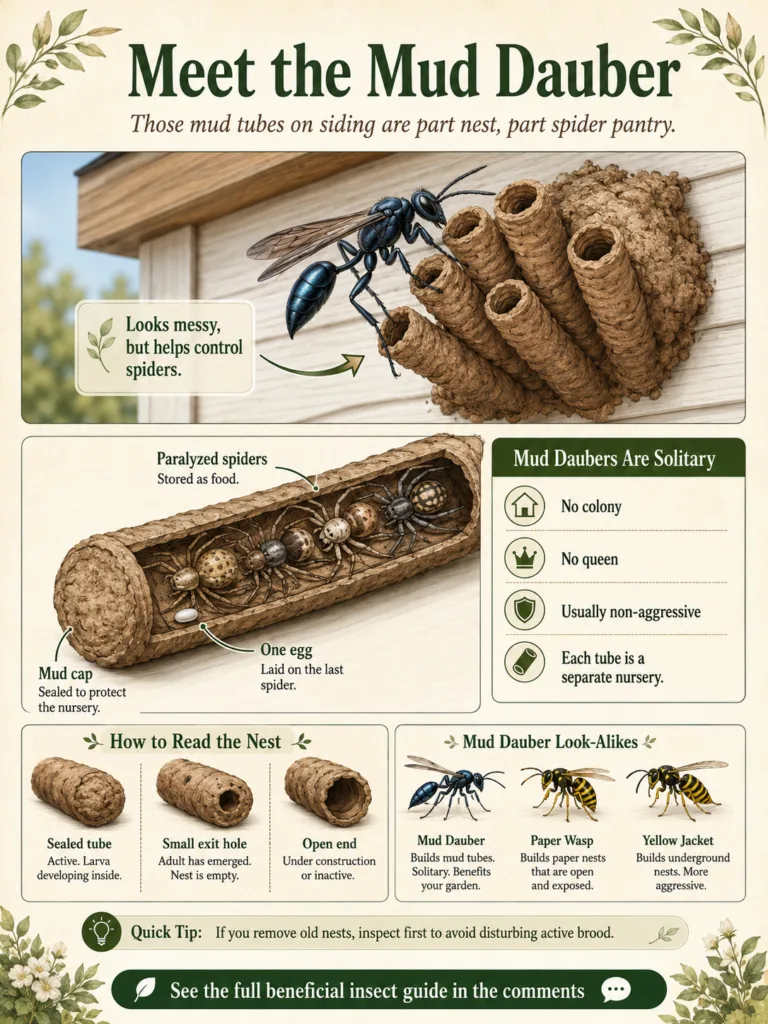 A close look at a mud dauber and its characteristic mud nest reveals the intricate world within.
So, what’s inside these curious mud tubes? This is where the mud dauber’s beneficial nature truly shines. A female mud dauber will build individual cells within the tube, stocking each one with paralyzed spiders – often black widows, garden spiders, or other common household spiders – which she has carefully caught and stung just enough to immobilize. On top of this spider feast, she’ll lay a single egg. Once the cell is full and the egg is laid, she seals it up.
The wasp larva that hatches from the egg then has a fresh supply of spiders to eat as it grows. This is a truly remarkable example of nature’s ingenious ways to ensure the next generation thrives while also keeping spider populations in check around our homes and gardens.
Reading a Mud Dauber Nest: What Do They Tell Us?
You can often tell a lot about a mud dauber’s nest just by observing it:
- Sealed Nests: If the mud tube is completely sealed, it usually means the nursery is active. A larva is likely developing inside, feasting on its spider provisions.
- Nests with Exit Holes: If you see a perfectly round hole in the side of a mud tube, it indicates that a new adult mud dauber has emerged and flown off to start its own life cycle. These nests are no longer active, but they were once successful!
- Open-Ended Nests: Sometimes you might find a mud tube that looks unfinished or has an open end. This could mean the female wasp is still actively building and stocking that particular cell or has abandoned it for some reason.
Spotting the Difference: Mud Daubers vs. Other Wasps
It’s easy to mistake a mud dauber for other, more aggressive wasps, but knowing the key differences can help you feel more comfortable letting these beneficial insects do their work:
Mud Daubers
- Appearance: Slender body, often metallic blue-black or dull black, with a very thin ‘waist’. They tend to have dark or smoky wings. They fly in a somewhat jerky, searching pattern.
- Nests: Characteristic mud tubes, often cigar or organ-pipe shaped, on sheltered surfaces.
- Temperament: Solitary, non-aggressive, unlikely to sting unless directly provoked or squashed.
Paper Wasps
- Appearance: Yellow and black or reddish-brown with a more robust body than a mud dauber, but still with a noticeable waist. Their legs often dangle when they fly.
- Nests: Umbrella-shaped paper nests, open-celled, often hanging from eaves or branches. You can usually see the open cells.
- Temperament: Social, can be aggressive if their nest is disturbed.
Yellow Jackets
- Appearance: Bright yellow and black, stout bodies, very short waist. They often look like small, stocky bees but without the hairiness.
- Nests: Often built in the ground, in wall voids, or in dense bushes. They are paper nests but often hidden from view.
- Temperament: Highly social and notoriously aggressive, especially later in the season when foraging for sweets.
Knowing these differences can give you peace of mind. If you see a slender, dark wasp, or a mud tube, chances are you’re looking at a mud dauber – a harmless helper!
Living Together: When to Intervene (and How)
Most of the time, the best approach with mud daubers is to simply let them be. They’re doing valuable work controlling spiders, and they pose very little threat to us. However, sometimes a mud dauber nest might be built in a truly inconvenient or undesirable spot, like right above a frequently used doorway.
If you absolutely must remove a nest, here’s how to do it safely and without harm, ideally when the nest is inactive:
- Timing is Key: The safest time to remove a mud dauber nest is in late fall or winter, after the young have either emerged or succumbed to the cold. You can also do it in early spring before a new female begins construction.
- Check for Activity: Look for exit holes. If a nest has a hole, it’s likely already empty. If it’s sealed, an occupant might still be inside. If you see a wasp actively building, you might want to wait or try to gently deter it from that specific spot before it’s too invested.
- Simple Removal: Once you’ve confirmed the nest is inactive, or if you’re comfortable doing so during the day when the adult wasp is out hunting (they tend to be less active at dawn or dusk), you can simply scrape the mud tube off the surface with a putty knife or a stick. The mud crumbles easily.
- Deterrence: If a particular spot is prone to mud dauber nesting and you truly don’t want them there, consider placing a physical barrier or making the surface less appealing. Sometimes a fresh coat of paint or a smooth, shiny surface can deter them.
Embracing Your Garden’s Natural Protectors
The mud dauber is a wonderful example of the intricate web of life in our gardens. By understanding their role and appreciating their gentle nature, we can foster a more balanced and thriving environment without resorting to harsh chemicals or unnecessary interventions. They’re just another reminder that sometimes, the best pest control is letting nature take its course.
Next time you see one of these metallic beauties, or spot one of their unique mud homes, take a moment to appreciate these unsung heroes of the garden. They’re working hard for you, keeping the spider population manageable and contributing to the health of your little patch of paradise.