If you’ve ever opened the fridge and thought, “Is this still okay to eat?”, you’re not alone. Most food poisoning doesn’t come from obviously rotten food. It comes from food that looks fine but has had enough time for bacteria to grow. That’s why a simple “fridge shelf life” guide can be one of the most practical wellness habits you build. It saves money, reduces waste, and most importantly helps you avoid avoidable stomach bugs.
Most people never realize this works because food safety is not about being strict. It is about being clear. Once you know the timelines, decisions get easier.
Below are the exact shelf-life ranges shown in the image, plus a few smart habits to make those timelines work in real life.
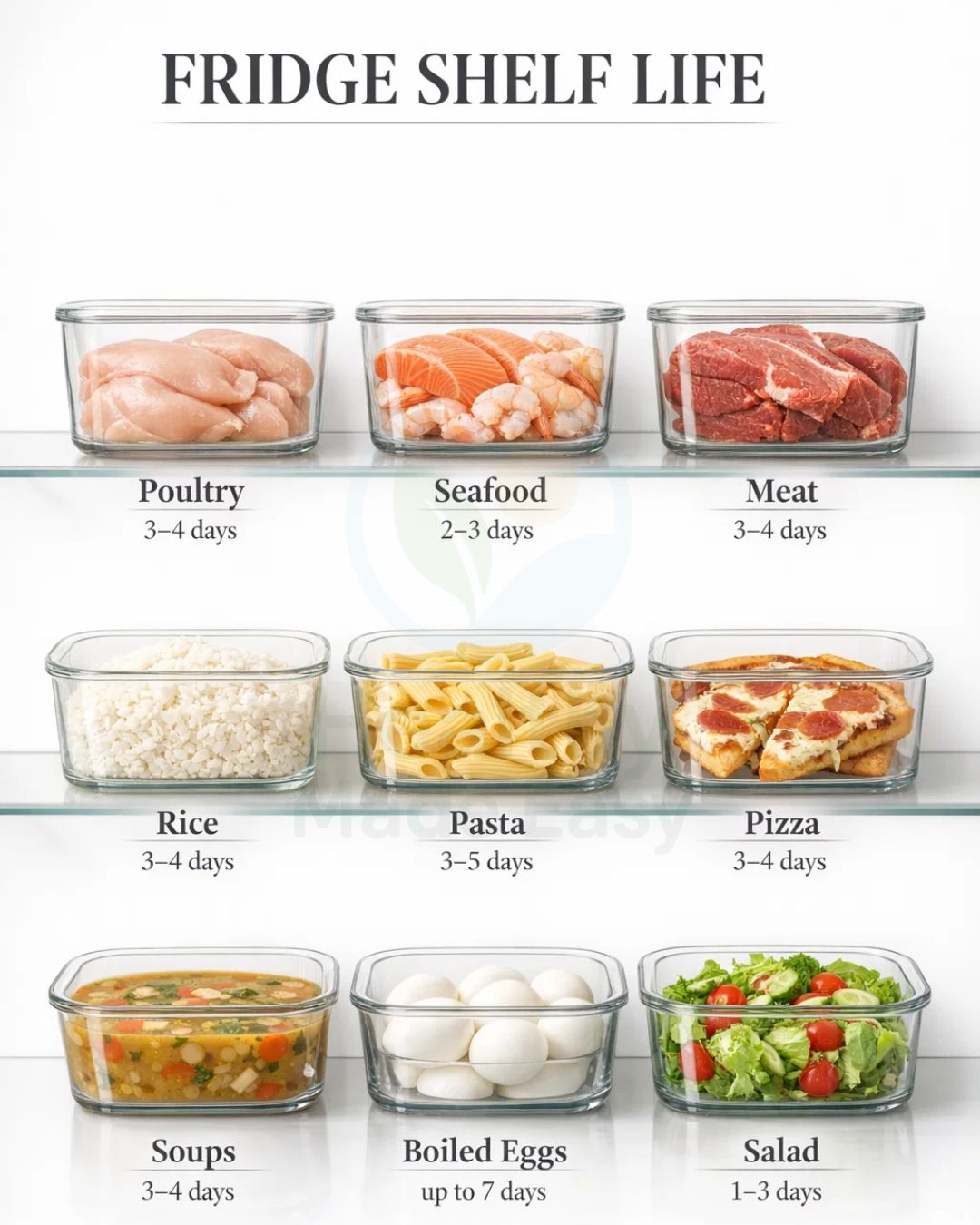
Fridge Shelf Life Cheat Sheet
1. Poultry: 3–4 days
Cooked chicken or turkey leftovers should generally be eaten within 3–4 days when stored properly in the refrigerator.
Best habit: Portion into shallow containers so it cools quickly and evenly.
2. Seafood: 2–3 days
Seafood is more delicate than many other proteins, so aim to eat it sooner rather than later. The “short limits” approach is a safety-first rule for refrigerated foods.
Best habit: If you won’t eat seafood within 2 days, freeze it for quality and peace of mind.
3. Meat: 3–4 days
Most cooked meats and mixed leftovers follow the 3–4 day guideline in the fridge.
Best habit: Reheat leftovers thoroughly. Food safety guidance commonly recommends reheating leftovers until hot (and many sources use 165°F / 74°C as the target).
4. Rice: 3–4 days
Cooked rice is safe for only a short window in the fridge. This matters because rice can be associated with bacteria that grow if it sits too long or cools slowly.
Best habit: Cool rice quickly (spread it out or use shallow containers), then refrigerate promptly.
5. Pasta: 3–5 days
Cooked pasta generally lasts a little longer than rice, but it still has a limit. Treat pasta like any other leftover: airtight container, quick cooling, and a clear “use by” day.
Best habit: If it’s day 4–5 and you’re unsure, don’t taste-test. When in doubt, throw it out.
6. Pizza: 3–4 days
Leftover pizza counts as leftovers, and the 3–4 day guideline applies.
Best habit: Store slices in a sealed container (or tightly wrapped) so they don’t dry out and so they stay protected from fridge odors.
7. Soups: 3–4 days
Soups are a common “meal prep” favorite—and they still follow the same 3–4 day leftover guideline.
Best habit: Divide big pots into smaller containers before refrigerating. This helps the soup cool faster, which reduces the time it spends in the temperature “danger zone.”
8. Boiled eggs: up to 7 days
Hard-cooked eggs can be stored in the refrigerator for up to one week after cooking (in the shell or peeled), as long as they are refrigerated within two hours.
Best habit: Date them. Boiled eggs are easy to forget because they look “fine” for days.
9. Salad: 1–3 days
Salads are highly variable, but the short window is a smart rule – especially for dressed greens or prepped salads that get watery fast. Food safety charts emphasize short time limits to keep refrigerated foods from becoming unsafe.
Best habit: Store dressing separately and keep greens as dry as possible.
10. Cooked Beans (lentils, chickpeas, black beans): 3–5 days
Cooked beans are a meal-prep favorite, but they still follow standard leftover safety rules.
Why this matters:
-
Beans are moist and protein-rich, which allows bacteria to grow if stored too long.
-
Mixed bean dishes (with rice, vegetables, or sauce) usually spoil faster.
Best habit:
Store beans in airtight containers, refrigerate within 2 hours, and reheat until steaming hot before eating.
11. Cooked Vegetables (steamed or roasted): 3–5 days
Plain cooked vegetables generally last slightly longer than mixed dishes, especially if they are not dressed with sauces.
Why this varies:
-
Vegetables with oil or seasoning hold moisture differently.
-
Vegetables mixed with protein shorten overall shelf life.
Best habit:
Keep cooked vegetables dry, store separately from sauces, and use them earlier in the week to maintain both safety and texture.
12. Sauces & Gravies (homemade): 3–4 days
Homemade sauces, gravies, and pan sauces count as leftovers and should not be treated like store-bought condiments.
Why this matters:
-
They often contain meat drippings, dairy, or starch.
-
These ingredients increase spoilage risk when stored too long.
Best habit:
Cool sauces quickly, label the container with a date, and discard anything older than 4 days—even if it smells fine.
The 3 Rules That Make These Timelines Actually Work
1) Cool fast, then seal
The fridge is not designed to rapidly cool large, hot pots. Dividing leftovers into shallow containers is one of the most effective food-safety habits you can adopt.
2) Use the “2-hour rule”
Do not leave cooked food sitting out “until later.” Refrigerate within 2 hours (or 1 hour if it’s very hot outside).
3) Don’t rely on smell or looks
This one surprises people. Bacteria that cause illness do not always change taste, smell, or appearance.
When You’ll Notice Relief (A Realistic Timeline)
- Immediately: Less stress at the fridge door, because you’re not guessing anymore.
- Within 1 week: Fewer “mystery stomach” moments from questionable leftovers, especially with rice and seafood.
- Within 2–3 weeks: Less food waste, because you start planning your leftovers on purpose.
Quick Safety Notes
- These timelines assume your fridge is at 40°F / 4°C or below. If your fridge runs warm, shorten the timeline.
- If you are pregnant, older, immunocompromised, or feeding young children, it is smart to be extra conservative with leftovers.
Final Takeaway
This is the simplest way to use the guide: most leftovers = 3–4 days, seafood sooner (2–3 days), boiled eggs up to 7 days, and salad quickly (1–3 days). Clear timelines beat guesswork—every time.
Related Source Science
- USDA FSIS: Leftovers and food safety (general 3–4 day guideline). (FSIS USDA)
- Mayo Clinic: Why leftovers become riskier after 3–4 days, and why you can’t trust smell/appearance. (Mayo Clinic)
- FoodSafety.gov + FDA storage charts: Short time limits for refrigerated foods to reduce risk. (FoodSafety.gov)
- FDA: Hard-cooked eggs should be eaten within 1 week. (U.S. Food and Drug Administration)