These plants can survive and continue growing in water for a period of time, and in some cases quite well, not because they “do not need soil,” but because:
Plants do not actually require soil as a mandatory substance. What they need are five main things: water, oxygen for the roots, light, carbon dioxide, and mineral nutrients.
In nature, soil mainly acts as a support medium that anchors roots, holds water, stores nutrients, and allows gas exchange around the root zone.
So if you replace the function of soil with clean water + dissolved oxygen + light + sometimes added nutrients, many plants can still grow. Here is the detailed scientific explanation.
1. From a plant physiology perspective: why do plants not necessarily need soil?
Soil is not the plant’s “food”
This is one of the most common misunderstandings. Plants do not “eat soil.” Most of a plant’s mass comes from:
- carbon dioxide (CO2) in the air
- water (H2O)
- light for photosynthesis
Through photosynthesis, plants make sugars, cellulose, leaves, stems, and roots.
Soil mainly provides:
- water
- mineral ions such as N, P, K, Ca, Mg, S, Fe, and others
- physical anchorage for roots
- a medium for gas exchange
That is why, if roots can still access water and dissolved minerals from a water-based environment, a plant can continue to live. This is the basic principle behind hydroponics.
Roots absorb nutrients as ions dissolved in water
Even when a plant grows in soil, the roots are not absorbing “soil” itself. They absorb mineral nutrients that are already dissolved in soil water, such as:
- nitrate NO3-
- ammonium NH4+
- potassium K+
- calcium Ca2+
- magnesium Mg2+
When you place a plant in water, the roots can still absorb water and any nutrient ions available in that water.
Roots need oxygen, not just water
This is the most important point: roots being able to live in water does not mean roots like to be completely suffocated in stagnant water.
Roots need oxygen for cellular respiration so they can produce ATP, the energy required for nutrient uptake and tissue maintenance. If the water becomes stagnant and low in oxygen, roots will:
- respire less efficiently
- accumulate toxic byproducts
- become more vulnerable to bacteria and fungi that cause root rot
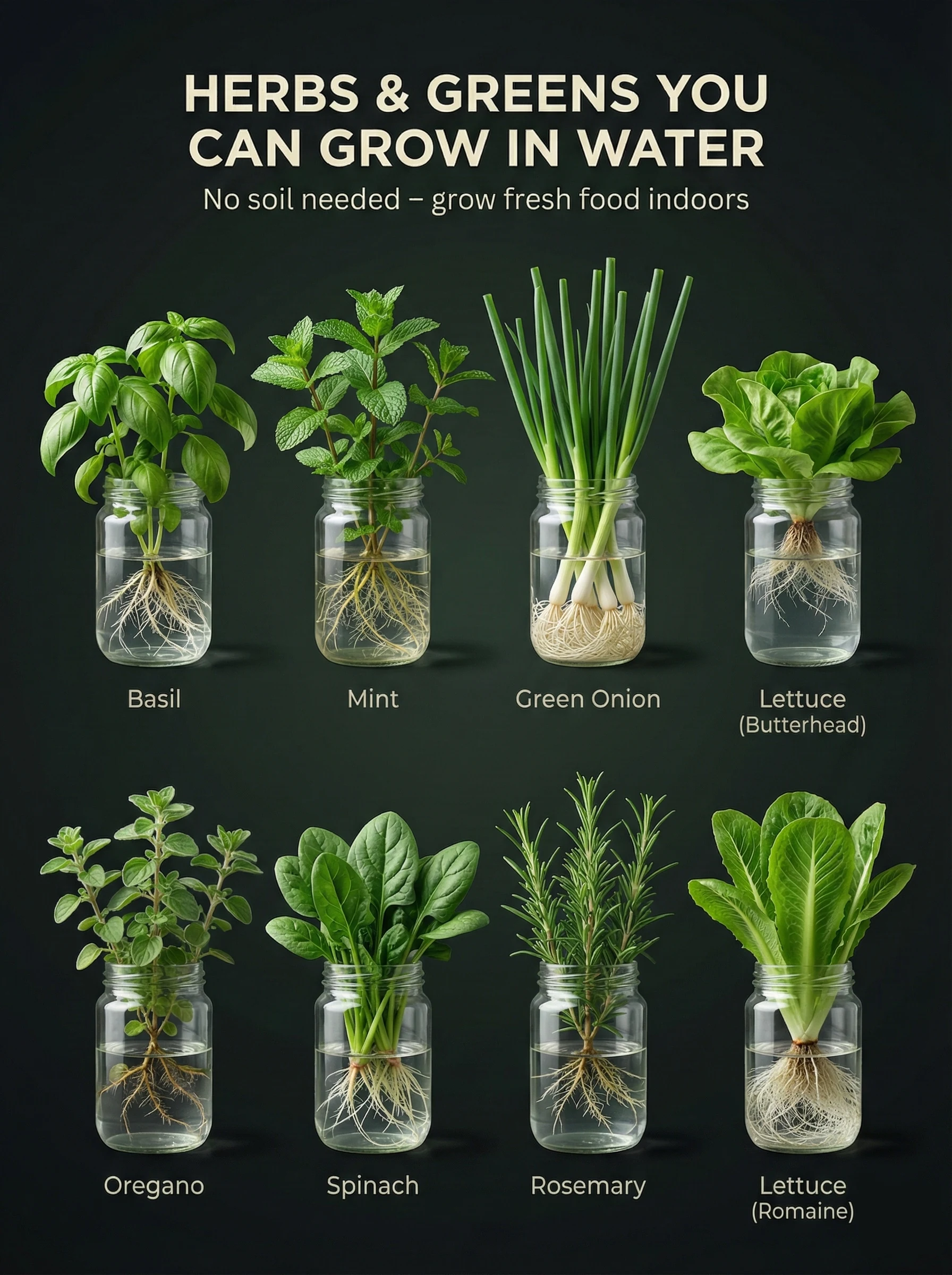
So the plants in the image can grow in water because:
- they are able to produce water-adapted roots
- the water still contains some dissolved oxygen
- the water level does not submerge the leaves and most of the stem
- people usually change the water regularly
2. Why are the specific plants in the image suited to growing in water?
These plants share several biological characteristics.
(a) They have a strong ability to form adventitious roots
Adventitious roots are roots that grow from:
- stems
- stem nodes
- leaf bases
- crown tissue
- wounded or cut tissues
Many soft-stemmed herbs and leafy vegetables have internal hormone balances that favor root formation, especially auxin. When a cutting is placed in a moist environment or in water:
- auxin accumulates near the cut site
- soft tissues around the vascular bundles respond
- callus and root initials begin to form
- new roots emerge
This is why basil, mint, green onion, and oregano root so easily.
(b) They have soft stem tissue and vascular systems that function well in moist environments
Soft-stemmed or lightly woody plants often adapt more easily to water because:
- their tissues are less heavily lignified
- water moves through their stems more easily
- cut surfaces are more likely to produce new roots
By contrast, strongly woody plants with root systems highly specialized for soil often struggle more in water.
(c) Their early nutrient demand is not extremely high
When a cutting is first placed in water, it does not immediately need large amounts of nutrients because it can use:
- stored sugars in the stem and leaves
- mineral reserves within its tissues
- energy from ongoing photosynthesis
So in the beginning, clean water and sufficient light are often enough for rooting and short-term maintenance.
(d) Some of these plants are naturally flexible survivalists
For example:
- mint is vigorous and loves moisture
- green onion and other alliums have very strong basal growth tissues
- lettuce and spinach have soft tissues and rapid life cycles
- basil roots very easily from cuttings
- oregano can root readily at the nodes
These are “fast-response” plants that quickly take advantage of favorable conditions.
3. Scientific explanation
Basil
Why can it grow in water?
Basil is a soft-stemmed plant with many nodes, and it forms roots readily from those nodes. At the cut site, auxin stimulates the formation of adventitious roots fairly quickly.
Biological strengths
- fast growth rate
- soft stem tissue
- efficient photosynthesis under good light
- strong ability to produce new roots in a moist environment
Important note
Basil grows well in water in the short to medium term. For long-term healthy growth, it usually benefits from diluted hydroponic nutrients.
Mint
Why is it especially suited to water?
Mint is one of the easiest plants to keep in moist environments because in nature it already thrives in damp soil and spreads aggressively by stems and runners.
Main mechanisms
- nodes root very easily
- stems grow vigorously
- the plant has a high capacity for regeneration
- its tissues tolerate high moisture better than many other herbs
Conclusion
Mint is one of the easiest and most reliable plants for simple water growing.
Green Onion
Why does it regrow with only water?
The base of a green onion still contains:
- the basal plate
- active meristematic tissue
- root initials or young roots
- stored nutrients in the lower stem
When placed in water, the base continues taking up water and pushing out new green leaves.
Important point
This is not “growth from nothing.” It is regrowth from living tissue that remains in the base.
Limitation
Green onions can regrow several times, but without added nutrients they usually become weaker over time.
Lettuce / Romaine / Butterhead
Why does the base keep growing?
The base of the lettuce head still contains central growing tissue. When placed in water:
- the tissue continues dividing
- it takes up water through the base
- new leaves emerge
But it has limits
Lettuce regrown in water often:
- produces smaller leaves
- does not usually recreate a full market-sized head
- becomes nutrient-limited if kept too long
So this method is better for “regrowing extra leaves” than for indefinite water culture.
Oregano
Why can it root in water?
Oregano roots fairly easily from stem nodes, although it is a bit firmer and more woody than basil or mint.
Important clarification
Oregano can root in water, but for long-term vigorous growth it still prefers a well-drained environment with good oxygen around the roots and more stable nutrition than plain water can provide.
Spinach
Why can it survive in water?
Spinach has soft tissues, fine roots, and a rapid life cycle. If you start with a young plant or a living crown/base, it can continue taking up water and growing for a while.
However
Spinach is not one of the very best long-term plain-water plants. It performs better in a true hydroponic system with nutrient solution.
Rosemary
This one needs a more careful explanation
Rosemary can produce roots in water from soft cuttings, but it is not an ideal plant for long-term growth in plain water.
Why can it still root?
- soft young stems are capable of producing adventitious roots
- the cutting can use stored reserves at first
Why is it less suitable for long-term water culture?
Rosemary is a semi-woody plant that prefers:
- very airy root conditions
- sharply drained soil
- environments that are not constantly waterlogged
So while it may root in water, long-term water culture often leads to slow growth or root decline if oxygen is limited.
Scientific conclusion:
rosemary is often suitable for water rooting as a propagation step, but not always ideal for long-term growth in plain water.
4. Does “no soil needed” mean “plain water is enough forever”?
Not exactly.
This is where many people misunderstand the concept.
A plant can survive for a period of time using:
- water
- light
- internal stored reserves
- small amounts of minerals already present in the water
But if you want long-term healthy growth, good leaf development, strong color, and real productivity, the plant still needs:
- nitrogen
- phosphorus
- potassium
- calcium
- magnesium
- trace elements
So there are really two different levels:
Level 1: The plant can survive or root in water
Most of the plants in the image can do this.
Level 2: The plant can grow well long term in water
This usually requires:
- regular water changes
- sufficient oxygen
- added nutrient solution
- adequate light
That is closer to semi-hydroponics or full hydroponics.
5. Why is changing the water important scientifically?
Changing the water is not just about making it “cleaner.” It matters for four physiological reasons.
(a) It increases dissolved oxygen
Fresh water typically contains more dissolved oxygen than old stagnant water.
(b) It reduces harmful microbes
Old water tends to accumulate bacteria and fungi, especially if leaves or decaying tissue are present.
(c) It removes metabolic waste
Roots and microorganisms release byproducts that can build up and become harmful over time.
(d) It helps maintain better ion balance and pH
Water that sits too long may shift in pH, accumulate salts, or become less suitable for nutrient absorption.
6. Why should leaves not be submerged?
Scientifically, submerged leaves are more likely to suffer from:
- reduced gas exchange
- soft tissue breakdown
- bacterial attack
- localized oxygen deficiency
- tissue rot
So in water growing:
- only the roots or base should be in water
- the leaves should stay above the water line
7. Why do “water roots” differ from “soil roots”?
This is a very interesting adaptation.
When a plant changes environment, it may produce a different type of root better suited to the new conditions.
Water roots are often:
- thinner
- paler
- less structured for soil friction
- adapted to constant moisture
Soil roots are often:
- more robust against physical soil contact
- better adapted to air pockets in soil
- more closely associated with soil microorganisms
That is why a plant moved from soil into water often needs time to adjust. Some old soil roots may decline, and the plant may produce new water-adapted roots.
8. What conditions help these plants do well in water?
Light
They usually need bright indirect light.
If light is too weak:
- stems stretch
- leaves become pale
- photosynthesis slows
- rooting becomes weaker
Temperature
Most of these plants prefer moderate warmth:
- if too cold, metabolism slows
- if too hot, water loses oxygen faster and roots are more likely to rot
Water quality
Clean water with lower chlorine stress and regular changes is better.
Nutrition
If the plant is kept only for days or a few weeks, nutrients may not be urgently needed.
If it is kept longer, diluted nutrient solution is usually beneficial.
9. Which plants do best in water, and which are more temporary?
Usually easiest and more reliable
- Mint
- Basil
- Green onion
- Some lettuce regrowth projects
Can root in water but usually need better long-term management
- Oregano
- Rosemary
- Spinach
This does not mean those plants “cannot grow in water.” It simply means:
- rooting in water
and - living strongly long term in water
are not exactly the same thing.
10. Scientific summary
These plants can grow in water because:
- Plants do not truly require soil; they require water, oxygen, light, and mineral nutrients
- Roots naturally absorb minerals in dissolved form
- These plants form adventitious roots readily from stems or bases
- They have soft tissues, high regenerative ability, and good adaptation to moisture
- They can use internal reserves during the early rooting stage
- If the water stays clean and oxygenated, roots can still respire
- For long-term growth, plants still need nutrients—not just plain water
In other words:
Soil is not a mandatory substance for plant life. Soil is simply a system that provides water, nutrients, oxygen, and support for roots. If water can replace most of those functions, the plant can still grow.