It can hold dozens of baby mantises, and in some cases the number may reach around 100 to 200.
So before you prune, toss, chip, burn, or bag garden branches, it is worth checking for these little natural pest-control capsules.
One saved branch today may mean a small army of predators waking up in your garden when warm weather returns.
A gentle reality check: praying mantises are helpful predators, but they are not magic pest erasers.
They may eat aphids, flies, beetles, caterpillars, moths, and other small insects, but they can also eat beneficial insects when available.
Still, protecting an egg case you already have is one of the easiest low-effort ways to support a more balanced backyard ecosystem.
Why it works:
- Overwintering protection: The egg case is built to protect developing mantises through cold weather.
- Spring timing: Many hatch when temperatures warm and insects become active again.
- Free garden support: If the egg case is already in your yard, you do not need to buy anything.
- Predator diversity: Mantises add one more layer to a garden that already uses birds, spiders, ladybugs, and healthy soil.
- No spray required: Saving an ootheca supports pest pressure management without reaching for harsh chemicals first.
If you find one, your next decision is simple: leave it in place if the branch is safe, or move the whole branch gently to a sheltered garden spot if you must prune.
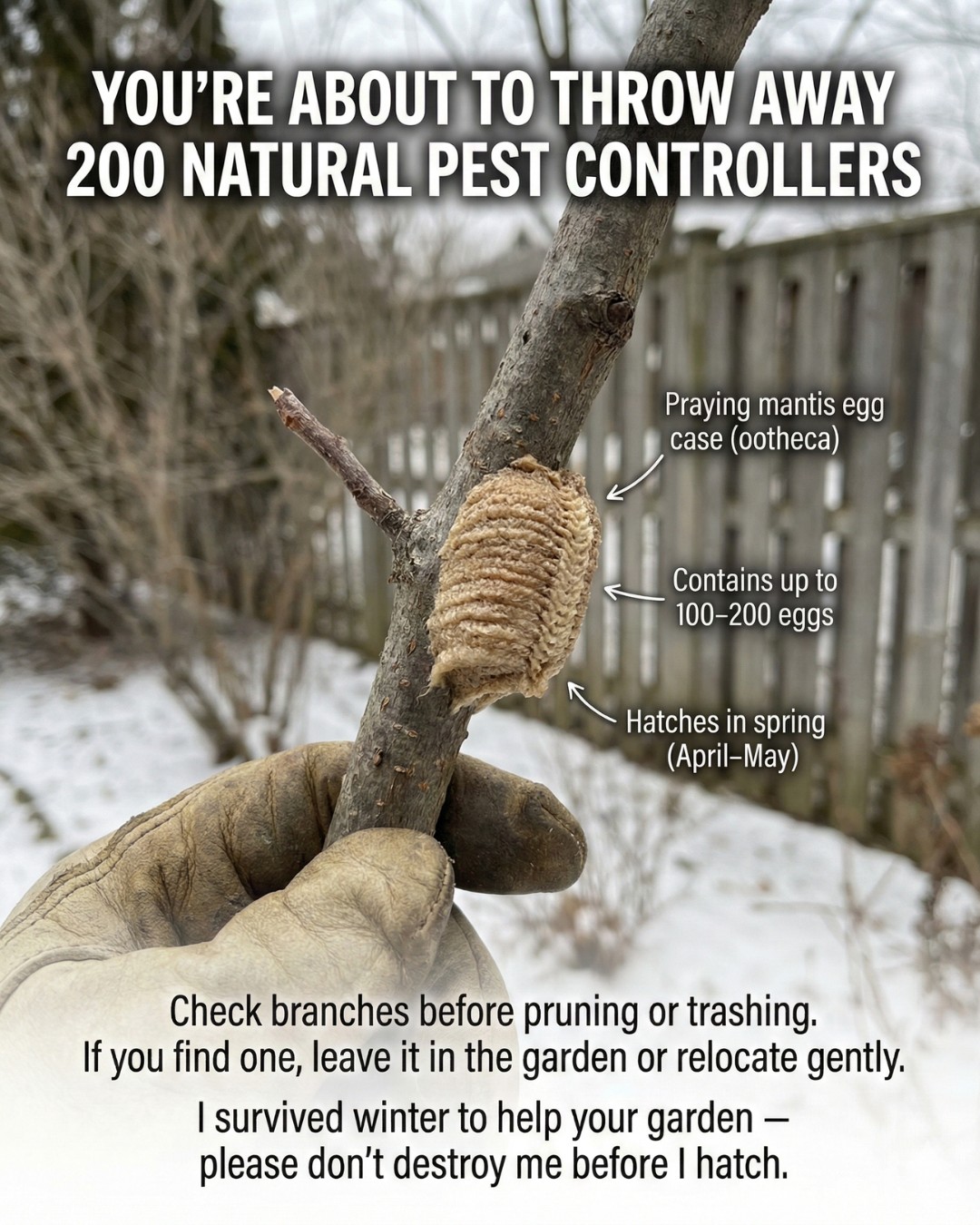
How to identify a praying mantis egg case
A praying mantis egg case usually looks like a tan, beige, brown, or straw-colored foamy mass attached to a twig, stem, fence, plant stake, shrub, or outdoor structure.
It often feels firm and dry from the outside, not wet or jelly-like.
Quick identification checklist
- Shape: Oval, rounded, ridged, pouch-like, or foamy depending on the mantis species.
- Color: Usually tan, light brown, beige, or weathered straw.
- Texture: Looks like hardened foam or dried expanding insulation.
- Location: Often attached firmly to twigs, stems, fences, vines, plant supports, or shrub branches.
- Season: Commonly noticed in fall, winter, or early spring when leaves are gone.
- Size: Often around 1 to 2 inches long, though this varies.
What it is not
- It is not a wasp nest if it is a small solid foam-like case attached directly to a twig.
- It is not a fungus if it has a structured, hardened, pouch-like form.
- It is not trash or bark damage if it is clearly attached as a separate tan mass.
If you are unsure, do not scrape it off right away. Take a photo, compare it with local mantis ootheca examples, or place the branch aside in a safe garden area until you can identify it more confidently.
How to move a praying mantis egg case safely
The safest method is to move the branch or stem it is attached to, not the egg case itself.
Scraping, peeling, squeezing, or twisting the case can damage the protective structure.
Simple relocation method
- Cut wide around it: Use clean pruners and leave at least 4 to 6 inches of branch on both sides of the egg case if possible.
- Keep the same side facing up: Try to preserve the original position so the case is not flipped or buried against a surface.
- Choose a sheltered spot: Place it in a shrub, perennial bed, vegetable garden edge, or near a fence protected from heavy foot traffic.
- Set it 2 to 4 feet above ground: This helps reduce flooding, trampling, and some ground-level disturbance.
- Tie the branch loosely: Use garden twine, jute string, or a soft plant tie. Do not wrap over the egg case.
- Keep it outdoors: Do not bring it into a heated home unless you are intentionally managing hatching, because warmth can trigger early emergence.
Best placement in the garden
Place the branch near plants that often attract small insects, such as vegetables, herbs, berry bushes, flowering perennials, or mixed borders.
Do not put it directly where you plan to spray, power-wash, heavily mulch, or cut back again.
Best praying mantis egg case for garden pest control
The best praying mantis egg case for garden pest control is usually the one already adapted to your outdoor conditions and already present in your yard.
If you discover one while pruning, saving it is often better than removing it and buying another later.
Leave it in place when possible
If the egg case is attached to a branch that does not need to be removed, the easiest option is to leave it alone.
Nature already selected that spot, and the ootheca has likely survived rain, wind, snow, and freezing temperatures there.
Move it only when needed
Move it if the branch is being pruned, chipped, hauled away, burned, or placed in municipal yard waste.
The goal is not to “rescue” every case from a stable spot, but to avoid accidentally destroying one during cleanup.
Support mantises with habitat
- Keep some shrubs, grasses, and flowering plants for cover.
- Avoid broad-spectrum insecticides where you want beneficial insects to thrive.
- Grow flowers that attract a variety of small insects, which supports a broader food web.
- Leave a few undisturbed garden edges when practical.
- Use targeted pest control only when damage is actually becoming a problem.
A mantis egg case is most useful when it is part of a bigger garden strategy, not the only tool you rely on.
What to look for before you buy a praying mantis egg case
Buying an egg case can be tempting, especially if you want a more natural approach to pest control.
Before you order one, check a few details so you do not accidentally choose a poor-quality, poorly timed, or ecologically questionable option.
Buying guide checklist
- Species clarity: Look for a seller that clearly lists the mantis species, not just “garden mantis eggs.”
- Regional fit: Prefer species appropriate for your region and avoid vague imported options.
- Hatch timing: Choose a shipping window that matches your outdoor season so the egg case does not hatch too early indoors.
- Storage instructions: A good seller should explain how to keep the ootheca cool, ventilated, and protected before release.
- Release directions: Look for practical placement guidance, including height, shade, shelter, and outdoor timing.
- No chemical exposure: Avoid egg cases that may have been stored near pesticides or treated plants.
- Ventilated packaging: Packaging should protect the case without sealing it in damp, mold-prone conditions.
- Realistic claims: Be cautious of sellers promising total pest elimination.
- Clear refund policy: Hatch rates vary, so choose a seller with transparent expectations.
- Garden readiness: Do not buy if your yard has no cover, no insects, or regular pesticide use.
What to avoid
- Listings with no species name.
- Claims that mantises will eliminate every pest.
- Egg cases shipped during extreme heat without protection.
- Instructions telling you to keep the egg case in a warm indoor room for long periods.
- Using purchased mantises as a replacement for soil health, plant spacing, pest monitoring, and habitat diversity.
If you already have a mantis egg case in your yard, start there first. It is free, already weather-tested, and easier to integrate into your existing garden.
Praying mantis egg case for vegetable garden pests
A praying mantis egg case can support a vegetable garden, especially when your goal is to reduce pest pressure without immediately reaching for sprays.
However, mantises are generalist hunters, so they do not target only the pests you dislike.
Pests mantises may help with
- Aphids
- Small flies
- Moths
- Small caterpillars
- Leafhoppers
- Beetles
- Small grasshoppers
- Other soft-bodied or slow-moving insects they can catch
Where to place an egg case near vegetables
- Near tomatoes, peppers, beans, cucumbers, squash, herbs, or flowering companion plants.
- Along the edge of the bed rather than directly in the middle of a high-traffic path.
- On a branch, stake, shrub, or trellis 2 to 4 feet above ground.
- Near cover so tiny nymphs are not exposed immediately after hatching.
Do not expect instant control the day it hatches. Baby mantises are tiny, and many will disperse or be eaten by other animals.
The benefit is more about adding predator pressure over time than creating a guaranteed pest-control wall.
Common Mistakes + Quick Fixes
- Mistake: Tossing pruned branches straight into yard waste. Why it matters: You may throw away overwintering beneficial insects. Fix: Inspect twigs and stems before bagging or chipping.
- Mistake: Scraping the egg case off the branch. Why it matters: The case can tear or lose protection. Fix: Cut and move the whole branch section instead.
- Mistake: Bringing it into a warm house. Why it matters: Warmth may trigger early hatching when there is no outdoor food. Fix: Keep it outdoors or in a cool, protected, unheated area only when necessary.
- Mistake: Tying string over the ootheca. Why it matters: Pressure can damage it or block emergence. Fix: Tie only the branch, leaving the case fully exposed.
- Mistake: Placing it on the ground. Why it matters: It may get soaked, stepped on, buried, or eaten. Fix: Secure it 2 to 4 feet above ground.
- Mistake: Spraying nearby plants after release. Why it matters: Broad sprays can harm the same predators you are trying to support. Fix: Use pest-specific methods and avoid spraying the release area.
- Mistake: Expecting mantises to protect every plant. Why it matters: They move, disperse, and hunt opportunistically. Fix: Combine them with row covers, hand-picking, companion planting, and regular pest checks.
Safety Note
Handle the egg case gently and avoid crushing, soaking, heating, or scraping it.
Wear gloves when pruning if you are handling thorny branches, moldy yard debris, or unknown insect structures.
Keep egg cases away from indoor living spaces because accidental early hatching can release many tiny mantises where they cannot survive well.
If you use pesticides, do not place the egg case in an area that will be sprayed. Avoid releasing purchased mantises into sensitive natural areas where local species balance matters.
Timeline: What to Expect After You Save One
Same day
You can inspect the branch, confirm the egg case, and decide whether to leave it or relocate it.
If you move it, secure it gently in a protected outdoor spot with the egg case exposed to natural air and seasonal temperatures.
After 1 week
You may not see any visible change, and that is normal.
Check only to make sure the branch is still secure, not buried in mulch, not covered by debris, and not placed where it will be sprayed or disturbed.
After 2 to 4 weeks of warmer spring weather
Hatching may begin when conditions are warm enough, although timing varies by region, species, and weather.
When they emerge, the nymphs are small and quick. Many will spread out through the garden looking for tiny prey.
Once you know what to look for, winter pruning becomes a little more interesting. Every twig is worth a quick second glance before it goes into the trash pile.
FAQ
What is the best praying mantis egg case for garden pest control?
The best option is often an egg case already found in your yard, because it has survived your local winter conditions and is already positioned in the environment.
If buying one, look for a clearly labeled species, realistic hatch instructions, and guidance that fits your region.
What should you look for before you buy a praying mantis egg case?
Look for species identification, regional suitability, safe shipping practices, clear storage instructions, and realistic claims.
Avoid vague listings that promise complete pest control or do not explain how and when to release the egg case.
How do you identify a praying mantis egg case?
Look for a tan or brown hardened foam-like case attached to a twig, stem, fence, or plant support.
It is usually firm, ridged or pouch-like, and commonly noticed in winter or early spring when leaves are off the branches.
How do you move a praying mantis egg case safely?
Cut the branch section around it and move the whole piece instead of scraping the case off.
Tie the branch loosely 2 to 4 feet above ground in a sheltered garden area, keeping the egg case exposed and undamaged.
Is a praying mantis egg case good for vegetable garden pests?
It can help support natural pest control in a vegetable garden, especially as part of a diverse garden ecosystem.
Mantises may eat some common pests, but they are generalist predators and will not target only harmful insects.
When do praying mantis egg cases hatch?
Many hatch in spring as temperatures warm, often around the same general period when insects become active again.
Exact timing depends on local weather, species, sun exposure, and whether the egg case has been kept outdoors naturally.
Can I keep a praying mantis egg case inside?
It is usually better to keep it outdoors or in a cool, protected, unheated space if temporary holding is necessary.
A warm indoor room can cause early hatching before there is enough outdoor prey or suitable habitat.
Should I buy praying mantis egg cases or attract beneficial insects naturally?
For most home gardens, attracting beneficial insects naturally is the stronger long-term strategy.
Plant diversity, reduced pesticide use, flowers, cover, and healthy soil can support mantises along with many other helpful predators.
If you decide to buy, compare species, timing, shipping conditions, and release instructions before choosing. A good egg case is only useful when the garden around it can actually support the nymphs after they hatch.
Final Takeaway
- A tan foam-like lump on a winter branch may be a praying mantis egg case, not garden debris.
- Check branches before pruning, chipping, burning, or trashing them.
- If the branch can stay, leave the egg case where it is.
- If the branch must be removed, cut a section around the case and relocate it gently outdoors.
- For buying, choose clear species labeling, realistic instructions, and region-appropriate options.
- Use mantises as part of a broader natural pest-control plan, not as a guaranteed one-step fix.