The best vegetable garden design ideas combine food, flowers, herbs, paths, compost, vertical supports, and beauty in one useful space.
Raised beds, fruit trees, edible flowers, herb spirals, strawberry borders, and colorful vegetables can turn a backyard into a productive garden that feels designed, not accidental.
The payoff is simple: easier harvests, better access, fewer wasted corners, and a garden you actually want to spend time in.
A beautiful layout still needs practical basics.
Sunlight, water access, soil depth, path width, and crop spacing matter more than decoration alone.
When the structure is right, the pretty details become easier to maintain.
Why it works:
- Raised beds define the space: They make planting areas clear and easier to manage.
- Paths prevent compaction: Walking areas protect the soil where vegetables grow.
- Vertical supports save room: Beans, peas, cucumbers, and small squash can grow upward.
- Flowers attract pollinators: Zinnias, calendula, nasturtiums, and sunflowers add color and insect activity.
- Compost closes the loop: A nearby compost bin turns garden waste into future soil improvement.
Before buying beds, trellises, or plants, decide how you want to move through the garden. A good path plan makes every other choice easier.
Best vegetable garden design ideas for backyard
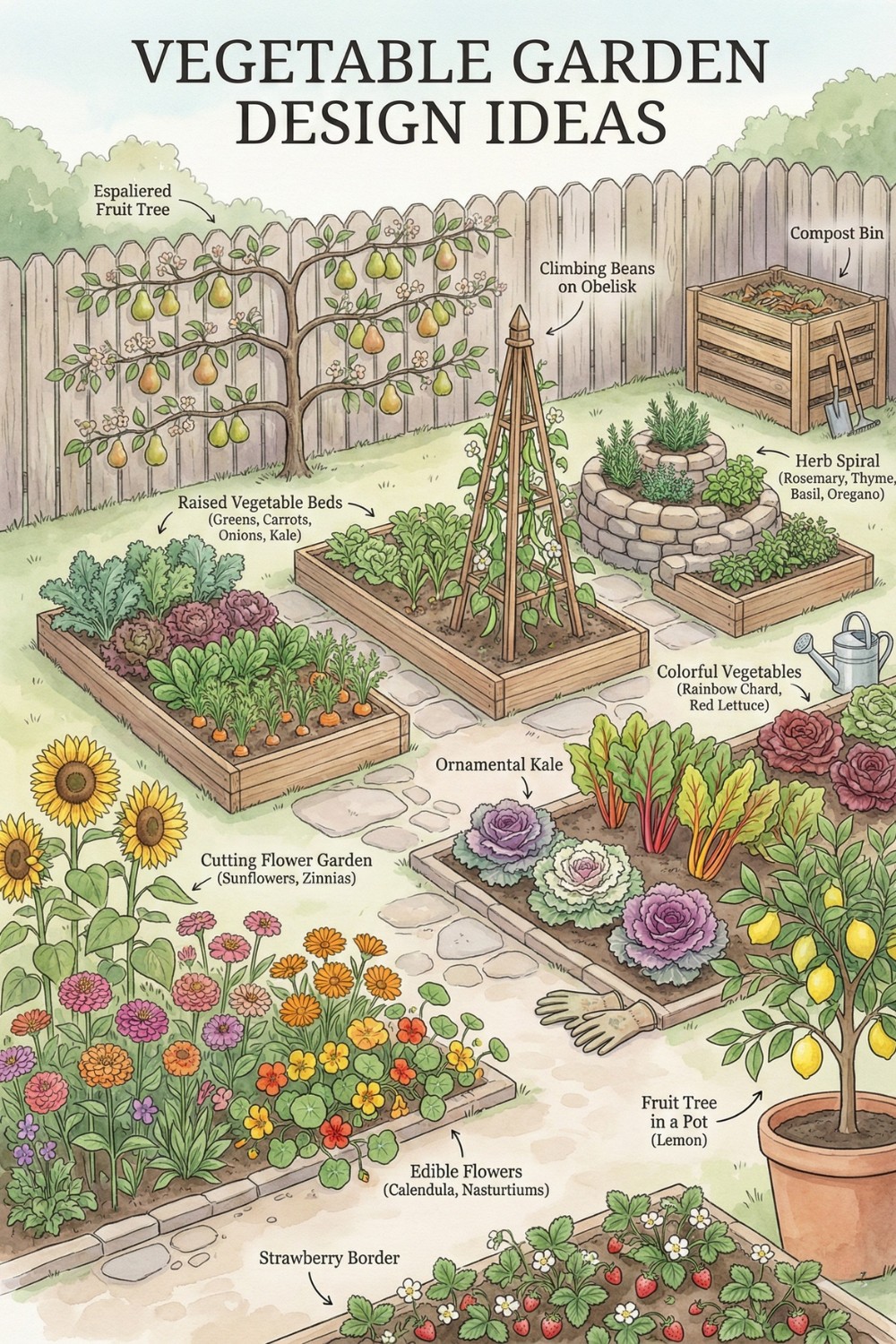
A strong backyard vegetable garden usually mixes structure with softness.
Use beds, paths, and vertical elements for order, then add herbs, flowers, fruit, and edible borders for color and interest.
Design ideas worth borrowing
- Raised vegetable beds: Use 4-foot-wide beds so you can reach the center from either side.
- Climbing bean obelisk: Add height in the middle of a bed with beans, peas, or flowering vines.
- Espaliered fruit tree: Train apples, pears, or other suitable fruit along a fence to save space.
- Herb spiral: Create a compact herb feature with dry-loving herbs at the top and moisture-loving herbs near the bottom.
- Compost corner: Place compost near the garden but not directly in the main walkway.
- Cutting flower strip: Use sunflowers, zinnias, calendula, and nasturtiums to bring pollinators and color.
- Strawberry border: Edge a bed or path with strawberries for a low edible groundcover effect.
- Fruit tree in a pot: Use a dwarf citrus or compact fruit tree where climate and container care allow.
- Colorful vegetables: Mix rainbow chard, red lettuce, purple kale, and ornamental cabbage for visual impact.
Simple backyard layout formula
For a medium backyard, start with four 4-by-8-foot raised beds, 30-inch paths, one vertical trellis, one compost area, and one flower border.
This gives you structure without making the garden feel crowded.
What to look for before you buy raised garden bed kits
Raised bed kits can save time, but not every kit is worth the money.
Check the material, depth, size, hardware, and long-term maintenance before you buy.
Buying guide checklist
- Bed width: Choose 3 to 4 feet wide for easy reaching from both sides.
- Bed length: Common sizes like 4-by-4, 4-by-6, and 4-by-8 feet are easy to plan around.
- Depth: Aim for at least 10 to 12 inches for most vegetables; deeper beds help roots and drainage.
- Material: Cedar, redwood, galvanized metal, composite, and stone all have different costs and lifespans.
- Food-safe construction: Avoid questionable treated materials where edible crops will grow.
- Corner strength: Look for sturdy brackets or reinforced corners that will not bow under soil weight.
- Assembly: Check whether the kit needs drilling, special tools, or two-person setup.
- Expandable design: Modular kits are useful if you may add more beds later.
- Drainage: Bottomless beds usually drain well when placed over soil; containers need proper holes.
- Total soil cost: Calculate how much soil the bed needs before deciding it is affordable.
What to avoid
- Very shallow beds marketed for deep-rooted vegetables.
- Thin panels that bow when filled with wet soil.
- Kits with vague material descriptions.
- Bed sizes that leave paths too narrow for a wheelbarrow.
- Oversized layouts that are hard to water and maintain.
How to design a vegetable garden layout
Start with function first: sunlight, water, access, and crop rotation.
Then add beauty through shapes, edges, colors, and vertical focal points.
Step-by-step layout plan
- Track sun: Choose a spot with 6 to 8 hours of direct sun for most vegetables.
- Measure the area: Sketch the full space, including fences, gates, trees, sheds, and water access.
- Set path widths: Use at least 24 inches for walking paths and 30 to 36 inches for wheelbarrow access.
- Place beds: Keep beds 3 to 4 feet wide and leave room to reach every side.
- Add vertical elements: Put trellises, obelisks, or cattle panels where they will not shade shorter crops.
- Plan water: Add drip lines, soaker hoses, or a hose route before planting.
- Include flowers: Place pollinator flowers near squash, cucumbers, beans, tomatoes, and fruiting crops.
- Keep compost nearby: Make compost easy to reach but not in the center of the harvest path.
Crop placement tips
- Put tall crops on the north side of beds in most Northern Hemisphere gardens so they shade less.
- Keep herbs near paths or doors for easy harvesting.
- Grow heavy feeders like tomatoes, squash, and corn in rich soil with consistent water.
- Use quick crops like lettuce and radishes to fill gaps early in the season.
How to use flowers and herbs in a vegetable garden
Flowers and herbs make a vegetable garden more attractive, but they also help with pollinator activity, scent diversity, and space efficiency.
They work best when integrated intentionally instead of sprinkled randomly.
Good flower choices
- Zinnias: Bright, easy annuals for pollinator activity and cutting.
- Calendula: Edible petals and cheerful color for bed edges.
- Nasturtiums: Edible flowers that trail nicely along paths or bed corners.
- Sunflowers: Tall focal points that can support insects and birds later.
- Marigolds: Useful for color and classic vegetable garden borders.
Good herb placements
- Rosemary and thyme in dry, sunny corners.
- Basil near tomatoes and peppers for easy kitchen harvesting.
- Parsley along bed edges where it can be picked often.
- Mint only in pots, because it spreads aggressively in open soil.
- Chives near paths or bed corners for flowers and edible leaves.
Use flowers and herbs as living design tools. They can soften straight bed lines, fill awkward corners, and make the garden feel more abundant.
Vegetable garden design ideas for small yards
Small yards need fewer beds, smarter vertical space, and tighter crop choices.
The goal is to grow what you use most often while keeping the layout easy to water, harvest, and maintain.
Small-space ideas
- One 4-by-8-foot raised bed: Grow lettuce, herbs, peppers, carrots, and compact tomatoes.
- Two narrow beds: Use 2-by-8-foot beds along a fence or walkway.
- Vertical bean tower: Add climbing beans or peas on an obelisk for height.
- Container fruit tree: Use a dwarf citrus or patio fruit tree where climate allows.
- Strawberry edge: Grow strawberries along a sunny border or in tiered planters.
- Herb corner: Use pots for basil, parsley, thyme, oregano, and mint.
- Edible flower strip: Add calendula and nasturtium to brighten a small bed.
For small spaces, prioritize high-use crops like herbs, salad greens, tomatoes, peppers, strawberries, and compact beans.
Common Mistakes + Quick Fixes
- Mistake: Making beds too wide. Why it matters: You step into the soil to reach the center. Fix: Keep beds 3 to 4 feet wide.
- Mistake: Forgetting path width. Why it matters: Harvesting and hauling soil become frustrating. Fix: Use 24 to 36 inches depending on access needs.
- Mistake: Placing tall trellises on the wrong side. Why it matters: They may shade smaller crops. Fix: Put tall structures where they cast the least harmful shade.
- Mistake: Buying beds before calculating soil volume. Why it matters: Soil can cost more than expected. Fix: Calculate length times width times depth before buying.
- Mistake: Designing too large in year one. Why it matters: Maintenance gets overwhelming. Fix: Start with 1 to 4 beds and expand later.
- Mistake: Hiding herbs too far away. Why it matters: You harvest them less. Fix: Put herbs near a path, patio, or kitchen door.
- Mistake: Skipping flowers. Why it matters: The garden can feel bare and less attractive to pollinators. Fix: Add zinnias, calendula, nasturtiums, or sunflowers.
Safety Note
Use food-safe materials around edible crops and avoid questionable treated wood, painted scraps, or unknown salvaged materials in planting beds.
Lift stones, soil bags, and bed panels carefully, especially when building larger structures.
Keep compost bins managed properly so they do not attract pests or produce strong odors near seating areas.
Confirm that edible flowers are correctly identified before eating them, and avoid flowers treated with ornamental pesticides.
Timeline: What to Expect
Same day
You can measure the space, mark bed locations, and sketch a simple layout.
Place hoses, pots, stakes, or string on the ground to test the flow before building.
1 week
You may have beds assembled, paths roughed in, and soil delivered or mixed.
This is a good time to install trellises and water lines before plants fill the space.
2 to 4 weeks
Cool-season crops, herbs, and transplants may begin settling in.
The garden will start showing whether the path widths, watering access, and crop placement feel practical.
FAQ
What are the best vegetable garden design ideas for backyard spaces?
Strong backyard ideas include raised beds, wide paths, vertical trellises, compost bins, herb spirals, flower borders, strawberry edges, and container fruit trees.
The best layout is the one that matches your sun, space, water access, and maintenance time.
What should you look for before you buy raised garden bed kits?
Look for bed depth, material, corner strength, food-safe construction, size, drainage, assembly requirements, and total soil volume.
A kit that looks inexpensive may cost more once soil, hardware, and delivery are included.
How do you design a vegetable garden layout?
Measure your space, track sunlight, plan paths, choose bed sizes, place tall supports carefully, and keep water access close.
Then add herbs, flowers, compost, and edible borders to make the layout more useful and attractive.
How do you use flowers and herbs in a vegetable garden?
Use flowers near fruiting crops to support pollinators and place herbs near paths for easy harvesting.
Keep aggressive herbs like mint in containers so they do not take over the bed.
What are the best vegetable garden design ideas for small yards?
Use one or two raised beds, vertical supports, compact vegetables, container herbs, strawberry borders, and dwarf fruit trees.
Small gardens work best when every plant earns its space.
How wide should vegetable garden paths be?
Use at least 24 inches for walking and 30 to 36 inches if you need wheelbarrow access.
Wider paths can feel like wasted space, but narrow paths often become frustrating during harvest.
Can a vegetable garden be pretty and productive?
Yes. Use colorful vegetables, flowers, herbs, structured beds, clean paths, trellises, and edible borders.
A productive garden can look polished when the layout is intentional.
Before buying beds or plants, compare layout size, soil cost, path width, and maintenance time. A beautiful vegetable garden is easier to enjoy when the structure supports daily use.
Final Takeaway
- Good vegetable garden design starts with sunlight, access, water, and path flow.
- Raised beds work best when they are narrow enough to reach across.
- Flowers, herbs, fruit trees, and colorful vegetables make the garden more inviting.
- Vertical supports add height and save space.
- Raised bed kits should be judged by material, depth, size, hardware, and total soil cost.
- Start smaller than you think, then expand once the layout proves easy to maintain.