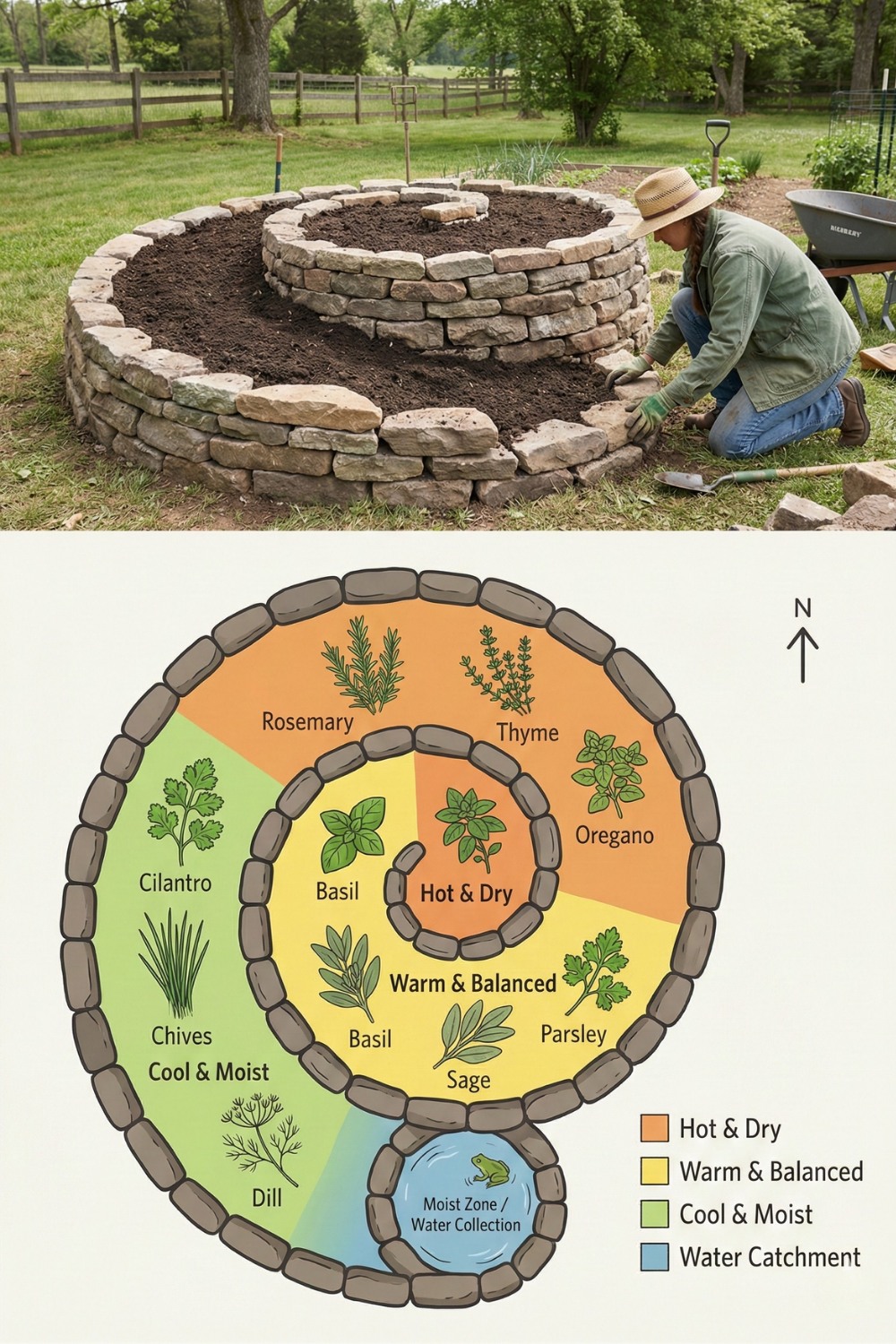
The spiral shape creates small growing zones: hot and dry near the top, warmer and balanced through the middle, and cooler or more moist near the bottom.
That means rosemary, thyme, oregano, basil, sage, parsley, cilantro, chives, and dill can all have better placement in one raised structure.
It is practical, beautiful, and especially useful when you want a kitchen herb garden without using a large bed.
A herb spiral is not maintenance-free.
It still needs proper drainage, quality soil, watering, pruning, and herbs matched to your climate.
But once built well, it can become one of the most efficient features in a backyard garden.
Why it works:
- Vertical use of space: The raised center gives you more planting surface in a small footprint.
- Microclimates: The top dries faster while lower sections hold more moisture.
- Easy harvesting: Herbs are grouped in one visible, reachable location.
- Good drainage: A raised spiral helps Mediterranean herbs avoid soggy roots.
- Visual structure: Stone or brick edges make the herb garden look intentional.
The key decision is whether you want a fast kit, a natural stone build, or a budget version using reclaimed materials.
Best herb spiral garden kit for backyard
The best herb spiral garden kit for a backyard is sturdy, food-safe, easy to assemble, and large enough for the number of herbs you actually use.
For most homes, a 5-to-6-foot-wide spiral gives enough room without taking over the yard.
Good backyard size
- Small spiral: 3 to 4 feet wide, best for 5 to 7 herbs.
- Standard spiral: 5 to 6 feet wide, best for 8 to 12 herbs.
- Large spiral: 7 feet or more, best for serious herb growers with plenty of space.
- Height: 24 to 36 inches at the center is practical for drainage and visual effect.
Kit vs DIY build
- Kit: Faster, more uniform, and easier for beginners.
- Natural stone: More organic-looking and long-lasting when built carefully.
- Brick or pavers: Clean appearance and easier stacking than irregular stone.
- Reclaimed material: Budget-friendly, but only use safe, clean materials around edible plants.
If you want a polished look quickly, choose a kit. If you want a garden feature with character, build with stone, brick, or pavers.
What to look for before you buy herb spiral materials
Herb spiral materials need to hold soil, drain well, resist shifting, and stay safe around edible plants.
Do not buy only by appearance. Weight, stability, and food safety matter.
Buying guide checklist
- Food-safe materials: Use natural stone, brick, untreated wood, concrete blocks designed for garden use, or galvanized edging made for planters.
- Wall stability: Choose pieces that stack securely and will not roll outward under soil pressure.
- Size consistency: Flat stones or pavers are easier to build with than very irregular rocks.
- Drainage material: Have gravel, small stones, or coarse material for the lower center if your soil drains poorly.
- Soil mix: Use a well-draining mix, not heavy clay alone.
- Compost: Add compost for fertility, especially in middle and lower zones.
- Mulch: Use light mulch around moisture-loving herbs, but avoid burying woody herb stems.
- Access space: Leave at least 18 to 24 inches around the spiral so you can harvest and weed.
- Water access: Place the spiral close enough to a hose or watering can route.
- Total volume: A standard spiral can take more soil than expected, so calculate before buying.
What to avoid
- Unknown painted, treated, or contaminated materials.
- Loose round stones that cannot stack safely.
- Heavy clay soil with no drainage amendment.
- Putting mint directly into the spiral without a container barrier.
- Building far from the kitchen if you want daily harvests.
How to build an herb spiral garden
You can build a simple herb spiral in a weekend with stone, soil, compost, and a clear plan.
A 5-foot-wide spiral is a good beginner size because it is large enough to create zones but small enough to reach.
Materials for a 5-foot spiral
- Natural stone, brick, or pavers for the spiral wall.
- Cardboard or landscape paper for the base layer, if building over lawn.
- Gravel or small stones for drainage in the center base.
- Topsoil and compost mixture.
- Coarse sand or fine gravel for the top dry zone, if needed.
- Garden hose or string to mark the spiral shape.
- Shovel, rake, gloves, level, and watering can or hose.
Step-by-step build
- Choose the location: Pick a sunny spot with 6 or more hours of light for most herbs.
- Mark the circle: Lay out a 5-foot-diameter circle with string, hose, or spray marking paint.
- Set the spiral path: Shape a spiral that winds inward, leaving planting pockets 12 to 18 inches deep.
- Prepare the base: Remove weeds or cover lawn with cardboard, then wet it down.
- Build the outer wall: Stack stones or bricks around the outside first.
- Raise the center: Continue stacking inward and upward until the center is about 24 to 36 inches high.
- Add drainage: Place coarse material near the center and bottom if drainage is poor.
- Fill with soil: Use a mix of topsoil and compost, making the upper area slightly sharper-draining.
- Water and settle: Water the soil, let it settle, and top off low areas before planting.
Do not rush the wall. A stable spiral is safer, better-looking, and easier to maintain for years.
How to plant an herb spiral garden
Plant herbs according to moisture and heat preference.
The top of the spiral is usually driest, while the bottom catches more moisture and runoff.
Top zone: hot and dry
- Rosemary
- Thyme
- Oregano
- Lavender
These herbs generally prefer sun, drainage, and less frequent watering once established.
Middle zone: warm and balanced
- Basil
- Sage
- Parsley
- Marjoram
This section works for herbs that like sun but appreciate more consistent moisture than the very top.
Lower zone: cool and moist
- Cilantro
- Chives
- Dill
- Mint in a buried pot or separate container
Use the lower section for herbs that prefer more moisture or cooler root conditions.
Planting spacing
- Small herbs: 8 to 12 inches apart.
- Medium herbs: 12 to 18 inches apart.
- Woody herbs: 18 to 24 inches apart if you plan to keep them long-term.
- Mint: Keep contained because it can spread aggressively.
Herb spiral garden for small spaces
A herb spiral garden is useful in small spaces because it stacks growing zones upward instead of spreading everything flat.
Even a compact spiral can hold enough herbs for regular cooking.
Small-space version
- Use a 3-to-4-foot diameter.
- Keep the center height around 18 to 24 inches.
- Choose 5 to 7 herbs you use most often.
- Place larger woody herbs at the back or top.
- Use compact basil, thyme, chives, parsley, oregano, and cilantro.
Patio alternative
If you cannot build into the ground, use stacked containers or a tiered planter to mimic the spiral idea.
Place dry-loving herbs on top tiers and moisture-loving herbs lower down.
Common Mistakes + Quick Fixes
- Mistake: Building in too much shade. Why it matters: Many herbs need strong sun. Fix: Choose a site with at least 6 hours of light.
- Mistake: Using heavy soil throughout. Why it matters: Rosemary, thyme, and oregano can suffer in soggy conditions. Fix: Improve drainage in the upper zone.
- Mistake: Planting mint directly in the spiral. Why it matters: Mint can take over. Fix: Keep mint in a pot or separate container.
- Mistake: Making the spiral too tight. Why it matters: Roots and harvesting space become crowded. Fix: Keep planting pockets 12 to 18 inches deep.
- Mistake: Forgetting access space. Why it matters: You need room to harvest and weed. Fix: Leave 18 to 24 inches around the structure.
- Mistake: Overwatering the whole spiral evenly. Why it matters: Different zones need different moisture. Fix: Water lower and middle areas more often than the dry top.
- Mistake: Using unsafe salvaged materials. Why it matters: Edible gardens need clean materials. Fix: Use food-safe stone, brick, pavers, or planter-grade materials.
Safety Note
Wear gloves when handling stone, brick, gravel, and rough soil.
Lift heavy materials carefully or build with help to avoid strain.
Use clean, food-safe materials around edible herbs, and avoid unknown painted, treated, or chemically exposed items.
Check herb safety before using them in teas or remedies, especially if pregnant, nursing, taking medication, or managing a health condition.
Timeline: What to Expect
Same day
You can choose the site, mark the spiral, gather materials, and begin the base wall.
If the structure is small, you may finish the basic build in one day.
1 week
The soil may settle after watering and weather exposure.
Top off low areas, check wall stability, and adjust any herbs that look poorly placed.
2 to 4 weeks
Many herbs begin rooting into their new zones and showing fresh growth.
Harvest lightly at first, then prune more regularly once plants are established.
FAQ
What is the best herb spiral garden kit for backyard use?
The best kit is sturdy, food-safe, appropriately sized, and easy to assemble.
For most backyards, a 5-to-6-foot spiral with a 24-to-36-inch center height is practical and attractive.
What should you look for before you buy herb spiral materials?
Look for food-safe materials, stable stacking, good drainage options, enough soil volume, and easy access around the spiral.
Avoid unknown treated, painted, or contaminated materials near edible herbs.
How do you build an herb spiral garden?
Mark a circle, shape a spiral, build the wall with stone or brick, raise the center, add drainage material, and fill with soil and compost.
Water the soil to settle it before planting.
How do you plant an herb spiral garden?
Place dry-loving herbs like rosemary and thyme at the top, balanced herbs like basil and sage in the middle, and moisture-loving herbs like cilantro and chives near the bottom.
Keep mint contained so it does not spread through the whole spiral.
Is a herb spiral garden good for small spaces?
Yes. A herb spiral uses vertical height and curved planting pockets to grow more herbs in less ground space.
A compact 3-to-4-foot version can work well for patios, small yards, or kitchen gardens.
How much sun does a herb spiral need?
Most culinary herbs prefer at least 6 hours of sun per day.
If your space is partly shaded, choose herbs that tolerate less sun and expect slower growth.
What herbs should not go in a herb spiral?
Aggressive spreaders like mint should not be planted directly into the spiral unless contained.
Large herbs or shrubs may also outgrow a small spiral if not pruned regularly.
Before buying supplies, compare kit size, stone weight, soil volume, drainage, and herb choices. The best spiral is the one you can build safely, water easily, and harvest often.
Final Takeaway
- A herb spiral garden creates hot, dry, balanced, and moist growing zones in one compact structure.
- Use the top for rosemary, thyme, oregano, and lavender.
- Use the middle for basil, sage, parsley, and similar herbs.
- Use the lower area for cilantro, chives, dill, and contained mint.
- Buy food-safe, stable materials and plan for more soil than you expect.
- Build near the kitchen or main path so you actually harvest from it.