PART 1: The Illusion of Righteousness
We always believe we are the ultimate protectors of our children. We build invisible fortresses around them. We buy the safest cribs, we install the loudest alarms, and we lock our heavy doors against the dark. We convince ourselves that as long as we are standing guard, no harm can ever cross the threshold. But the most terrifying threats do not knock on the front door. They do not shatter glass or set off alarms. They seep into your home silently. They wrap around your family while you sleep. And sometimes, in our desperate, blind panic to protect the ones we love, we become the very monsters we are trying to keep out.
I replay that freezing December night in my head a thousand times a day. Every single detail is burned permanently into my mind. The wind was howling outside our isolated cabin in the mountains. It was the worst blizzard our county had seen in a decade. The snow was piling up against the windows in thick, heavy drifts. The temperature had plummeted well below zero. My wife, Elena, was exhausted. Our daughter, little Chloe, was only three months old. The endless cycle of late-night feedings and sleep deprivation had turned our home into a quiet, tense sanctuary.
And then there was Barnaby.
Barnaby was an eight-year-old rescue sheepdog. Elena had found him at a high-kill shelter two years before Chloe was born. He was massive, clumsy, and completely covered in thick, matted fur. His left eye was clouded with age. His hips were stiff with arthritis. He walked with a slow, heavy limp. I had argued against keeping him when Elena brought him home. I told her we did not have the time or the money for an aging dog with medical problems. But Elena had looked at me with tears in her eyes. She told me Barnaby had been returned to the shelter three times because nobody wanted to deal with a senior dog. She refused to let him die alone in a concrete cage.
So, Barnaby stayed. He became a fixture in our living room. He spent his days sleeping on a braided rug near the fireplace. He was quiet and incredibly gentle. But everything changed when Chloe arrived. I became intensely protective. I watched Barnaby like a hawk. He was a ninety-pound animal. Chloe was a fragile, tiny infant. Every time the old dog lumbered too close to her bassinet, my chest tightened with anxiety. I would loudly order him to back away. Barnaby would simply lower his heavy head, let out a soft sigh, and retreat to his rug. He never growled. He never snapped. He just watched over her from a distance. His amber eyes were always fixed on her tiny, sleeping form. I thought he was curious. I never realized he was standing guard.
The storm hit its peak around midnight on a Tuesday. The wind shrieked through the pine trees surrounding our property. The heavy wooden beams of our cabin groaned under the pressure. The power grid had flickered and died hours ago. We were entirely reliant on our old propane furnace in the basement to keep the freezing temperatures at bay.
I remember feeling a dull, throbbing headache right behind my eyes as I checked the thermostat. I attributed it to exhaustion. I had been working double shifts at the lumber yard to pay for Chloe’s medical bills. Elena was already asleep in our bedroom. Chloe was swaddled in her wooden crib in the nursery just down the hall. I walked past Barnaby on my way to bed. The old dog was pacing in front of the hallway. He looked agitated. He was whining softly, a low, vibrating sound deep in his throat. His nose was pressed against the floorboards.
“Go to sleep, Barnaby,” I muttered. My voice was heavy with fatigue. I rubbed my temples, trying to massage the headache away. “Settle down.”
Barnaby did not listen. He followed me to the door of the nursery. He nudged my leg with his wet nose. He let out a sharper, more urgent whine. I felt a spike of irrational irritation. I was exhausted. I just wanted to close my eyes. I gently but firmly pushed the dog away with my foot. I closed the nursery door, making sure it clicked shut. I walked into my own bedroom, collapsed onto the mattress beside Elena, and fell into a deep, heavy abyss.
It was not a normal sleep. It was a suffocating, unnatural paralysis. The air in the room felt thick. It felt heavy. I remember dreaming of drowning in a dark ocean. My limbs felt like lead. My lungs were burning. I could not pull myself to the surface.
Then, a sound shattered the silence.
It was a violent, catastrophic crash. It sounded like heavy wood splintering and breaking apart. It echoed through the quiet cabin like a gunshot.
My eyes snapped open. The darkness of the bedroom spun wildly around me. My headache had amplified into a blinding, agonizing pressure. I felt incredibly nauseous. I tried to sit up, but my arms shook uncontrollably. Elena was shifting beside me, moaning softly in her sleep, completely unable to wake up.
Another sound tore through the walls. It was a scream. It was Chloe.
The sound of my infant daughter screaming in absolute terror triggered a primal, explosive surge of adrenaline. The lethargy vanished. I threw the heavy blankets off my legs. I stumbled out of bed, my bare feet hitting the freezing hardwood floor. I was dizzy. The room tilted dangerously, but I forced myself forward. I sprinted out into the dark hallway.
The door to the nursery was wide open.
I burst into the room. The moonlight filtering through the frosted window illuminated a scene of absolute, horrifying chaos.
Chloe’s beautiful, expensive wooden crib was destroyed. The heavy slatted rails were shattered. Pieces of jagged wood were scattered across the floor. The mattress was torn and flipped over. And right in the center of the destruction, standing over my crying daughter, was Barnaby.
The massive sheepdog was panting heavily. His thick fur was standing on end. He had a piece of the baby’s blanket clamped firmly in his jaws. He was physically dragging Chloe across the floorboards. He was pulling her toward the doorway.
My brain completely short-circuited. Logic disappeared. Reason vanished. The toxic, suffocating air in the house had clouded my judgment. All I saw was a ninety-pound beast standing over my helpless child amidst a pile of broken wood. All the anxieties I had harbored for months exploded into a blinding, violent rage. I thought the dog had snapped. I thought the animal had finally lost its mind and attacked my baby.
“Get away from her!” I roared. My voice did not even sound human. It was a raw, guttural sound of pure terror.
I lunged across the room. I did not care about the jagged wood slicing into my bare feet. I reached out and grabbed Barnaby by the thick leather collar around his neck. I threw my entire body weight backward. The sheer force of my anger was immense. I violently yanked the massive dog away from my daughter.
Barnaby let go of the blanket instantly. He stumbled backward, his arthritic hips giving out. He crashed hard against the wall. He let out a sharp yelp of pain. He did not growl at me. He did not bare his teeth. He just looked at me. His cloudy amber eye was wide with frantic urgency. He scrambled to his feet. He tried to push past me. He tried to get back to Chloe.
“No!” I screamed, my vision turning red. I grabbed his collar with both hands. I twisted the leather tightly, cutting off his air. I dragged him out of the nursery.
Elena was standing in the hallway now. She was leaning heavily against the wall. She looked pale and sickly. She was clutching her head, totally disoriented. She looked at the destroyed nursery. She heard Chloe sobbing on the floor.
“Mark!” Elena gasped, her voice trembling with horror. “What did he do? What did he do to her?”
“He attacked the crib!” I shouted back. I was breathing hard. My heart was hammering against my ribs. “He went crazy! Get Chloe! Check her! Check her for bites!”
Elena stumbled into the nursery, dropping to her knees beside our crying daughter. I did not wait to hear if Chloe was bleeding. I was consumed by a righteous, unforgiving fury. I hauled Barnaby down the hallway. The dog was struggling now. He was digging his paws into the floorboards. He was resisting with every ounce of strength his aging body possessed. But he was not trying to attack me. He was desperately trying to stay inside the house. He was looking back toward the hallway, whining loudly, a sound of pure distress.
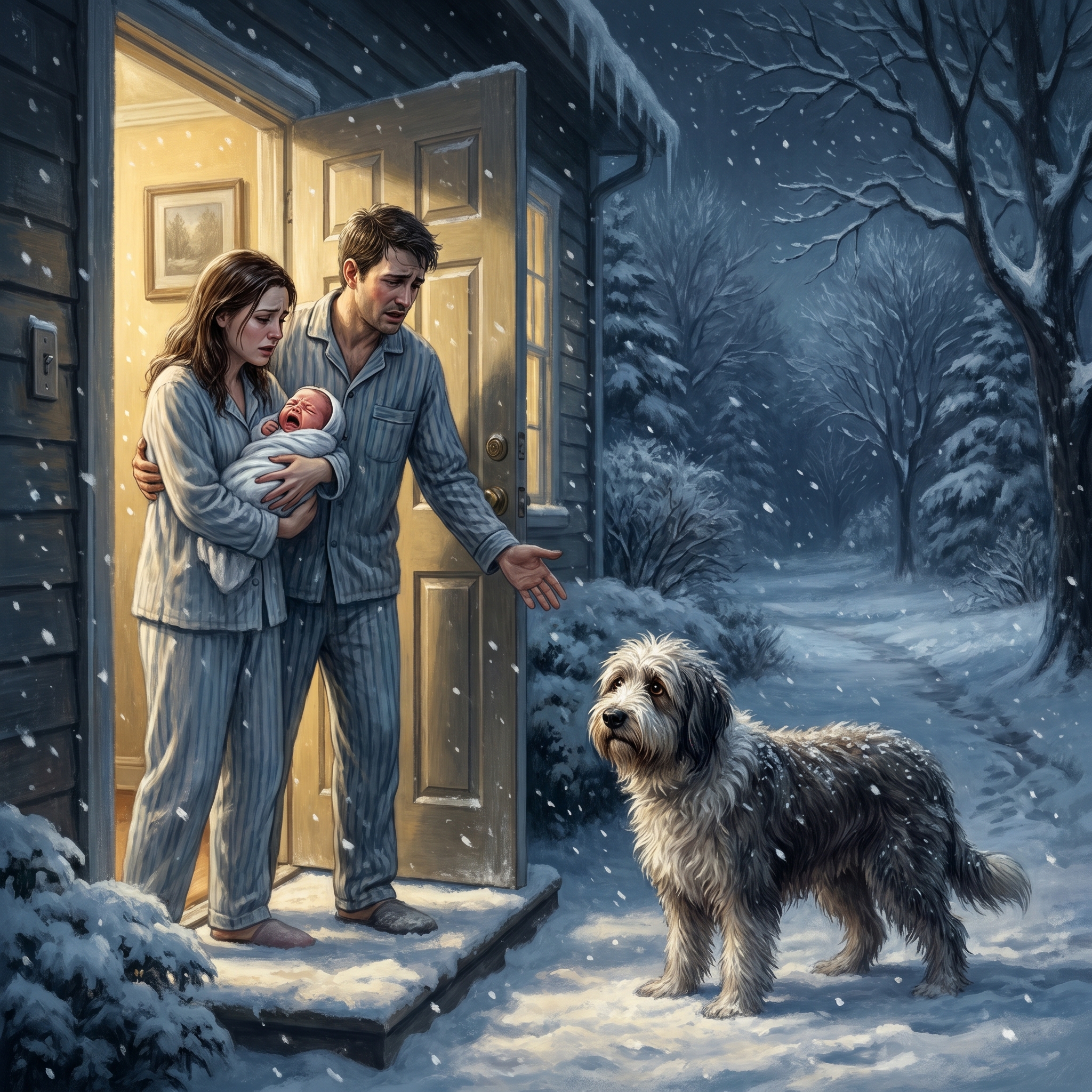
We reached the front door. I unlocked the deadbolt with shaking hands. I ripped the heavy oak door open.
The blizzard screamed into the living room. A wall of freezing, sub-zero air slammed into my face. The snow was blowing horizontally. The wind sounded like a freight train. The temperature was deadly. It was the kind of cold that freezes exposed skin in minutes. It was no place for any living creature.
But I was not looking at a living creature. I was looking at a monster. I was looking at the beast that had tried to maul my innocent child.
I dragged Barnaby out onto the front porch. The wind instantly whipped his thick fur around his body. The cold took my breath away. Barnaby looked up at me. He stopped struggling. He sat down on the snow-covered planks of the porch. He looked into my eyes. I will never forget that look as long as I live. It was not a look of guilt. It was a look of profound, devastating sorrow. He knew what I was doing. He knew I was sending him to his death.
I did not care.
“Get out,” I snarled, my voice dripping with absolute hatred. “If you ever come near my family again, I will kill you myself.”
I stepped back inside. I grabbed the heavy brass handle. I slammed the heavy oak door shut. I turned the deadbolt with a loud, final click. I locked the secondary chain.
The silence inside the cabin was immediate. The howling of the blizzard was muffled by the thick walls. But another sound quickly replaced it.
It was the sound of heavy paws scratching frantically at the solid wood.
Scratch. Scratch. Scratch.
Barnaby was digging at the door. He was throwing his heavy body against the wood. He was letting out a long, haunting howl. It was a sound of absolute desperation. It was a plea for mercy. He was begging me to let him back inside. He was begging me to understand.
I stood in the entryway for a long moment. My chest was heaving. The cold draft from the floorboards chilled my bare feet. I listened to the dog crying in the storm. A tiny, rational voice in the back of my mind whispered that I was making a mistake. It whispered that Barnaby had never shown an ounce of aggression in his entire life. But the protective father inside me silenced that voice immediately. I convinced myself I had done the right thing. I had eliminated the threat. I had protected my flock.
I turned my back on the front door. I walked away from the scratching. I walked away from the howling. I walked back down the hallway toward the nursery.
Elena was sitting on the floor of the ruined room. She had Chloe wrapped tightly in a thick quilt. She was rocking back and forth. She was crying softly. The baby was still fussing, but the frantic screaming had stopped.
“Is she hurt?” I demanded, rushing to her side. I dropped to my knees. I quickly inspected my daughter’s face, her arms, her tiny legs.
“No,” Elena sobbed, wiping her eyes. “There is no blood. There are no bites. He didn’t bite her, Mark. But the crib… he completely destroyed it. He dragged her right out of it. Why would he do that? Why would he just snap like that?”
“It does not matter why,” I said firmly. I wrapped my arms around both of them. I pulled them close to my chest. I felt a surge of arrogant, blind triumph. I had saved them. I was the provider. I was the shield. “He is gone. He is locked outside in the storm. He will not survive the night. He can never hurt her again.”
Elena rested her head against my shoulder. She was trembling violently. “I feel so sick,” she whispered. Her voice was incredibly weak. “My head is pounding. I feel like I am going to pass out again.”
“It is just the adrenaline,” I reassured her. I kissed the top of her head. I ignored the fact that my own vision was blurring. I ignored the intense, crushing pain pulsing behind my eyes. I ignored the strange, metallic taste in the back of my throat. I blamed it all on the shock of the attack. “Let us just sleep in the living room tonight. We will sleep by the fireplace. We are safe now.”
I helped my wife to her feet. We walked slowly down the hallway. As we passed the front door, the scratching had stopped. The howling had faded into the roaring wind. Barnaby had given up. Or the cold had finally taken him.
I felt a brief, fleeting pang of guilt. I pushed it down violently. I told myself he deserved it. I told myself a dog that attacks a baby does not deserve a warm bed. I laid a heavy mattress down on the floor of the living room. I tucked Elena and Chloe under a pile of thick blankets. I lay down beside them. I wrapped my arms around them protectively.
I closed my eyes. The deadly, odorless gas from the broken furnace continued to flood into the cabin. It filled the living room. It settled over us like an invisible, suffocating blanket. I fell into a deep, dark sleep, entirely convinced that I was a hero. I had absolutely no idea that I had just locked our only savior out in the freezing snow, and chosen to lie down quietly with the real killer.
PART 2: The Invisible Assassin
The night stretched on like a frozen eternity. The blizzard outside did not surrender. It battered the wooden walls of our isolated cabin with relentless fury. The wind screamed through the pine trees. It sounded like the wailing of restless ghosts. Inside the house, the silence was equally terrifying. We lay huddled on the living room floor. The heavy blankets offered very little comfort against the creeping cold.
I woke up several times during those dark hours. Every single time I opened my eyes, my head throbbed with a blinding intensity. It felt as though a rusted iron spike was being driven directly into my skull. My mouth was incredibly dry. My tongue tasted like old metal and dust. I tried to sit up once to check the fire, but a wave of violent nausea forced me back down onto the mattress. I convinced myself it was simply the adrenaline crash. I told myself that hauling a massive sheepdog out into a sub-zero blizzard had taken a severe physical toll on my body. I was the protector. Protectors were allowed to be tired.
I listened to the steady breathing of my wife and daughter beside me. Elena was completely unresponsive. She had not moved an inch since we lay down. Her skin was unusually pale. It looked almost translucent in the dim light of the dying fireplace embers. Chloe was quiet. She was far too quiet. The frantic, terrified sobbing from the nursery had been replaced by a shallow, unnatural stillness. I placed my heavy hand on her tiny chest. I felt the faint flutter of her heartbeat. She was alive. I had saved her. I closed my eyes and let that arrogant, deeply flawed conviction lull me back into the toxic abyss.
I did not know that the real monster was sitting right there in the room with us.
The sun finally rose around seven in the morning. The blizzard had passed, leaving behind a blinding, brilliant white landscape. The light reflecting off the snow pierced through the living room windows like a physical weapon. It hit my eyes and sent a shockwave of absolute agony through my brain.
I groaned and rolled over. My muscles felt like lead. My joints were stiff and aching. I felt worse than I had the night before. The metallic taste in my mouth had intensified into a sickening, sweet poison. I pushed myself up onto my elbows. The room spun violently. I had to close my eyes and wait for the vertigo to pass.
“Elena,” I croaked. My voice sounded weak and pathetic. It did not sound like the voice of a hero. “Elena, wake up. It is morning.”
My wife did not answer. She was lying on her back. Her breathing was incredibly shallow. Her lips had taken on a faint, terrifying shade of blue. Panic, cold and sharp, finally pierced through my lethargy. I scrambled to my knees. I grabbed her shoulders and shook her gently.
“Elena! Open your eyes!” I pleaded.
She let out a soft moan. Her eyelids fluttered, but they did not open completely. She was trapped in a heavy, unnatural stupor. I looked down at Chloe. The baby was deeply asleep. Her tiny chest was rising and falling in rapid, uneven increments. She felt cold to the touch.
Something was deeply, fundamentally wrong. My brain sluggishly tried to process the situation. I thought perhaps the cold had gotten to them. The cabin was freezing. The ambient temperature in the living room had dropped to near freezing. I needed to get the heat back on. I needed to call for help.
I forced myself to stand up. My legs trembled violently under my own weight. I leaned against the wall for support and stumbled toward the kitchen counter where I had left my cell phone. The screen was completely dead. The power outage had drained the battery. I cursed loudly. I grabbed the old landline phone mounted on the kitchen wall. I prayed the storm had not taken down the copper wires.
A dial tone hummed in my ear. It was the most beautiful sound I had ever heard. I quickly dialed the emergency number for the local HVAC repair service. They operated twenty-four hours a day during winter storms. A dispatcher answered on the third ring.
“My furnace is broken,” I gasped into the receiver. “My house is freezing. My wife and baby will not wake up properly. I think the cold is getting to them. You need to send someone right now.”
The dispatcher took my address. She promised a technician was already in the area and would be there in less than twenty minutes. I hung up the phone. I slid down the kitchen cabinets and hit the floor. I pulled my knees to my chest. I tried to regulate my breathing. Every inhalation felt thick and suffocating.
While I waited, my mind drifted back to the nursery. I thought about the shattered crib. I thought about Barnaby. A sudden wave of righteous anger washed over me again. That dog had betrayed us. He had destroyed the one safe space we built for our daughter. I told myself that locking him out was the only logical choice. I could not risk him attacking again while we slept. I was absolutely justified. I clung to that narrative desperately. It was the only thing keeping my fear at bay.
Twenty minutes later, the sound of heavy tires crunching through the deep snow broke the silence. A large white utility van pulled into our driveway. I dragged myself up from the floor. I unlocked the front door and pulled it open. The freezing morning air rushed into the cabin. It felt incredibly crisp and clean. My lungs expanded, desperately pulling in the fresh oxygen.
A tall man in a heavy canvas jacket stepped onto the porch. He was carrying a large metal toolbox. He took one look at my pale, sweating face and his expression turned deadly serious.
“Mr. Davis?” he asked. “I am Gary from the repair service. You look terrible, sir. Are you alright?”
“I am just cold,” I muttered, stepping aside to let him in. “My head is killing me. My wife and baby are in the living room. They are very lethargic. Please, just fix the heat.”
Gary stepped into the entryway. He did not immediately walk toward the basement door. He stopped dead in his tracks. He sniffed the air. He frowned deeply. He set his heavy toolbox down on the floorboards. He reached into his jacket pocket and pulled out a small, yellow digital device.
“Sir, did you smell anything strange last night?” Gary asked. His voice was tight with sudden tension.
“No,” I replied, rubbing my pounding temples. “Just the wood smoke from the fireplace. Why?”
Gary did not answer. He pressed a button on the yellow device. The screen lit up. Instantly, a piercing, high-pitched alarm began to shriek from the little machine. It was deafening. It echoed off the wooden walls of the cabin. The digital numbers on the screen were flashing violently in bright red.
Gary looked up at me. His eyes were wide with absolute horror.
“Get your family out of this house right now!” he shouted. He grabbed my arm and shoved me toward the living room. “Do not pack anything! Just grab them and get out!”
“What is going on?” I demanded. My confusion was completely overwhelming. I tried to pull my arm away. “What is that alarm?”
“Carbon monoxide,” Gary yelled over the shrieking device. “The levels in here are lethal! Your furnace did not just break, Mr. Davis. The exhaust vent collapsed. It has been pumping pure, odorless poison into your home all night. You are suffocating!”
The words hit me like a physical blow to the chest. Carbon monoxide. The silent killer. The invisible assassin. Suddenly, everything made terrifying sense. The blinding headache. The nausea. The extreme lethargy. Elena’s blue lips. We were not tired from the adrenaline. We were slowly dying in our sleep.
Pure, unadulterated panic completely took over. I sprinted into the living room. I ignored the agonizing pain in my head. I dropped to my knees beside the mattress. I grabbed the heavy quilt and wrapped it tightly around Chloe. I scooped her tiny, unresponsive body into my left arm. I reached out with my right arm and grabbed Elena by the shoulder of her sweater.
“Elena! We have to go!” I screamed.
Gary rushed in to help. He grabbed Elena’s other arm. Together, we hauled my semi-conscious wife off the floor. We dragged her through the entryway and out the front door. We did not stop on the porch. We waded through the knee-deep snow until we reached the back of Gary’s utility van.
Gary ripped the back doors open. We shoved Elena and Chloe inside the cargo area. Gary turned on the van’s engine and blasted the auxiliary heater. The clean, warm air blew over us. I collapsed onto the metal floor of the van. I was gasping for breath. My heart was hammering so hard I thought my ribs would crack.
“I am calling the paramedics,” Gary said urgently. He pulled his radio from his belt. “They need pure oxygen immediately.”
I sat in the back of the van, clutching my daughter to my chest. The crisp outdoor air was slowly clearing the toxic fog from my brain. Elena was beginning to stir. She coughed weakly, her eyes fluttering open. The blue tint on her lips was slowly fading into a pale pink. We had survived. We had barely escaped with our lives.
Gary finished his radio call. He walked over to the back of the van. He looked at me with an expression of profound disbelief.
“You are incredibly lucky, Mr. Davis,” Gary said, shaking his head. “I have been doing this job for twenty years. With the levels of gas trapped inside that cabin, you should all be dead. The highest concentration of the poison was pooling in the back of the house. Right near the nursery.”
My blood turned to absolute ice. The back of the house. The nursery.
“If you had slept in those back bedrooms last night,” Gary continued, completely unaware of the psychological earthquake he was triggering inside my mind, “you would not have woken up this morning. Whoever moved your family into the living room saved your lives. You avoided the deadliest pocket of gas.”
I stopped breathing. The world around me ceased to exist. The hum of the van’s engine faded into complete silence. The blinding white snow vanished. All I could see was the destroyed wooden crib.
He completely destroyed it. He dragged her right out of it.
Elena’s words from the night before echoed in my mind. They rang with a new, terrifying clarity. Barnaby had not snapped. Barnaby had not attacked my daughter.
Sheepdogs have an incredible sense of smell. They can detect changes in the atmosphere long before human senses can register anything. Barnaby had smelled the poison leaking from the floorboards. He knew the nursery was filling with deadly gas. He had paced the hallway. He had whined at my feet. He had literally begged me to follow him. He had tried to warn me.
And when I ignored him, when I arrogantly pushed him away and went to sleep, the dog took matters into his own paws. He broke into the nursery. He shattered the heavy wooden crib because he could not reach the baby inside. He grabbed Chloe by her blanket and physically dragged her out of the toxic room. He dragged her into the hallway. He dragged her toward the living room where the air was cleaner.
He did not try to maul her. He risked his own life to pull my child away from the brink of death.
And what was his reward?
I attacked him. I choked him. I dragged him out into a deadly, sub-zero blizzard. I looked into his eyes as he begged for mercy, and I locked the door. I threw our ultimate savior out into the freezing night to die alone in the snow.
A crushing, agonizing weight slammed into my chest. It was a grief so profound, so violently absolute, that it physically doubled me over. I dropped my head into my hands. I let out a raw, guttural scream of pure agony. It was not a sound of physical pain. It was the sound of a man’s soul tearing apart at the seams.
“Mr. Davis?” Gary asked, stepping forward with concern. “Are you alright? Is it the headache?”
“The dog,” I gasped, tears streaming down my face, mixing with the dirt and sweat on my cheeks. My voice was broken and hysterical. “Oh my God. The dog. Where is the dog?”
Gary looked around the empty, snow-covered yard. He looked confused. “What dog? I did not see a dog.”
I did not wait to explain. I handed Chloe to Elena. My wife was sitting up now, looking terrified and confused by my sudden outburst. I scrambled out of the back of the van. I hit the deep snow and immediately fell to my knees. I ignored the biting cold. I ignored the weakness in my limbs.
I forced myself up and began to run. I ran frantically toward the front porch.
“Barnaby!” I screamed at the top of my lungs. My voice echoed across the quiet, frozen mountains. “Barnaby! Come here, boy! Barnaby!”
There was no answering bark. There was no sound of heavy paws rushing through the snow. There was only the mocking, endless silence of the winter morning.
I reached the front porch. The wooden planks were covered in a thick layer of fresh snow. But right in front of the heavy oak door, the snow was disturbed. There were deep, frantic scratch marks gouged into the wood of the door itself. I fell to my knees, staring at the physical evidence of his desperation. He had tried so hard to get back inside. He had fought until the very end.
I began to dig through the snow around the porch like a madman. I threw handfuls of freezing white powder over my shoulders. I checked under the wooden stairs. I checked behind the frozen bushes.
“Barnaby!” I sobbed, crawling on my hands and knees. My bare hands were turning blue, but I did not care. I deserved to freeze. I deserved every ounce of pain the world could inflict upon me.
I crawled around the side of the cabin. The wind had created a massive snowdrift against the foundation. It was piled high, almost reaching the window sills. As I scrambled closer, my eyes caught a glimpse of something dark peeking out from beneath the white mound.
It was a patch of thick, matted gray fur.
My heart completely stopped beating. I threw myself forward into the snowdrift. I began to dig with an absolute, terrifying frenzy. I tore away the heavy layers of ice and snow.
“No, no, no,” I chanted repeatedly. It was a useless, desperate prayer.
I uncovered his back first. Then his heavy legs. Finally, I cleared the snow from his head.
Barnaby was lying curled in a tight ball against the wooden foundation of the house. He had tried to seek shelter from the brutal wind. He was completely covered in frost. His magnificent, thick coat was frozen solid. He was entirely motionless.
I grabbed his heavy shoulders and pulled him into my lap. His body was stiff and impossibly cold. He felt like a statue carved from ice. I wrapped my arms around his massive neck. I buried my face into his frozen fur.
“I am so sorry,” I wailed. The sound of my own weeping was pathetic and entirely useless. “I am so sorry, Barnaby. You were a good boy. You were the best boy. I am so sorry.”
I rocked back and forth in the snow, clutching the frozen body of the dog I had murdered. I had thought I was a righteous protector. I had thought I was the hero of my family. But the truth was a harsh, unforgiving mirror. I was the monster. I was the arrogant, blind fool who had destroyed the purest love I had ever known.
As I sat there weeping in the snow, I noticed something that completely broke whatever was left of my shattered heart.
Even in his final moments, as the freezing cold slowly stole his life away, Barnaby had not turned his back on us. His head was resting on his paws. His clouded amber eye was half-open. He was perfectly positioned.
He had died staring directly at the window of the living room. He had spent his last breath watching over my family, guarding us from the outside, even after we had thrown him away.
PART 3: The Agony of Hope
I held the frozen body of the dog I had condemned. The snow around us was stained with the bitter reality of my arrogance. I buried my face in his icy fur. I was begging for a forgiveness I knew I would never deserve. The silence of the mountain morning was absolute. It was a heavy, suffocating blanket of judgment. I wanted the cold to take me. I wanted the mountain to swallow me whole. I did not deserve to go back inside to the warmth of my family. I had forfeited that right the moment I turned the deadbolt on our greatest protector.
Then, a heavy hand grasped my shoulder. It was Gary. The technician had run around the side of the cabin. He was carrying a thick thermal emergency blanket from his utility van.
“Mr. Davis, you have to let him go,” Gary said gently. His voice was full of pity. “You are going to freeze to death out here. The paramedics are on their way for your wife and baby. You need medical attention too.”
“I killed him,” I whispered. My voice was completely hollow. It did not even sound like my own. “He saved my little girl. He pulled her out of the gas. And I murdered him.”
Gary knelt beside me in the deep snow. He reached out to wrap the silver thermal blanket around Barnaby’s stiff body. He wanted to cover the dog out of respect. As Gary slid his bare hand beneath the massive chest of the sheepdog, he suddenly froze. His eyes widened in absolute shock. He pressed his fingers harder against the frozen ribcage.
“Wait,” Gary breathed. His voice was sharp and urgent. It cut directly through the freezing air. “Wait a minute. Be quiet. Be absolutely quiet.”
I stopped sobbing immediately. The wind seemed to hold its breath. The entire world stood perfectly still.
“He is not gone,” Gary shouted. The sudden explosion of volume made me flinch violently. “I feel a pulse! It is incredibly weak. It is barely there. But he is still alive!”
The words hit me like a massive jolt of electricity. A violent, impossible surge of hope erupted in my chest. Logic told me it was impossible. The dog had been buried under the snow for hours in sub-zero temperatures. But desperation is far louder than logic. I ripped my winter gloves off. I pressed my bare, freezing hand directly against Barnaby’s chest. I pushed through the solid, matted fur. I pressed against his skin as hard as I could.
Beneath the layers of ice, beneath the stiff muscle, I felt it. It was microscopic. It was a faint, agonizingly slow flutter. A tiny vibration of life. There was a long, terrifying pause. Then, another tiny flutter. He was fighting. Even after I had thrown him into the frozen abyss, his loyal heart was stubbornly refusing to stop beating.
“Help me!” I screamed. The lethargy of the carbon monoxide poisoning vanished entirely. “We have to move him! We have to get him to a doctor right now!”
Gary did not hesitate. He wrapped the silver thermal blanket tightly around the dog. Together, we hoisted Barnaby out of the snowdrift. He was incredibly heavy. His body was stiff and unyielding, making him awkward to carry. We slipped and stumbled through the knee-deep snow. We fought our way around the side of the cabin toward the driveway.
The paramedics had just arrived. A large white ambulance was parked behind Gary’s van. Two medics were already loading Elena and Chloe onto a stretcher. Elena saw me sprinting across the yard carrying the frozen dog. She looked terrified.
“Mark!” Elena cried out. She was wearing an oxygen mask over her face. “What is happening?”
“He is alive!” I shouted back. I did not stop running. I could not afford to lose a single second. “He saved us, Elena! Barnaby saved Chloe! The gas was in the nursery. He broke the crib to get her out! I am taking him to the clinic!”
I did not wait to see the realization dawn on my wife’s face. I reached the back of Gary’s utility van. Gary threw the rear doors open. We gently placed Barnaby onto the metal floor. Gary cranked the auxiliary heater to its absolute maximum setting. A blast of hot air flooded the cargo space.
“I will drive,” Gary volunteered, sprinting toward the driver’s seat. “You stay in the back with him. Keep rubbing his chest. Try to stimulate the blood flow.”
I dropped to my knees beside the dog. The van lurched forward, its heavy tires spinning in the snow before catching traction. We accelerated down the winding mountain road at a terrifying speed. Gary was hitting the horn, forcing other winter drivers out of our way. The back of the van swayed violently with every sharp turn.
I ignored the chaotic movement. I focused entirely on Barnaby. I rubbed his chest with both hands. I massaged his stiff legs. I leaned over his head and breathed warm air onto his frozen snout.
“Come on, buddy,” I pleaded. The tears were flowing freely down my face again. “Please do not leave us. Please stay. I am so sorry. You are a good boy. You are the best boy in the world. Just hold on.”
The drive to the emergency veterinary clinic in the valley usually took forty minutes. Gary made it in twenty. The tires screeched against the salted pavement as he slammed the brakes in front of the glass doors of the animal hospital. I threw the back doors open before the van had even come to a complete stop.
“I need help!” I roared, carrying the heavy bundle of silver foil and frozen fur toward the entrance. “Emergency! Please help me!”
The glass doors slid open. The bright, sterile lights of the clinic lobby blinded me for a moment. Three veterinary technicians rushed toward me. They took one look at the frozen state of the dog and immediately sprang into action. They guided me into a trauma room in the back. A metal examination table sat in the center of the room under a massive surgical light.
“Put him down right here,” a tall veterinarian ordered. She had a stethoscope around her neck and a look of intense focus. “What happened?”
“He was locked outside all night,” I confessed. The words tasted like ash and poison in my mouth. Admitting it out loud to a stranger made the guilt infinitely heavier. “He was in the blizzard. He has been buried under the snow for at least six hours.”
The veterinary team did not waste time judging me. They descended upon Barnaby with practiced, ruthless efficiency. They stripped away the silver blanket. They placed warm, fluid-filled heating pads around his core. A technician shaved a small patch of fur on his front leg and inserted an intravenous line. Another technician placed a small oxygen mask over his snout.
“His core body temperature is dangerously low,” the doctor announced. Her voice was clinical and detached. “The thermometer cannot even register a reading. He is in profound hypothermic shock. His heart rate is twenty beats per minute. It should be over eighty. We need to push warmed saline intravenously right now.”
I stood backed against the wall of the trauma room. I was entirely useless. I watched the team work on my dog. I watched them desperately try to undo the damage I had deliberately caused. Every beep of the heart monitor was sluggish and weak. Every pause between the beeps felt like a knife twisting in my stomach.
“Sir, you need to step outside,” a technician told me gently. She guided me by the arm toward the waiting room. “We are doing everything we can. We will come get you when we know more.”
I allowed myself to be pushed out of the room. The heavy wooden door closed in my face, separating me from the struggle inside. I collapsed into a plastic chair in the empty waiting room.
The silence of the clinic was deafening. It left me entirely alone with my own thoughts. The adrenaline was finally leaving my system, leaving behind a profound, crushing emptiness. I leaned forward and buried my face in my dirty, calloused hands.
My mind began to relentlessly replay the events of the previous night. It was a torture session of my own making. I remembered the way Barnaby had paced the hallway. I remembered the soft, urgent whines he made while trying to warn me about the poison leaking from the floorboards. He knew the danger. He had smelled the silent killer entering our home. He had begged me to listen.
And how had I responded? I had kicked him away. I had told him to settle down. I had arrogantly assumed I knew better than the animal whose instincts were perfectly tuned to protect the pack.
The memories shifted to the nursery. I remembered bursting through the door and seeing the shattered crib. I remembered the blinding, irrational fury that had completely consumed my reasoning. I did not stop to investigate. I did not look at my daughter to see if she was actually harmed. I had instantly transformed into a tyrant. I had grabbed the heavy leather collar around Barnaby’s neck and choked him.
I remembered dragging him down the hallway. He had dug his paws into the wood. He was fighting to stay inside, not because he was aggressive, but because he knew the house was still filled with poison. He knew my wife and I were still in danger. He was trying to stay and finish his job.
And then, the final, most devastating memory surfaced. It was the moment on the front porch. The wind had whipped his matted fur. The deadly cold had instantly bitten into our skin. Barnaby had sat down on the snowy planks. He had looked up at me with his cloudy amber eye. He had not fought back. He had simply accepted his punishment. He looked at me with a sorrow so deep it transcended human understanding. He knew I was making a fatal mistake, and he forgave me for it even as I locked the door in his face.
A fresh wave of violent tears spilled over my fingers. The psychological agony was absolute. It was a crushing weight of regret that made it difficult to draw breath. I had proudly called myself the protector of my family. I had puffed my chest out and claimed to be the shield against the darkness. But my protection was a toxic, arrogant illusion.
When the real monster came for my child in the form of odorless gas, I went to sleep. When the silent assassin filled our lungs, I did nothing. Barnaby was the one who stood guard. Barnaby was the one who threw himself into harm’s way to drag my baby from the jaws of death.
I was the villain of this story. I was the cruel, blind dictator who had sentenced the true hero to a freezing execution.
Hours passed. The wall clock in the waiting room ticked away the morning. My hands were stained with dirt and dried blood from my scraped feet. My head was still throbbing from the remnants of the carbon monoxide, but the physical pain was nothing compared to the emotional torment.
Around noon, the front doors of the clinic opened. Elena walked in. She was leaning heavily on the arm of a nurse from the human hospital. She looked pale and exhausted, but she was alive. She had been treated with pure oxygen and released. Chloe was safe with Elena’s mother across town. Elena had demanded a taxi bring her directly to the veterinary clinic.
She saw me sitting in the corner. She walked over and sat down in the plastic chair beside me. She did not say a word. She just reached out and took my dirty hand in hers.
“The doctors told me everything at the hospital,” Elena whispered. Her voice was trembling. “They told me about the broken exhaust vent. They told me where the gas was concentrated. They said whoever moved Chloe saved her life.”
“It was him,” I sobbed, unable to hold the tears back anymore. I looked at my wife. My face was a portrait of complete devastation. “It was Barnaby. He smelled the gas. He broke the crib because he could not reach her over the railing. He dragged her out to save her.”
Elena closed her eyes. A silent tear slipped down her cheek. “I know, Mark. I know.”
“I threw him outside,” I continued. The confession was a necessary punishment. I needed her to know exactly what a monster I had been. “He fought me, Elena. He scratched at the door. He howled. He begged me to let him back in. And I ignored him. I went to sleep while he froze to death trying to protect us.”
“We both made a mistake,” Elena said softly, squeezing my hand tightly. “We were panicked. We were poisoned by the gas. You cannot carry all this blame alone.”
“I have to,” I replied. My voice was completely hollow. “If he dies in that room, Elena, I will never forgive myself. I will carry this guilt until the day I stop breathing. I destroyed the purest thing we had.”
We sat in silence for another hour. The waiting was an agonizing purgatory. Every time the heavy wooden door to the back rooms swung open, my heart hammered against my ribs in sheer terror. I expected the doctor to walk out with a solemn face and shake her head. I expected to hear that the cold had finally won.
The door clicked open again.
The tall veterinarian stepped into the waiting room. She pulled the surgical mask down from her face. She looked incredibly tired. Her scrubs were stained with water and iodine. She looked at Elena and then directly at me.
I stood up. My legs were shaking so badly I had to lean against the wall for support. I braced myself for the absolute worst. I prepared my soul for the final, crushing blow.
“Mr. Davis,” the doctor said. Her clinical tone was gone. Her voice was soft and carried a strange, unbelievable weight. “We have spent the last four hours actively warming his blood and massaging his heart.”
She paused. She took a deep breath.
“I have been doing this job for fifteen years,” the doctor continued. “I have seen animals survive incredible things. But I have never seen anything like this.”
The world seemed to stop spinning. The fluorescent lights hummed above us.
“He is stable,” she said. The words hung in the air like a miraculous spell. “His core temperature is rising. His heart rate has returned to a normal rhythm. He is breathing on his own without the ventilator. He is awake.”
I dropped back into the plastic chair. My knees completely gave out. I covered my face with my hands and wept. It was not a cry of sorrow this time. It was a torrential, explosive release of pure relief. It was the sound of a drowning man finally breaking the surface of the water and pulling in a lungful of sweet, clean air.
“Can we see him?” Elena asked, her voice thick with tears of joy.
“Yes,” the doctor smiled softly. “He is very weak, but he is looking for you. Follow me.”
I stood up on unsteady legs. I wiped my face with the sleeve of my jacket. I followed the doctor through the heavy wooden doors and down the sterile hallway. My heart was pounding a new rhythm. It was a rhythm of redemption. I was about to face the animal I had betrayed. I was about to beg for a forgiveness I did not deserve. And for the first time in my life, I truly understood the monumental weight of grace.
PART 4: The Masterclass of Forgiveness
The hallway of the veterinary hospital felt like it was a thousand miles long. The walls were painted a sterile, unforgiving white. The harsh fluorescent lights hummed above us. They cast long, heavy shadows on the linoleum floor. Every step I took felt like I was walking through wet concrete. My boots felt impossibly heavy. My heart pounded a frantic, terrifying rhythm against my ribs. I was walking toward the judgment I deserved. I was a man who had nearly destroyed his own family out of sheer arrogance. Now, I had to look my victim in the eye.
Elena walked quietly beside me. She kept her hand firmly wrapped around my arm. Her grip was the only thing keeping me anchored to the earth. Without her, I felt like I would collapse into a miserable heap on the sterile floor. The tall doctor walked a few paces ahead of us. She moved with a quiet, respectful grace. She understood the monumental gravity of this moment. She knew she was not just leading us to a recovering animal. She was leading us to a living miracle.
We stopped in front of a heavy wooden door at the very end of the corridor. A small, rectangular glass window allowed us to look inside. The doctor turned to us and offered a soft, reassuring smile.
“He is incredibly weak,” the doctor warned us gently. Her voice was barely above a whisper. “His body went through a catastrophic trauma. The hypothermia nearly shut down his major organs. Please keep your voices low. Do not make any sudden movements. He needs to know he is safe now.”
I nodded silently. I could not speak. There was a massive, suffocating lump in my throat. I felt a fresh wave of hot tears burning behind my eyes.
The doctor pushed the heavy door open. We stepped into the quiet recovery room.
The room was dim. The main overhead lights had been turned off. A small, warm amber lamp glowed softly in the corner. The air smelled of iodine, clean cotton, and rubbing alcohol. In the center of the room sat a large, low-to-the-ground recovery bed. It was piled high with thick, heated blankets. A network of clear plastic tubes ran from a tall metal stand down toward the bed. A heart monitor beeped softly in the background. It was a steady, rhythmic sound. It was the most beautiful sound I had ever heard in my entire life.
I took a slow, trembling step forward. I peered over the edge of the heated blankets.
Barnaby was lying on his side. He looked incredibly small. The massive, intimidating sheepdog I had wrestled with in the nursery was gone. The freezing storm had stripped away his strength. His thick gray fur was dry now, but it looked dull and brittle. An intravenous line was taped securely to his shaved front leg. Clear, warm fluids were dripping steadily into his veins. A thin plastic oxygen tube rested just beneath his nose.
His eyes were closed. His breathing was shallow but steady. He looked like an old, tired soldier who had finally returned home from a brutal war.
The sight of him completely broke me. The last remnants of my pride, my arrogance, and my stubborn ego shattered into a million irreparable pieces.
I did not care that the doctor was watching. I did not care about the sterile environment. I walked over to the edge of the recovery bed and my knees simply gave out. I collapsed onto the floor. I buried my face into the thick layers of the heated blankets. I let out a raw, shuddering sob that echoed through the quiet room.
“I am so sorry,” I wept. The words tumbled out of my mouth in a broken, pathetic stream. “I am so sorry, Barnaby. I am a monster. I am a terrible, blind fool. I did this to you. I put you out in that storm. I left you there to die. I am so sorry.”
I cried with an intensity I had never experienced before. It was a complete, violent purging of my soul. I cried for the shattered crib. I cried for the deadly gas that almost stole my daughter. I cried for the agonizing hours this beautiful, loyal animal had spent freezing in the snow, waiting for a master who had abandoned him.
Elena knelt down on the floor right beside me. She wrapped her arms around my shaking shoulders. She was crying softly too. She reached out with her free hand and gently stroked the soft fur on top of Barnaby’s head.
“You saved her,” Elena whispered through her tears. Her voice was thick with an overwhelming gratitude. “You saved our little girl, Barnaby. You are our hero. We were so wrong. We were so horribly wrong.”
I kept my face buried in the blankets. I could not bring myself to look at him. I felt entirely unworthy of his presence. I felt like a criminal standing before a saint. I expected him to growl. I expected him to pull away from my touch. If a human being had treated me the way I had treated him, I would harbor a violent, lifelong hatred. I would never forgive the person who locked me out in a deadly blizzard. I would never forget the betrayal.
But a dog is not a human. A dog operates on a plane of emotional purity that we can barely comprehend.
I felt a subtle shift in the blankets. I heard a soft, tired sigh.
I slowly lifted my head. I looked through my blurry, tear-filled vision.
Barnaby had opened his eyes. His good eye was clear and bright. His cloudy eye blinked slowly in the dim light. He looked at Elena. He looked at the tears streaming down her pale cheeks. Then, he slowly turned his heavy head and looked directly at me.
I held my breath. I waited for the rejection. I braced my heart for the visible fear in his eyes.
Instead, Barnaby let out a low, gentle rumble in his chest. It was not a growl. It was a sound of absolute comfort. He slowly lifted his heavy head from the mattress. The effort clearly exhausted him. His muscles trembled violently. But he pushed through the weakness. He leaned forward and pressed his wet nose against my tear-stained cheek.
He closed his eyes and let out a long breath. Then, he gently licked the tears right off my face.
I completely froze. My heart swelled to three times its normal size. It felt like it was going to burst right out of my chest.
I looked down at the back of the recovery bed. It was a microscopic movement. It was so faint I almost missed it. But beneath the heavy layers of heated blankets, the tip of his thick gray tail was thumping softly against the mattress.
Thump. Thump. Thump.
He was wagging his tail.
He was not angry. He was not resentful. He did not hold a single ounce of bitterness in his enormous heart. He did not care about the choking collar, the freezing snow, or the locked door. He only cared that his pack was safe. He only cared that his humans were sitting beside him, crying over him, and finally understanding his profound devotion.
It was the ultimate masterclass in forgiveness. It was a lesson in unconditional love that no philosopher, no poet, and no religious text could ever teach me. In that quiet hospital room, a battered, arthritic sheepdog taught me what it truly means to be a protector. Protection is not about arrogant strength. It is not about asserting dominance or assuming you always know best. True protection is absolute sacrifice. It is standing in the cold so others can be warm. It is taking the punishment so others can live.
I carefully wrapped my arms around his massive neck. I buried my face in his soft fur. I breathed in the smell of the clinic, the clean blankets, and the undeniable scent of life.
“I will never fail you again,” I whispered into his ear. It was not just a promise. It was a solemn, unbreakable vow. “I will spend the rest of my life making this right. I swear it to you, Barnaby. You will never know a cold night again.”
We spent the next four hours sitting on the hard linoleum floor beside his bed. We refused to leave his side. We watched the intravenous fluids drip into his vein. We watched his chest rise and fall with a steady, reassuring rhythm. Every time he opened his eyes, we were right there, whispering words of comfort and love.
The recovery process was slow. It was a grueling uphill battle. The severe hypothermia had taken a massive toll on his aging joints. The frostbite on his paw pads took weeks to heal. We visited the clinic every single day. We sat with him for hours. We hand-fed him soft food. We helped the technicians gently massage his stiff muscles.
While Barnaby fought his way back to health, I completely tore our house apart.
I hired Gary and his repair crew to completely rip out the old, deadly propane furnace. I spared absolutely no expense. I paid them double to install the most advanced, expensive, and redundant heating system on the market. I installed industrial-grade carbon monoxide detectors in every single room. I hardwired them directly into the electrical grid and backed them up with heavy-duty batteries. I transformed our cabin from a potential death trap into an absolute fortress.
Then, I focused on the nursery.
I threw away every single piece of the shattered wooden crib. I burned the jagged wood in the fireplace. I never wanted to see it again. I bought a new crib. It was wider, lower to the ground, and built with smooth, rounded edges. But the most important change was not the crib itself. It was the massive space I cleared right beside it.
I bought the thickest, most luxurious orthopedic memory foam dog bed I could find. It was designed specifically for senior dogs with severe arthritis. It was large enough to fit a small horse. I placed it directly under the window in the nursery, exactly one foot away from Chloe’s new crib.
Three weeks after the blizzard, the miracle was finally complete.
The tall doctor walked into the hospital lobby holding a sturdy leather leash. At the end of the leash walked Barnaby. He moved slowly. He still had a noticeable limp. His back legs were stiff, and he wore special protective booties over his healing paws. But his head was held high. His thick gray fur had been brushed and washed. He looked magnificent. He looked like a king returning to his throne.
Elena was holding Chloe in her arms. She dropped to her knees right in the middle of the crowded lobby. Barnaby walked straight toward her. He completely ignored the other dogs barking in the waiting room. He gently nudged his massive head against the baby blanket. Chloe cooed softly and reached her tiny hands out, tangling her fingers in his gray fur. Barnaby closed his eyes and let out a deep sigh of utter contentment.
I walked over to the reception desk. I pulled a small, custom-made velvet box out of my jacket pocket. I opened it and took out a brand-new collar. It was crafted from thick, supple brown leather. The inside was lined with soft sheepskin to prevent chafing. But the centerpiece was the heavy, polished brass tag hanging from the center.
I walked over to Barnaby and knelt down. I unbuckled the thin hospital collar they had given him. I carefully wrapped the new leather collar around his thick neck and secured the brass buckle.
The brass tag gleamed in the fluorescent lights. It did not just have his name and our phone number. It had a deep, permanent engraving cut into the metal.
Barnaby. The Guardian. The Hero of Our Family.
“Let us go home, buddy,” I said softly, scratching him behind his ears.
The drive back to the mountain cabin was entirely different from the terrifying race in Gary’s van. The sun was shining brightly. The snow was beginning to melt along the edges of the road. The atmosphere in the car was light and filled with overwhelming gratitude. Barnaby sat in the back seat. He had his heavy head resting on the center console, right between Elena and me. He watched the trees pass by with a calm, peaceful expression.
When we finally unlocked the front door of the cabin, Barnaby did not hesitate. He walked through the entryway. He sniffed the air cautiously, perhaps remembering the invisible poison that had flooded the rooms. But the air was clean now. The deadly threat was gone.
He walked slowly down the hallway. He walked straight past his old braided rug in the living room. He did not even look at it. He headed directly for the nursery.
Elena and I followed him quietly. We stood in the doorway and watched.
Barnaby walked up to the new crib. He sniffed the wooden rails. He gently nudged the side of the mattress. Then, he looked down at the massive, luxurious orthopedic bed sitting right beside it. He stepped onto the soft memory foam. He turned around in a slow circle three times. Finally, with a heavy, satisfied groan, he collapsed onto the plush fabric.
He stretched his long legs out. He rested his chin on the raised, padded edge of the bed. He let out a long breath that puffed his cheeks out. He looked up at us. His eyes were bright and completely devoid of fear. He knew exactly where he belonged. He was back on duty, but this time, he was not guarding us from the shadows. He was guarding us from a throne of absolute comfort.
Years have passed since that freezing December night. The mountain winters have come and gone. The blizzards still howl outside our cabin, but they no longer hold any power over us. We are safe. We are protected.
Chloe is a toddler now. She runs around the house with boundless energy. She is loud, chaotic, and wonderfully alive. And wherever she goes, a massive, slow-moving gray shadow follows closely behind.
Barnaby is much older now. His muzzle is entirely white. His limp is more pronounced, and he spends most of his day sleeping. But his devotion has never wavered for a single second. He allows Chloe to use him as a giant pillow. He lets her dress him in ridiculous hats and pull on his ears. He never growls. He never snaps. He just watches her with an endless, patient love.
Every night, before I go to sleep, I walk into the nursery. I check on my beautiful, healthy daughter. Then, I kneel down beside the giant orthopedic bed. I press my face against Barnaby’s thick fur. I listen to the steady, comforting rhythm of his heartbeat.
I remind myself every single day of the massive debt I owe this animal. I remind myself of the dark, arrogant path I walked, and the incredible grace that brought me back into the light. I am not the hero of this family. I never was. I am simply a man who was given a second chance by a creature far better than I will ever be.
Karma is a fascinating concept. We often think of it as a cosmic scale of punishment, balancing our evil deeds with equal suffering. We expect the universe to strike us down when we make catastrophic mistakes. But sometimes, karma does not deliver a swift, violent retribution. Sometimes, the universe hands down a punishment far more complex and emotionally agonizing.
My punishment was not to lose my family. My punishment was to keep them. My punishment is to look into the eyes of this magnificent, loyal animal every single day and remember exactly what I almost threw away. The guilt of that night will never fully leave me. It sits in the back of my mind, a permanent scar on my conscience.
But alongside that guilt is an overwhelming, blinding light. It is the light of pure, unadulterated love.
Barnaby will spend the rest of his days sleeping on the softest bed in the house. He will eat the finest food. He will be showered with endless affection, countless treats, and gentle scratches behind his ears. He will never know a cold night, a locked door, or a harsh word ever again. He is a king. He is our savior.
As I watch him close his cloudy eyes and drift into a peaceful sleep, his tail giving one final, lazy thump against the memory foam, I know the absolute truth. Human beings build the houses, we buy the food, and we lock the doors. We pretend we are the masters of the world. But it is the animals, with their boundless forgiveness and their impossibly pure hearts, who truly teach us how to live.