PART 1: THE INCIDENT
I remember the humidity first.
That probably sounds strange, considering what people usually remember about their wedding day. The dress. The flowers. The music. The way the groom looked when the doors opened. But when I think about that morning now, I remember the air before anything else. Charleston after rain has a way of holding moisture like a secret it refuses to give up. The streets outside the hotel were still wet, and the old brick courtyard smelled faintly of wet grass and gardenias beaten down by the storm the night before.
The ballroom itself was already too cold. Someone had turned the air conditioning high because of the flowers, and it hummed above us with that steady hotel sound I knew too well from years of working events. I had a cracked mug of burnt coffee in the bridal prep room, sitting beside my emergency kit and a pair of pearl earrings I almost forgot to put on. The coffee had been there so long it had gone bitter and flat, but I kept sipping it anyway because brides are allowed very few honest vices before noon.
I was thirty-four, a luxury event planner, and I had built a career fixing other people’s chaos before it could be photographed. I knew how to calm a mother of the bride without insulting her. I knew which florists padded invoices and which photographers drank too much if no one watched them. I could tell from across a ballroom whether a cake table was too close to a west-facing window. I was good at details. Too good, Daniel used to say, though he said it with affection then.
My wedding to Daniel Ashcroft should have been the easiest event I ever planned.
It was not.
The Ashcrofts were one of those old Charleston families whose name seemed to appear on plaques more often than mailboxes. Hospital wings. Scholarship funds. Restoration committees. Their family portraits looked less like people and more like proof of ownership. Daniel was different from them in the ways that mattered to me. He was kind, not loudly, but in the dependable way of a man who remembered which parking garage made me nervous and walked me to my car without making a performance of it.
Still, he was an Ashcroft.
That meant the wedding was never going to be only ours.
His aunt Margaret made sure of that.
Margaret Ashcroft was sixty-seven, elegant, narrow, and terrifying in the way only very polished women can be terrifying. She never raised her voice because she did not need to. She could make a florist apologize for a rose blooming incorrectly. She could say “How thoughtful” in a tone that made the recipient reconsider their bloodline. Daniel loved her, or at least he believed he owed her love. She had helped raise him after his mother died, and that kind of debt is hard to measure cleanly.
Margaret did not dislike me at first. That would be too simple. She thought I was useful. I knew caterers, venues, donors, press etiquette, and the private language of wealthy people pretending not to care what things cost. She respected competence as long as it knew its place.
The problem was that I was marrying in.
To her, that meant I was both guest and threat.
“You are very calm for a bride,” she told me that morning while a stylist adjusted the veil at the back of my head.
“I do this for a living,” I said.
“Planning and marrying are different things.”
“They are,” I said. “But place cards are still place cards.”
She looked at me through the mirror. “And family is still family.”
I remember smiling because it was easier than answering. That was one of my flaws then. Maybe it still is. I could handle emergencies if they wore a staff badge or came with a vendor contract. But personal confrontation made me hesitate. I told myself I was being gracious. Looking back now, I think I was afraid of becoming the difficult woman in a room full of people waiting for me to prove I belonged.
Daniel came by before the ceremony, even though Margaret said it was bad luck. He knocked on the prep room door and asked if he could see me for one minute. He stood in the hallway in his tuxedo, hair still slightly damp from the shower, looking too handsome and too anxious.
“How bad is she?” he asked.
“Your aunt?”
He made a face. “When you say ‘your aunt’ like that, it means bad.”
“She is managing her feelings through napkin placement.”
Daniel laughed, then glanced over his shoulder. “She means well.”
I looked at him.
He sighed. “She means something.”
That was Daniel. He could see the truth, but he often softened it before speaking. At the time, I found that gentle. Later, I found it exhausting. Not because he lacked courage, but because he had been raised to believe peace was the same as love.
The ceremony itself was beautiful. I can admit that. The rain stopped before noon, and by the time guests arrived, the courtyard stones were shining. The florist had used white camellias and pale blue hydrangeas, which Margaret initially called “a little coastal” before deciding everyone else admired them. Daniel cried when I walked down the aisle. Not dramatically. Just one hand over his mouth, eyes red, trying to hold himself together. I loved him for that.
For a few hours, I let myself believe the day would remain ours.
The reception was held in the hotel’s grand ballroom, an old coastal property that had survived hurricanes, lawsuits, renovations, and at least three generations of families who believed tradition meant never asking who paid for the chandelier. I had worked there before. Everyone in Charleston events had. The staff was professional, the kitchen reliable, the banquet director polite in the way people become when they have handled too many wealthy tantrums.
There was one senior waiter I noticed early. Thomas Reed. Seventy-eight, maybe, though he moved with the careful steadiness of someone determined not to be treated as old. He had silver hair, a straight back, and hands that held a tray like it was a matter of personal honor. He had served my table at charity luncheons years before. I remembered him because he never hovered, never fawned, never seemed impressed by last names. Good waiters at expensive events often become invisible. Thomas had the unusual gift of being invisible and dignified at the same time.
During dinner, he refilled my water and said, “Congratulations, Mrs. Ashcroft.”
I smiled. “Not used to that yet.”
“You do not have to answer to it until you are ready,” he said.
It was an odd little kindness, and I remember it because that day was full of people trying to rename me.
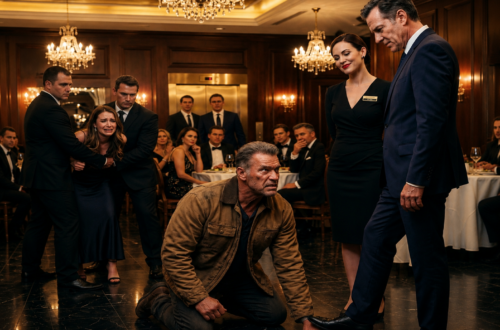
The toast came after the first course and before the plated entrée, because Margaret wanted the speeches early, before people drank too much and became “sentimental in public.” The head table had been set with champagne flutes arranged in a perfect line. I had approved the rental order myself, or at least I thought I had. Crystal flutes, narrow stems, polished rims. Nothing unusual.
The best man spoke first. Daniel’s college roommate, a charming lawyer who made three jokes about Daniel being bad at golf and one joke about me being “the only woman alive who could organize a hurricane into a seating chart.” People laughed. I laughed too, because it was harmless enough.
Then Margaret stood.
That was not in the original schedule.
I looked at Daniel. He gave me a tiny apologetic shrug.
Margaret lifted her glass with a smile that had been practiced in mirrors for fifty years.
“To Daniel,” she said, “who has always carried the Ashcroft name with grace. And to Evelyn, who now joins not only a marriage, but a history.”
There was polite applause.
I remember the AC humming overhead. I remember a fork clicking against a plate somewhere near Table 9. I remember thinking Margaret’s toast sounded less like a welcome and more like a transfer of property.
A server placed a champagne flute in front of me.
Thomas was not the one who set it down. A younger waiter did, nervous and quick, already turning toward the next guest.
I reached for it automatically.
Then I saw the mark.
It was small. Almost nothing. A scratch etched near the base of the bowl, just above the stem. Three short lines crossing a shallow curve. Not decorative. Not a manufacturer’s flourish. It looked accidental unless you had spent twenty years trying not to remember it.
My fingers stopped before touching the glass.
The ballroom noise blurred, not vanished. I could still hear people. A chair shifting. Someone laughing too loudly at a table near the windows. Ice settling in a water glass. But my attention narrowed to that scratch.
I had seen it before.
I was fourteen the first time.
My mother had taken me to a charity gala at a coastal hotel, one of those events where adults wore perfume too heavy for the room and told children they were “getting so grown” because they had nothing else to say. My mother was a pediatric nurse then, though she had dressed that night like someone from a magazine. Navy dress. Small pearl earrings. A lipstick color she never wore again after that year.
I remember being bored. I remember sneaking rolls from a basket when no one watched. I remember a waiter setting down champagne for adults and sparkling cider for me, except somewhere in the confusion of glasses, I lifted the wrong flute. Or maybe someone handed it to me. That part is not clear anymore.
But I remember the scratch.
Three lines and a curve near the stem.
I remember tracing it with my thumb because I had nothing else to do at a table full of adult donors. I remember the taste being wrong. Bitter in a way champagne should not be bitter, even to a child. I remember my mother taking the glass from me and saying, “Evelyn, no, that is not yours.”
Later that night, people became ill.
Not everyone. That was part of why the official story held. Some guests blamed the oysters. Some blamed the cream sauce. Some said the hotel kitchen had mishandled food. My mother became seriously ill and never fully recovered. Not in a dramatic one-day way. In the quieter, more expensive way that changes a family slowly. Specialist visits. Missed shifts. Insurance arguments. Fatigue she pretended was normal. Pain she hid from me until I was old enough to recognize lying.
The hotel settled with some families quietly. My mother refused to sign at first. Then bills came. Then a hospital administrator told her the evidence was inconclusive. Then a lawyer told her a case could take years and cost more than she had. The story disappeared under the phrase food contamination.
For twenty years, that phrase sat in my family like dust no one could clean.
Food contamination.
I looked at the glass in front of me and felt fourteen again, though not in the way people mean when they romanticize memory. I felt small, ashamed, confused, and angry without knowing where to put the anger.
Daniel leaned toward me. “Ev?”
I did not answer.
Margaret continued speaking.
“May this family continue to stand for dignity, loyalty, and discretion.”
That word. Discretion. It cut through the noise.
I pushed the glass away.
Not far. Just a few inches.
But at a head table, during a toast, a bride refusing to touch champagne might as well throw it at the wall.
Margaret paused.
The best man lowered his glass.
Daniel whispered, “Evelyn, what is it?”
“The glass,” I said.
“What?”
I tried to say it quietly. “There is a mark on the glass.”
He glanced at it. “A scratch?”
“Not just a scratch.”
Margaret’s smile tightened. “Evelyn, dear, if the glass is chipped, someone can replace it after the toast.”
“I am not drinking from it.”
A few guests laughed. Not cruelly at first. They thought it was bridal nerves, maybe a joke they had missed. Someone at the second table said, “Smart girl, make sure it’s the good stuff.” A few more people laughed.
Daniel touched my arm. “Do you want another glass?”
“No.”
My own voice surprised me. It sounded too firm for someone who had spent years smoothing problems before they reached guests.
Margaret lowered her flute. “Is there a problem?”
“Yes,” I said.
The laughter thinned.
“What problem?”
I looked at the glass again. I hated how small the mark was. I hated that I could not explain it without sounding unstable. I hated that the room was full of people who knew me as a planner, not as a child who had once watched her mother lose her health to a sentence no one wanted to reopen.
“I have seen this mark before,” I said.
Margaret blinked. “On a champagne glass?”
“At another event.”
Daniel’s grip on my arm tightened, not hard, just anxious. “Ev, maybe we can step out.”
That hurt more than he meant it to. I know that now. He was trying to protect me from the room. But in the moment, it felt like he was trying to move the problem out of sight.
“No,” I said.
Margaret set her glass down carefully. “This is not the time.”
That sentence is what made me angry.
Not loud angry. Not table-flipping angry. Something colder. I had heard versions of it my whole life. Not the time to upset your mother. Not the time to question the hotel. Not the time to sue. Not the time to ruin dinner. Not the time to make powerful people uncomfortable.
I stood.
Chairs shifted across the room. A phone appeared in someone’s hand. Then another. That is one of the ugly truths about public humiliation now. It multiplies before anyone understands what it is recording.
“Evelyn,” Daniel said softly.
“I cannot drink from this.”
Margaret’s voice sharpened. “Then do not drink. Smile, hold the glass, and we will move on.”
“I will not hold it either.”
A murmur passed through the room.
Someone near the back whispered, “Is she drunk?”
I was not. I almost wish I had been. Drunk brides are easier for families to explain.
A young waiter stepped forward, pale and embarrassed. “Ma’am, I can bring another flute.”
“No,” I said again. “I need to know where this came from.”
Margaret laughed once. It was short and polished and meant for the room as much as me. “It came from the rental company, darling. Like every other glass in the room.”
The word darling landed badly.
Daniel stood beside me then. “Aunt Margaret, give us a second.”
“No,” she said. “I will not allow a scene to be built out of a scratch on glass.”
I looked at him.
He looked torn. That was Daniel’s first failure that night, though not his last and not his worst. He wanted to believe me, but he also wanted the room to stop watching us. He wanted to be my husband and an Ashcroft at the same time, and for several painful minutes, those two duties did not know how to stand together.
“Ev,” he said, very quietly, “are you sure?”
There it was.
The question I had been asking myself for twenty years.
Was I sure?
I remembered the scratch. I remembered the taste. I remembered my mother’s hand taking the glass. I remembered her later at the kitchen table with medical bills stacked beside a cracked mug, telling me she was fine when her hands shook too badly to hold a pen. But memory is not a document. It can be cross-examined by anyone who needs it to fail.
“I am sure enough,” I said.
That was the most honest answer I had.
The room might have recovered. Margaret might have forced a laugh, replaced the glass, and converted the whole thing into a charming story about bridal nerves. Daniel might have pulled me aside. The guests might have gone back to their salads and speculation.
Then Thomas Reed saw the glass.
He had been standing behind the service line near the wall, holding a tray of replacement flutes. At first, I did not even notice him looking. He stepped forward slowly, his eyes fixed not on me, but on the mark near the stem. His face lost color in a way that had nothing to do with age.
The tray slipped from his hand.
It did not crash dramatically. The carpet caught most of it. A few glasses struck one another with a bright, delicate sound.
Everyone turned.
Thomas did not apologize. He did not bend to pick anything up.
He looked at the flute in front of me and whispered, “That should not be here.”
The ballroom went quiet enough for the AC hum to return.
Margaret stared at him. “Thomas?”
He did not look at her.
He looked at me.
And in that moment, I understood that whatever I had remembered, I was not remembering it alone.
PART 2: THE WRONG STORY
The first story people told was that I had a panic attack.
That is how public embarrassment becomes manageable. People name it quickly, usually in a way that protects everyone except the person at the center. A bride having a panic attack is unfortunate, but not threatening. A bride recognizing a champagne glass from a buried incident twenty years earlier is inconvenient. Inconvenient things require decisions. Panic only requires sympathy.
By the time Daniel got me into the side hallway, someone had already posted a twelve-second clip online. It showed me refusing the glass. It did not show the scratch. It did not show Thomas’s face clearly. It did show Margaret lowering her champagne flute with the expression of a woman watching a stain spread across silk.
The caption was cruel in the lazy way strangers are cruel.
Bride refuses toast at old-money wedding. Groom looks terrified.
By dinner service, the clip had been shared in three local Facebook groups and one wedding vendor group where people who had worked with me started arguing over whether I had always been “intense.” That is the word people use when a woman notices things before they want her to.
Intense.
Not careful. Not observant. Not right.
Intense.
In the hallway, Daniel kept one hand on my back and one hand in his hair, which was a sign he had no idea what to do. A banquet manager hovered six feet away. A bridesmaid cried quietly because she thought crying was helpful. My cousin Lily kept asking if I needed water. I did not need water. I needed someone to put the glass in a box and lock the box away before it vanished.
“Where is it?” I asked.
Daniel frowned. “Where is what?”
“The glass.”
He looked toward the ballroom doors. “I don’t know. On the table?”
“Go get it.”
“Evelyn, people are watching.”
“That is why you should go now.”
He hesitated.
I saw it. I wish I had not, but I did.
“Daniel.”
“I am not saying you are wrong,” he said.
“You are saying something close.”
He closed his eyes for a second. “I am saying I don’t understand what just happened.”
“Neither do I.”
That was true. I knew what I remembered, but I did not know what it meant. There is a difference, and that difference is where doubt slips in.
Margaret came into the hallway without knocking because women like Margaret believe thresholds are for other people. She had not lost her composure, which somehow made her seem more dangerous. A few guests stood behind her at a polite distance, pretending not to listen and listening completely.
“Evelyn,” she said, “I am going to ask you to breathe before you speak again.”
“I am breathing.”
“Then think.”
Daniel stiffened. “Aunt Margaret.”
“No, Daniel. Someone needs to be practical.” She turned back to me. “You are tired. You had too much coffee and not enough food. Weddings are emotional. No one will blame you if you return to the room, apologize lightly, and let the staff replace the glass.”
“I am not apologizing for recognizing something.”
“You recognized a scratch.”
Thomas appeared at the end of the hallway then, holding the flute in a white service napkin.
Every conversation stopped.
He looked smaller outside the ballroom. Older. His black banquet jacket hung neatly, but his hand trembled around the stem. The glass did not look dangerous. That was the maddening part. It looked elegant and clean and harmless.
Margaret saw it and moved toward him. “Thomas, give that to the banquet manager.”
He did not.
“Thomas,” she repeated.
He said, “Mrs. Ashcroft, this glass should not be in circulation.”
“In circulation?” Daniel asked.
Thomas swallowed. “It was supposed to be destroyed.”
The bridesmaid stopped crying.
Margaret’s expression shifted from irritation to something harder. “You are mistaken.”
Thomas looked at her, and for a second I saw a history between them I did not understand. Not friendship. Not exactly. Recognition.
“I wish I were,” he said.
The banquet manager reached for the glass. Thomas pulled it back.
That small movement caused more trouble than my refusal had.
“Enough,” Margaret said. “This is a private family event.”
“It is my wedding,” I said.
She turned on me. “And you are making it into a spectacle.”
“No,” I said. “Someone else did that twenty years ago.”
I did not know where the sentence came from. It was too sharp, and maybe unfair because I still did not know what anyone had done. But Margaret flinched. Not much. Enough.
Daniel saw it too.
“What happened twenty years ago?” he asked.
Margaret looked at him as if he had betrayed her by asking in public.
“Nothing that belongs in this hallway,” she said.
That was when I understood Margaret knew something. Maybe not everything. Maybe only family gossip, a whisper from an old hotel board, a settlement rumor passed among donors. But she knew enough to want silence.
The wrong story grew anyway.
By the time we moved into a small conference room behind the ballroom, three versions of the incident were already spreading. Version one: I had seen an ex-boyfriend at the wedding and panicked. Version two: I was pregnant and refusing alcohol, but the Ashcrofts were covering it badly. Version three: I was accusing the hotel of poisoning guests because I had unresolved childhood trauma.
That last one was the closest to the truth and still insulting.
Inside the conference room, the AC was even colder. A bowl of wrapped mints sat in the center of the table. Someone had left an old receipt near the phone from a printer repair service. I remember turning it over and over while people argued, because my hands needed something ordinary to do.
Daniel stood beside me at first. Margaret stood across from us. Thomas sat near the door, still holding the glass in the napkin until Daniel finally found an unused centerpiece box and placed it inside.
The banquet manager, a woman named Claire, kept saying, “We need to preserve the guest experience,” which is hospitality language for “please stop creating liability in my building.”
Margaret wanted the reception to continue.
“Replace the glassware,” she said. “Quietly. Serve dinner. Give Evelyn ten minutes to compose herself.”
I stared at her. “You still want people drinking from those glasses?”
“One glass,” she said. “One glass has upset you.”
“Thomas said it was supposed to be destroyed.”
“Thomas is elderly.”
Thomas’s face tightened.
I hated her then. Not permanently, perhaps, but in that moment I hated her with a clean simplicity that felt almost restful.
“He is sitting right here,” I said.
Margaret exhaled. “And he knows I mean no disrespect.”
Thomas looked down at his hands. He said nothing.
That silence bothered me. At the time, I read it as fear of Margaret. Later I understood it was older than that.
Daniel finally spoke. “Aunt Margaret, what do you know?”
“About what?”
“The glass.”
“I know that Evelyn had a frightening memory.”
“That is not an answer.”
Margaret’s mouth pressed thin. “There was an incident years ago at a coastal hotel. It was handled.”
I leaned forward. “Handled by whom?”
“By people whose job it was to handle it.”
“What kind of incident?”
She looked at Thomas. “Foodborne illness.”
Thomas closed his eyes.
I said, “My mother was there.”
Margaret’s attention returned to me more slowly. “I know.”
“You know?”
“Charleston is not a large city.”
The answer was so perfectly evasive I almost laughed.
Daniel looked between us. “You knew Evelyn’s mother was involved?”
“I knew there were families affected,” Margaret said. “Many families were affected. That is exactly why irresponsible accusations help no one.”
“No one?” I said. “Or no one still powerful enough to be embarrassed?”
The conference room went still.
Margaret’s face changed. For the first time that day, she looked not angry but old. Tired. Not weak, but burdened by something she had carried so long she had mistaken carrying it for virtue.
“You do not understand what happens when old scandals are reopened,” she said. “People lose jobs. Hotels close. Staff who had nothing to do with decisions get punished. Families who took settlements get dragged through depositions again. You think truth arrives clean because you have suffered. It does not.”
That was the comment war before the comments. The argument people would later have online was already sitting in that room.
Was Margaret protecting guilty people, or was she protecting collateral damage?
I knew my answer, but I also knew she believed hers.
Daniel said, “If something happened to Evelyn’s mother, she has a right to know.”
Margaret turned to him. “And if knowing destroys people who had no part in it?”
“Then maybe the people who caused it should have thought of that before hiding it.”
I looked at him then. Really looked. His voice shook, but he had said it.
Margaret saw the shift too.
“You are choosing a scene over your family,” she said.
Daniel’s jaw tightened. “No. I am choosing my wife in front of my family, which apparently should have happened sooner.”
That did not solve anything. Real loyalty rarely arrives early enough to be painless. But it mattered.
Thomas cleared his throat.
“I need to speak to Mrs. Ashcroft,” he said.
Margaret answered before I could. “No.”
Thomas looked at me. “Not her. The bride.”
The word bride sounded strange after everything.
Margaret stood. “Thomas, you will not fill her head with half memories.”
Thomas’s hand tightened on the edge of the table. “They were not half memories.”
“You signed a statement.”
“I signed what they put in front of me.”
“You accepted the settlement.”
Thomas’s face reddened. “I accepted enough to pay rent after they cut my hours.”
That stopped Daniel.
It stopped me too.
Thomas looked ashamed the second the words left him. There is a particular shame older working people carry when money has once forced them to bend. It is not guilt exactly. It is the memory of being priced.
Margaret softened, unexpectedly. “Thomas, I know you were treated unfairly.”
“No,” he said. “You know I was useful to blame.”
She did not answer.
The banquet manager whispered that guests were getting restless. Phones were out. The story was spreading. Someone from a local society page had texted Margaret asking if the reception had been “paused due to a medical event.” Margaret looked at her phone, then at me, and I knew she was calculating damage in real time.
I was calculating something else.
For twenty years, I had wondered if my mother exaggerated. Not intentionally. She was not a dishonest woman. But illness changes memory. Grief changes memory. Poverty makes every institution look crueler because institutions usually are. I had wondered if the scratch I remembered was just a child’s fixation. A tiny mark turned into a symbol because I needed something to blame.
I asked Thomas, “Did you work the gala?”
His answer was immediate.
“Yes.”
“The one where people got sick?”
“Yes.”
“Did you see this mark then?”
He looked at the box where the glass lay wrapped in a napkin.
“I saw crates of them,” he said.
The room became quiet enough to hear distant applause from the ballroom, probably some guest trying to restart the party without us.
Thomas looked at me then. Not at Margaret. Not at Daniel.
“At least one crate was supposed to be destroyed,” he said. “All of them, really. But one was missing before the inventory was signed.”
Margaret whispered, “Thomas.”
He ignored her.
“I thought it was gone,” he said. “For twenty years, I thought it was gone.”
PART 3: THE HIDDEN TRUTH
Thomas would not tell the story in the hotel.
At first, I thought that was cowardice. I was not generous in that moment. I had been humiliated in my wedding dress, filmed by guests, doubted by my husband, and scolded by a woman who had somehow known enough to be afraid but not enough to tell the truth. When Thomas said he could not speak there, I wanted to shake him.
He said, “Not in this building.”
Margaret muttered, “Dramatic.”
Thomas turned to her. “No. Practical.”
His voice was not loud, but it carried the authority of someone who had spent decades being underestimated in rooms he understood better than the people who rented them.
We moved to the small courtyard service area behind the ballroom. It was covered, but the rain had started again, light and steady, tapping against the metal awning. Someone had left stacks of folded linens near the wall. A young busser smoked near the dumpster until he saw us and crushed the cigarette under his shoe. The air smelled like rain, cigarette smoke, and fryer oil from the kitchen vents.
I was still in my wedding dress.
That detail matters because nothing feels more ridiculous than standing in satin and lace beside a service dumpster while learning your childhood was not a misunderstanding.
Thomas stood with his back to the wall, looking at the wet pavement.
“The gala was at the Maribel Coast Hotel,” he said. “Twenty years ago. A children’s hospital fundraiser.”
“I was there,” I said.
He nodded. “I remember.”
That surprised me. “You remember me?”
“Not your name. Your mother.” He paused. “She was the nurse who kept telling people the drinks tasted wrong before anyone believed her.”
My throat tightened.
My mother had told me she complained early. I had never known whether that was true. Hospital records later made her sound like one more affected guest, not someone who tried to warn others.
Thomas continued. The hotel had received a shipment of crystal glasses after a warehouse mishap. A crate had been exposed to industrial cleaning chemicals, not meant for food service, after being stored near the wrong supplies. The glasses were supposed to be quarantined and destroyed. But the gala was understaffed. Inventory was behind. A banquet supervisor, now dead, signed off on replacements without checking the warning labels properly.
“Were the glasses poisoned?” Daniel asked.
Thomas shook his head. “Not the way people think when they hear that word. There was residue. Enough to make people sick. Some worse than others. It depended on which glass, how much was left, how long the drink sat.”
I thought of the bitter taste. My mother’s hand taking the flute away.
“My mother drank from mine,” I said.
Thomas looked at me with something like pain. “I know.”
That sentence made me angry.
“You know?”
“She took it from you. I saw her.”
For a moment, I could not speak. I had spent years thinking my mother became ill because of bad luck. Because she had attended the wrong gala, eaten the wrong food, trusted the wrong hotel. But if she had taken my glass, if she had drunk from it after stopping me, then part of what happened to her had been an act of protection.
I sat on a stack of folded chair covers because my legs did not feel dependable.
Daniel crouched beside me. “Ev.”
I shook my head. I did not want comfort yet. Comfort too early can feel like being asked to stop reacting.
Thomas told the rest slowly. Guests became ill through the evening. Management first blamed seafood. Then cream sauce. Then “possible food contamination.” Medical staff arrived. Thomas noticed the pattern before management did because he had been clearing glasses. The sickest guests were from tables served with flutes from the same replacement crate. He told the banquet captain. The captain told him to keep serving water and stop alarming guests.
“So you stopped?” I asked.
The question came out sharper than I intended.
Thomas accepted it.
“For about ten minutes,” he said.
That answer mattered. He did not make himself a hero. He did not say he fought everyone from the first second. He admitted the pause. The fear. The obedience.
“Then I saw your mother in the hallway,” he said. “She was leaning against the wall, still trying to tell a paramedic the glass tasted chemical. I went to the ambulance bay and told one of the medics to ask about the champagne.”
Margaret spoke for the first time. “That was not in the report.”
“No,” Thomas said. “It was not.”
“Why not?” Daniel asked.
Thomas smiled without humor. “Because after the incident, the hotel needed someone low enough to pressure and visible enough to blame.”
They blamed Thomas for mishandling glassware.
Not officially in a public way. That would have required admitting glassware mattered. Instead, they cut his shifts, removed him from high-end banquet rotations, and told future employers he was “difficult under pressure.” He signed a statement acknowledging confusion in service flow. In exchange, he kept enough work to pay rent and help his daughter through community college. Later, he came back into luxury service through staffing agencies, never again as a banquet captain.
“What about the records?” I asked.
“Destroyed, altered, or settled into silence,” he said.
Margaret said, “There were settlements because families needed help.”
I turned to her. “Did you know?”
She looked at the rain.
“Margaret.”
Her lips pressed together. “The Ashcroft Foundation was a donor to the hospital. Daniel’s grandfather sat on the Maribel advisory board. I was not in management. I did not clean glasses. I did not poison anyone.”
“No one said you did.”
Her eyes flashed. “No, but that is where stories go. They need a villain they can point to. They do not care who actually signed what.”
Daniel said, “Aunt Margaret, did you know the food contamination story was false?”
She did not answer right away.
That was answer enough.
“I knew it was incomplete,” she said finally.
“Incomplete,” I repeated.
“It was a bad situation. A hotel on the edge of bankruptcy. Hundreds of workers. A hospital fundraiser that could have become a legal disaster for families who had nothing to do with the mistake.”
“My mother had something to do with it,” I said. “Her life.”
Margaret’s face softened for the first time in a way that seemed real. “I am sorry for your mother.”
I believed her.
I also hated that her sorrow had been so quiet for twenty years.
Thomas said the mark near the stem was not a scratch from use. It was a warehouse inventory mark. The three short lines and shallow curve identified a damaged crate category from a temporary storage contractor. All affected glasses should have been destroyed. The official destruction report claimed they were.
“But one crate went missing,” I said.
Thomas nodded.
Daniel stood. “And somehow it ended up here.”
“Not directly,” Thomas said. “Things move. Hotels close. Suppliers merge. Rental houses buy lots at auction. A crate no one understands becomes inventory again.”
The thought was almost worse than a deliberate act. No villain placing a glass in my hand. No mastermind. Just negligence, fear, paperwork, money, silence, and time. That is how institutions hurt people and still sleep at night. Each person touches only one small part and tells themselves the whole injury belongs to someone else.
Lan was not in this story, obviously. There was no reporter friend waiting in the wings. In our case, the journalist came later, after one of Daniel’s cousins leaked a distorted version to protect the family. Her name was Marissa Vale, a local investigative reporter who had covered hospitality labor disputes and hospital billing scandals. I found her because Thomas still had an old newspaper clipping of her article on unpaid hotel staff.
But before the journalist, before the records, before the public fight, there was my wedding reception falling apart in real time.
Margaret wanted the glass returned quietly to the rental company.
Thomas refused.
Daniel surprised me then. He took the box containing the flute and held it under one arm.
“No,” he said.
Margaret stared at him. “Daniel.”
“No,” he repeated. “We are not sending it away.”
“It is not yours.”
“It was served to my wife.”
“Your wife,” she said, and the word finally cracked. “You have been married for three hours, and you are ready to burn your family down over a glass?”
Daniel’s face changed. Not anger first. Grief.
“If the family can burn because someone asks what happened,” he said, “then maybe it was already burning.”
It was a good line. Too good, honestly. He later admitted he had heard a version of it in a sermon years earlier and it surfaced without permission. Real life borrows from everywhere.
We did not return to the reception the way Margaret wanted. Dinner was served without us. Guests argued in clusters. Some left early. Some stayed because rich people hate missing a scandal they can later claim to have found distasteful. By midnight, the wedding clip had thousands of views. By morning, the headline on a local gossip page read: Ashcroft Bride Melts Down Over Champagne Toast.
That was the wrong story.
It lasted almost forty-eight hours.
Then Thomas brought me the first document.
It was not the destruction report. Not yet.
It was a photocopy of an employee schedule from the Maribel Coast Hotel, dated the night of the gala. His name was on it. So was the banquet captain’s. So was the service code for the replacement glassware crate.
Next to that code, someone had handwritten three marks.
The same three lines and curve from my glass.
“I kept this because I was angry,” Thomas said when he handed it to me at a diner two mornings after my wedding. “Then I kept it because I was ashamed. After a while, there stops being a difference.”
The waitress poured coffee into a mug with a hairline crack near the handle. Outside, traffic moved beyond the rain-streaked windows. Daniel sat beside me, quiet, reading the paper again and again.
We had a useful clue now.
But not proof.
For proof, we needed the missing destruction report.
And according to Margaret, if it existed, it had been gone for twenty years.
PART 4: CONSEQUENCE
The report was found in the least dramatic place possible.
Not a vault. Not a lawyer’s office. Not a hidden drawer in a mansion. It was in a banker’s box in a climate-controlled storage unit outside North Charleston, mislabeled Holiday Decor, 2004.
That almost made me laugh when Marissa told me. Not because it was funny. Because after years of official silence, the truth had survived beside plastic wreaths and old place card holders.
The box belonged to the estate of a retired Maribel administrative assistant named Carol Wynn. Carol had died two years earlier. Her nephew was clearing storage and contacted Marissa after seeing the wedding clip and Thomas’s name in a follow-up post. He remembered his aunt saying the hotel had “made that old waiter eat a sin he did not cook.” That was her phrase. It sounded Southern enough to be true.
Inside the storage box were partial banquet records, internal memos, and a copy of the destruction report.
The report stated that all marked glassware crates had been destroyed after the incident.
But attached to it was a handwritten exception note.
One crate unaccounted for.
Pending location verification.
No later update.
That was the missing document.
It did not put anyone in prison. People expecting that were disappointed. The statute of limitations had passed on several possible charges. Key executives had died. The hotel company had changed ownership twice. Insurance carriers fought over responsibility like dogs over a bone, though with more expensive stationery. The hospital issued a careful statement expressing sympathy for “families affected by the historical event.” Historical event. That phrase made me want to throw something.
But the document did something else.
It made denial harder.
The story shifted. Not cleanly, but noticeably. The gossip page deleted its meltdown headline and replaced it with Bride’s Toast Refusal Linked to 20-Year Hotel Incident. The Charleston paper published Marissa’s investigation three Sundays later. Former guests came forward. A retired paramedic confirmed someone from banquet service had warned them to ask about champagne. That someone was Thomas.
My mother read the article at our kitchen table.
She was sixty-one by then, though illness had made certain days sit heavier on her. She had never stopped working completely, but she had reduced her hours years earlier. Her hands had a tremor when she was tired. She hated when I noticed, so I pretended not to.
She read slowly.
Daniel and I sat across from her. My father had died years earlier, so there was no one else in the room to perform strength for. Just us, the article, and the rain ticking against the kitchen window.
When she finished, she folded the paper.
“I told them,” she said.
Her voice was not triumphant.
That was the part I had not expected. I thought proof would bring relief. I imagined some clean exhale, some righteous satisfaction. Instead, my mother looked exhausted in a new way.
“I told them it was the glass,” she said again. “They made me feel so foolish.”
I reached for her hand.
She let me take it.
For years, I had thought the worst part was that they had not believed her. Sitting there, I understood the deeper injury was that they had almost convinced her not to believe herself.
Thomas was publicly cleared in the way institutions clear people when they would rather not admit they harmed them. The article described him as a banquet employee whose warning helped medical responders identify the likely source of exposure. Former staff members wrote comments saying he had been a decent man, a quiet man, a man who never deserved what happened to him. The hotel company did not apologize to him by name at first. After public pressure, they issued a revised statement.
Thomas did not frame it.
He told me, “Paper is paper.”
Still, I saw him read it three times.
Margaret became the center of the ugliest arguments. Some people said she was no better than the executives because she knew enough to discourage questions. Others defended her, saying she had been a young donor’s wife then, not a decision-maker, and that reopening the story hurt elderly employees and families who had settled long ago. Margaret herself gave no interview.
She did call me.
I almost did not answer.
Daniel was on the porch when the phone rang, avoiding the call by pretending to check a loose railing. We were still married, though those first weeks were not romantic in the way newlyweds are promised. We loved each other, but love had become work immediately. He had to learn that supporting me privately was not enough if his family humiliated me publicly. I had to learn that he was breaking from a system that had raised him, and that breaks are messy even when they are necessary.
I answered Margaret on the fourth ring.
She did not say hello.
“I owe you an apology,” she said.
“Yes,” I replied.
A silence followed. I think she expected me to soften it. I did not.
“I was trying to prevent harm,” she said.
“You did not prevent it.”
“No,” she said. “I suppose I redirected it.”
That was the most honest thing she ever said to me.
Margaret did not become my friend. Stories like this tempt people into neat reconciliations, but real life is less tidy. She attended one family dinner months later and brought my mother flowers. My mother accepted them. She did not hug her. Daniel squeezed my knee under the table because he knew I was trying to decide whether forgiveness was expected of me.
It was not.
Thomas received some money from a hospitality workers’ legal fund after public pressure, not enough to undo twenty years of smaller opportunities lost. Several victims’ families received formal acknowledgment, though not the kind of compensation people imagined in comment sections. No one got rich. No one went to jail. The rental company that had supplied our wedding glasses insisted they had bought the crate legally in a bulk inventory sale and had no idea what it was. That may even have been true.
The remaining marked glasses were destroyed under supervision.
I did not attend that.
I had seen enough.
Daniel and I had no second wedding reception. Margaret suggested, in the way Margaret suggested things, that we host “a small corrective gathering” once the scandal settled. I told her my marriage did not need a replacement party. It needed honesty and a decent dinner with people who did not record us while pretending concern.
We ate takeout on our apartment floor instead. Thai food from the place near King Street, still in wedding gift chaos, surrounded by boxes we had not unpacked. Daniel raised a paper cup of water and said, “To no speeches.”
I clinked mine against his.
That toast I accepted.
Several weeks later, I visited Thomas at his home.
He lived in a small house north of the city, not poor but modest in the way working people become when they have spent a lifetime making other people’s rooms beautiful. The rain had returned that day, gentle and steady. His kitchen smelled like coffee, real coffee, not hotel coffee burned down to punishment. There was a small table by the window and a faded dish towel folded over the sink.
Thomas moved slowly but not weakly. He had made pound cake, which he said was store-bought and then admitted he had baked himself because he did not like store-bought cake but did not want to seem vain about it.
We sat for a while without talking about the article.
That was kind of him.
Finally, he stood and opened a drawer near the stove. He took out a faded employee badge from the Maribel Coast Hotel. The plastic had yellowed. His photograph showed him younger, mustache darker, eyes more guarded.
“I was going to throw this away,” he said.
“Why didn’t you?”
He shrugged. “Same reason people keep things they hate. To make sure it happened.”
He handed it to me.
“I can’t take this.”
“You are not taking it,” he said. “You are holding it for a minute.”
So I held it.
The badge was lighter than I expected. That bothered me for reasons I still cannot explain. Maybe I wanted guilt to have weight.
Thomas looked out the kitchen window where rain moved down the glass in thin lines.
“Your mother was brave,” he said.
“She was scared.”
“Most brave people are.”
I thought about the gala. About her taking the wrong glass from my hand. About all the years she wondered if she had remembered correctly. About how strange it is that a life can turn on a tiny mark near a stem, a waiter who notices too late, a report placed in the wrong box and surviving by accident.
“Did you ever forgive yourself?” I asked.
Thomas rubbed his thumb over the edge of the badge.
“No,” he said. “But I stopped making that the most important thing.”
That was not the answer I expected. It was better.
Before I left, he wrapped a slice of pound cake in foil for my mother. No speech. No grand gesture. Just cake, because people who have served others their whole lives often apologize with food when words feel too proud.
On the drive home, the rain softened the city into reflection. Streetlights stretched across puddles. Windows held brief versions of passing cars. At a red light, I looked at my own face in the dark windshield and thought of that champagne flute, how clean it had looked, how harmless, how easily a room full of people had asked me to ignore what I saw.
A glass only reflects what stands before it.
But sometimes, if you turn it slightly, it shows what everyone tried to keep behind you.