PART 1
The first thing I remember clearly is the sound of the vending machine at the end of the hallway. It had a loose panel or an old motor, maybe both, and it gave off this low, tired hum that seemed too loud in the space between the lockers. I remember the rain smell, too, that wet wool smell of jackets hung over backpacks, mixed with hand sanitizer and floor cleaner. I remember my daughter standing outside Room 214 with her hand wrapped so tightly around Scout’s leash that her knuckles had gone pale. What I do not remember clearly is whether I spoke first, or whether Principal Caldwell did. Some moments from that morning are sharp enough to hurt. Others I only know because Emma told me later, in a smaller voice than any child should have.
Emma was eleven then, though she looked younger when she was frightened. She had my brown hair, her father’s long eyelashes, and a habit of pressing her lips together when she was trying not to make trouble. She was the kind of child teachers called quiet, which usually meant they liked her until she needed something. She drew tiny houses in the margins of her math worksheets, little square houses with crooked chimneys and curtains in every window. I used to think that meant she felt safe. Looking back now, I think maybe she was always drawing places where nothing could suddenly go wrong.
That morning had started before sunrise, as most of my mornings did then. I was working night shifts at Hollis Pharmacy, four nights a week, sometimes five when someone called out or when the electric bill arrived with that ugly red box around the number. By six-thirty, my feet were aching in my sneakers and my uniform smelled faintly of receipt paper and cough syrup. I had two packets of crackers in my pocket because I had skipped dinner again, not intentionally, just because the hours folded into each other. The rain had been falling since sometime after midnight, cold autumn rain that made the parking lot shine under the streetlights. When I got home, Scout was already sitting at the kitchen doorway, watching me like he knew the day had teeth.
Scout was a golden retriever, broad-headed and patient, with ears that turned darker when they were damp. He had come to us after a year of applications, fundraising, training visits, and paperwork so thick I kept it in a blue accordion folder with a rubber band around it. Emma called him “the serious one” because he never chased squirrels and only seemed offended by them. He slept beside her bed, followed her from room to room, and had a way of nudging her knee when he wanted her attention. At the time, I thought that morning’s restlessness was because of the weather. He kept pacing between Emma’s chair and the back door, his nails clicking softly on the linoleum.
Emma sat at the table with one sock on and one sock in her hand, staring at her cereal until the flakes went soft. “Is he really coming today?” she asked.
I was rinsing my coffee mug, though I had barely drunk the coffee. “Yes,” I said, and tried to make it sound like a fact instead of a decision I had made with my stomach twisted in knots. “We talked about this. Nurse Grant said temporary accommodation was reasonable while they finished the review.”
“But Principal Caldwell didn’t say yes.”
“No,” I said. “He also didn’t say no.”
That was the kind of sentence I was good at back then, the kind that sounded practical while hiding a whole roomful of fear. I had spent months doing everything the correct way. I had submitted Emma’s neurologist report, Scout’s certification, training records, emergency plans, medication forms, and a letter explaining why waiting was not neutral for a child whose seizures did not wait politely for paperwork. I had called the school office so many times that the receptionist started greeting me with a tired little pause before saying my name. I had learned to keep my voice calm. I had learned that mothers like me were called difficult if we sounded afraid.
Emma put her other sock on slowly. “What if people stare?”
“They might,” I admitted. “At first.”
“What if they say he’s just a dog?”
I dried my hands on a dish towel. There was a crack in one of my kitchen tiles near the stove, shaped like a lightning bolt. I remember focusing on it because looking at Emma’s face made me feel like I was failing her in five different ways at once. “Then you tell them he’s working,” I said. “You don’t have to explain anything else.”
She nodded, but she did not eat her cereal.
At school drop-off, the rain was coming down sideways, the kind that made children run hunched over with backpacks held above their heads even though backpacks are not umbrellas. Scout stepped out of the car calmly, his blue collar bright against his fur. The tag on it said MEDICAL ALERT SERVICE DOG in white letters. I had checked that tag three times before we left the house, which seems ridiculous now, but I kept thinking if everything looked official enough, adults would behave officially. Emma stood beside him in her yellow raincoat, and for a moment she looked almost proud. Then two boys near the entrance pointed at Scout, and her shoulders folded inward.
I walked her to the front doors. I was not supposed to go farther without signing in, and I knew that because I had read every policy twice. Mrs. Lang, the sixth-grade math teacher, was stationed by the entrance, holding a clipboard under one arm and a paper cup of coffee in the other. She saw Scout and stopped smiling. Not dramatically. Just enough.
“Sarah,” she said. “I don’t think this was approved.”
“Good morning, Mrs. Lang.” I kept my voice even. “Nurse Grant has the temporary plan. I sent another copy yesterday.”
Mrs. Lang looked past me toward the office. “You’ll need to speak with administration.”
“I have,” I said. “Many times.”
Emma shifted closer to Scout. The rain tapped against the glass doors behind us. A girl from Emma’s homeroom came in shaking water from her sleeves and whispered, “Oh my gosh, Emma brought a dog.” It was not cruel exactly, just amazed, but Emma heard it the way children hear everything when they already feel exposed.
Mrs. Lang lowered her voice. “You understand that other children have allergies. And distractions are a real concern.”
“I do understand,” I said. “That’s why I submitted the seating plan and the allergen protocol from his trainer.”
She blinked once, as if I had answered in a language she recognized but disliked. “I’ll call the office.”
That should have been the moment I stayed. I know that now. I should have signed in, sat in the office, refused to leave until someone with authority looked me in the eye and said whether my daughter would be protected that day. But I had worked all night, and I had another shift that evening, and I believed, foolishly and completely, that documentation created a floor people could not fall through. I also believed that if I acted too forcefully, they would use my tone against Emma. So I kissed her wet hair, told her I loved her, and watched her walk down the hall with Scout at her side.
The call came at 9:18.
I know the exact time because I still have the phone record. I was in my kitchen, standing in front of the open refrigerator, not because I wanted food but because I could not remember why I had opened it. My uniform shirt was half unbuttoned at the collar, and one cracker packet had split in my pocket, leaving crumbs in the seam. When the school number appeared on my phone, my first thought was that Emma had had a seizure. That fear arrived before any other thought, as if it had been waiting by the door.
“Mrs. Mitchell?” the secretary said. “You need to come to school immediately.”
“Is Emma all right?”
There was a pause. In that pause, I heard papers moving, a phone ringing somewhere in the background, the small machinery of an institution preparing its language. “She is safe,” the secretary said. “But there has been a disciplinary issue.”
I drove there in the rain with my pharmacy shoes still on and my hands shaking on the steering wheel. I remember stopping at a red light and seeing a mother in the next car hand a toddler a banana piece by piece. The ordinary cruelty of that image almost broke me, how life kept offering tiny normal scenes when mine was tilting. I called the school twice on the way. No one picked up.
By the time I arrived, the video had already started moving through the school.
I did not know that yet. I only knew that the front office was too quiet when I walked in. The secretary, Mrs. Alvarez, looked up and then away, which frightened me more than if she had been rude. Rainwater ran from my hair onto my collar. I could smell wet jackets again, and that sharp hand sanitizer smell from the pump beside the attendance sign-in sheet. Somewhere beyond the office wall, children were changing classes, voices rising and falling in the hallway like a tide.
“Where is Emma?” I asked.
Mrs. Alvarez stood. “Principal Caldwell is waiting for you.”
“Where is my daughter?”
“In his office.”
I pushed past the desk before she could tell me to wait. That was the first rule I broke that day, at least openly. Principal Caldwell’s office door was half open, and I saw Emma before I saw him. She sat in one of the two chairs facing his desk, her backpack on her lap, her raincoat still damp at the shoulders. Scout lay beside her with his head on his paws, but his eyes were open and fixed on her. Emma’s face was blotchy in the way it got after she had been trying not to cry for a long time.
Caldwell stood behind his desk in a gray suit and red tie. He had the kind of posture some men develop when they mistake stillness for authority. His office smelled like coffee and the lemon polish they used on district furniture. On the wall behind him were framed certificates, a photo of him shaking hands with some board member, and a banner about excellence through accountability. I remember that banner because the word accountability was directly above Emma’s head.
“Mrs. Mitchell,” he said. “Please sit down.”
“I’d rather stand.” I went to Emma and touched her shoulder. She flinched before she realized it was me, and that small movement has stayed with me longer than anything Caldwell said. “Are you okay?”
She nodded too quickly. “I’m sorry.”
“You have nothing to be sorry for.”
Caldwell cleared his throat. “That remains to be discussed.”
I turned toward him. “What happened?”
“What happened,” he said, “is that your daughter brought an animal into school without authorization, disrupted instructional time, and refused to comply when asked to remove him from the classroom.”
Emma whispered, “I didn’t refuse.”
Mrs. Lang was standing by the window with her arms folded. I had not noticed her at first. Her mouth tightened when Emma spoke, not quite anger, not quite embarrassment. “Emma became emotional,” she said. “The situation escalated.”
“Because everyone was looking at me,” Emma said.
“Emma,” Caldwell said, in the tone adults use when they want a child to feel rude for defending herself. “Let the adults speak.”
I felt something hot move up my neck. “She is one of the people this happened to. She can speak.”
Caldwell’s eyes shifted to me. “Mrs. Mitchell, I understand you are upset. But there are procedures. You cannot decide unilaterally that school rules do not apply to your child.”
There it was, the sentence everyone would repeat later in different ways. Rules apply to everyone. It sounded fair if you did not look too closely at who the rules were protecting and who they were crushing. At the time, though, I still tried to argue within the lines. I asked whether he had reviewed the file. I asked whether Nurse Grant had been consulted. I asked whether he understood that Scout was not a pet. My voice stayed calmer than I felt, which I regret and do not regret at the same time.
Caldwell opened a folder on his desk. “The accommodation request has not been formally approved.”
“It has been under review for months.”
“Pending review is not approval.”
“The nurse recommended temporary accommodation.”
His expression did not change. “Nurse Grant does not authorize policy exceptions.”
Mrs. Lang added, “I have twenty-six students in that room. I cannot have children thinking they can bring pets when they feel like it.”
Emma’s face crumpled then, not fully, but enough that I saw the effort it took for her to hold herself together. Scout lifted his head and pressed his nose against her knee. He made a soft whining sound. Not loud. Just enough that the room noticed.
Caldwell pointed toward the dog. “And that is exactly the disruption we are talking about.”
“He’s alerting to her stress,” I said, though that was not quite right. At the time, I did not know whether he was alerting to stress, seizure activity, or the chaos in the room. I only knew he was doing what he had been trained to do. “Please let her sit somewhere quiet.”
“She can sit at home,” Caldwell said. “Emma is suspended for three days, effective immediately.”
For a second, the office became strangely detailed. I saw the dent in his metal letter opener, the water spot on Mrs. Lang’s coffee lid, a paper clip lying open like a tiny broken arm. I heard the fluorescent lights overhead. I smelled Emma’s raincoat and Scout’s damp fur. I was furious, but I still reached down and zipped Emma’s backpack because one of the notebooks was sliding out. That is the kind of thing mothers do when they are coming apart. We straighten what we can reach.
“You’re suspending an eleven-year-old with a medical condition for bringing her service dog to school,” I said.
“I am suspending a student for violating school policy.”
“You know what he is.”
“I know what you claim he is.”
I stared at him. “That is not the same thing as the truth.”
His jaw moved once. “Mrs. Mitchell, I would caution you against making accusations.”
I laughed then, once, and it sounded ugly even to me. I hate admitting that. Emma looked at me with fear in her eyes, not because she was afraid of me, but because children understand when adults have stopped standing on ordinary ground.
Then I saw the plastic bag.
It was on the right side of Caldwell’s desk, near the phone. Clear, sealed, with a white label strip across the top. Inside it was Scout’s blue collar, coiled like something confiscated from a crime scene. The tag was turned outward. MEDICAL ALERT SERVICE DOG. The words were bright and plain and impossible to misunderstand.
“Why is his collar in a bag?” I asked.
Caldwell followed my gaze. “We removed it during the incident.”
“You removed his medical identification?”
“It was causing confusion.”
“No,” I said. “It was preventing confusion.”
Mrs. Lang looked away.
Emma’s hand moved to Scout’s neck, where the fur lay flattened from the missing collar. “They said it was distracting people,” she whispered.
For a moment, I could not speak. I had thought the fight would be about paperwork, about whether they had received enough proof, about whether rules had caught up with need. I had not understood until that second that the visible proof had been right there on my daughter’s dog and someone had taken it off him. Someone had touched Scout, removed the collar that told strangers why he was there, sealed it in plastic, and then told my child she had caused confusion.
That was the first moment I understood this was not a misunderstanding.
It was something colder.
PART 2
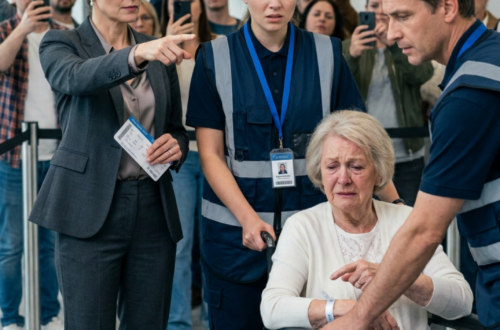
By noon, the video was everywhere parents knew how to be cruel without leaving fingerprints. It was only fourteen seconds long, which made it perfect for people who wanted certainty without context. In it, Emma stood in the hallway outside Room 214 while students crowded near the lockers, their phones raised chest-high or hidden badly against binders. Scout tugged once on the leash and nudged Emma’s leg. Someone laughed. Then a boy’s voice, clear and delighted with itself, shouted, “Since when do dogs go to sixth grade?”
The clip ended before Emma looked down at Scout. It ended before he whined again, before she put one hand against the locker because her balance had gone strange, before Nurse Grant arrived from the office. It ended before Principal Caldwell removed the collar. Fourteen seconds can be a lie without containing one false image. I learned that that day, though I wish I had learned it somewhere less expensive.
The first message came from a mother named Denise Baker, whose son played trumpet badly in the winter concert and once borrowed Emma’s pencil for three weeks. She wrote, “I hope Emma is okay, but bringing a dog without approval was not fair to the other kids.” Then came another, and another. Some sounded concerned. Some sounded righteous. A few did not bother pretending to be either.
By two o’clock, a parent group online had turned my daughter into a lesson. People said I was teaching her special treatment. They said allergies mattered too, which was true but not the whole truth. They said emotional support animals had gone too far, though no one had said emotional support animal except them. One father wrote that children needed discipline more than excuses. Someone else asked whether the school would allow snakes next, and forty people clicked a laughing reaction.
Emma saw some of it before I could stop her.
I found her sitting on the bathroom floor with Scout pressed against her side. She had changed out of her school clothes into pajama pants printed with moons, but she still wore her damp socks. Her phone lay faceup on the bath mat. The screen showed a paused image of her own face in the hallway, mouth slightly open, eyes wet, looking smaller than she was. The bathroom smelled like lavender soap and wet dog. Rain ticked against the little frosted window above the shower.
“Give me the phone,” I said softly.
She handed it over without arguing, which somehow hurt worse.
“They think I lied,” she said.
“They don’t know anything.”
“They think Scout is bad.”
“Scout is not bad.”
She scratched behind his ear. “He pulled.”
“He was trying to tell you something.”
“I didn’t know what.” Her voice cracked. “I thought maybe he was scared because everybody was loud.”
I sat on the edge of the bathtub because my legs felt suddenly empty. “Maybe he was. Maybe he was worried about you.”
“I told Mrs. Lang I needed to sit down.” Emma stared at the tile grout. “She said we were all upset.”
That sentence stayed with me. We were all upset. It turned a child’s medical warning into a classroom inconvenience, spread the discomfort evenly over everyone, and made my daughter’s body just one more difficulty for adults to manage. I wanted to call Mrs. Lang and say things I could not take back. Instead, I took the crackers from my uniform pocket, saw they were crumbs, and put them on the sink without knowing why.
For the rest of that afternoon, I did what I had always done when frightened. I gathered paper. I pulled the blue accordion folder from the bottom drawer of my desk and spread everything across the kitchen table. Neurologist letters. Training certificates. Email printouts. Forms with boxes checked and signatures dated. A medication plan. A seizure action plan. A note from Dr. Patel explaining that Emma’s seizures were not always preceded by obvious symptoms, which was the entire reason Scout mattered.
The kitchen light flickered twice while I worked. I remember because Emma hated that flicker and usually told me to change the bulb, but that day she stayed silent in the living room. The television was on low, some baking competition she was not watching. Scout lay at her feet, his collar back around his neck, the blue tag resting against his chest like a small stubborn fact.
I called the school first. Mrs. Alvarez said Principal Caldwell was unavailable. I asked for the superintendent’s office and got voicemail. I called the district compliance coordinator and left a message that was too long, too careful, and probably too apologetic. Then I called Dr. Patel’s office and asked whether they could resend the letter. The nurse there knew my voice by then. She said, “Again?” and immediately softened when I did not answer.
At 4:37, an email arrived from Principal Caldwell.
The subject line was “Incident Involving Unauthorized Animal on Campus.” Even now, I remember the way my vision narrowed around those words. Unauthorized animal. Not service dog. Not medical matter. Not student safety concern. The email stated that Emma had violated campus policy by bringing an animal to school without approval, that she had caused disruption to instructional time, and that her suspension would remain in effect pending review. It also said the school would not comment on “social media speculation,” which was a neat phrase for videos of my child being mocked in a hallway while adults watched.
I wrote back with attachments. I included the neurologist report, the service dog certification, the accommodation request, the email chain from August, and the one from September. I wrote, “Please confirm receipt.” It was a sentence I had written so many times that my fingers seemed to know it without me.
He did not respond.
That evening, my mother came over with a casserole because she belonged to a generation that believed food could stand in the doorway when words failed. She was seventy-one then and moved slowly when it rained, one hand braced against her lower back. She did not understand email attachments and district procedures, but she understood when a child had been shamed. She sat beside Emma on the couch and told her the casserole was terrible because she had forgotten the pepper, which made Emma smile for half a second.
My mother waited until Emma went upstairs to brush her teeth before saying, “You have to make noise now.”
“I’m trying.”
“No,” she said. “You’re still trying to be the reasonable one.”
I was washing a spoon that was already clean. “If I sound unreasonable, they’ll say that’s the problem.”
“They already are.”
I turned off the water. The kitchen smelled like onions, rain, and the lemon dish soap I bought because it was always on sale. “I brought Scout before the final approval.”
“You brought him because your daughter needed him.”
“That’s not how they’ll say it.”
“Then stop letting them be the only ones talking.”
I wanted to be angry at her, because anger was easier when it had somewhere familiar to land. But she was right. Or partly right. At the time, I still believed the correct evidence placed in the correct hands would fix things. I did not yet understand that evidence can sit unopened in an inbox while people build a story around its absence.
The next morning, Emma did not want to get out of bed. She was not supposed to go to school anyway, but she usually woke early from habit. I found her curled on her side, facing the wall, with Scout’s head on the mattress beside her. The room smelled faintly of the vanilla body spray she had started using because some girls in sixth grade said everyone should have a “signature scent.” On her desk was a math worksheet from the day before, folded in half. In the margin, she had drawn three tiny houses. One of them had no door.
“Do people at school hate me?” she asked.
“No.”
“You don’t know.”
“No,” I admitted. “I don’t know. But I know the loudest people are not always the most people.”
She looked at me then. “Do you hate them?”
I sat on the edge of the bed. “I’m angry.”
“That’s not what I asked.”
I thought about lying. Mothers lie all the time in small ways, not because we enjoy it but because truth sometimes feels too heavy to place in a child’s lap. “I hate what they did,” I said. “I’m trying not to hate them.”
Emma nodded, as if that answer made practical sense.
By midmorning, the district had called. Not the superintendent, not yet, but a woman from student services named Ms. Reilly. Her voice had that polished carefulness people use when a conversation might later be repeated. She said she was sorry Emma had experienced distress. She said the district took medical needs seriously. She said they were reviewing the matter. She did not say the suspension was wrong.
“Did you receive the documents?” I asked.
“We are in the process of compiling the relevant file.”
“I sent them again yesterday.”
“Yes, we have received your latest correspondence.”
“Latest,” I repeated. “I sent the first request in August.”
“I understand that is your position.”
“My position?” I said, and heard my voice sharpen. “It’s not a position. It’s an email.”
There was a pause. I could almost hear her deciding how to label me. “Mrs. Mitchell, I want to help. But it is important that we allow the process to work.”
“The process is why my daughter was filmed crying in a hallway.”
“I understand emotions are high.”
That phrase nearly undid me. Emotions are high. As if emotion were the problem and not the smoke from it. I ended the call before I said something worse, then immediately regretted ending it because polite people stay on the line. I was still measuring myself by rules that had never protected us.
The second video came that afternoon, sent by a father I barely knew. His daughter, Lily, had been in the hallway and had recorded longer than the clip everyone shared. The father wrote, “I’m sorry. Lily was afraid to send this because kids are talking. But you should have it.” The file was nearly four minutes long.
I watched it at the kitchen table with my hand over my mouth. Not because it showed something shocking in the way people mean online. It showed the ordinary mechanics of humiliation. Emma standing near the lockers. Scout nudging her knee once, then again. Mrs. Lang saying, “Emma, this has gone far enough.” Caldwell arriving with two office staff behind him. Students pretending not to record while clearly recording. Someone whispering that Emma’s mom was going to get sued. Someone else laughing.
Then Emma said, “I need to sit down.”
Her voice was quiet, but the phone had caught it.
Mrs. Lang said, “We all need to calm down.”
Scout whined and tugged toward Emma’s left side. Emma’s hand fluttered near the locker. Caldwell stepped closer and said, “Remove the animal from the building.” Emma said, “He’s working.” Caldwell said, “Not without authorization.” Then he reached for the collar.
I stopped the video there the first time. I could not watch his hand on Scout’s neck. I stood up so fast the chair legs scraped the floor and Emma called from the living room, “Mom?” I told her everything was fine, which was a lie with no shape at all.
When I watched again, I forced myself to keep going. Caldwell unclipped the blue collar while Scout stood rigid and trembling with contained obedience. Nurse Grant appeared at the far end of the hall at almost the same moment, moving quickly but not running. She said something the phone did not catch. Caldwell turned toward her. The camera dipped, and for a few seconds all I saw were sneakers, tile, and the edge of a dropped pencil. Then the clip ended.
I sent it to Ms. Reilly. I sent it to Dr. Patel. I sent it to myself in three places because fear makes you practical.
At 6:12 that evening, my phone rang from a number I recognized but had never used. It was the school nurse, Melissa Grant. She had always been kind to Emma in a brisk, competent way, the kind of woman who wore cardigans with deep pockets and kept extra hair ties in her desk. Her voice sounded different that night. Lower. Less official.
“Mrs. Mitchell,” she said. “Are you able to talk?”
I looked toward the living room. Emma was feeding Scout pieces of plain chicken from a plate, counting each one as if fairness mattered to dogs. My mother had gone home. The rain had finally stopped, leaving the windows black and streaked. “Yes,” I said.
“I can’t discuss everything over the phone,” Nurse Grant said. “But I need to ask you something.”
“Okay.”
“Do you still have the email from September 3rd?”
The date meant nothing for half a second. Then my eyes moved to the accordion folder on the table. September 3rd. That was the day Nurse Grant had written that temporary accommodation was medically advisable while the formal review continued. That was the email I had printed twice because I remember the phrase medically advisable making me cry in relief when I first saw it.
“Yes,” I said slowly. “I have it.”
Nurse Grant exhaled, not quite relief, not quite fear. “Good. Do not delete it. Do not forward it back to the school server. Keep your copy exactly as it is.”
My mouth went dry. “Why?”
There was another pause, and in it I heard something I had not heard from anyone at the school yet.
Shame.
“Because,” she said, “it is not in Emma’s file anymore.”
PART 3
I slept maybe two hours that night, and even that is generous. I kept waking to the small sounds of the house, the heater ticking, Scout shifting in Emma’s room, rainwater dripping from the gutter even after the storm had moved on. Each time, I thought of the same sentence. It is not in Emma’s file anymore. Not misplaced, not overlooked, not under review. An email that had existed plainly enough for me to print had vanished from the place where decisions were supposedly being made.
At 5:10 in the morning, I sat at the kitchen table with my laptop, the blue accordion folder, and a mug of coffee gone cold. The house smelled like toast because I had made some and forgotten to eat it. I found the September 3rd email in three places: my inbox, my printed records, and a forwarded copy I had sent to my mother because she once told me to “send important things somewhere else,” which at the time had seemed like old-lady suspicion. Nurse Grant’s message was short, professional, and careful. She recommended temporary access for Scout under a controlled plan due to the documented risk of seizure activity and the pending formal accommodation process.
I read it until the words blurred.
Then I started building a timeline. August 11, initial request submitted. August 14, records delivered to the front office. August 20, Dr. Patel letter emailed. August 27, service-dog certification sent. September 3, Nurse Grant recommendation. September 8, my follow-up. September 15, district review delayed. September 30, another follow-up. October 6, Caldwell wrote that “campus animal policy remains unchanged pending administrative review.” Every date was a nail. Every email was proof that I had not imagined the months we spent waiting.
At seven, Emma came downstairs in slippers, with Scout beside her. Her hair was tangled on one side, and she looked at the papers on the table with the exhausted suspicion of a child who has already learned paperwork can hurt her. “Do I have to talk to anyone today?” she asked.
“Maybe Dr. Patel,” I said. “Maybe Ms. Reilly. Not alone.”
“Do I have to watch the video?”
“No.”
She nodded and went to the cabinet for a bowl. Then she stopped. “Did I almost have one?”
I knew what she meant. A seizure. We had learned to say the word directly in our house, but fear still made us circle it sometimes. “I don’t know,” I said. “Scout thought something was wrong.”
“Did the grown-ups know?”
That question was so simple that I almost lied again. “Some of them knew enough.”
Emma poured cereal. A few pieces bounced onto the counter. She picked them up one by one and put them in the trash instead of the bowl, because she had always been particular about that. “Then why did they act like I was bad?”
I had no answer that would not make the world less safe. So I said, “Because sometimes adults are more afraid of admitting mistakes than making them.”
She looked at me for a long moment. “That’s stupid.”
“Yes,” I said. “It is.”
By nine, Ms. Reilly had agreed to a district meeting that afternoon. I say agreed, but really I think the second video and Nurse Grant’s warning had moved the situation from uncomfortable to dangerous for them. The meeting would include Caldwell, a district administrator, someone from legal, Nurse Grant, me, and, if I permitted it, Emma. I did not permit it. Emma had been made into public evidence once already.
Before the meeting, Dr. Patel called me personally. She had treated Emma since the first seizure, the one that happened in a grocery store aisle when Emma was seven and I thought she had tripped. I still remember the sound of a soup can rolling under the shelves. Dr. Patel was not warm in a soft way, but she was direct, and directness can feel like kindness when everyone else is fogging the room.
“The dog’s behavior in the longer video is consistent with alerting,” she said.
I closed my eyes. “So she may have been close.”
“Possibly. I cannot diagnose from a video, but yes, the behavior is clinically significant given his training.”
“They removed his collar.”
“I saw.”
There was a silence on the line. I heard pages turning on her end. “Sarah,” she said, using my first name for maybe the third time in four years, “bring every document. Not copies they supplied. Yours.”
“I will.”
“And bring someone with you if possible.”
“My mother can’t sit through that.”
“Then bring the documents and your anger,” she said. “Just keep the anger organized.”
That almost made me laugh. Almost.
The district office was attached to an older brick building near the high school, with shrubs trimmed into shapes no plant would choose for itself. The rain had stopped, but the sky was still low and gray, pressing down on the town. Inside, the lobby smelled like old carpet and burnt coffee. A bulletin board displayed smiling photos from last year’s academic awards, including one of Principal Caldwell standing beside a row of students holding certificates. He looked proud in the photo, and maybe he was. That was the part I kept stumbling over. He was not a cartoon villain. He wrote recommendation letters. He attended concerts. He probably believed he had dedicated his life to children.
That did not make what he did smaller.
The meeting room had a long table, a pitcher of water, and a clock that ticked too loudly. Caldwell sat on one side with his hands folded. Beside him was Ms. Reilly, wearing a navy blazer and an expression of professional concern. A man from legal introduced himself as Mr. Voss and shook my hand with exactly two pumps. Nurse Grant sat near the far end of the table with a folder in front of her. She did not look at Caldwell.
I placed my accordion folder on the table. The rubber band snapped when I removed it. For some reason, that embarrassed me.
Ms. Reilly began by saying the district wanted to establish facts. Mr. Voss said this was not an adversarial proceeding. Caldwell said nothing. I thought of Emma at home with my mother, drawing houses or pretending not to care, and I felt my fear settle into something harder.
“Then let’s start with the fact that my daughter’s medical identification was removed from her service dog,” I said.
Caldwell’s mouth tightened. “The collar was removed temporarily to avoid further distraction and confusion.”
“It said MEDICAL ALERT SERVICE DOG.”
“Students were already upset.”
“Emma was upset.”
“Mrs. Mitchell,” Ms. Reilly said, “we understand that this was distressing.”
“No,” I said. “You keep saying that. Distressing is not the word for adults humiliating a child during a medical alert.”
Mr. Voss made a note.
Nurse Grant looked down at her folder.
They asked me to explain why Scout had been brought before formal approval. I gave them the timeline. I gave them copies of the medical reports. I gave them the certification. I gave them the September 3rd email. When I slid that page across the table, Nurse Grant finally looked up. Caldwell did too, and for the first time since I had met him, something in his expression moved before he could discipline it.
Ms. Reilly read the email slowly. Mr. Voss leaned toward her. Caldwell adjusted his cuff.
“This email does not appear in the current review packet,” Ms. Reilly said.
“I know,” I said. “Nurse Grant told me.”
The room changed. Not loudly. No one gasped or shouted. But the air shifted in the way a house does when a door opens somewhere in winter.
Mr. Voss turned to Nurse Grant. “Melissa?”
Nurse Grant placed both hands flat on her folder. “I sent that email on September 3rd to Mrs. Mitchell, Principal Caldwell, Assistant Principal Harris, and the district accommodation inbox.”
Caldwell said, “I receive a high volume of correspondence.”
“You replied to it,” I said.
He looked at me.
I opened another page from the folder. “September 4th. You wrote, ‘Thank you, Melissa. We will need to consider student reactions, allergy concerns, and the precedent this may create before allowing the dog on campus.’”
Ms. Reilly took that page from me.
Caldwell’s face reddened slightly above the collar. “Consideration is not approval.”
“No,” I said. “But it is knowledge.”
There was a long silence. The clock ticked. In the hallway outside, someone laughed, and the sound seemed to belong to another building entirely.
Caldwell leaned back. “My concern has always been safety and order. We have hundreds of students. We cannot allow parents to bypass procedure by arriving with animals and demanding exceptions.”
“That is not what happened.”
“That is exactly what happened from the school’s perspective.”
Nurse Grant spoke then, quietly. “Richard, she had a seizure action plan on file.”
He turned toward her. “No one is disputing the medical condition.”
“You treated the dog as unrelated to it.”
“I treated an unapproved animal as unapproved.”
“He alerted in the hallway.”
“We cannot know that.”
“You would not let me examine Emma until after she was in the office.”
Caldwell’s eyes sharpened. “That is not accurate.”
Nurse Grant’s hands trembled once, then stilled. “It is.”
I looked between them and realized there was more to the hallway than even the longer video had shown. “What happened after the clip ended?”
Nurse Grant glanced at Ms. Reilly, then at Mr. Voss. “I asked to take Emma to my office for evaluation. Principal Caldwell instructed me to wait until the disciplinary situation was under control.”
Caldwell said, “That is a mischaracterization.”
“She said she needed to sit down,” Nurse Grant said. “The dog was alerting. Her mother had provided documentation that the dog’s alerts could precede seizure activity. That should have ended the disciplinary response immediately.”
For the first time, I saw Caldwell angry in a way that was not polished. Not explosive, but deeply offended. “And I suppose you would have me let every parent dictate medical policy by email?”
“No,” Nurse Grant said. “I would have you read the emails you answer.”
It was not a dramatic line. She said it with sadness, not triumph. Maybe that is why it landed.
Mr. Voss asked for a brief recess. That is what he called it, a recess, as if we were in court or school or some other place where naming a pause made people less responsible for what came before it. Ms. Reilly and Caldwell left the room with him. Nurse Grant stayed. I did too.
For a minute, neither of us spoke. The pitcher of water had condensation running down its side. Someone had left a blue pen uncapped near the center of the table. I thought of Scout’s blue collar in the plastic bag and had to look away from it.
“Why did you call me?” I asked.
Nurse Grant rubbed her thumb along the edge of her folder. “Because I should have done more before.”
“You tried.”
“Not enough.”
I wanted to comfort her, which annoyed me because I was tired of women cleaning up the emotional debris after powerful men made decisions. Still, she looked so worn that my anger could not quite stay pointed at her. “What happened to the file?”
“I don’t know exactly,” she said. “The review packet I saw yesterday was missing my recommendation and one of Dr. Patel’s letters. The log showed the documents were uploaded. Then the packet generated for review did not include them.”
“Generated by who?”
She hesitated. “Administration.”
“Caldwell?”
“I can’t prove that.”
“But you think it.”
She did not answer, which was answer enough.
When they returned, Caldwell looked composed again. Mr. Voss did most of the talking. The district would conduct an internal review. Emma’s suspension would be “held in abeyance” pending that review, which meant they were not yet ready to say they had been wrong but wanted the punishment to stop existing in the meantime. They would remove disciplinary language from her attendance record temporarily. They would request all documentation from all parties.
“No,” I said.
Ms. Reilly blinked. “I’m sorry?”
“No. Temporarily is not enough. Held in abeyance is not enough. My daughter was suspended publicly. The correction needs to be public.”
Caldwell spoke before Mr. Voss could. “Absolutely not.”
There it was. Too quick. Too revealing.
Ms. Reilly turned to him. “Richard.”
“I will not stand in front of students and apologize for enforcing campus policy.”
“You stood in front of students and enforced it,” I said.
He looked at me with open dislike then. It was almost a relief after all the polished phrases. “Mrs. Mitchell, with respect, you created this situation by bringing the animal before final approval.”
I felt my hands go cold. “Service dog.”
“Before final approval.”
“You knew why he was there.”
“I knew what was being requested.”
“You knew what Nurse Grant recommended.”
He leaned forward. “I knew Melissa had concerns about possible seizure escalation in high-stimulation environments, yes. That did not grant you permission to violate procedure.”
The room went very still.
Ms. Reilly’s eyes moved to him. Mr. Voss stopped writing. Nurse Grant closed her eyes briefly.
Caldwell had said possible seizure escalation in high-stimulation environments. Those were not my words. They were not in the form letter. They were from Dr. Patel’s second report, the one Caldwell had claimed he had not reviewed, the one missing from the official packet. I knew because I had read that phrase so many times it had burned itself into me.
I opened my folder slowly and removed the report. My fingers did not shake now. “That wording,” I said, “comes from Dr. Patel’s September 12th letter.”
Caldwell’s face changed.
“You said that letter was not in the review materials,” I continued. “You said you could not make decisions based on documents you had not received.”
“I may have seen a reference.”
“No,” Nurse Grant said quietly. “That phrase only appears in the letter.”
Ms. Reilly reached for the document. Mr. Voss was watching Caldwell with the expression of a man realizing the problem had stopped being a parent.
Caldwell sat back, and for just a moment he looked older than fifty-six. Not sorry. Not yet. But cornered by his own certainty. His fatal mistake was not that he had failed to read the documents. His mistake was that he had read them, understood enough to fear liability, and still believed controlling the story would be easier than admitting Emma needed protection before the paperwork was finished.
The rest of the meeting became careful and quiet. Mr. Voss asked for copies of everything. Ms. Reilly said the district would be in touch within twenty-four hours. Caldwell said almost nothing. Nurse Grant walked me to the lobby afterward, and we passed the bulletin board of smiling award photos again.
At the door, she said, “How is Emma?”
I looked through the glass at the wet parking lot. “Embarrassed. Angry. She thinks everyone sees her as the girl with the dog now.”
Nurse Grant nodded. “I’m sorry.”
“I know.”
“No,” she said. “I am sorry. I was in that hallway and I let his authority slow me down.”
I wanted to say it was all right, but it was not. “Then don’t let it slow you down again.”
She accepted that like she deserved it.
When I got home, Emma was at the kitchen table drawing. My mother had made tea and left a ring on the counter because she never used coasters no matter how many I bought. Scout lifted his head when I entered, and his tag jingled softly. Emma looked at my face and asked, “Did they say sorry?”
“Not yet.”
She went back to her drawing. “They won’t.”
“I think they will.”
“Because they mean it?”
I hung my wet jacket over a chair. The smell of rain rose from it again, familiar and sour. “Maybe not at first.”
She drew a roof on a tiny house. “Then what’s the point?”
I did not answer right away. I wanted justice to be clean for her. I wanted to say apologies mattered because truth mattered, because adults learned, because wrongs corrected themselves when exposed to light. But she was eleven, not foolish. She had seen adults remove the words that named her safety and seal them in a bag.
“The point,” I said carefully, “is that they don’t get to make everyone believe you were bad.”
Emma’s pencil stopped.
“And they don’t get to pretend they didn’t know.”
She looked at Scout, then at me. “Will I have to go back there?”
That was the question underneath everything. Not whether Caldwell would apologize. Not whether the district would change policy. Whether my daughter would have to walk again through a hallway where children had laughed and adults had watched.
“I don’t know,” I said. “But not until you feel safe.”
She nodded, and I saw both relief and grief in her face. It is hard to explain that expression unless you have seen a child lose something invisible. She was relieved I would not force her back immediately. She was grieving that the choice had become necessary.
That night, after Emma fell asleep, I watched the long video one more time. Scout nudged. Emma swayed. Mrs. Lang folded her arms. Caldwell reached for the collar. But now the video looked different. The tugging was not disobedience. The whining was not disruption. Emma’s silence was not guilt. Even Caldwell’s calm was different, not ignorance but strategy.
Fourteen seconds had made people think they understood my daughter.
Four minutes made them wrong.
PART 4
The apology happened three days after the hallway incident, though it took those three days to drag the truth through enough locked doors. By then, the parent group had quieted in the way people quiet down when they realize their confidence has been recorded. The district had received the longer video, the email chain, Nurse Grant’s statement, and Dr. Patel’s written clarification. Someone, I never learned who, leaked that missing documents had been restored to Emma’s file. That part still bothers me. Restored is a soft word. It makes absence sound like an accident that wandered home.
The school sent a message to all families at 7:04 on Thursday morning. I remember the time because I was standing in the pharmacy break room, eating crackers from my pocket and reading it under a fluorescent light that made everyone look unwell. The message said an assembly would be held to address “recent events involving a student accommodation matter.” It said the district was committed to student dignity and accurate information. It did not name Emma. It did not name Scout. It did not name the harm.
I called Ms. Reilly immediately. “No.”
She sounded tired. “Mrs. Mitchell, we are trying to respect Emma’s privacy.”
“You respected her privacy after she was filmed in the hallway?”
A pause. “The assembly will correct misinformation.”
“Will Principal Caldwell apologize?”
“He will make a statement.”
“That is not what I asked.”
Another pause. “Yes.”
I looked through the break room window at the alley behind the pharmacy, where rainwater had collected around a flattened cardboard box. A delivery truck beeped as it backed up. “Emma will not attend.”
“That is completely understandable.”
“But I will.”
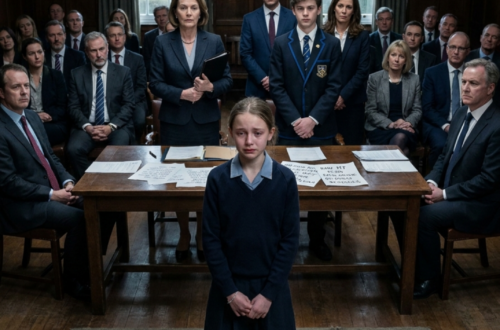
The assembly was held in the gym, because schools always return to the rooms where children are used to being arranged. Folding chairs had been set up for parents along one side. Students sat by grade on the bleachers. The place smelled like floor varnish, damp sneakers, and the faint sweetness of whatever had been served at breakfast. The fluorescent lights buzzed overhead. At the far wall, a scoreboard displayed zeros for both teams, which felt almost too neat, like the room was mocking the idea of winners.
I sat in the second row beside my mother, who had insisted on coming and wore her church coat like armor. Nurse Grant stood near the side doors. Mrs. Lang sat with the sixth-grade teachers, her hands folded in her lap. She looked pale. I did not know yet whether she was sorry or frightened. Sometimes those look the same from a distance.
Caldwell stood at the microphone in the center of the gym. He wore a dark suit, not the gray one from his office. Ms. Reilly stood behind him with the superintendent, Dr. Harlan, a broad-shouldered woman whose expression suggested she had spent the morning removing broken glass from a carpet. Caldwell held a printed page. His hands were steady.
He began with the usual phrases. Recent incident. Student wellbeing. Commitment to process. I could feel my mother stiffen beside me. On the bleachers, students shifted and whispered. Someone coughed. The microphone gave a small burst of feedback.
Then Dr. Harlan stepped forward and touched Caldwell’s elbow.
It was a tiny gesture, but I saw it. So did he. He looked down at the page, then back at the students.
“On Monday,” he said, “a sixth-grade student was removed from class after bringing a service dog onto campus.”
The gym quieted in layers.
“I stated at that time that the student had violated school policy. That statement was incomplete and unfair. The district has since confirmed that medical documentation related to the student’s need for a seizure-alert service dog had been submitted before the incident. The student and her family had been engaged in the accommodation process for several weeks.”
Not months, I thought. Several weeks was smaller than the truth. But it was not nothing.
Caldwell swallowed. “During the incident, the student’s dog was separated from his identifying collar. That should not have happened. The student was publicly embarrassed in a way no child should be embarrassed by school staff. For that, I apologize.”
There was no gasp, no dramatic wave of regret across the bleachers. Real public shame is quieter than people think. Some students looked down. Some looked at each other. One boy in the seventh-grade section, maybe the one who had shouted in the video, stared hard at his shoes.
Caldwell continued. “The suspension has been removed from the student’s record. The district is revising procedures for temporary medical accommodations, staff response during medical alerts, and the handling of service animals on campus. Recording and sharing videos of classmates during vulnerable moments is also unacceptable, and we will address that separately.”
That last part made several students shift.
Then he said, “Rules matter. But rules exist to support student safety, not to replace judgment.”
I wondered who had written that line. I hoped it had hurt him to say it.
When the assembly ended, parents stood slowly, uncertain whether to speak. My mother squeezed my arm. Nurse Grant came over and asked quietly whether Emma was home with Scout. I said yes. Mrs. Lang approached after a minute, holding a folded tissue though she was not crying.
“Mrs. Mitchell,” she said.
I waited.
“I’m sorry,” she said. “I should have listened when Emma said she needed to sit down.”
It was not enough. It was also more than I expected.
“She trusted you,” I said.
Mrs. Lang’s face tightened. “I know.”
“No,” I said, more tired than angry now. “You know now.”
She nodded, and I saw that the sentence had landed where it needed to. She did not ask me to forgive her. I appreciated that. People who ask too quickly for forgiveness usually want relief more than repair.
Caldwell did not approach me. Dr. Harlan did. She told me he would be placed on administrative leave during the internal review. She told me the district would provide home instruction for Emma while we decided next steps. She told me they were prepared to approve Scout’s accommodation immediately if Emma returned. She used careful language, but her eyes did not slide away from mine, and by then that counted for something.
“Will the missing documents be investigated?” I asked.
“Yes.”
“Will I be told what happened?”
“To the extent we are legally able.”
I almost laughed, but I was too tired. “That means maybe.”
“That means maybe,” she admitted.
Partial honesty can feel almost generous after days of polished avoidance.
Emma watched a recording of the apology that evening, sitting on the couch with Scout’s head in her lap. We did not make her watch it. She asked. The house smelled like tomato soup because my mother had made too much and left half of it in our refrigerator. Outside, the rain had finally cleared, and the sky had that pale washed look autumn gets after a storm. Emma held the remote in both hands. She paused the video after Caldwell said the word apologize.
“He looks mad,” she said.
“He probably is.”
“At me?”
“At being wrong.”
She considered that. “He didn’t say my name.”
“No.”
“I’m glad.”
“Me too.”
She restarted the video. When Caldwell said the suspension had been removed, she leaned back a little, but when he mentioned recording classmates, she covered Scout’s ears. It was such a childlike thing to do that I had to look away. I had spent three days fighting adults with emails and evidence, and there was my daughter protecting a dog from hearing bad news.
The official consequences unfolded slowly, as official consequences do. Caldwell did not lose everything. People online wanted that, once the story turned. They wanted him fired by noon, disgraced by dinner, erased by the weekend. What happened was less satisfying and probably more real. He remained on leave through the semester, then resigned in December “to pursue opportunities outside district administration.” Mrs. Lang completed mandatory training and sent Emma a handwritten apology that Emma read once and placed in a drawer. Nurse Grant became part of the district’s new accommodation review team, which seemed like both recognition and punishment, depending on the day.
The policy changes were real. Temporary medical accommodations could no longer sit indefinitely without written interim plans. Service-dog identification could not be removed except in a direct safety emergency. Staff had to treat alert behavior as medical information, not classroom disruption. Student videos of medical incidents were addressed under privacy and bullying rules. On paper, it was progress. I have learned to respect paper while never worshiping it again.
As for Emma, she did not return to Caldwell’s school.
For a while, I thought that meant they had taken something permanent from her, and in one way they had. She loved her tiny locker mirror. She loved the library window seat. She loved a girl named Maya who shared sour candy with her during lunch and drew flowers on her sneakers. Leaving was not a clean victory. It was another loss dressed as a solution.
In January, Emma started at a smaller public charter school across town. The building was older, with uneven sidewalks and a front office that smelled like coffee, printer toner, and peppermint gum. On the first morning, the air was cold enough to turn our breath white. Scout walked beside Emma with his blue collar in place and his tag resting against his fur. I had packed her lunch twice, checked the paperwork three times, and tucked crackers into my coat pocket though I was not the one going to school.
At the entrance, Emma stopped.
“You can wait,” I said. “We don’t have to rush.”
A group of students passed us, laughing about something on a phone. Emma’s hand tightened on the leash, but Scout leaned gently against her leg. Not alerting, I think. Just there. The new principal, Ms. Alvarez, not related to the old secretary, stood inside the doors wearing boots with mud on one heel. She came out into the cold instead of calling Emma in.
“You must be Emma,” she said. Then she looked at Scout. “And you must be Scout. We’re glad you’re both here.”
Emma did not smile exactly, but her face opened a little.
Ms. Alvarez crouched, not to pet Scout, just to be closer to Emma’s height. “Nurse’s office is ready if you need it. Your homeroom teacher has your seating plan. And nobody touches Scout’s gear except you or your mom unless there’s an emergency. Sound right?”
Emma looked at me, then back at her. “Yes.”
“All right,” Ms. Alvarez said, standing. “Take your time.”
It was ordinary, almost painfully ordinary. A principal at a door. A child with a backpack. A dog waiting for the next step. No assembly, no apology, no viral outrage. Just the basic decency that should never have required a fight.
Emma walked in without holding my hand.
I stayed outside longer than I needed to. Through the glass, I watched her move down the hallway with Scout at her side. A boy glanced at the dog, then at Emma, and then kept walking. Somewhere inside, a bell rang, softer than the old school’s bell, or maybe I only remember it that way. Scout’s blue tag jingled once as he turned the corner beside her.
That sound is what I keep.
Not Caldwell’s apology. Not the video. Not the plastic bag on the desk. I keep the small silver-blue sound of the tag moving freely where it belonged, no longer sealed away as evidence, no longer treated like a problem to hide. Emma did not get back the version of herself who walked into sixth grade believing adults would read every form and do the right thing. I did not get back the mother who believed patience was the same as protection.
But my daughter walked forward.
And Scout walked beside her.