Part 1 – The Boy From the Scholarship Brochure
I was thirteen when St. Bartholomew’s Academy learned it could punish me faster than it could protect me. That is the cleanest way I know how to say it now, though at the time nothing felt clean. It felt like damp wool, cheap shoe polish, old radiators, and the sour taste of fear in the back of my throat. It felt like adults leaning over polished tables and using careful words to make a child sound dangerous.
Before that week, I believed music could save me from being noticed for all the wrong reasons. I had a scholarship, a secondhand blazer with sleeves my mother had turned up twice, and a bus ticket folded inside my piano book as a bookmark. Every morning, I rode from Manchester with my knees pressed together, tapping scales silently on my thighs while rain crawled down the window glass. I tried not to look at the other boys’ shoes when they got on near the village, because their shoes always looked as if they had never met a puddle.
My mother, Ruth Miller, worked mornings in a cafe and cleaned offices at night. She bought the cheaper tea bags and left them steeping too long, so every cup in our flat tasted a little bitter, as if the kettle knew we were tired. On gala week, she kept asking whether my shirt still fit, whether I had eaten, whether Mr. Reed had said anything about the solo. She asked ordinary questions in an ordinary voice, but her hands moved too quickly around the sink.
Mr. Alistair Reed was the kind of teacher parents quoted at dinner. He had silver at his temples, long fingers, and a way of lowering his voice that made a whole room lean in. He almost never shouted. I used to say he shouted at me, but that is not true. Mr. Reed did something worse: he softened his voice until I felt as if I had become very small and unreasonable.
To everyone else, he was the soul of the academy. He rescued talent. He found promise where society had failed to look. He said things like that at assemblies while donors smiled from the front row. When he introduced me the first time, he put his hand on my shoulder and said, “Ethan Miller reminds us why scholarships matter.”
The applause had been warm enough to make my face burn.
I wanted the applause, but I did not want the reason for it. That was the first contradiction I did not know how to explain. I wanted to be heard because I could play, because my left hand could hold a broken chord steady while my right hand climbed out of it, because I could remember a melody after hearing it once. I did not want to be heard because my mother worked until her feet swelled or because I had learned on a cracked church keyboard with one dead B-flat.
The annual donor gala was the biggest night in the music department. Parents came in velvet jackets and silk scarves. Governors stood near the wine table and laughed with their mouths open. The hall smelled of lilies, floor wax, and piano polish, and the black Steinway on the stage shone like still water under the lights. That year, Mr. Reed had told me I might play my own composition.
I had called it “North Window” in my head, though I never wrote the title on the page. It was named after the window in our flat where the glass rattled in winter, the one above the radiator that never heated properly. The melody began quietly, three notes falling and one answering, like someone deciding whether to speak. I had shown the handwritten pages only to Mr. Reed because he said private work should be protected until it was ready.
“You have something rare here,” he told me after rehearsal one Tuesday. “But talent is not enough, Ethan. Presentation matters.”
I nodded because I always nodded at school. It was easier than finding words.
On the Thursday before the gala, he handed me a printed sheet. We were alone in Practice Room Four, where the carpet smelled faintly of dust and wet coats. Through the wall, someone was murdering a clarinet scale. Mr. Reed stood beside the upright piano and tapped the paper with one finger.
“You’ll read this before you play,” he said.
I looked down. The first line said, My name is Ethan Miller, and before St. Bartholomew’s, I never imagined a future like this.
At first, I thought it was only awkward. Then I kept reading. It mentioned my mother’s jobs. It mentioned “financial hardship.” It said the academy had given me “not just an education, but dignity.” That word made my stomach tighten, because dignity was not something they had handed me. My mother had scrubbed for it. I had practiced for it. We had both gone without things for it.
“I don’t want to say this,” I said.
Mr. Reed smiled as if I had misunderstood the time of a rehearsal. “It’s simply context.”
“It says my mum couldn’t give me opportunities.”
“It says your mother made sacrifices,” he replied. “No one is insulting her.”
I remember rubbing my thumb over the edge of the page until it bent. “Can I just play?”
The smile stayed, but his eyes changed. “This evening is not about just playing. People give generously because they see what generosity makes possible. You are old enough to understand that.”
I was old enough to understand more than he wanted me to. I understood that the boys whose parents paid full fees were introduced by their achievements. I understood that I was introduced by what I lacked. I understood that gratitude, at St. Bartholomew’s, had a script.
“I’m grateful,” I said, hating how thin my voice sounded. “But I don’t want to read that.”
Mr. Reed folded the paper once, very neatly. “Then you may not be ready for the solo.”
My chest went hot. “But you said the composition was good.”
“It is. You are good. But you are also proud in ways that will hurt you.” He placed the folded paper on the piano. “Think carefully, Ethan. There are many talented children. Not all of them are given a stage.”
That night, I did not tell my mother. She was sitting at the kitchen table in her black work trousers, counting coins for the bus and making a shopping list on the back of an envelope. The flat smelled of fried onions from next door. Her hair was still pinned up from the cafe, and there was a red mark on her wrist where a cleaning glove had rubbed the skin.
“Did he like the piece?” she asked.
I said yes.
She smiled with her whole tired face. “Then that’s what matters.”
I should have told her. That was one of my mistakes. I thought protecting her meant keeping the humiliation to myself. Children do that sometimes. We mistake silence for bravery because silence is the only tool we can lift.
On Friday afternoon, I sent Mr. Reed an email from the school library. I wrote that I was sorry if I sounded ungrateful, but I wanted to play the solo without the speech. I wrote too much. I begged a little. I said the composition mattered to me and that my mother did not like people knowing our business. When I pressed send, my hands were shaking, and the old computer fan hummed as if it disapproved.
By the end of rehearsal, I had lost the solo.
Mr. Reed announced it in front of the chamber group with a sorrowful calm that made everyone look at me. “Ethan is not quite steady enough this week,” he said. “We’ll have Oliver perform the Chopin instead.”
Oliver’s parents donated to the new auditorium fund. He was not cruel, not really, but he looked relieved in the way people look relieved when your bad luck gives them something. I stared at my music stand while the room went quiet. My eyes filled before I could stop them, and I hated that most of all.
After rehearsal, I went to the bathroom near the music corridor and cried in a stall with my fist pressed against my mouth. Two boys came in laughing about cufflinks. One of them said, “Is someone dying in here?” and the other said, “Probably Miller. Lost his charity solo.”
I waited until they left.
The gala itself passed in pieces. I played in the ensemble. I turned pages. I stood at the back while Mr. Reed gave his speech about opportunity, excellence, and the academy’s moral duty. He called me “one of our brightest scholarship promises” even though I was no longer playing my piece. People turned in their chairs to look at me, and I felt my face arrange itself into something obedient.
After the concert, the music wing emptied slowly. There were cases snapping shut, parents calling names, the scrape of chairs, rain ticking against the tall windows. My mother had not been able to attend because the cafe had asked her to cover a late shift. I remember being glad and ashamed of being glad. I did not want her to hear anyone speak about us as if we were a project.
Mr. Reed asked me to help return scores to the rehearsal room. His voice was normal. That is one thing people later used against me, as if harm must announce itself with thunder. I followed him down the corridor past the framed photographs of old music scholars, past the radiator that knocked three times whenever the heating cycled, past Practice Room Four and into the small rehearsal room at the end.
The room was already dark except for the grey light from the high window. It smelled of piano polish and damp wool from all the blazers that had hung there that week. My composition pages were on the upright piano, though I had not left them there. One page had been torn at the corner.
Mr. Reed picked it up. “You made tonight difficult.”
I said nothing.
“Do you understand what people were expecting?”
“I only wanted to play.”
“No,” he said softly. “You wanted the benefits without the humility.”
That sentence stayed with me longer than the darkness did.
I will not make the locked room sound more dramatic than it was. He did not strike me. He did not scream. He did not say, “I am locking you in,” like a villain in a children’s book. He told me to stay there and think about whether I wished to remain part of the academy’s music family. Then he walked out. The door shut. The lock clicked.
For a few seconds, I thought he would come back.
Then the corridor sounds moved farther away. Shoes, laughter, a trolley squeaking, someone calling goodnight. I tried the handle. It did not move. The room had no inside key because the lock had been sticking for months and the caretaker had not repaired it. I knocked, then knocked harder. The sound seemed to disappear into the thick door.
I do not know exactly how long I was inside. Later, everyone wanted minutes. Adults love minutes because numbers look cleaner than fear. I remember the radiator knocking through the wall. I remember my breath sounding too loud. I remember sitting under the piano with my blazer pulled around me because that is what I used to do when I was little and my mother’s old landlord shouted in the stairwell.
When the caretaker finally opened the door, he looked irritated before he looked worried. “What are you doing in here?”
“Mr. Reed locked me in,” I said.
He blinked. “Don’t be stupid.”
Those were the first words anyone said after I told the truth.
Part 2 – The Liar
By Monday morning, I was no longer a frightened boy who had been found in a dark room. I was a disciplinary concern. That was the phrase Mrs. Vale from the scholarship office used when she called my mother. Not safety concern. Not welfare matter. Disciplinary concern. My mother wrote it down on the back of an electricity bill because she always wrote things down when she was trying not to panic.
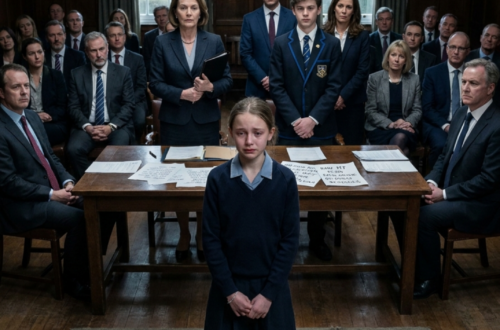
The meeting took place in a room with a glass wall and a silver bowl of mints on the table. I remember the mints because I kept staring at them instead of at the headmaster’s face. Dr. Hargreaves sat at one end with his hands folded. Mrs. Vale sat beside him with a folder. Mr. Reed was not there at first, which made me think, foolishly, that perhaps they were taking it seriously.
My mother came straight from the cafe. She still smelled faintly of coffee and chip oil, and there was rain on the shoulders of her coat. In that room, surrounded by framed rowing photographs and polished wood, she looked smaller than she was. I could see her noticing it too, and I hated the school for making her aware of her own coat.
Dr. Hargreaves began with my email.
“We understand Ethan was disappointed after a change to the gala programme,” he said. “That is natural. Young artists can be sensitive.”
“I told you what happened,” I said.
My mother touched my sleeve under the table, not to stop me, exactly, but to steady me.
Mrs. Vale slid a printed copy of my email across the table. Certain lines had been highlighted. I would be very grateful for the chance. I know I was upset. Please don’t give it to someone else. The words looked different in yellow, needy and childish. I wanted to grab the paper and explain that begging for a solo did not mean inventing a locked door.
“Ethan,” Dr. Hargreaves said, “no one is saying you intended harm.”
That was when my mother lifted her head. “You’re saying he lied.”
“We are saying there are inconsistencies.”
“What inconsistencies?”
He gave a patient sigh. “Mr. Reed’s account is that Ethan was emotional, that he left the music wing, and that he later returned. There is no evidence Mr. Reed locked him anywhere.”
“There’s Ethan,” my mother said.
The room went quiet in a way I had never heard before. Not empty quiet. Managed quiet.
Mrs. Vale opened her folder. “There is also the question of Ethan’s wellbeing. Several pupils saw him crying after rehearsal. One described him as angry. Another said he made comments about Oliver taking what was his.”
“I didn’t,” I said. Then I stopped, because maybe I had said something like that. Not to Oliver. Not seriously. In the bathroom, after crying, I had muttered that it should have been mine. A boy might have heard. Shame makes memory slippery.
Mr. Reed entered halfway through the meeting. He apologized for being late, though he did not sound sorry. He sat opposite me and looked at my mother with gentle concern. That was his gift. He could make concern feel like a witness statement.
“Ethan is tremendously gifted,” he said. “I hope no one doubts my affection for him.”
My mother did not thank him. I loved her for that.
“But he has been under pressure,” Mr. Reed continued. “Scholarship pupils sometimes feel they must prove themselves every second. It can become overwhelming.”
“Don’t talk about him like he isn’t here,” my mother said.
A pink patch rose on Mrs. Vale’s neck.
Mr. Reed turned to me. “Ethan, I know you were upset. I know you felt humiliated. I am sorry for that. But this story about being locked in a room is not the way to express pain.”
I tried to answer, but my throat closed around the words. That was another thing they used. I could play in front of three hundred people, but when adults asked questions in that room, I became clumsy. My sentences came out broken. I said he told me to stay. I said the door clicked. I said the caretaker found me. I could not make it sound as real as it had been.
By lunchtime, everyone knew.
No official announcement was made, of course. Schools like St. Bartholomew’s did not gossip; they allowed information to circulate through concerned channels. Someone’s mother had heard from someone on the gala committee. Someone’s father had spoken to a governor. By the time I reached the dining hall, boys at the end table were whispering “liar” into their sleeves.
I was removed from orchestra pending review. My youth conservatory recommendation was “paused.” I was told to use the library during music period. The library had green lamps and a smell of paper dust, and I sat there while the distant sound of scales came through the walls like a language I had been banned from speaking.
The worst part was not the boys who mocked me. It was the teachers who became careful. My maths teacher stopped asking me to solve problems on the board. My form tutor said, “Chin up,” while looking past my shoulder. The school nurse asked whether I was sleeping, but she wrote notes the whole time, and I could not tell whether she wanted to help me or document me.
On Wednesday, the torn page appeared.
Mrs. Vale called me from English and asked me to bring my bag. My mother was not there. Dr. Hargreaves was. So was Mr. Reed. On the table lay a page from my composition, torn across the top, with my pencil marks and fingerings crowded in the margins. I knew that page. It was from the middle section, where the left hand repeated a low E like a pulse.
“This was found in Oliver Grant’s folder,” Mrs. Vale said.
I stared. “Why would it be in Oliver’s folder?”
“That is what we are asking.”
“I didn’t put it there.”
Mr. Reed looked pained. “Ethan, please.”
“No.” My voice cracked. “I didn’t.”
Dr. Hargreaves leaned back. “Oliver says you were near his bag after rehearsal.”
“I walked past it.”
“And given your disappointment about losing the solo, you can understand how this appears.”
I could understand exactly how it appeared. That was the trap. Good lies do not float in the air; they hook themselves to things that are true. I had been upset. I had sent the email. I had cried. I had walked past Oliver’s bag. Now a torn page made me look jealous enough to sabotage him and desperate enough to accuse Mr. Reed.
When my mother arrived that afternoon, she looked as if she had run from the bus stop. Her work shoes were wet through, and her hair had come loose at one side. Mrs. Vale offered tea. My mother said no.
They showed her the page. They showed her my email again. Then they showed her the statement.
It was not called a non-disparagement agreement. It had a softer title, something about community standards and reputational responsibility. The meaning was plain enough. My mother was expected to agree not to make public accusations against the academy or its staff while the matter was under review. If she refused, my scholarship status could be reconsidered due to “breakdown of trust.”
My mother read it twice. She did not have a lawyer. She did not have a husband in a suit beside her. She had a tired child, a damp coat, and a pen the school had placed neatly near her right hand.
“You want me to sign away my right to defend my son,” she said.
Mrs. Vale folded her hands. “We want to avoid unnecessary harm.”
“To whom?”
No one answered quickly enough.
At home that night, my mother burned the fish fingers because she kept checking her phone. The flat smelled of smoke and cheap tea. I sat at the table with my piano book closed in front of me. For the first time since I was seven, I did not want to touch the keys.
“Maybe I should say I made a mistake,” I said.
My mother turned from the sink. “Did you?”
“No.”
“Then don’t.”
“They’ll take the scholarship.”
Her face changed then. Not because she had not thought of it, but because I had. She came and sat opposite me, rubbing her thumb over a crack in the table varnish. “Listen to me. I am scared. I won’t lie about that. I am scared of their letters and their fees and their clever words. But I am more scared of you learning that truth is only for people who can afford it.”
I looked down.
She reached across the table and tapped my piano book. “You know what you heard. You know what happened. Hold on to that.”
The school released the hallway footage on Friday to selected parents before anyone showed it to us. I say “released,” but it was more like a controlled leak wrapped in concern. A parent sent it to another parent. Someone’s older brother uploaded a clip to a private group. By afternoon, half the year had seen me walking down the music corridor in grainy black and white.
Dr. Hargreaves finally showed it to us in his office. “We hoped to avoid this,” he said, as if the video had escaped by itself.
The footage showed the corridor outside the rehearsal rooms after the gala. There was no sound at first, only a grey image of doors, lockers, and the radiator beneath the honours board. Then I appeared, walking quickly past Practice Room Four. My head was down. My blazer was bunched in one hand. According to the timestamp, this was after I claimed to have been locked inside.
“There,” Dr. Hargreaves said softly. “You can see the difficulty.”
My mother leaned toward the screen. “Where does he go?”
“Out of frame.”
“That doesn’t show him leaving the wing.”
“It shows him mobile and unconfined at the relevant time.”
I watched myself on the screen and felt the floor tilt under me. I had walked past that camera after the caretaker let me out, when I was looking for Mr. Reed. I remembered that. Or did I? The timestamp said something else. The adults were watching my face, waiting for confusion to become guilt.
“May we have the original file?” my mother asked.
Dr. Hargreaves closed the laptop slightly. “That will not be possible during an internal review.”
On the bus home, rain streaked the windows so thickly the city lights smeared into yellow lines. My mother sat beside me, her jaw set. I held my piano book on my lap, the folded ticket still marking the page where “North Window” used to be complete. Neither of us spoke for six stops.
At home, she played the clip again from the parent message. This version had sound, thin and tinny from her phone speaker. The corridor hissed. Someone laughed far away. A door clicked. My own figure crossed the screen.
Then I heard it.
Three notes falling and one answering.
My mother did not notice at first. “Ethan?”
“Play it again,” I said.
She did.
Behind the corridor noise, faint but clear to me, a piano was playing in one of the rehearsal rooms. Not Chopin. Not scales. Not anything from the gala programme. It was my melody, the opening of “North Window,” the song I had never written down for anyone except Mr. Reed.
I took the phone from her and held it close.
The school said I had already left.
But after I was supposedly gone, my music was still playing behind a locked door.
Part 3 – The Music That Shouldn’t Be There
For two days, I listened to that clip until the notes followed me into sleep. My mother worried it was hurting me, and maybe it was, but it was also the first solid thing I had been able to hold. Adults could twist my words. Boys could repeat rumours. A timestamp could lie politely from the corner of a screen. But a note had a pitch. A rhythm had a place. Sound did not care who paid school fees.
We used my mother’s old laptop because the phone speaker blurred the audio. The laptop fan coughed whenever it opened a video, and the kitchen light flickered if the washing machine was on, so we sat very still while the clip played. The room smelled of over-steeped tea and radiator dust. Outside, buses sighed at the stop. I wrote down what I heard with a pencil sharpened down to a stub.
The first time the melody came in, it was almost hidden under footsteps. I marked it. Then I heard a chair scrape. Then the low E from the middle section, played too heavily, not the way I played it. Whoever was at the piano knew the notes but not the reason for them. That made me angry in a clean, useful way.
“Could it be someone else’s piece?” my mother asked carefully.
“No,” I said. “It’s mine.”
She nodded. She did not ask again.
On Sunday afternoon, I noticed the radiator.
It happened because my mother paused the clip to answer a call from work. The video froze on the empty corridor. In the silence after she stepped away, I found myself remembering the sound from the rehearsal room. Three knocks through the wall. The old radiator in the music corridor always knocked three times when the heating cycled, usually just after the hour. It was one of those useless details you absorb when you spend your life waiting outside rooms.
I replayed the clip from the beginning, this time ignoring the piano. There it was, faint and metallic: knock, knock, knock. Then, later, another set, closer than it should have been if the timestamp was right. I did not understand it fully yet, but I knew the sound belonged somewhere.
At school on Monday, I asked to see the full footage again. Dr. Hargreaves refused. Mrs. Vale said the matter was emotionally difficult and I should focus on “restoring trust.” Mr. Reed passed me in the corridor and touched two fingers to my shoulder as if blessing me.
“Careful, Ethan,” he murmured. “Obsession can make people hear what they need to hear.”
I stepped away so fast my bag hit the wall.
That afternoon, my name had been removed from the practice rota. My locker in the music wing had been emptied into a cardboard box and delivered to my form room. Inside were my theory books, a spare tie, two pencils, and a programme from last year’s winter concert. No note. No apology. Just my small life packed as if I had already been erased.
In the box, beneath the programme, I found an old gala booklet from two years earlier. I almost threw it away. Then I saw a photograph of a girl holding a violin, standing beside Mr. Reed. The caption called her Amelia Hart, scholarship recipient, “a shining example of courage and gratitude.”
I knew the name. Older students said she had left suddenly. Some said she could not handle the pressure. Some said her mother had caused trouble. St. Bartholomew’s had many ways of making departures sound like personal weakness.
At home, I searched for her online. My mother told me not to message strangers, then sat beside me while I did. Amelia was sixteen by then and studying at a state sixth form with a strong music programme. Her profile picture showed her in a red scarf, violin case on her back, not smiling exactly but not hiding either.
I wrote three versions of the message before sending one.
My name is Ethan Miller. I’m a scholarship student at St. Bartholomew’s. Mr. Reed was my teacher. Something happened after the gala and the school says I’m lying. I found your name in an old programme. Did they ever ask you to read speeches for donors?
She replied the next evening.
Do not talk to them alone. Is your mum with you?
My hands went cold.
Amelia agreed to meet us at a cafe near the tram stop, not near school. It was Saturday and raining again, that steady Manchester rain that makes every coat smell tired. She arrived with her violin case and a guarded look. She was taller than I expected, with bitten nails and a voice that sounded older when she spoke about St. Bartholomew’s.
“I can’t prove what happened to you,” she said after my mother bought her tea. “I need to say that first.”
“I know.”
“But I can tell you what he does.”
My mother leaned forward.
Amelia wrapped both hands around her mug. “He chooses scholarship students who are good enough to impress donors and insecure enough to manage. He makes you feel special. Then he makes the school feel like something you owe him personally.”
I stared at the scratched cafe table.
“They wrote speeches for me,” she continued. “About my dad leaving. About my mum working nights. They wanted me to say music gave me a family. I said no to one line, just one, because it made my mum sound pathetic. After that, I lost a regional audition recommendation. Reed told everyone I was unstable.”
“What happened?” my mother asked.
Amelia’s mouth tightened. “My mum pulled me out before they could expel me. We didn’t have the energy to fight. That’s what they count on.”
She took folded papers from her case. Old gala scripts. Programme notes. An email from Mr. Reed praising “emotional transparency” in donor remarks. The phrases were different, but the shape was the same. Before St. Bartholomew’s. Without your generosity. Given dignity. Found a family. Gratitude made into theatre.
One page had Amelia’s edits in blue pen. She had crossed out: My mother could not guide me toward a better life. In the margin, she had written, Don’t say this.
I looked at my mother. Her eyes were wet, but her face was hard.
Amelia turned to me. “Did he give your piece a name?”
“No,” I said. “I mean, I had a name. In my head.”
“Did you tell him?”
I thought back to Practice Room Four, to Mr. Reed turning pages while I played. “Maybe. Once. I said it sounded like the north window in our flat.”
“But you didn’t submit that title?”
“No.”
“Remember that.”
The chance came sooner than we expected. On Monday, Dr. Hargreaves called another meeting because my mother had formally requested the uncompressed hallway file and the access log for the rehearsal room. She had found a free legal advice clinic that helped her phrase the request. The letter was only one page, but it changed the temperature of the room.
Mr. Reed was there. So was Mrs. Vale. This time my mother brought a notebook and wrote down names before anyone could soften them.
“We are concerned,” Dr. Hargreaves said, “that this process is becoming adversarial.”
“It became adversarial when you called my son a liar,” my mother replied.
He flinched at the plainness of it.
They refused the original file. They said it contained images of other pupils, safeguarding concerns, data protection issues. Some of that may even have been true. Institutions are clever that way. They hide behind rules that exist for good reasons and use them for bad ones.
Mr. Reed folded his hands. “Ethan, all this fixation on recordings and timings is not healthy. You are a musician. You should be thinking about healing.”
I had promised myself I would not speak unless I had to. Then he added, “Let go of ‘North Window’ for now. It has become tangled up in a painful memory.”
My mother’s pen stopped.
Dr. Hargreaves looked at him. “North Window?”
Mr. Reed’s expression did not change quickly enough, but I saw the flicker. “The piece. Ethan’s composition.”
“I never submitted that title,” I said.
The room went very still.
Mr. Reed smiled faintly. “You must have mentioned it.”
“To you,” I said. My voice shook, but it did not break. “Only to you.”
Mrs. Vale shifted papers that did not need shifting. Dr. Hargreaves cleared his throat and said the title was not relevant to whether I had fabricated the locked-room allegation. But it was relevant. We all knew it. The private title connected Mr. Reed to the melody in the footage, and the melody connected the school’s neat timeline to something messy.
After that meeting, the academy changed tactics. They did not apologize. They did not admit doubt. They announced a second donor event: a spring scholarship evening to celebrate “resilience through the arts.” A Year Seven boy named Daniel would perform. Daniel had round glasses, a nervous smile, and a blazer even worse-fitting than mine. I saw him outside Practice Room Four holding a printed sheet.
Mr. Reed stood beside him, speaking softly.
I wanted to walk over. I wanted to snatch the paper from Daniel’s hand and tell him not to say a word they had written. But I also knew how frightening it was to be warned by someone already branded as trouble. So I did something smaller. I waited until Daniel was alone near the lockers and said, “Read it to your mum before you agree.”
He looked startled. “What?”
“The speech. Read it to someone who loves you.”
His fingers tightened around the paper. “Mr. Reed said you’re not well.”
“I know.”
Daniel glanced down the corridor. The radiator knocked three times. Neither of us moved until the sound faded.
That week, Amelia sent statements from two other former scholarship students. Not dramatic stories. That made them stronger. One had lost a competition entry after refusing to mention his father’s unemployment. Another had been told she lacked humility after asking not to be photographed beside a donation cheque. Each account was a small tile in a larger pattern.
I worked on the audio the only way I knew how. I could not unlock school servers or force adults to hand over files. But I could listen. I mapped every sound in the clip: footsteps, door, laugh, piano, radiator. I compared it with recordings I made secretly from the corridor during lunch, holding my phone inside my blazer sleeve while the heating came on. It was not perfect evidence. It was a child’s evidence, gathered between lessons, with a cracked screen and a pencil.
But it was evidence.
The radiator did not knock at the time shown on the video. It knocked later, after the heating cycle reset. The school’s timestamp said I was walking free before I was found. The sound said otherwise. Either the timestamp had been added after trimming, or the clip had been cut from a longer recording and relabeled. I did not have the technical language then. I only had the rhythm.
Knock, knock, knock.
Three small sounds, patient as truth.
Part 4 – The Song They Couldn’t Edit
The spring scholarship evening was held in the same hall as the donor gala, though the flowers were cheaper and the lighting softer. St. Bartholomew’s knew how to make damage look like tradition. There were banners about access and excellence. There were glossy brochures with photographs of smiling pupils holding instruments. My photograph had disappeared from the newest display, but last year’s brochure still sat on a side table, my face turned toward the camera while Mr. Reed’s hand rested on my shoulder.
My mother wore her best coat, the navy one with the missing inside button. She had ironed my shirt until the collar sat flat, though I was not scheduled to perform. We arrived early because buses do not care about dignity. The hall smelled of lilies again, and coffee, and the expensive perfume of people who did not need to check the price before buying it.
Amelia came with her mother. They sat near the back, not hiding but not inviting conversation. Daniel’s mother sat two rows ahead of us, twisting a tissue in her lap. Daniel stood near the stage with his printed speech, his face pale behind his glasses. When he saw me, he looked away, then looked back quickly. That was enough.
We had sent everything that morning: my written timeline, my mother’s account, Amelia’s scripts, the former student statements, the audio notes, and a simple comparison of the radiator knocks. The free legal adviser had helped my mother send it not just to Dr. Hargreaves, but to the chair of governors, the safeguarding lead, and two trustees whose names appeared on the charity documents. My mother said sending copies was like turning on lights in several rooms at once.
No one replied before the event.
For the first half hour, it seemed the academy would carry on as if paper could not burn. Dr. Hargreaves welcomed everyone. He spoke about opportunity. Mrs. Vale smiled near the aisle with a clipboard. Mr. Reed moved through the room receiving sympathy from parents who had clearly heard a version in which he was the wounded party.
Then he stepped onto the stage.
I had once admired the way he stood before an audience, as if silence belonged to him. That night, I noticed the mechanics of it: the lowered chin, the pause before warmth, the careful glance toward the scholarship pupils before turning to donors. He thanked the families whose generosity changed lives. He said music could give a child language where hardship had taken it away.
My mother’s hand found mine in the dark.
Mr. Reed introduced Daniel as “a young man of remarkable promise and humility.” Daniel walked to the microphone with his paper. For one terrible second, I thought he would read it. Then he unfolded the page, looked at it, and looked at his mother.
“I’m going to play first,” Daniel said.
A small ripple moved through the hall.
Mr. Reed’s smile held. “Of course, Daniel. As rehearsed.”
Daniel sat at the piano and played a simple piece, not perfectly but honestly. His left hand stumbled once. No one minded. The applause afterward was kind, and that kindness made me ache because children should not have to earn protection by performing well.
When Daniel returned to the microphone, he did not read the school’s speech. He said, “My mum helps me practice after work. That’s all I wanted to say.”
His mother covered her mouth.
It was not a revolution. It was one sentence. But the room changed.
Mr. Reed stepped forward smoothly, ready to rescue the moment. Before he could speak, the chair of governors, Lady Whitcombe, rose from the front row. She was a narrow woman with white hair and a voice that cut through murmurs without becoming loud.
“Dr. Hargreaves,” she said, “before Mr. Reed continues, I believe we need to address a matter that has been brought to the board.”
The headmaster’s face went bloodless around the mouth. “This is hardly the appropriate moment.”
“I disagree.”
You must understand, Lady Whitcombe was not saving me out of pure goodness. I learned that later. She had been embarrassed by not being told the full risk before an event full of donors. Institutions often move when their own control is threatened, not when a child is hurt. Still, a door opened, and we walked through it.
My mother stood. Her voice shook, but everyone heard her. “My son was called a liar. You used a cut video to do it.”
A donor muttered, “Oh, for heaven’s sake.”
Amelia stood too. “They used scripts on me. They punished me when I refused.”
Then her mother stood. Then Daniel’s mother. Then another woman near the aisle whom I did not know until later, the mother of a former pianist. The hall became full of small movements: chairs creaking, programmes folding, people turning to see who else had been carrying a story.
Dr. Hargreaves tried to regain the room. “These are complex matters and not suitable for public airing.”
My mother lifted her phone. “The school made it public when parents were shown footage of my child.”
Lady Whitcombe asked to hear the audio.
I felt every eye shift toward me. My skin prickled under my collar. For weeks, adults had spoken about me while I sat nearby. Now they were waiting for me to speak, and I hated that I still wanted permission.
My mother whispered, “Only if you want to.”
I walked to the front with the phone. My legs felt separate from the rest of me. Mr. Reed watched me with an expression I could not read. Not fear, exactly. Calculation. Perhaps sadness too, though not enough of it to stop him.
I held the phone near the microphone. The hallway footage played: hiss, footsteps, the grey corridor, my own small figure crossing the screen. Some people whispered when they saw me. Then the piano came through, faint but present.
Three notes falling and one answering.
I stopped the clip. “That’s my composition,” I said. “It plays after the school says I had already left. The title is ‘North Window.’ I never submitted that title to the gala office. Mr. Reed knew it.”
Mr. Reed gave a soft laugh. “Ethan, you mentioned the title in lessons. That proves nothing.”
“No,” I said. “It proves you knew the piece. The radiator proves the time.”
I played the second clip, the one I had recorded from the corridor. Knock, knock, knock. Then I played the school clip again. Knock, knock, knock. I explained the heating cycle badly at first, then better. I said the knocks in their footage did not match the timestamp. I said the audio belonged later than the time on the screen. I said the original file would show that if they released it.
I do not remember every adult sentence after that. I remember faces. Mrs. Vale staring at the floor. Dr. Hargreaves whispering to a governor. Oliver’s mother looking annoyed, as if truth had interrupted a pleasant evening. Daniel watching me as if I had shown him a hidden exit.
A man from the board asked Mr. Reed whether he had accessed the rehearsal room after the gala. Mr. Reed said many staff had access. Lady Whitcombe asked whether he had played Ethan’s composition that night. He said he could not recall. That was not a confession. People like Mr. Reed do not hand you the knife. They place it on a table and deny owning cutlery.
But his answer damaged him because he had built his life on precision. Mr. Reed could remember a wrong fingering from three months earlier. He could remember which donor preferred Schubert. Suddenly, when asked whether he had played a child’s private composition during the very time that child claimed to be locked away, his memory became fog.
The academy did not collapse that night. No one dragged Mr. Reed from the hall. There was no perfect speech where every adult admitted shame. Some donors left early, offended by the discomfort. One governor told my mother that public confrontation could harm future scholarship funding, and my mother told him that using children as decorations had already done harm.
But the inquiry began.
Mr. Reed was suspended pending review. The word suspended sounded enormous when I first heard it, though it turned out to be quieter than justice should be. Dr. Hargreaves wrote to parents about “procedural concerns” and “the need for independent assessment.” The school protected itself in every sentence. My scholarship was confirmed through the end of the year, then through the next, after my mother refused to accept anything less in writing.
The original hallway file was eventually provided to the independent reviewer. We were not allowed to keep it, but the finding said enough. The clip circulated to parents had been exported from a longer file with misleading timestamp labeling. The audio track included sound from later in the evening than the visual segment implied. No one wrote, “We tried to make Ethan look like a liar.” They wrote, “The presentation of evidence was incomplete and created an inaccurate impression.”
That is how schools apologize when lawyers are nearby.
The torn page was never fully explained. Oliver said he found it in his folder and assumed I had put it there. I believe him, mostly. He was embarrassed when he said it, and embarrassment has a different sound from lying. Mr. Reed had access to every folder after rehearsal. So did others. The inquiry could not determine who placed it there, which meant the academy did not have to say what everyone in the room understood.
Amelia’s statements widened the inquiry beyond me. Former scholarship students were contacted. Some spoke. Some did not, and I do not blame them. There is a special exhaustion in proving pain to people who benefit from doubting it. The donor scripts were reviewed. The academy promised new guidelines about pupil dignity in fundraising materials. The brochures changed. The photographs became less theatrical. The language became cleaner.
Clean language can still hide dirty habits, but it is harder once people know where to look.
I stayed at St. Bartholomew’s for another year. That surprises people. They expect stories to end with a dramatic departure, a new school, a fresh start under kinder lights. Life is less generous. My scholarship was there. The youth conservatory recommendation, after pressure, was restored. My mother could not simply rearrange work, buses, fees, and my future because the academy had finally been forced to blink.
So I walked the same corridors. Some boys apologized. Some avoided me. Oliver once said, “I didn’t know,” and I said, “I know,” though knowing did not fix much. Teachers became excessively polite. Mrs. Vale left at Christmas. Dr. Hargreaves remained headmaster, because institutions are skilled at shedding smaller parts to save the body.
Mr. Reed never returned to teach me. His suspension became a resignation for personal reasons. The local paper ran a cautious article about governance failures in scholarship fundraising at an unnamed independent academy. No photograph. No dramatic headline. People who needed to know, knew. People who preferred not to know were given enough fog to stand in.
The first time I played “North Window” publicly, it was not at St. Bartholomew’s. It was in a small community hall above a library, where the piano was slightly out of tune and the heating clicked like old bones. My mother sat in the second row with Amelia beside her. There were no lilies, no glossy brochures, no donors waiting to be thanked for my dignity.
I introduced myself.
That was all.
My hands shook when I began. The opening notes sounded too bare in that little hall, three falling and one answering. For a moment, I was back in the rehearsal room with the dark pressing close and the door refusing my hand. Then the left hand came in, steady as rain. The melody moved where I had always meant it to move, toward something narrow but bright.
I did not play it perfectly. I missed one note in the middle section, the low E that had once made me so angry when I heard someone else strike it too hard. But nobody owned that mistake except me. It was mine, and somehow that made it bearable.
Afterward, my mother hugged me in the corridor near a vending machine that smelled faintly of burnt sugar. She did not say she was proud immediately. She just held me with one hand at the back of my head, the way she had when I was small and feverish. Amelia stood nearby pretending to read a poster about council recycling until we both laughed.
On the bus home, my mother took the folded ticket from my piano book and smoothed it against her knee. It was old by then, soft at the edges, the ink nearly rubbed away. She asked if I wanted to throw it out.
I said no.
Some people think the important part of my story is that the school was caught. It is not. Schools can be caught and still keep most of what they are. Powerful people can be exposed and still land softly. Written apologies can arrive without the word sorry appearing anywhere useful.
The important part is that for a while, I almost believed them. I almost believed my fear made me unreliable, my poverty made me suspect, my gratitude was overdue, and my silence was the rent I owed for being allowed in the room. That is what their kind of power does best. It teaches you to unlock the door from the inside even when you are the one trapped.
Music did not save me because it was magical. It saved me because I had listened closely when no one thought listening mattered. I heard the notes. I heard the radiator. I heard the difference between a story and a performance.
And in the end, the song they tried to use against me was the one thing they could not edit cleanly enough.