PART 1 — The Place With White Curtains
The first thing I remember clearly is the smell of potato soup.
Not the bruise.
Not the document.
Not Elena Voss smiling at me across the polished desk while she explained, in a voice soft enough to be mistaken for kindness, that daughters sometimes confused guilt with evidence.
The soup came first.
It was my mother’s recipe, although she would have argued with me about that. Marta Weiss had never believed recipes belonged to anyone. “Food belongs to whoever is hungry,” she used to say, usually while taking over someone else’s kitchen. But the soup was hers in all the ways that mattered: potatoes cut too unevenly, carrots sliced too thick because she said thin carrots had no courage, onions browned longer than reasonable, marjoram rubbed between the fingers before going into the pot.
I brought it every Saturday in a dented blue thermos.
By then, my mother lived in Haus Linden, a private nursing home outside Berlin with white curtains, polished floors, and a lobby piano that played itself at low volume in the afternoons. The brochure called it “a residence for dignified aging.” The website showed residents painting watercolors, laughing over coffee, and sitting beneath linden trees while young nurses knelt beside them as though tenderness had been professionally choreographed.
I believed the brochure.
That is not easy to admit now.
I was thirty-nine, divorced, teaching a class of twenty-three primary school children in Neukölln, and paying for my mother’s care with the remains of the apartment I had sold after the divorce. It had been a small apartment, third floor, bad plumbing, loud neighbors, a kitchen window that looked directly into another kitchen window. But it was mine. Or it had been mine. When my mother had the stroke, when the hospital social worker began talking about waiting lists and home modifications and long-term care options, I sold it faster than I should have.
People praised me for that.
“You’re a good daughter,” they said.
I nodded as if goodness had been the point.
The truth was more complicated. My father had died alone in his kitchen three years earlier while I was on a school trip with my class near Potsdam. I had missed his last two calls because I was supervising children near a lake and my phone was in a plastic bag to keep it dry. By the time I called back, the police had already broken the door. My mother never blamed me. That was worse. She only touched my face at the funeral and said, “He knew you were with children. He liked that.”
I had not forgiven myself.
So when Marta needed care, I became the kind of daughter who read inspection reports at midnight, compared staff ratios, asked about stroke rehabilitation programs, toured facilities with a notebook, and told herself that choosing the most expensive option was not panic but love.
Haus Linden had made me feel safe.
That was Elena Voss’s gift.
She met us herself on the first tour. She was fifty-eight, tall, silver-blonde, perfectly dressed in soft gray wool, with a voice that seemed designed for difficult rooms. She spoke about elder dignity without sounding sentimental. She knew the names of residents we passed in the hallway. She corrected a nurse gently when a blanket slipped from an old man’s knees. She told my mother that privacy mattered at every age.
“Your mother is not becoming a child,” Elena said to me during that first visit. “She is an adult whose body has changed. We respect the difference.”
I cried in the car afterward.
Marta watched me from the passenger seat, one side of her mouth still weaker from the stroke.
“You cried because she used good sentences,” she said.
I laughed through my nose. “Maybe.”
“Good sentences are not soup.”
“What does that mean?”
“It means we will see.”
My mother had always distrusted elegance when it arrived too polished. I should have listened. But at that time, she still mixed up words when she was tired. She sometimes called the television the window and the refrigerator the cupboard. She once asked where my father had gone, then remembered before I answered and turned her face to the wall. I told myself her suspicion of Haus Linden was fear, not instinct.
I moved her in on a gray Thursday in November.
Berlin rain turned to sleet against the car windows as we drove out toward the nursing home. I carried two suitcases, her framed wedding photo, three cardigans, her old radio, a tin of sewing buttons, and a stack of notebooks where she had written grocery lists for thirty years. She insisted on bringing her own vegetable peeler.
“In case they cut carrots wrong,” she said.
At Haus Linden, a young nurse took her coat, called her Frau Weiss, and complimented the blue scarf she wore. My mother touched the scarf with her good hand and said, “My daughter chose it because she thinks I look dead in brown.”
The nurse laughed.
So did I.
That first month was not perfect, but it was survivable. Marta complained about the coffee. She said the soup was thin. She disliked the television in the common room because “everyone watches crimes but no one solves them.” She forgot the name of one nurse and called another one by my aunt’s name for a week. But she did her physiotherapy. She gained a little strength in her left hand. She sat by the window with other residents and judged people walking dogs.
Every Saturday, I brought potato soup.
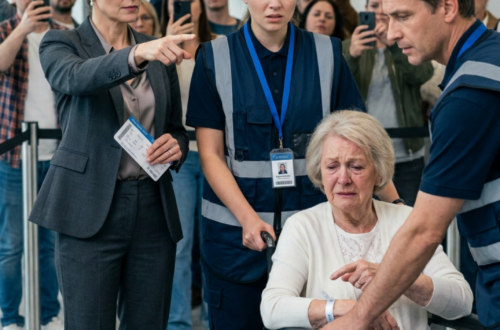
I would sign in at reception, walk past the lobby piano, take the lift to the second floor, and wait for the automatic glass door to the memory-care wing to buzz open. Marta was not officially in full memory care then. Elena called it “transitional support.” The wing had white curtains, pale wood furniture, and artwork of fields that looked calm until you noticed none of the paths led anywhere.
The buzz of that door became part of my Saturdays.
Soft. Mechanical. Final.
I did not understand yet how much harm can hide behind doors that open politely.
The first bruise appeared in January.
It was on my mother’s upper arm, half-hidden beneath the sleeve of her cardigan. Purple at the center, yellowing at the edges. I noticed it while she was stirring soup in the bowl with unnecessary concentration.
“What happened there?” I asked.
Marta glanced down, then pulled the sleeve lower.
“Door kissed me.”
“What door?”
She shrugged with one shoulder. The weaker side barely moved. “The fast one.”
I looked toward the hallway.
“The automatic door?”
“No. Not that. The chair door.”
That was how the trouble began: with words that almost made sense.
I asked the nurse on duty, a young woman with tired eyes and a name badge that read KATRIN. She checked the chart and said there had been a transfer incident two days earlier. Marta had lost balance moving from wheelchair to bed. No fall. No serious injury. Documented and monitored.
“Why wasn’t I told?”
Katrin looked genuinely uncomfortable. “It was classified as minor.”
“My mother bruises easily, but I still want to be informed.”
“I understand.”
That phrase, I would learn, could mean many things.
Sometimes it meant I understand.
Sometimes it meant I have written down that you are becoming difficult.
Elena Voss called me that evening.
“Clara,” she said, using my first name as she always did, as though we were cooperating in a shared moral project. “I hear you were concerned about your mother’s arm.”
“I was not informed.”
“You should have been. I apologize for that.”
The apology was immediate. Clean. Reassuring.
I softened.
“She said something about a door.”
“After stroke, spatial descriptions can become confused,” Elena said. “She may be describing the transfer process. Wheelchair, bed rail, door, side—these can blur.”
“That makes sense.”
I hated how quickly I said it.
Elena sighed softly. “It is hard, I know. Families often search for a clear cause because decline feels intolerable when it is random.”
I looked at the stack of exercise books on my dining table waiting to be marked. Outside my rented one-room apartment in Berlin, sleet scratched the window.
“I’m not searching for anything,” I said.
“Of course not.”
But she had placed the idea in the room.
Clara searches because she cannot accept decline.
The second sign came from my mother herself.
Two Saturdays later, I arrived with soup and found Marta sitting in the visiting room instead of her usual chair near the window. The visiting room was meant for privacy, but it had too much glass. Glass walls toward the hallway. Glass door with a frosted stripe. Glass that made every private conversation feel observed from the corner of someone’s eye.
Marta was folding her napkin.
Triangle.
Open.
Triangle again.
I set the thermos on the table. “You’re busy.”
“Engineering,” she said.
“What are we building?”
“A hat for the soup.”
I smiled, then noticed her hands.
There was a faint tremor, worse than usual.
“Are you cold?”
She ignored the question and leaned forward. “Red hair.”
I looked around. “What?”
“Red-haired nurse.”
“There is a red-haired nurse?”
Marta pressed one corner of the napkin with her finger. Tap. Tap.
“No badge,” she whispered.
I felt something move under my skin.
“What did she do?”
Marta frowned, struggling. Her mouth pulled slightly to the left when she concentrated too hard. She hated that. She had been vain about her mouth before the stroke. Lipstick every day. “A woman should decide her own color,” she used to say, applying dark plum lipstick before going to the bakery.
“Paper,” she said.
“What paper?”
“Coffee moon.”
I leaned closer. “Mum, what paper?”
Her eyes filled with sudden frustration. Not confusion. Frustration.
That distinction matters.
I would say later that she looked helpless, but that is not true. She looked furious, trapped inside a tired body that would not deliver the words she wanted.
Before she could try again, Elena entered.
She did not knock. She never knocked on glass doors, only opened them gently enough to make the intrusion seem like care.
“Frau Weiss,” she said warmly. “There you are. Clara, I hope your visit is going well.”
Marta stopped folding the napkin.
Her hand flattened over it.
I looked at Elena, then back at my mother. “Mum was telling me about a red-haired nurse.”
Elena’s expression did not change.
“A red-haired nurse?”
“With no name badge.”
“Ah.” Elena smiled. “That may be an agency worker from December. Or it may be a memory fragment. Hair color is often retained when names are not. The brain is fascinating that way.”
Marta whispered, “No badge.”
Elena placed a hand on the back of the chair. “Frau Weiss, you know all our staff wear identification.”
My mother looked down.
I hated that look.
It was not agreement.
It was retreat.
After Elena left, Marta would not speak about the red-haired nurse again. She complained instead that I had cut the carrots too thick.
“You always say thick carrots have courage,” I said.
“Not stupid courage,” she replied.
That made me laugh.
It made her laugh too, briefly, and for one minute she was so much herself that I felt foolish for being afraid.
Then she folded the napkin into a triangle and tapped one corner again.
Tap.
Tap.
Tap.
The document appeared the following week.
It arrived in my email as an attachment from Haus Linden’s administrative office, included under the subject line: Updated Resident Financial Authorization — Marta Weiss.
I opened it during my lunch break at school.
Children were shrieking in the courtyard below. Someone had spilled yogurt near the sink. My red pen had leaked into my coat pocket that morning, leaving a stain shaped like a small wound on the lining. I remember these things because the ordinary world continued around me while the floor of my life shifted.
The document was titled:
Supplementary Financial Power of Attorney and Special Care Fund Authorization.
My mother’s name appeared at the top.
Marta Weiss.
Resident ID 417.
Authorized representative: Haus Linden Verwaltungs GmbH.
Purpose: expedited access to funds for enhanced care packages, therapeutic adjustments, private support needs, and emergency resident welfare expenses.
At the bottom was my mother’s signature.
Shaky.
Uneven.
But close enough to hers that my first reaction was not certainty.
It was nausea.
Beside the witness line was a coffee stain shaped like a crescent.
A small brown moon.
I stared at it until one of my pupils knocked on the staff-room door and asked if I had more glue sticks.
That afternoon, I called Elena.
She answered on the second ring.
“Clara.”
“What is this financial authorization?”
“A standard support document.”
“My mother signed over financial authority to the facility?”
“No. That is not how I would phrase it.”
“How would you phrase it?”
“A flexible administrative mechanism to prevent delays in care.”
“I already pay monthly.”
“Yes, and you have been very responsible. This concerns supplemental care pathways. Physiotherapy upgrades, private escorts, specialist consultations, cognitive support resources.”
“Why was I not included?”
There was a tiny pause.
“You were sent the document.”
“After she signed it.”
“Your mother is legally competent to sign certain administrative forms.”
“When did she sign it?”
“January 16.”
I closed my eyes.
That was the day after she told me about the red-haired nurse.
“Who witnessed it?”
“Our clinical coordinator and an external witness.”
“Who?”
“I can request the file.”
“Elena.”
Her voice softened.
“Clara, I hear your alarm. But your mother is not without agency. We must be careful not to infantilize her.”
There it was.
The beautiful sentence.
The correct moral vocabulary.
Used like a locked door.
“I want the original,” I said.
“Of course. Submit a formal records request.”
“I want to ask my mother about it tomorrow.”
“I would caution against approaching her with anxiety. It could distress her.”
“She signed a financial document.”
“Yes.”
“With a coffee stain near the witness line.”
Another pause.
Very small.
Too small, perhaps, for anyone else to notice.
But I teach seven-year-olds. I notice pauses. I notice when a child knows who broke the pencil before anyone says pencil. I notice when a story has been practiced and where the practice runs out.
Elena said, “I am not sure what the stain has to do with anything.”
Neither was I.
Not yet.
But I remembered my mother tapping the corner of the folded napkin.
Coffee moon.
The following Saturday, I found Marta in the common room, not the visiting room. She was watching a nature documentary with three other residents. A wolf crossed a snowy field on the television. My mother pointed at it and said, “That one knows taxes.”
I sat beside her. “What?”
“Nothing with that face is free.”
I laughed too loudly because I needed her wit to mean she was safe.
I waited until the others were distracted, then opened my folder.
“Mum, do you remember signing this?”
She looked at the page.
Her face changed.
Not confusion first.
Fear.
Then anger.
“No,” she said.
“It has your signature.”
“No.”
“Did Elena ask you to sign something?”
“No.”
“Did a red-haired nurse bring papers?”
Her hand moved to the napkin in her lap.
No napkin this time.
She patted her cardigan, searching for something to fold.
“Mum.”
“Too much soup,” she said.
“What?”
“Too much sleep.”
I leaned closer. “Did they give you medication?”
Her eyes flicked toward the nurses’ station.
A nurse I did not recognize stood there, watching us. Brown hair. Name badge turned backward.
“Mum, listen to me. Did you sign this?”
Marta’s mouth trembled.
“No coffee,” she whispered. “I don’t drink coffee.”
Then she began to cry.
Quietly. Furiously. With her good hand clenched around the edge of her cardigan.
I stood to find someone, and the automatic hallway door buzzed shut behind me.
I do not remember every word from what happened next.
I remember the buzz.
I remember the sound of my own shoes on the polished floor.
I remember Elena appearing from the records corridor, calm as winter light.
“Clara,” she said. “You are upsetting your mother.”
And just like that, the truth had been turned around to face me.
PART 2 — The Difficult Daughter
The meeting was scheduled for Tuesday at four.
Not requested.
Scheduled.
Elena’s assistant emailed me a calendar invitation titled Family Support Review — Marta Weiss. The guests included Elena Voss, Dr. Rainer Feld, a geriatric consultant attached to the facility, Frau Lehmann from resident social services, and a guardianship lawyer named Matthias Krüger.
My name appeared last.
Clara Weiss, daughter.
By then, I had asked for the original financial authorization three times. I had requested the visitor logs for January. I had asked who the red-haired nurse was. I had asked why my mother had been listed for a “supplemental care package” costing almost twice the standard monthly fee. I had asked why the bank transfer from my mother’s savings account had been initiated before I was notified of the document.
Every question produced a professional answer that answered nothing.
Your concern is noted.
Records are being compiled.
Staffing privacy limits disclosure.
Care adjustments are made in resident interest.
Financial processing may precede family notification in urgent circumstances.
Urgent.
My mother’s urgency was always strangely profitable.
The meeting room at Haus Linden sat beside the director’s office. It had pale walls, a round table, and a framed photograph of old hands holding a teacup. I remember thinking the photograph was manipulative. Not because old hands are not beautiful. They are. My mother’s hands, even after the stroke, were beautiful in their way: veined, stubborn, flour-scarred from decades of cooking, one knuckle slightly bent from breaking up a fight between two boys when she was a school secretary in the 1980s.
But the hands in the photograph were too clean.
No stains. No tremor. No rage.
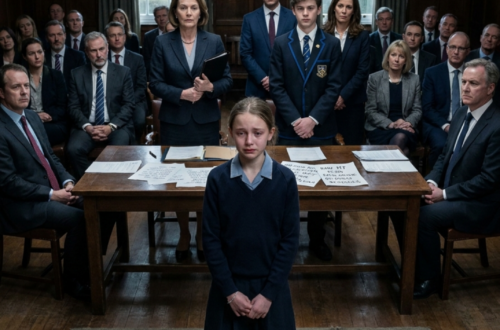
Elena sat across from me, a file open before her. Dr. Feld sat to her right, white-haired, heavy-lidded, smelling faintly of aftershave and medicinal lozenges. Frau Lehmann had kind eyes and a tablet. Matthias Krüger wore a navy suit and the expression of a man paid to sound reluctant before doing exactly what he came to do.
“Clara,” Elena began, “thank you for coming.”
“I did not feel I had a choice.”
She inclined her head as if accepting grief from an unreasonable person.
“We are all here because we care about your mother’s wellbeing.”
I looked around the table. “Then why is this meeting about me?”
Dr. Feld folded his hands. “Family dynamics are part of resident wellbeing.”
There was the tone. Gentle. Professional. Cruel in its softness.
Elena opened the file.
“We have observed a pattern in recent weeks. Your visits, while clearly motivated by love, appear to correlate with increased agitation in your mother.”
“Because I asked about a document she does not remember signing.”
“Because you introduced distressing ideas in a way she could not process,” Dr. Feld said.
“My mother said she does not drink coffee.”
Frau Lehmann looked confused. “Coffee?”
“The document has a coffee stain.”
Elena smiled faintly. “Clara, stains on paperwork do not indicate wrongdoing.”
“No. But my mother mentioned a coffee moon before I showed her the document.”
That made Dr. Feld glance at Elena.
Just once.
I noticed.
Elena turned a page. “Marta has also been reporting a red-haired nurse without a name badge.”
“Yes.”
“This appears in her confusion notes. Staff have attempted to reassure her.”
“Who is the nurse?”
“We have no current employee matching that description.”
“Then maybe she was temporary.”
“We do use agency workers during illness periods,” Elena said. “All are properly registered.”
“Then give me the roster.”
“Staff privacy law—”
“Of course.”
I heard my own voice rising.
I hated that.
Elena did not.
She waited.
That was one of her strategies. Let the other person become louder in a quiet room. Let love turn into evidence.
Matthias Krüger opened his folder. “Frau Weiss, no one is questioning your devotion. But devotion can become harmful when it prevents acceptance of cognitive decline.”
“My mother had a mild stroke. She has word-finding issues. She is not incompetent.”
“No one said incompetent.”
“You said decline.”
“Decline is not an insult.”
“Neither is daughter.”
The room went quiet.
Frau Lehmann looked down.
Elena sighed, almost sadly. “This is precisely our concern. Your mother becomes distressed when financial or medical matters are discussed. You seem unable to separate your understandable guilt from her clinical reality.”
There it was.
My father entered the room without being named.
I looked at Elena. “Do not use my guilt as evidence.”
She held my gaze. “Then do not let it guide your behavior.”
For a moment, I could not speak.
Because some part of me feared she was right.
That is what made her dangerous. Her lies were not wild. They grew around real wounds. I was guilty. I was exhausted. I was divorced. I had sold my apartment. I had argued in the hallway. I had cried in my car after visits. I had once snapped at a nurse for moving my mother’s radio. I was not the calm daughter in the brochures.
But I was not wrong.
Elena slid several printed pages across the table.
Care notes.
Dates. Times. Staff initials.
January 13, 15:42 — Resident became tearful after daughter’s visit. Repeated phrases about “papers” and “red nurse.” Required reassurance.
January 20, 16:10 — Daughter questioned staff aggressively. Resident agitated afterward, refused supper.
January 27, 15:55 — Resident distressed after family interaction. Daughter appears unable to accept cognitive changes.
February 3, 16:20 — Resident cried following daughter’s visit. Daughter discussed financial matters despite guidance.
I read them while my face burned.
Every note took something true and bent it.
My mother had been tearful because she was afraid.
I had questioned staff because no one answered.
She had refused supper because the medication made her nauseous.
Or at least I thought so.
That was the worst part.
Part of me began checking myself against their notes.
Had I upset her? Had I pushed too hard? Was I so desperate to prove I had not failed her like I failed my father that I had turned every normal sign of aging into a crime scene?
Dr. Feld watched me read. “Families often struggle most when a loved one is intermittently lucid. The flashes of clarity can make confusion seem intentional.”
I looked up. “My mother’s anger is not a symptom just because it is inconvenient.”
Elena’s expression cooled by half a degree.
Matthias Krüger spoke then. “At this stage, Haus Linden is not seeking formal restriction of visits.”
“At this stage,” I repeated.
“However, if resident distress continues, structured visitation may be recommended.”
“What does that mean?”
Elena answered. “Visits supervised by staff. Limited topics. Possibly shorter duration.”
“You want to keep me from asking questions.”
“We want to protect Marta from distress.”
“You want to protect the paperwork.”
Dr. Feld’s pen stopped moving.
There it was. Too direct. Too angry. Exactly what they wanted.
Elena closed the file gently.
“Clara, we understand this is painful. But if you continue approaching your mother with accusations she cannot understand, you may force us to take steps none of us want.”
The meeting ended with a printed care plan.
I left with it folded in my coat pocket beside three red pens and a packet of tissues I did not remember buying.
The automatic door buzzed shut behind me.
For the first time, the sound felt less like security and more like a verdict.
After that meeting, Haus Linden began changing my Saturdays.
Marta was “resting” when I arrived.
Marta was “in physiotherapy.”
Marta was “not having a good cognitive day.”
Marta had “requested quiet.”
That last one nearly broke me. My mother had never requested quiet in her life. She believed silence was for churches, libraries, and men who had been asked direct questions.
When I was allowed to see her, staff stayed close.
Sometimes Katrin. Sometimes another nurse. Sometimes a man I did not recognize who checked his watch every few minutes. The visiting room door remained open. If I lowered my voice, someone entered with tea. If Marta tried to speak, someone adjusted her blanket.
My mother changed.
Not dramatically.
That would have been easier to explain.
She became softer around the edges. Sleepy at odd hours. Slow to anger, which was not like her. Her words slipped more often. Once she called me “little sister,” then looked horrified because she knew it was wrong. Another time she fell asleep with the spoon halfway to her mouth.
I asked about medication.
Dr. Feld’s office sent me a list.
Everything looked standard.
Adjusted dosage for nighttime anxiety.
Mild sedative as needed.
As needed by whom?
The answer came back: clinical staff.
Meanwhile, the bills grew.
Supplemental mobility support.
Cognitive stabilization program.
Private supervision block.
Behavioral distress monitoring.
Administrative coordination fee.
Every phrase sounded designed to survive a complaint.
I began sleeping badly. I marked schoolwork at midnight and forgot breakfast. Once, in class, I called a pupil by my ex-husband’s name. The children laughed, and I laughed with them, but afterward I stood in the staff bathroom and gripped the sink until the panic passed.
My colleague Anja found me there.
“You are not all right,” she said.
“I’m fine.”
“You teach seven-year-olds. Do not lie like one.”
So I told her a little.
Not everything. Enough.
The nursing home. The document. The meeting. The possibility of restricted visits.
Anja listened, arms crossed.
Then she said, “Write dates.”
“I am.”
“No. Properly. Like school incident reports. Dates, times, who said what, who witnessed. You always tell parents memory becomes argument unless it is written.”
I stared at her.
She was right.
I told children’s parents that constantly. If something mattered, write it down. Not because memory was useless, but because systems respect paper more than pain.
That night, I started the timeline.
I used a red pen first because I had one in my coat pocket. Then another. Then a black pen. Then a spreadsheet, because the paper became too messy.
Columns:
Date.
Visit time.
Marta’s condition.
Staff present.
Medication notes.
Financial charges.
Camera status.
Documents signed.
At first, I did not know why I included camera status. Maybe because the hallways had so many small black domes in the ceiling. Maybe because Elena often mentioned resident safety systems. Maybe because Marta kept saying red hair and no badge, and I wanted to know when someone unknown could have entered unnoticed.
I requested maintenance logs.
Haus Linden denied the first request.
I requested again through a patient advocacy service.
They sent a summary.
Most days: operational.
Some days: scheduled maintenance.
January 16 — second-floor west corridor camera under maintenance, 13:00–17:00.
January 30 — records office hallway camera under maintenance, 12:30–16:30.
February 6 — memory-care access corridor camera under maintenance, 14:00–18:00.
I did not yet understand what those dates meant.
I only copied them into the spreadsheet.
Then the school heard.
I found out from my headmistress, Frau Berger, who asked me to stay after a staff meeting. She closed the door of her office carefully. That carefulness told me someone had called.
“Clara,” she said, “I received a concerning inquiry today.”
My stomach tightened.
“From whom?”
“A legal representative connected to your mother’s care facility.”
I sat still.
“They did not disclose private details. But they asked whether the school had observed signs of emotional instability that might affect your professional duties.”
The room went small.
My classroom was my last stable place. Children were chaotic, yes, but honest in ways adults rarely were. If they disliked soup, they said so. If they were afraid, they drew monsters. If they lied, they looked at the floor. I knew how to stand in that room. I knew how to be useful without being erased.
“They are trying to make me look unstable,” I said.
Frau Berger watched me for a moment.
“Are you?”
It was a fair question.
It hurt anyway.
“I am frightened,” I said. “I am angry. I am sleeping badly. But I am not unstable.”
She nodded once. “Then we document that too.”
“What?”
“You have not missed work except approved leave. Your classroom observations are strong. Parents have not complained. Your colleagues confirm no professional impairment.”
I blinked.
She continued, “If someone intends to build a file, we build one as well.”
For the first time in weeks, I nearly cried from relief instead of fear.
The impossible date appeared three days later.
It was a Thursday evening. Gray drizzle had turned to sleet, ticking against my apartment window. I sat at my small kitchen table with soup simmering on the stove, schoolbooks stacked on one chair, Haus Linden records spread across every available surface.
I had finally received a fuller care-log extract after threatening to file a complaint with the regional care authority. It arrived as a PDF, seventy-two pages, many of them almost identical.
Resident anxious.
Resident redirected.
Resident reassured.
Daughter visit.
Resident agitated.
Daughter visit.
Resident tearful.
Daughter visit.
Resident refused meal.
At first, the repetition numbed me. Then one entry made me stop breathing.
Tuesday, February 10.
15:35 — Daughter visited. Resident became highly agitated after daughter raised concerns about finances. Resident repeatedly stated “no coffee” and “red nurse.” Daughter argumentative with staff. Resident required medication support at 16:10.
I stared at the date.
February 10.
A Tuesday.
At 15:35 on February 10, I had been in my classroom in Berlin.
I knew that before checking anything. Tuesdays were long days. I taught until 15:45, then supervised handwriting club until 16:30 because Milo Schneider’s mother could not pick him up earlier during her hospital rotation. I remembered February 10 specifically because Milo spilled an entire bottle of blue ink on his workbook and then cried because it looked “like the ocean had a problem.”
I opened my school calendar.
Teaching block: 13:15–15:45.
Handwriting club: 15:50–16:30.
Staff sign-out: 17:02.
I opened the attendance system.
My login at 7:31.
My classroom smartboard activity.
Email to Frau Berger at 16:48.
I opened my phone photos.
At 15:58, I had taken a picture of the blue ink spill to send to Milo’s mother with the message: No disaster, only a very dramatic sea.
The care log said I was upsetting my mother at Haus Linden.
I was teaching twenty-three children in Berlin.
I printed the page.
Then I printed my school records.
Then I sat at the kitchen table with both pages in front of me and felt something inside me go very still.
Until that moment, I had been defending myself against the possibility that I was wrong.
Now I had a different problem.
Haus Linden was not misunderstanding me.
They were writing events that had never happened.
And if they were willing to invent my presence, what else had they invented around my mother?
PART 3 — The Days the Cameras Slept
I did not call Elena first.
That was the first smart thing I did.
Every earlier instinct in me wanted to confront. To demand. To march into Haus Linden with the care log in one hand and my school records in the other. To place both papers on Elena’s polished desk and watch her face when I asked how I had upset my mother from thirty kilometers away.
But I had finally begun learning.
People like Elena did not fear confrontation. They prepared for it. They wrote notes afterward. They used raised voices as proof. They translated outrage into instability.
So I called Anja.
Then Frau Berger.
Then the patient advocacy service.
Then a lawyer.
Her name was Lea Sommer, and she worked in elder law from a narrow office above a pharmacy near Hermannplatz. She had short dark hair, no patience for decorative language, and a wall of files that looked as if they might collapse and reveal bodies. I liked her before she finished the first meeting.
She read the February 10 entry.
Then my school documentation.
Then the care log again.
“Do not show them this yet,” she said.
“I want to ask Elena how she explains it.”
“She will explain it.”
“How?”
“Clerical error. Wrong date. Wrong daughter. Staff selected standard text by accident. Resident confused and mentioned you, so it was summarized poorly. There are many explanations if she knows what she needs to explain.”
I hated how right that sounded.
“So what do we do?”
“Find out whether February 10 is the only impossible date.”
It was not.
That became clear within two days.
The care logs claimed I visited on January 30 at 14:20.
I had a dentist appointment in Berlin at 14:00 and a receipt.
They claimed I argued with a nurse on February 6 at 17:05.
I was at a parent meeting until 18:10, with four parents and Frau Berger present.
They claimed Marta became distressed after I discussed legal forms on January 16.
I had visited January 15, not January 16.
January 16 was the day of the financial authorization.
The day the west corridor camera was under maintenance.
I added rows.
Dates.
False visits.
Camera maintenance.
Documents signed.
Medication given.
Transfers initiated.
The pattern did not appear all at once. It emerged the way a word emerges from a child’s messy handwriting: first shape, then intention.
On suspicious days, cameras slept.
On days cameras slept, documents appeared.
On days documents appeared, Marta received “as needed” calming medication before or after signing.
On days I was not there, the logs said I had upset her.
The false version of me was doing useful work for them.
She agitated Marta.
She justified medication.
She justified restricted visits.
She explained confusion.
She made documents look necessary.
I almost admired the design.
That thought made me feel sick.
Jonas Keller found me on a Friday evening.
Not the Jonas Keller from any story I would have invented. He was twenty-six, maybe, thin, pale from night shifts, with anxious hands and a scarf wrapped twice around his neck. He approached me outside Haus Linden after a supervised visit during which Marta had been too sleepy to finish two spoonfuls of soup.
“Frau Weiss?”
I turned.
He looked around the parking lot before speaking. “I work nights. Second floor.”
I recognized him then. Not by name, but by movement. He was the nurse who always walked quickly, as if apologizing to the air for taking up space.
“My mother’s floor?”
He nodded.
“What is it?”
He swallowed. “You should ask for staff rosters.”
“I did.”
“Not the public version.”
I stared at him.
He pulled a folded paper from his coat pocket and handed it to me so quickly it looked like a mistake.
“Don’t say I gave this.”
Then he walked away.
I sat in my car before opening it.
It was not a full roster. Just a printed schedule for three dates.
January 16.
January 30.
February 6.
A name appeared in handwriting beside each shift block:
R. Brandt — agency.
No employee number.
No badge ID.
No initials in the formal care logs.
R. Brandt.
I took a photo, then another.
My hands shook so badly the second image blurred.
I called Lea.
“Do not contact Jonas again unless he contacts you,” she said.
“He knows something.”
“Yes. And if he loses his job before we secure his statement, Elena will call him disgruntled.”
“Everyone who tells the truth becomes disgruntled.”
“Exactly.”
Lea filed formal requests.
The facility delayed.
So we went around them.
First, the agency.
There were many temporary nursing agencies around Berlin. Lea sent inquiries where she could. Most refused information. One, accidentally or carelessly, confirmed that an agency nurse named Renate Brandt had been assigned to Haus Linden on several January and February dates.
Renate.
Red-haired nurse?
Maybe.
Not enough.
Then other families began appearing.
The first was a man named Peter Albrecht, whose aunt had lived at Haus Linden until the previous autumn. He contacted me after the patient advocacy office, without naming me, asked if any families had experienced unusual financial authorizations. Peter was a taxi dispatcher in Spandau, blunt and tired, with a folder of documents thicker than mine.
“They said my aunt became paranoid,” he told me in a café near Alexanderplatz. “She kept saying someone came at night with papers. I thought dementia. What do I know? Then money started moving.”
He showed me a form.
Different resident.
Different amount.
Same format.
And near the witness line, a stain.
Not crescent. Circular.
Coffee.
“My aunt hated coffee,” Peter said. “Drank tea with lemon like it was medicine.”
The second family was a daughter in Potsdam. Her father had supposedly signed an enhanced care authorization the day after she complained about unexplained charges. Care logs described her as aggressive. She was a pharmacist with time-stamped work records proving she was not present during one alleged confrontation.
The third was a nephew in Leipzig. His uncle’s visitor sign-in sheets disappeared after he requested them.
Different families.
Same phrases.
Resident agitated after family interference.
Relative unable to accept decline.
Resident benefits from reduced stimulation.
Cameras under maintenance.
Documents signed.
Money moved.
I went home after meeting the third family and vomited in my kitchen sink.
Not because I was surprised anymore.
Because the pattern meant Marta was not unusual.
She was one of many.
That kind of rage is hard to hold in one body.
It needs somewhere to go.
I put it into the spreadsheet.
Rows multiplied.
Lea called it “the ugliest spreadsheet I have ever been pleased to see.”
Jonas contacted me again through Lea.
This time, properly.
He gave a statement.
Not dramatic. Not heroic. He was terrified. He said staff had been pressured to sign notes based on summaries they did not witness. He said Elena’s office sometimes “corrected language” before logs were finalized. He said agency staff were used during “sensitive resident administration periods,” especially when families were difficult. He said Dr. Feld’s medication notes were sometimes entered after the fact.
He did not claim he saw Elena forge signatures.
That mattered.
Real witnesses rarely know everything.
But he gave us the missing schedule clue.
On January 16, Renate Brandt had worked the west corridor from 13:00 to 17:00.
The camera was listed as under maintenance from 13:00 to 17:00.
Marta’s financial authorization was signed at 15:10.
At 15:40, the care log said I visited and upset her.
I was at school.
My mother had said:
Red hair.
No badge.
Coffee moon.
Too much sleep.
The napkin gesture came back to me late one night.
Triangle.
Tap.
Triangle.
Tap one corner.
I had been staring at the power-of-attorney copy so long the text seemed to float. The crescent-shaped coffee stain sat near the witness line, not far from where Marta’s signature leaned shakily across the bottom. I had assumed she was pointing to the stain itself.
But Marta did not fold circles.
She folded triangles.
A triangle has corners.
She tapped one corner.
I enlarged the scanned document.
Near the lower right corner, partly cut off in the copy, was a handwritten initial.
Not the witness signature.
A tiny mark near the page edge.
RB.
Renate Brandt.
The agency nurse.
The original copy would show it more clearly.
Haus Linden had sent a cropped scan.
I sent the image to Lea at 1:12 a.m.
She replied at 1:14.
Sleep. Then file emergency complaint in morning.
I did not sleep.
The next morning, Haus Linden moved to restrict my visits.
Elena sent the notice through Matthias Krüger.
Due to repeated destabilizing interactions and escalating unfounded accusations, Haus Linden recommends temporary supervised-only visitation with subject limitations. Resident Marta Weiss may be transferred to the secure memory-care wing for reduced stimulation pending medical review.
Secure wing.
Reduced stimulation.
Words that meant locked doors.
Lea filed the emergency complaint before lunch.
Frau Berger provided my school records. Peter Albrecht provided his aunt’s documents. The pharmacist from Potsdam provided work records. Jonas provided his statement through counsel. Dr. Feld’s medication timing inconsistencies were flagged. Maintenance logs were cross-referenced. The agency confirmation of Renate Brandt’s shifts was attached.
The regional care authority scheduled an on-site review.
Elena found out before they arrived.
I know because she called me herself.
“Clara,” she said, voice as smooth as ever. “I wish you had come to me before escalating.”
I was standing in my classroom after dismissal, wiping blue marker from a desk. Outside, children shouted in the corridor. A paper snowflake hung crooked in the window.
“I did come to you.”
“With fear,” she said. “Not trust.”
I almost laughed.
“You wrote that I upset my mother on February 10.”
A pause.
Not long.
But real.
“We can review any clerical inconsistencies.”
“Clerical?”
“Care documentation is complex.”
“I had twenty-three children in front of me.”
“I understand you feel vindicated by a date error.”
I stopped wiping the desk.
“Elena, I did not tell you which date.”
Silence.
There it was.
Not a confession.
A slip.
She recovered quickly. “Your lawyer’s filing references multiple dates.”
“You have not been served yet.”
Another silence.
This one colder.
Then she said, “You are making a grave mistake.”
“No,” I said. “I made that when I trusted your curtains.”
I hung up.
My hands were shaking so hard I had to sit in one of the children’s chairs.
When I looked down, a red pen had leaked in my coat pocket again.
For some reason, that made me laugh.
The on-site review happened two days later.
I was not allowed into the records office during the review, but I was in the building with Lea. So were two representatives from the care authority, a legal observer, and eventually, though I did not know until later, a financial crimes investigator.
Haus Linden looked the same.
White curtains.
Piano.
Polished floor.
Residents drinking weak coffee in the lounge.
A vase of yellow tulips on the reception desk.
That was the obscenity of it. Harm does not always darken a room. Sometimes the flowers remain fresh.
Elena greeted the review team with professional warmth.
She wore navy.
She had prepared binders.
Of course she had.
But documents that depend on no one comparing dates do not like rooms where everyone has brought a calendar.
The original visitor sign-in sheets for January 16, January 30, and February 6 were missing.
Haus Linden provided typed summaries.
The authority requested the originals.
Elena said they had been archived.
Jonas, pale but steady, stated that original sign-in sheets were kept physically for six months in the reception archive.
The reception supervisor, when asked, said she had been instructed to replace several sheets with typed summaries “for clarity.”
By whom?
She looked toward Elena.
Then down.
By administration.
The first staff member had turned.
Not because of sudden courage. Because the forged notes were becoming legally dangerous for everyone who had signed near them.
After that, the room changed.
Katrin admitted she had not witnessed two care-log entries bearing her initials. She said she had been told they were “standard family distress notes” and that Elena’s office had approved language. Another nurse said Dr. Feld sometimes adjusted medication charts after residents had already been given sedatives. A records assistant confirmed the camera maintenance windows were often entered manually after the fact.
No one said Elena forged signatures.
No one needed to.
The system began pointing to her from every direction.
I saw Marta late that afternoon.
Not in the visiting room.
Not behind glass.
Lea insisted I be allowed a short supervised visit during the review. A care authority representative joined us. So did Dr. Feld at first, until Marta saw him and turned her face away with such naked disgust that the representative asked him to leave.
Marta sat in her wheelchair near the window. She looked smaller than she had in November, but her eyes were bright.
Furious.
Alive.
I knelt in front of her.
“Hallo, Mama.”
She looked at my face for a long moment, as if checking whether I was truly there or another paper version someone had written.
Then she said, “Carrots?”
I laughed and cried at the same time. “Yes. I brought soup.”
“Too thick?”
“Probably.”
“Good.”
The care authority woman smiled.
I opened my folder and took out the financial authorization copy.
“Mum, I need to ask you something. Only if you can answer. Did you sign this because you wanted Haus Linden to manage more of your money?”
Marta looked at the paper.
Her good hand gripped the wheelchair arm.
“No.”
The word was quiet.
But clear.
The representative leaned forward. “Frau Weiss, do you remember this document?”
Marta’s mouth worked.
“Sleepy,” she said.
I held my breath.
“Red hair. No badge. Coffee.” Her eyes filled with tears, but her voice sharpened. “I said no coffee. She laughed.”
I closed my eyes.
The representative asked, “Were you asked to sign?”
Marta looked at me.
Then at the stranger.
“No reading,” she said. “Hand heavy. She put…” She lifted her good hand, mimed someone guiding it. “Here.”
She tapped the witness line.
Then the crescent stain.
“Moon,” she said.
I pressed my hand over my mouth.
Marta was not giving a courtroom speech. She was not magically cured. The words came broken, partial, hard-won. But they came.
And this time, someone wrote them down as testimony instead of confusion.
Elena entered the doorway halfway through.
No one had called her.
She looked at my mother, at the document, at the care authority representative taking notes.
For once, the perfect sentence did not arrive quickly enough.
Marta saw her.
My mother’s spine straightened.
It was not dramatic. She was still frail. Still tired. Still in a wheelchair. But for a moment, she looked like the woman who used to argue with butchers about bone weight and tell bank clerks their forms were designed by cowards.
“No more,” Marta said.
Elena’s face remained composed.
But her hand tightened around the doorframe.
That was the closest thing to a confession I ever got.
PART 4 — The Signatures They Stole
I removed my mother from Haus Linden nine days later.
Not immediately. Nothing good happened immediately. There were temporary orders, medical reviews, transfer arrangements, bank freezes, medication audits, and arguments conducted in rooms where everyone called my mother “the resident” until I wanted to throw a chair.
But nine days later, Marta left.
It was raining when we packed her things.
Not dramatic rain. Berlin rain. Gray, patient, irritating. It tapped against the windows while I folded cardigans into a suitcase and collected the pieces of her life Haus Linden had reduced to inventory.
Blue scarf.
Wedding photo.
Old radio.
Tin of sewing buttons.
Vegetable peeler.
Three notebooks.
Two missing cardigans never found.
One cracked mug she insisted was not cracked but “artistically interrupted.”
Katrin helped me pack. She was quiet for most of it.
At the end, she said, “I’m sorry.”
I paused with my hand on the suitcase.
“For what?”
“For the notes. For not asking more.”
“Were you afraid?”
“Yes.”
“Then say that.”
She looked at me.
I was tired of apologies that hid the machinery.
She swallowed. “I was afraid of losing my job. I signed things I should have questioned. I told myself families were always emotional.”
I nodded.
That was not forgiveness.
But it was truth.
“Thank you,” I said.
She cried after that. I did not comfort her. Not because I wanted to be cruel, but because women had been comforting the wrong people around my mother for too long.
Elena did not come to say goodbye.
Of course she did not.
She had been placed on administrative leave pending investigation two days earlier. The announcement on Haus Linden’s website described it as “a temporary leadership transition during regulatory review.” Her photograph disappeared from the homepage before sunset.
The newspapers picked up the story after the second family filed publicly.
Then the third.
Then the fourth.
No headline said what I wanted it to say.
They used words like irregularities, allegations, documentation concerns, billing questions, procedural failures.
Procedural failures.
As if my mother’s hand had been guided across a financial authorization by a procedure.
As if her fear of the red-haired nurse had been a clerical irregularity.
As if daughters had been labeled unstable by accident.
Elena’s old interviews circulated for a while. Clips of her speaking about dignity in aging. Donor panels. Photos at charity galas. She looked calm in all of them. Sincere. That was what unsettled me most. I do not think Elena woke each morning thinking, I will harm the elderly today. I think she believed she understood families better than they understood themselves. I think she believed guilt made us irrational, that residents were manageable, that money could be moved more efficiently if love did not keep asking questions.
That belief did not make her less dangerous.
It made her more so.
Dr. Feld’s association opened an internal review. Renate Brandt, the agency nurse, could not be reached for several weeks. When found, she claimed she had only witnessed documents prepared by facility administration and had no knowledge of financial transfers. Maybe that was true. Maybe not. Legal truth moves slowly and often arrives thinner than moral truth.
The missing money did not all return.
Some transfers were frozen. Some charges reversed. Some vanished into service categories broad enough to swallow outrage.
Peter Albrecht’s aunt had already died.
The pharmacist’s father had been moved.
Another resident’s family found out too late that a flat had been sold under authorization they were still challenging.
Victory, when it came, had teeth marks in it.
Marta moved into a smaller care apartment attached to a community nursing program in Berlin. Not luxurious. No white curtains. No lobby piano. The hallway smelled sometimes of cabbage, sometimes of laundry, sometimes of the disinfectant they used too generously near the lift. The staff were overworked, blunt, and occasionally late.
My mother preferred it immediately.
“The soup is honest,” she said after the first week.
“What does honest soup taste like?”
“Like nobody charged extra for parsley.”
I laughed.
She did too.
Her recovery did not become a miracle. I need that understood. She still searched for words. She still had bad days when fatigue made her frightened and the past mixed with the present. She still sometimes asked whether my father had fed the cat, though we had never owned a cat. But the fog lifted enough that her anger returned properly, and I welcomed it like spring.
She complained about my soup.
Every Sunday now, not Saturday, because my teaching schedule changed.
“Carrots too thick,” she said one afternoon.
“You said thick carrots have courage.”
“These have arrogance.”
I sat at her little kitchen table in the care apartment and laughed so hard I had to wipe my eyes.
She watched me carefully.
“You cried,” she said.
“I laughed.”
“Same face sometimes.”
She was right.
My life changed too, though not in ways that looked impressive.
I did not get my apartment back. I still lived in the small rental with the radiator that hissed and the neighbor who practiced trumpet badly on Wednesdays. I continued teaching. Frau Berger wrote a formal letter in support of me when the investigation requested employment verification. My pupils drew cards for Marta after I told them, carefully, that my mother had moved homes because the old one was not right for her.
Milo Schneider drew a potato wearing a crown.
Marta kept it on her fridge.
Lea continued the legal work. The investigation widened. More staff cooperated once Elena could no longer protect or threaten them. Jonas left Haus Linden and found work in a public hospital. He sent me one message months later:
I should have spoken sooner.
I replied:
You spoke.
I meant it.
Not everyone can be brave at the first necessary moment. I had learned that from myself.
Elena never confessed.
People ask that sometimes when they hear the story. Did she admit it? Did she break down? Did she apologize?
No.
She released a statement through counsel expressing confidence that “all administrative actions were taken in accordance with resident welfare protocols.” She said documentation discrepancies reflected “the complexity of managing vulnerable populations.” She said families facing cognitive decline often experience “deep distress that can lead to misinterpretation.”
Even exposed, she used the same door.
But fewer people walked through it.
That mattered.
Haus Linden lost its top rating. Inspections increased. The financial office was audited. The memory-care wing director resigned. Dr. Feld stopped consulting there. Matthias Krüger quietly removed elder guardianship from his website.
Partial justice is an ugly phrase because it sounds like compromise.
But sometimes it is the only honest one.
One evening in early spring, I brought Marta soup in the blue thermos.
Her new room had a window overlooking a courtyard where residents had planted herbs in raised boxes. Rain had stopped just before I arrived, leaving the pavement dark and shining. Inside, the room smelled of boiled laundry, potato soup, and the lavender hand cream one of the nurses used.
Marta sat at the table folding a napkin.
I froze.
Triangle.
Then she folded it again.
A rectangle.
Then a terrible crooked swan.
She looked up. “Bad bird.”
I smiled slowly. “Very bad.”
“Your father made worse.”
“He made napkins?”
“He made excuses.”
I laughed.
She pushed the swan toward me. “No more triangles.”
I sat down.
“No more triangles,” I said.
She tapped the table once.
Then she looked at me, suddenly serious.
“You came.”
My throat tightened.
“Yes.”
“You listened.”
“I should have listened sooner.”
She waved her good hand. “Children always late.”
“I’m thirty-nine.”
“Still child.”
I looked down at the soup bowls because if I looked at her too long, I would cry in the way that frightened her.
“I wasn’t there when Papa died,” I said.
Marta sighed, impatient. “Again this old potato.”
I blinked.
“What?”
“You carry it. Heavy. Boring.”
A laugh broke out of me, half sob.
“Mama.”
“He died. Bad. You were with children. Good. Both true.”
I pressed my fingers to my eyes.
She continued, slower now, searching each word. “This time you came. That is this time.”
That is this time.
Not forgiveness exactly.
Something better.
A boundary around grief.
For years, I had treated my father’s death as proof that my love arrived too late. Elena had used that wound to make me doubt myself. Haus Linden had turned my fear into a file. But my mother, with her broken words and fierce eyes, gave me a different record.
This time you came.
I kept that.
The investigation is still ongoing as I write this.
That is not a satisfying ending, I know. Stories like this are supposed to end with locks changed, money returned, villains punished, and every resident safe. But institutions do not collapse neatly. Paperwork resists blame. People protect themselves. Some families never know what was taken. Some residents cannot testify. Some signatures remain legally ugly even after everyone understands they were morally stolen.
But Marta is safe.
That is not everything.
It is not nothing.
On Sundays, I make soup in my small apartment before taking the train across the city. I cut the carrots thick enough for courage but not arrogance. I still keep red pens in every coat pocket. Sometimes they leak. I no longer mind as much. Evidence can be messy and still useful.
When I enter Marta’s new building, the door buzzes too.
A different sound.
Lower.
Less final.
I still feel my body tense when I hear it. Memory is not reasonable. It does not care that this hallway is warmer, that the nurse at the desk wears her name badge properly, that my mother is waiting by the window with two bowls already set out because she is impatient and thinks I walk too slowly.
But then the door opens.
And it stays open long enough for me to pass through.
That is what I keep.
Not Elena’s polished voice. Not the crescent coffee stain. Not the false Tuesday log, though that page sits in a folder in Lea’s office, marked and copied and ready for whatever comes next.
I keep my mother sitting at a small table, holding a spoon like a judge’s gavel, telling me the soup needs salt.
I keep the fact that her anger survived.
I keep the fact that a woman they called confused remembered red hair, no badge, too much sleep, no coffee, moon.
I keep the fact that the perfect paperwork cracked because one false note placed me in a hallway where I had never stood.
They called me unstable because I would not accept their version of my mother.
They called her confused because she could not deliver the truth in the shape they preferred.
But truth does not always arrive in clean sentences.
Sometimes it arrives as a napkin folded into a triangle.
Sometimes as a coffee stain shaped like a crescent.
Sometimes as a care log that tells one lie too many.
And sometimes, if you are lucky and stubborn and late but not too late, truth sits across from you in a small kitchen and complains about the carrots.
Marta lifted her spoon that Sunday and tasted the soup.
I waited.
She frowned.
“Better,” she said.
From my mother, that was a blessing.
Outside, Berlin rain softened against the window. Inside, the soup steamed between us.
No white curtains.
No piano.
No locked glass door.
Just my mother, safe enough to criticize dinner.
And me, finally learning that love is not proving you were never late.
Love is coming back, asking again, writing everything down, and believing the person whose words arrive broken before you believe the institution whose lies arrive perfectly formatted.