When people try to lose weight, they often focus on cutting calories or eliminating “bad” foods.
But sustainable weight loss is less about restriction — and more about how food affects digestion, blood sugar, and hunger signals.
The swaps shown in this guide are not magic tricks.
They work because they change the structure of what you eat, slowing digestion and improving satiety.
Let’s break down why these healthy food swaps may help reduce rebound hunger and support steady weight management.
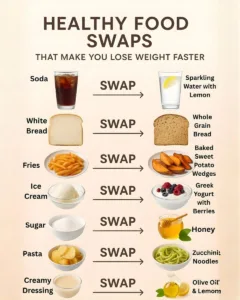
1. Swap Soda → Sparkling Water with Lemon
Why it helps:
-
Removes liquid sugar
-
Reduces rapid blood sugar spikes
-
Eliminates high-calorie beverages that don’t increase fullness
Sugary drinks are strongly associated with weight gain because they add calories without triggering satiety hormones. Replacing soda with sparkling water reduces calorie intake without increasing hunger.
Adding lemon provides flavor without added sugar.
2. Swap White Bread → Whole Grain Bread
Why it helps:
Whole grain bread contains:
-
More fiber
-
Slower-digesting carbohydrates
-
Greater satiety per serving
Refined white bread digests quickly, often leading to faster blood sugar rises and drops. Whole grains slow gastric emptying and may help stabilize appetite.
3. Swap Fries → Baked Sweet Potato Wedges
Why it helps:
-
Lower added fat from frying
-
Higher fiber content
-
Rich in beta-carotene and potassium
Deep-fried foods are calorie-dense and easy to overconsume. Baking sweet potatoes preserves flavor while reducing excess oil.
Sweet potatoes also provide more fiber than standard fries, which may improve fullness.
4. Swap Ice Cream → Greek Yogurt with Berries
Why it helps:
-
Higher protein
-
Lower added sugar
-
Adds fiber from berries
Protein increases satiety hormones such as GLP-1 and peptide YY. Greek yogurt provides more protein per serving than most ice creams, helping reduce hunger later.
Berries add natural sweetness with antioxidants and fiber.
5. Swap Sugar → Honey (In Moderation)
This swap is about reducing refined sugar intake, not increasing total sugar.
Honey contains trace antioxidants and has a slightly different glycemic effect than refined sugar. However, it still contains sugar and should be used mindfully.
The key benefit is reducing highly processed sweeteners, not increasing sweetness overall.
6. Swap Pasta → Zucchini Noodles
Why it helps:
-
Lower calorie density
-
Higher water content
-
Increased volume for fewer calories
Zucchini noodles provide more food volume per calorie, which may improve satiety without increasing energy intake.
This swap can be especially helpful when portions tend to become large.
7. Swap Creamy Dressing → Olive Oil & Lemon
Why it helps:
-
Reduces ultra-processed ingredients
-
Provides healthy monounsaturated fats
-
Supports flavor without heavy additives
Extra virgin olive oil contains polyphenols and healthy fats associated with anti-inflammatory benefits.
Using olive oil and lemon can simplify ingredient lists while maintaining taste.
Why These Swaps May Support Weight Loss
The pattern behind these swaps is consistent:
-
Reduce refined carbohydrates
-
Increase fiber
-
Increase protein
-
Lower liquid calories
-
Improve satiety
When digestion slows and blood sugar stabilizes, hunger signals tend to calm down. That reduces the likelihood of overeating later.
This approach focuses on structure — not deprivation.
What the Research Says
-
Higher protein diets are associated with improved satiety and reduced calorie intake.
-
Fiber intake is linked to lower body weight in observational studies.
-
Liquid calories are consistently associated with increased energy intake.
-
Diet patterns such as the Mediterranean diet are linked to healthier body weight over time.
Weight loss is not driven by one swap. It’s driven by consistent dietary patterns.
A Sustainable Mindset
These healthy food swaps are tools, not rules.
You do not need to eliminate foods entirely. Instead, consider where small structural changes could:
-
Improve fullness
-
Reduce rebound cravings
-
Lower calorie density
-
Support long-term habits
Over time, these changes can feel easier and more sustainable than strict restriction.
Final Thought
Weight loss does not come from eating “perfectly.”
It comes from building meals that work with your biology instead of against it.
Sometimes, a simple swap can shift the entire pattern.