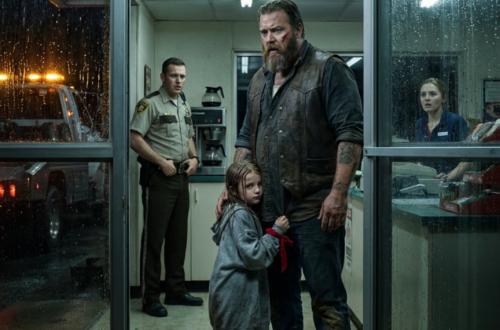
PART 1: The Perfect Babysitter My Dog Wouldn’t Let Near The Crib
Buddy had been in my life longer than my husband had.
That sounds like a joke, but it’s true. I adopted him when he was eight weeks old, long before I had a mortgage, a marriage, or a baby monitor glowing on my nightstand. He was a golden retriever with enormous paws, soft ears, and the kind of gentle stupidity that made strangers trust him immediately. Children at the park used to crawl over him like furniture. Toddlers pulled his ears, old women fed him crackers from their purses, and once, a delivery man dropped an entire stack of packages because Buddy rolled onto his back in the driveway and demanded a belly rub.
In ten years, he had never bitten anyone. He had never even growled at a person.
Then Rachel came into our house.
Rachel was the kind of babysitter exhausted mothers pray for. She had a degree in Early Childhood Education, CPR certification, a clean background check, and three glowing references printed neatly inside a blue folder she brought to our interview. She spoke softly, wore cardigans, kept her nails short, and called my fourteen-month-old son Noah “sweet boy” the second she saw him. Mark liked her immediately because she was organized. I liked her because she made me feel less like I was drowning.
Noah was at that age where everything was hard. He fought naps. He screamed during diaper changes. He threw food, woke up at odd hours, and clung to me every morning like I was abandoning him forever. I worked from home part-time, but work with a toddler in the house is not work. It is typing three words, removing a plastic spoon from the dog’s water bowl, typing two more words, and realizing someone has smeared banana into the carpet.
Rachel started on a Monday.
By Wednesday, Noah was napping.
Not just napping. Sleeping deeply, peacefully, beautifully. Rachel would rock him in the nursery, hum under her breath, and twenty minutes later she would come downstairs smiling. “He just needs consistency,” she told me. “A predictable rhythm.”
Mark said we had finally found someone who knew what she was doing.
Buddy disagreed.
At first, it was small. Rachel would carry Noah upstairs, and Buddy would lift his head from the living room rug. If she crossed the nursery doorway, he would stand. If she closed the nursery door, he would sit outside it with his nose almost touching the wood. Rachel laughed about it the first week. “He’s protective,” she said. “That’s sweet.”
But it did not feel sweet.
Buddy wasn’t guarding the house. He wasn’t relaxed. His body looked tense in a way I had almost never seen. When Rachel rocked Noah, Buddy paced outside the nursery. When Rachel prepared a bottle, Buddy followed her into the kitchen and watched her hands. Once, when she leaned over Noah’s crib, Buddy pushed between her and the rail so hard she had to step back.
“Buddy,” I snapped.
He looked at me, ears low, tail still.
Rachel smiled gently. “It’s okay. Some dogs have trouble adjusting when a baby starts bonding with another caregiver.”
That sounded reasonable. Everything Rachel said sounded reasonable.
The first scratch happened during nap time. I heard Rachel gasp upstairs and found her standing beside the crib, holding her wrist. Buddy was between her and Noah, breathing hard, one paw planted on the nursery rug like he was ready to throw himself forward again.
“He jumped at me,” Rachel said, voice shaking. “I was just laying Noah down.”
Two thin red lines crossed her wrist.
I apologized so much I embarrassed myself. Rachel kept saying it was okay, but the way she looked at Buddy was different after that. Not afraid exactly. More like she had been waiting for him to prove something.
The next week, it happened again. This time Buddy scratched her forearm while she was feeding Noah a bottle in the rocking chair. Rachel texted me a photo of the marks while I was on a client call. I remember staring at the picture, my stomach tightening, while a man on Zoom talked about quarterly projections.
When Mark came home, I showed him.
He was quiet for a moment. “He’s ten, Claire.”
“I know how old he is.”
“Dogs change.”
“Buddy doesn’t.”
Mark didn’t argue. That was the problem with Mark. He rarely argued when he was worried. He became gentle, which somehow made everything worse. “Rachel has training. She has references. She knows babies. Buddy is a dog.”
I hated that sentence.
I also understood it.
The third incident was the one that changed the house. I came home from the grocery store and found Rachel in the kitchen with her sleeve rolled up, her arm streaked with blood from wrist to elbow. Mark was home early, standing beside her with a towel. Noah was asleep upstairs.
Rachel’s voice trembled when she spoke. “He came at me again while I was putting Noah down. I didn’t even touch him, Claire. I swear.”
Buddy was locked in the laundry room. I could hear him whining behind the door.
Rachel held up her arm. The scratches were deeper this time, ugly and red and already swelling. Then she said the thing that made the whole room tilt.
“Either that dog goes, or I do.”
Mark closed his eyes.
I looked toward the laundry room door. Buddy had stopped whining, as if he was listening.
Rachel wiped her face with the back of her hand. “I’m sorry. I know you love him. But I’m scared of him now. What happens if he does this to Noah?”
There it was.
Noah.
The one name that could make every other truth smaller.
I did not answer right away. Buddy scratched once at the laundry room door, not hard, just one soft drag of nails against wood. Rachel flinched, and Mark put his hand on her shoulder.
That was the first time I saw it clearly: my husband standing beside the babysitter, while our dog cried behind a door.
PART 2: The Bruises Rachel Said Buddy Left Behind
We did not put Buddy down. Not then.
I called the vet the next morning, and Dr. Patel refused to jump to that conclusion. She examined Buddy, ran bloodwork, checked his teeth, joints, ears, eyes, and neurological responses. He was older, yes, but not sick. Not in pain. Not aggressive in the clinic. He let two technicians lift his paws, open his mouth, and press along his ribs without so much as a warning growl.
“Has he gone after anyone except Rachel?” Dr. Patel asked.
“No.”
“Anywhere except the nursery?”
I paused. “I don’t think so.”
“That matters.”
I was annoyed by that answer. I wanted Dr. Patel to tell me exactly what to do. Instead, she told me to separate Buddy from Rachel, observe patterns, and be careful.
So we locked Buddy out of the nursery.
Then downstairs during naps.
Then in the laundry room whenever Rachel was working.
The first time I shut him in there, he stood on the other side of the door and made a sound I had never heard from him before. It wasn’t barking. It wasn’t whining. It was lower, confused, almost embarrassed. For ten years, Buddy had slept wherever he wanted in that house. Beside my bed. Near the couch. Outside Noah’s door. Now he was on cold tile beside a dryer because I believed a woman I had known for three weeks.
Rachel became sweeter after that. Too sweet, maybe, but I did not see it then. She brought homemade muffins one morning. She texted photos of Noah sleeping with captions like little angel finally resting. She cleaned the bottles, folded laundry, and kept a daily note about his naps and meals in perfect handwriting. Mark started saying we were lucky to have found her.
Buddy got worse.
Or seemed to.
He barked when Rachel carried Noah upstairs. He threw himself against the laundry room door if Noah cried. Once, he knocked over a baby gate hard enough to crack the plastic latch. Rachel said he had started lunging at her even when Noah wasn’t in her arms, though I never saw that myself.
Then the bruises began.
The first was small, near Noah’s upper arm. I noticed it during bath time, a faint purple mark shaped like two fingertips. I asked Rachel about it the next morning.
Her face changed perfectly. Concerned, but not defensive. “Oh no. I didn’t want to scare you, but yesterday Buddy jumped against the crib before I could get him out. Noah might have bumped the rail.”
“Buddy was in the laundry room.”
Rachel hesitated just long enough to seem honest. “He got out when I went to switch the laundry. I’m sorry. I should have told you.”
She looked so ashamed that I comforted her.
The next bruise was on Noah’s thigh. Then one near his shoulder. Always small. Always explainable. He was learning to walk. He fell. He bumped furniture. Buddy knocked into things. Rachel always had a reason before I had formed the question.
When Mark saw the bruise on Noah’s thigh, he sat down heavily at the kitchen table.
“We can’t keep doing this,” he said.
“He’s never hurt Noah.”
“Claire, look at his leg.”
“You don’t know that was Buddy.”
“I know Rachel keeps getting hurt. I know Noah has bruises. I know Buddy has become unpredictable around the baby.”
The word unpredictable did something to me. It made Buddy sound like a threat instead of a family member.
That night, I snapped at him.
Noah was fussing in my arms, tired and heavy, and Buddy stood at the bottom of the stairs blocking Rachel’s path. Rachel was holding a warm bottle. Buddy’s body was stiff, his eyes fixed on her hand.
“Move,” Rachel said softly.
Buddy didn’t.
I came around the corner and saw Rachel standing there, frightened, bottle in hand, while Buddy refused to let her pass.
“Buddy, get away from her,” I said.
He glanced at me but didn’t move.
I shouted then. Really shouted.
“GET AWAY FROM HIM!”
Buddy flinched as if I had hit him.
The whole house went quiet.
Noah began to cry. Rachel stepped back. Mark appeared from the office doorway. Buddy lowered his head and walked into the laundry room before anyone told him to.
I followed him and closed the door.
For the next hour, he did not make a sound.
Later, when Rachel thought I had gone outside to take a call, I heard her voice through the cracked nursery door.
“You stupid old dog,” she whispered. “Keep this up. Please. Give me one more reason.”
I stopped in the hallway.
Noah whimpered.
Rachel’s voice changed instantly, soft and bright. “Shh, sweet boy. You’re okay.”
I stood there with my hand on the wall, waiting to hear more. Nothing came. When I stepped into the nursery, Rachel was rocking Noah, smiling tiredly. “He’s fighting sleep today,” she said.
I told myself I had misheard her.
That is how badly I wanted the house to make sense.
The final attack happened on a Thursday afternoon.
Rachel screamed so loudly that our neighbor called 911 before I reached the stairs. I found her in the hallway outside the nursery, one hand clamped over her forearm, blood running between her fingers. Buddy stood in front of Noah’s crib, teeth bared, body shaking. Noah was crying inside the crib, red-faced and terrified.
Rachel sobbed, “He bit me. He actually bit me.”
It was not just a scratch this time. Buddy’s teeth had torn into the soft part of her arm. There was blood on the rug, on Rachel’s sleeve, on Buddy’s muzzle.
Mark came running up behind me. He saw the blood and went pale.
Rachel screamed again when Buddy moved. “Get him away from me!”
Mark grabbed Buddy’s collar. Buddy resisted at first, not snapping, not growling at Mark, just pulling back toward the crib. That made it worse. It looked like obsession. Like danger. Like everything Rachel had warned us about.
Animal Control arrived twenty minutes later.
So did Rachel’s brother.
I don’t remember who called him. Maybe Rachel did. Maybe Mark. Maybe one of the neighbors. He was a thick-necked man named Evan who came in furious, saw Rachel’s bandaged arm, and looked at Buddy like he was looking at a wild animal.
“That thing did this?” he said.
Buddy was in the kitchen, cornered between Mark and the Animal Control officer. His golden fur was matted near his mouth where Rachel’s blood had dried. He looked confused more than angry.
Evan stepped forward and kicked him hard in the ribs.
Buddy yelped and hit the cabinet.
“Hey!” the officer snapped. “Back up.”
I did not move fast enough.
That is what I remember.
Not that I did nothing. I said Evan’s name. I think I did. I stepped forward. Maybe I raised my hand. But not fast enough. Not before Buddy looked at me from the kitchen floor with a kind of stunned disbelief I still see when I close my eyes.
The officer loaded him into a truck. Buddy did not fight. He limped, but he walked. At the open door, he turned his head back toward the house.
Not toward me.
Toward the upstairs window of Noah’s nursery.
Then the door closed.
Rachel cried into Mark’s shoulder and said, “I’m so sorry. I never wanted this.”
Mark held her carefully, like she was the injured one.
And I stood in the driveway, watching the truck carry away the only one in that house who had never stopped trying to tell us something was wrong.
PART 3: The Camera Inside The White Noise Machine
The house was quiet without Buddy.
At first, I told myself quiet was good. No barking. No pacing. No heavy body outside the nursery door. Rachel returned two days later with a bandage around her arm and tears in her eyes. She hugged me carefully and said she knew how hard it must have been.
“I’m not angry,” she said. “I just want Noah safe.”
Noah slept sixteen hours that day.
Not all at once, but close enough to scare me. He slept through the vacuum. He slept through the doorbell. He slept through Mark dropping a glass in the kitchen. When I lifted him from the crib, his head rested against my shoulder with a heaviness that felt wrong.
“Maybe he’s catching up,” Mark said.
Maybe.
That word had become the wallpaper of our house.
Maybe Buddy was jealous. Maybe Rachel was unlucky. Maybe the bruises were accidents. Maybe Noah was just tired.
The next day, Noah barely ate. Rachel said he had finished a bottle before I came downstairs, but when I held him, his eyes rolled sleepily toward the ceiling. He did not laugh when I made the silly popping sound he usually loved. He did not reach for my necklace. He only leaned against me and breathed through his mouth.
Something was wrong.
Not with Buddy.
With Noah.
I called the pediatrician, who told me to monitor him and bring him in if it continued. Rachel listened from the kitchen with that calm, concerned face I had learned to trust.
“He’s probably just adjusting,” she said. “Poor little guy had so much stress with all the dog stuff.”
Dog stuff.
As if Buddy had been an inconvenience.
That night, after Rachel left, I went into the nursery and looked at the room the way Dr. Patel had told me to look. The crib. The rocking chair. The bottle warmer. The changing table. The white noise machine. The old baby monitor Rachel knew about. The corner where Buddy used to sleep.
I realized something then.
Every bad thing had happened in this room.
Only this room.
I drove to a store twenty minutes before closing and bought a small camera hidden inside a white noise machine. I told the clerk it was for security. I did not tell Mark. I did not tell anyone. I set it on the bookshelf facing the crib and rocking chair, then paired the app to my phone with hands that would not stop shaking.
I thought I was looking for proof that Rachel had exaggerated.
Or proof that Buddy had been dangerous.
I don’t think I was ready for proof that I had been blind.
At 2:15 a.m., my phone buzzed with a motion alert.
Rachel was in the nursery.
She was not supposed to be there. She did not live with us. She did not work nights. But there she was, moving quietly in the black-and-white glow of the hidden camera, wearing the spare cardigan I kept on the nursery chair.
She checked the hallway. Then she closed the door.
Noah stirred in the crib.
Rachel leaned over him, and the softness disappeared from her face.
“Oh, stop,” she whispered. “Don’t start.”
Noah whimpered.
She reached into the cardigan pocket and pulled out a small amber bottle with a white dropper cap.
I stopped breathing.
Rachel took the bottle from the warmer, unscrewed the dropper, and squeezed liquid into Noah’s milk. One drop. Then another. Then another. She shook the bottle and lifted my son from the crib.
“Drink it,” she whispered when he turned his head away. “You’re not going to ruin my night again.”
Noah began to cry.
Rachel’s hand tightened around his arm.
“Stop it,” she hissed. “Do you know how easy your mother thinks this is? You cry, I deal with it. You scream, I deal with it. Not tonight.”
She pushed the bottle nipple against his mouth.
Then she looked toward the closed nursery door and smiled.
“Your stupid dog almost ruined everything.”
I made a sound then. Not words. Something animal. Mark woke beside me and grabbed my arm as I shoved the phone into his hands.
He watched the screen.
Rachel fed Noah the bottle. Noah swallowed because he was a baby and because he trusted the person holding him. When he sagged against her, Rachel relaxed. She placed him back in the crib and adjusted his sleeve.
That was when I saw the bruise.
She pressed two fingers into his upper arm, exactly where the mark had been the week before. Noah jerked in his sleep.
Rachel whispered, “Let’s see them blame the dog for this one too.”
Mark sat down on the edge of the bed like his bones had disappeared.
On the screen, Rachel stood over the crib for another moment, then turned off the lamp and left the room.
I was already calling 911.
PART 4: The Dog They Locked In The Back Cage
The police came first.
Then the ambulance.
Then a detective named Harris, who watched the footage in our kitchen with his jaw clenched so tightly I could see the muscle moving. Noah was taken to the hospital before sunrise. His bloodwork confirmed what the amber bottle later proved: Rachel had been dosing him with a concentrated sleep aid never meant for a child his age.
She was arrested at her apartment that morning.
When police searched her bag, they found the bottle, a second dropper, and several printed invoices for injury claims she had already started preparing against us. She told the officers she only wanted Noah to rest. She said he was difficult. She said Buddy was unstable. She said we had no idea how exhausting it was to care for a child who would not stop crying.
Then Detective Harris played the footage of her pressing her fingers into Noah’s bruise.
Rachel stopped talking after that.
But I barely remember her arrest.
I remember Buddy.
Animal Control had taken him to a county holding facility first, then transferred him after his condition declined. The woman on the phone said he was alive but in critical condition. She said he had been injured during “the incident.” She said the words carefully, as if careful words could make the truth less ugly.
Mark drove.
I sat in the passenger seat with Noah’s hospital bracelet still in my coat pocket. He was stable. The doctors said he would recover. They said we were lucky.
Lucky.
I wanted to tear that word out of the air.
The shelter smelled like disinfectant, wet concrete, and fear. A worker led us past rows of barking dogs to a separate area in the back. “He was marked aggressive,” she said quietly. “So he was isolated.”
Buddy was in the last cage.
At first, I thought we were looking at the wrong dog.
He lay on his side on a thin blanket, too still, his golden fur dull under the fluorescent light. One side of his face was swollen. His breathing came shallow and uneven. There was a bruise darkening beneath his ribs where Evan had kicked him, and one of his paws twitched weakly when the kennel door opened.
“Buddy,” I whispered.
No response.
Mark covered his mouth with one hand.
The worker’s voice softened. “You’re lucky you came today.”
I turned on her so fast she stepped back.
“Don’t say that.”
She nodded, eyes lowering. “I’m sorry.”
We took him straight to an emergency veterinarian. They put him on fluids, oxygen, pain medication. The vet said shock, dehydration, bruised ribs, stress. He said Buddy was older, and older dogs do not always come back from that kind of collapse. He did not say it cruelly. He simply did not lie.
For two days, Buddy hovered somewhere between here and gone.
Mark and I took turns sitting beside his oxygen cage. We did not talk much. What was there to say? Sorry felt too small. We were wrong felt obvious. We should have known felt useless.
On the second night, Mark leaned forward with his elbows on his knees and said, “I told you Buddy was just a dog.”
I looked at him.
He didn’t look back. His eyes stayed on the cage.
“I said Rachel had training and Buddy was just a dog.”
His voice broke on the last word.
I put my hand over his.
Neither of us moved it away.
Buddy woke properly on the third morning.
Not dramatically. No miracle leap. No tail-thumping reunion. He opened his eyes while the technician was adjusting his IV and looked around the room as if trying to remember where he was. When he saw me, his tail moved once beneath the blanket.
Once.
That was enough to make me cry so hard the technician had to leave us alone.
Noah came home from the hospital the next day. He was groggy, clingy, and furious about nearly everything. He cried because his banana broke in half. He screamed when Mark tried to change his shirt. He threw a spoon across the kitchen and then laughed at the sound it made against the cabinet.
It was the most beautiful noise I had ever heard.
A week later, the vet allowed us to bring Noah to see Buddy.
The exam room was small and warm, with a blue blanket spread across the floor so Buddy would not have to climb onto the table. He was thinner, moving carefully, one side still sore. He lifted his head when we entered.
Noah recognized him immediately.
“Buh,” he said, reaching down from my arms.
Buddy tried to stand. The vet stepped forward, but Mark quietly shook his head. Buddy managed only halfway before his legs trembled, so I knelt and lowered Noah near the blanket, close enough for Buddy to smell him but not enough for Noah to grab.
Buddy stretched his neck forward and sniffed Noah’s sock. Then he lowered his head beside my son’s foot and closed his eyes.
He stayed there, breathing softly, with Noah’s tiny hand resting on the blanket near his nose. After everything we had done, after the locked doors and the shouting and the truck and the cage in the back of the shelter, Buddy still moved toward the child he had been trying to protect.
Noah laughed.
Buddy’s tail shifted once against the blanket.
Nobody in that room said anything for a while.
There are parts of that month I still cannot forgive myself for. The laundry room door. The way Buddy flinched when I shouted. The sound he made when Animal Control closed the truck. Evan’s foot hitting his ribs while I stood two steps too far away.
Buddy came home two weeks later.
He never fully became the same dog again. He limped when it rained. He startled at raised voices. For a while, he slept downstairs instead of beside our bed. But every night, when Noah went to sleep, Buddy dragged himself to the nursery door and lay down with his nose facing the crib.
We bought him the softest bed we could find.
He ignored it and slept on the rug.
That was Buddy.
Rachel went to prison. Her certification disappeared. The references turned out to be polished lies from families too embarrassed to admit how much they had ignored. The injury claim vanished the moment the footage surfaced.
People asked me later how we missed it.
I could give a hundred answers. We were tired. Rachel looked trustworthy. Noah slept better. Buddy couldn’t explain. The bruises were small. The lies were careful.
All of that is true.
None of it changes what happened.
The only one who saw Rachel clearly from the beginning was the one we locked away for trying to stop her.
And when I think about that hidden camera footage from 2:15 a.m., the part that still breaks me is not Rachel standing over my son’s bottle with that amber dropper in her hand.
It is the empty space outside the nursery door, where Buddy should have been.