I think it was a Tuesday, though Phong still says it was Wednesday because that was the afternoon the old vending machine swallowed his money twice. He had been complaining about it for nearly an hour, tapping the glass with two fingers as if the packet of peanuts inside might feel guilty and fall. The radio in the corner was playing a football match through heavy static, and every few minutes someone would shout at the referee in a game none of us were really watching. The coffee on the hot plate had burned down to a bitter smell, but no one wanted to admit who had forgotten to turn it off.
That is the part I remember first, which may sound strange. Not the girl. Not the burned metal carrier. Not the name that later pulled a twelve-year-old fire back into my life. I remember the ordinary things because, at the time, the day still belonged to ordinary people. Cold rain was sliding down the glass doors of Fire Station 17, my old helmet strap was half-repaired on the desk, and I was thinking about whether I could get home early enough to buy fish sauce before the shop near my apartment closed.
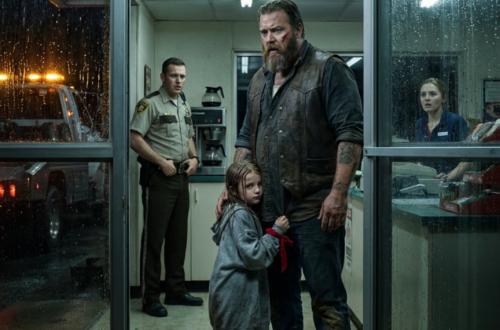
The girl came in close to the end of shift. She was small, maybe nine, wearing a yellow raincoat darkened by rain. Her hair stuck to her cheeks, and she held something wrapped in a gray kitchen towel against her chest. She did not cry. That was the first thing I noticed, though I told myself later I noticed the smoke smell first. No, that is not right. I noticed the silence first.
Children who come into a fire station usually ask for someone. They ask for their mother, their dog, the ambulance, the bathroom, anything. This child looked at the name tags on our shirts until she found mine. Then she walked to the desk and placed the bundle in front of me with both hands, careful, almost formal, like a person returning something borrowed.
Inside the towel was an old metal lunch carrier, the two-tier kind workers used years ago before plastic containers became common. One side was dented inward. The handle had warped from heat. A corner was burned black, and flakes of ash dropped onto the desk when the towel opened. Phong stopped complaining about the vending machine.
The girl said, “Dad told me to give this only to someone who still remembers that smoke.”
I asked her name. She said Lê Hoài An. I asked where she lived, and she gave an address in Thịnh An, a narrow neighborhood about ten minutes away. I asked where her father was. She stared at the old thing on the desk and said she did not know.
At first, I thought her father had sent her to us because he had caused a fire. That was my first wrong idea. People do strange things when they panic. They send children away, hide evidence, blame neighbors, pretend they smelled smoke later than they did. A missing father, a burned room, and a child carrying a scorched container looked less like a mystery to me than a domestic mess already turning ugly.
An said the smoke came from the room behind the kitchen, the room her father never let her enter. He had told her to hide in the wardrobe, but she heard him shout. Then she heard another man say, “Find the box.” After that, the smoke got worse, so she ran out through the back with the metal carrier under her coat.
Phong called the nearest crew to check the address. While he did that, I asked An whether her father had enemies. She said he fixed safes for people and sometimes came home with dirty hands and a headache. That answer did not help much. Half the men I knew came home with dirty hands and a headache.
The crew in Thịnh An reported back after several minutes. The house had a small fire in the rear room, already contained. There was no adult male inside. The room had been searched before the fire spread, drawers pulled out, floorboards disturbed. There was blood near the rear door, but not enough to say whether someone had been dragged or had cut himself climbing out.
That last detail gave me my second wrong idea. I wondered whether Lê Quang Hòa had staged his own disappearance. It is ugly to admit that now, but I did. A safe repairman with a hidden room, a daughter carrying a burned object, blood at a back door, and a dramatic instruction about “someone who remembers” sounded almost too arranged. I did not say that to An, of course. But I thought it.
I leaned closer to the carrier. Burned cloth, wet metal, old cooking oil, and something sharper underneath. I could not place it at first. Maybe I did not want to. Then a memory rose from somewhere I had kept sealed for years: the Vạn Lộc warehouse fire, twelve years earlier, and the chemical smell that never belonged in the official report.
Vạn Lộc had been ruled faulty wiring. One man died there, Nguyễn Đức Tâm, an accountant who was supposed to testify in a smuggling case. We pulled him out alive, barely. He grabbed my jacket and said something I spent years arguing with myself about. I think his first words were “not an accident.” The next two were clearer.
“The safe.”
Later, when I reported that, I was told smoke inhalation made dying men speak nonsense. Captain Bảo, my senior officer then, put a hand on my shoulder and told me we saved the living; we did not rewrite investigations. I believed him because I needed to believe someone older than me knew where the edge of our duty ended.
Looking back now, that was not duty. It was comfort.
An said the container had belonged to her mother, Lê Thu Hà, a nurse who died when An was four. Officially, it had been a gas leak. Her father kept the box in a cabinet for years and never let anyone touch it until that morning. He told her, “If I do not come back before dark, take this to Station 17.”
I asked why she did not wait until dark. She said, “Because I heard them say they found Dad.”
That confused me. “Who said that?”
“The men outside the kitchen. One said, ‘If he runs, Bảo will know where to look.’”
The name landed badly, but not cleanly. There are plenty of men named Bảo. There had also been a retired firefighter named Dũng Bảo who once managed old equipment storage at our training yard. For a few minutes, I grabbed onto that possibility because it was easier. Maybe “Bảo” was a surname. Maybe 17-B03 was a storage bay. Maybe the clue pointed to an old equipment cage, not a man I had trusted with my life.
I should have stopped there and locked everything down. Instead, I made the kind of practical mistake that sounds reasonable until it becomes a disaster. I called Captain Bảo.
He was retired, but still answered like he had been waiting beside the phone. I did not tell him everything. At least that is what I told myself. I asked whether the code 17-B03 had ever belonged to an equipment bay or old storage rack. He went quiet for a second, then said, “Why are you asking?”
I said a child had brought something in.
“A girl?” he asked.
I had not said girl.
That should have been enough. It was not. Respect is a habit before it is a thought. I told myself maybe someone from Thịnh An had called him. Maybe he had heard radio chatter. Maybe old captains always seemed to know things because everyone still called them first.
I opened the burned carrier with gloves. The main compartment was empty except for a thin layer of black dust. Phong said whoever searched the house must have already taken what mattered. I almost agreed. It would have supported my wrong theory that Hòa had staged the scene or lost control of whatever he had tried to hide.
But the bottom looked thicker than it should have. Near the burned corner, where the heat had lifted a strip of metal, I saw a fine seam. Not obvious. Not hidden well enough from someone trained to notice damage, but hidden well enough from someone opening it in a hurry.
A false bottom.
I pried it slowly. A blackened piece of a safe key dropped onto the desk. Beside it was a small bent metal tag etched with: 17-B03.
For a moment, I thought it belonged to the old training yard. Then Phong said, too quickly, “Wasn’t B03 Dũng’s storage cage?”
That gave me something to hold onto. A false suspect. A safer suspect. Dũng had been bitter when he retired, and he had handled old gear records. He also lived near Thịnh An. For ten minutes, maybe fifteen, I let myself believe the tag pointed to him.
Then the front door opened.
Captain Bảo stepped in from the rain wearing a dark coat, his hair thinner than I remembered and his face tired in a way that made him look more human than legendary. Every man in the room straightened without meaning to. He had trained half of us. He had pulled me out of a roof collapse when I was thirty. In my mind, he was still the man who taught me to read smoke by smell before trusting my eyes.
He looked at An, then at the metal carrier on the desk. “You called me,” he said.
“I asked a question,” I said.
He smiled, but it did not reach his eyes. “Same thing with you, Minh.”
An moved behind my chair. I noticed it, but I misunderstood that too. I thought she was only shy around another adult in uniform.
Bảo came closer and lowered his voice. “Give it to me. If this is tied to an old incident, it has to be handled properly. You do not want this turning into a circus.”
The old part of me almost obeyed. My hand moved toward the bag before I stopped it. I hate that memory more than I hate some of the later ones. I had a frightened child beside me, a missing father somewhere in the rain, and a number connected to my old captain on the desk, but my first instinct was still to trust him.
An tugged my sleeve. Through the rain-streaked glass, she was looking at the man standing under the awning behind Bảo. He had a scar along his neck and a gold ring shaped like a tiger’s head.
“That man came to our house,” she whispered.
Bảo heard her. His face tightened.
I put my palm over the evidence bag. “How did you know to come here?”
He frowned. “You called.”
“I did not tell you there was a box.”
He looked annoyed then, not guilty. That somehow frightened me more. “Do not play detective with me, Minh. You are tired, the child is confused, and you have already touched evidence you should not have touched.”
He was right about the last part, and he knew it.
Phong stepped closer. “Captain, maybe we should wait for the police.”
Bảo snapped, “Stay out of this.”
The room went quiet. I had heard Bảo give hard orders before, but not like that. Not sharp from fear. Not aimed at a man who had simply said the correct thing.
Then Bảo looked back at me and said, “Is the key even complete?”
He realized what he had done almost immediately. His mouth closed, and for one second the old captain, the mentor, the man with steady hands in smoke, disappeared behind someone cornered and angry.
I had not told him about any key.
That was where I should have ended the conversation. Instead, I made one more mistake. I lied badly. I said the key was only a fragment and probably useless. I said the tag might belong to Dũng’s old storage cage. I watched Bảo’s face relax by half an inch, and that relaxation told me more than any confession could have.
But it also bought him time.
By the time we secured An in the back office and called outside help, the man with the tiger ring had already left the awning. And less than twenty minutes later, the crew at An’s house radioed that someone had returned through the rear door.
The second half of the key was gone.
For a few minutes after that call, everyone in the station talked at once. Phong argued that we should never have let Bảo walk out. One of the younger firefighters kept asking whether he should call local police or headquarters, and nobody gave him the same answer twice. An sat in the back office with a paper cup of water in both hands and did not drink any of it. The vending machine in the hallway made a grinding sound and dropped the peanuts Phong had paid for an hour earlier, and for some reason that made him curse louder than anything else that day.
That detail has no meaning. I only remember it because real days are untidy. Terrible things happen while machines spit out snacks late and men forget who has the station keys.
I called Mai Lan, the investigative reporter who had once written about the Vạn Lộc fire before her series was shut down. I did not trust the first chain of command anymore, but I did not fully trust myself either. My head was full of wrong theories: Hòa staging his disappearance, Dũng as the owner of B03, Bảo simply trying to control damage because he disliked scandal. I needed someone outside my loyalty.
Lan answered, and when I mentioned 17-B03, she went quiet. Then she said the number had once been assigned to Bảo’s personal equipment record during the Vạn Lộc response. She also knew about Dũng’s old storage cage and told me it had been B13, not B03. My safer suspect collapsed in one sentence.
She gave me the next piece carefully. Lê Quang Hòa was not born with that name. His birth name was Nguyễn Minh Hòa. He was Nguyễn Đức Tâm’s son.
I remember asking her to repeat it, even though I heard it clearly the first time. Hòa had changed his surname after his father died at Vạn Lộc. He became a safe technician because his father’s last words had been about a safe. His wife, Lê Thu Hà, the nurse who died in the gas leak, had been on duty the night Nguyễn Đức Tâm was brought in. According to Lan, there had always been a rumor that Tâm passed something to a nurse before he died, but no one could prove it.
“Thu Hà kept it in the food carrier,” I said.
“Maybe,” Lan replied. “Or maybe Hòa only believed she did. Be careful with grief, Minh. It makes people build churches around guesses.”
That was the first sensible thing anyone had said to me in hours.
We went back to An’s house too late. I will not dress that up. If I had sealed the place, if I had not called Bảo, if I had not chased the Dũng theory for even a few minutes, the second half of the key might still have been under the kitchen floor. Instead, we arrived to find the rear door forced open again and muddy prints across the tiles.
The house looked worse than before. The fire had been small, but the search had not. Sofa cushions were cut open. Drawers were emptied. A family photograph lay facedown near the table, the glass cracked across Thu Hà’s face. On the kitchen table sat a bowl of rice, dried at the edges, and beside it an electric bill with a red overdue stamp. It had nothing to do with the case. I remember it because I kept looking at it while An counted tiles, as if staring at an unpaid bill could stop me from looking at the blood near the back step.
Seven tiles across from the refrigerator. Three down from the kitchen doorway. The hollow tile had already been lifted. Beneath it was only torn plastic wrap and dust.
An stared at the empty space. “It was here,” she said.
“I know.”
“No, it was here. Dad showed me. He made me practice.”
Phong turned away and kicked the leg of a chair. “Damn it, Minh.”
He was not wrong to be angry. I was angry too, but mine had nowhere clean to go. An had trusted us with the one place her father told her to remember, and because I had tipped Bảo, someone reached it before we did.
Then An said something that pulled us back from useless anger. “There was another place.”
I looked at her. “What place?”
She hesitated. Children raised around secrets learn that each fact has a price. “Dad said if the tile was empty, then I should look where Mom used to leave her spoon.”
I almost snapped at her. Not because of her, but because I was tired and ashamed, and the sentence sounded too vague. A spoon could mean a drawer, a lunch bag, a kitchen cabinet, a memory from a woman dead five years. Phong saw my face and said, “Captain, don’t.”
He was right. Again.
An opened a lower cabinet near the sink. Inside were old jars, a cracked white mug, and a small tin of tea gone stale. Behind them, taped to the underside of the shelf, was a USB drive wrapped in medical tape. Thu Hà’s name was written on the tape in faded blue ink.
The USB did not contain the second half of the key. It contained a video from Hòa.
We watched it in Lan’s car because I did not want An standing in that ruined kitchen any longer. In the video, Hòa wore a blue shirt and looked like he had not slept in days. He said that if An was seeing the recording, the first hiding place had failed. He apologized to her before explaining anything else. That made me trust him more than all the evidence had.
He explained that Nguyễn Đức Tâm, his father, had hidden ledgers and a voice recording in a secondary safe before the Vạn Lộc fire. The safe had been moved after the fire, not destroyed. Thu Hà received a metal tag and half a key from Tâm before he died at the hospital. She hid them inside her old food carrier because no one searching for criminal evidence respected domestic objects.
Then Hòa said the thing that made An press both hands over her mouth.
“Your mother did not die because of gas. She died because she kept what a dying man gave her.”
He named Bảo in the video, but not as the man who lit the fire. That mattered. Hòa said Bảo had been paid to alter supplemental notes, suppress chemical concerns, and delay the movement of one response record long enough for the official timeline to look clean. He said Bảo’s defense, if caught, would be that he was protecting the station from political retaliation.
At the end, Hòa gave the location of the secondary safe: the old fire-training warehouse south of the city. It had belonged to a contractor tied to Vạn Lộc and had been used by Station 17 for drills years earlier. Hòa believed Bảo had hidden the safe there because a burned training structure was the last place anyone would treat scorch marks as suspicious.
My phone rang before the video ended. Bảo.
I answered and put it on speaker. Lan shook her head, but I needed witnesses.
“Where are you?” Bảo asked.
“At the house.”
He swore. Not loudly, not dramatically, just like a man who had spent all day losing patience. “You always had to make things difficult.”
“Where is Hòa?”
“You are chasing a liar.”
“Then why are you scared of him?”
“I’m not scared of him. I’m tired of cleaning up after men who think a sad story makes them heroes.”
That was more like the real Bảo than the calm mentor from earlier. Defensive. Irritated. Mean when cornered. He said Hòa had been unstable for years, obsessed with his father’s death, feeding conspiracy stories to a child. He said Thu Hà’s death had been tragic, but grief had twisted Hòa into someone dangerous.
For a moment, I nearly believed part of it. Not all. But part. Hòa had hidden things under floors, changed names, trained his daughter to carry evidence through rain. Those are not normal choices. Then I looked at An, sitting in the back seat with her mother’s USB in her lap, and understood that normal is a luxury some families lose when other people keep burning the truth around them.
Bảo told me to bring the container and the tag to the warehouse if I wanted Hòa alive. He did not ask for the USB. That told me he did not know about the second hiding place.
We left An with Lan’s colleague at a small clinic near the hospital. There was an orange cat sitting on the clinic steps, wet and furious, refusing to move out of the rain. An watched it while Lan explained where she would be taken. It is another detail with no use. I only remember An asking whether the cat belonged to someone, and Lan saying, “Probably itself.”
I told An I would try to bring her father back. I did not promise. I had learned at least that much by then.
The old training warehouse stood behind a cut chain-link gate on the south edge of the city. The place had not been used in years, but the burn rooms still carried soot on the walls. That made it perfect for a lie. Any fresh scorch could be mistaken for old training damage unless someone cared enough to check.
Inside, the air smelled of damp concrete, engine oil, mold, and chemical accelerant. We moved slowly. Phong was with me, along with two off-duty firefighters and an investigator Lan trusted named Khải. None of us were supposed to be there in exactly that formation, which would become a problem later. At the time, it felt less like bravery than a group of people hoping our mistakes could cancel out someone else’s.
We found Hòa in the old machine room. He was tied to a chair, head hanging forward, one eye swollen shut. His left hand was badly injured. Two fingers were crushed, probably so he could not work a lock again. He was alive, but barely steady enough to focus.
“An?” he asked when I cut the tape from his mouth.
“Safe,” I said.
He closed his eyes and breathed once through his teeth. Then he said, “The safe is still here.”
“You are leaving first.”
“No,” he said, trying to grab my sleeve with his damaged hand and failing. “If the safe burns, they will say I made it all up.”
I wanted to tell him evidence mattered. I wanted to say we could not let the record vanish again. But I had already spent too many years letting a dead man’s last words become a file note no one believed. This time, I chose the living man first.
That decision saved Hòa, but it cost us.
While Phong and I carried him out, smoke began to crawl low across the corridor. Someone had poured accelerant near the old control room. Khải and one of the off-duty men went for the safe, but the fire spread faster than expected. They got it open only because Hòa, half-conscious, told us the key pattern from memory. The second half of the key had already been used and left in the lock, which meant Bảo or his man had opened the safe before we arrived.
Inside were ledgers, partial chemical reports, a recorder, and half of a metal nameplate matching 17-B03. But one envelope was missing. Hòa said it should have contained the original list of payments made after Thu Hà’s death. Without it, the second fire would be harder to prove.
Bảo appeared near the side exit while we were moving the files out. He did not give a speech. He shouted. He called Hòa a parasite. He called Lan a scavenger. He told me I had no idea how many men would be hurt by “dragging old garbage into daylight.”
I asked him whether he knew Thu Hà’s gas leak was staged.
He pointed at me, hand shaking. “Do not put that on me.”
“Did you know?”
“I heard things.”
“Did you report them?”
He looked away. “You think reports fix anything?”
Phong yelled at him then. Phong was younger and less careful with his grief. He asked whether Bảo had ever looked at our faces in the station and remembered the people he helped erase. Bảo told him to shut up. Then Khải moved in with the officers who had finally reached the warehouse, and Bảo tried to pull away hard enough that one of them nearly fell.
That is how I remember his arrest: not dignified, not cinematic, not full of clever last words. A tired old man in a wet coat, furious that the room no longer obeyed him.
The fire was contained, but not before part of the control room collapsed. The missing envelope was never found. The man with the tiger ring escaped through the rear fence during the confusion. Two months later, police found the ring in a pawnshop, but not the man. That open space in the story still bothers me, partly because it is convenient for fear to have no face.
Hòa survived, though his left hand never recovered enough for delicate safe work. He could no longer do the job he had built his life around. He opened a small repair shop later, mostly copying keys, fixing hinges, and sharpening kitchen knives for old neighbors who paid late. He put both names on the sign: Lê Quang Hòa and Nguyễn Minh Hòa. He said he was tired of hiding either one.
The Vạn Lộc case reopened. Bảo was charged with evidence tampering, obstruction, and taking payment tied to the altered reports. He denied direct involvement in setting the fires until the end. The missing envelope weakened the case around Thu Hà’s death, and the official language remained careful: “suspicious circumstances,” “probable arson,” “insufficient surviving evidence for full prosecution.” Those phrases made me angrier than shouting would have.
Bảo never testified fully. He had a stroke three weeks before a scheduled hearing and died in hospital without naming the people above him. Some called that mercy. I did not. It left too many doors half-open.
An saw her father the night we pulled him from the warehouse. She stood in the hospital doorway and did not run to him at first. She looked at his bandaged hand, his swollen face, the tubes, the gray blanket. Then she walked to the bed and placed the gray kitchen towel beside him.
“You came back,” she said.
Hòa shook his head. “You brought me back.”
I left before they said more. That was their moment, not mine. In the hallway, the air smelled of disinfectant and wet shoes. A nurse was arguing with a delivery man about boxes blocking the elevator. Life kept being life, rude and ordinary, even beside a family trying to survive the truth.
Months later, Hòa and An brought the burned carrier back to Station 17. They had cleaned it but not polished away the blackened corner. Underneath, beside the old mark where the tag had been hidden, Hòa had engraved four words in Vietnamese: Đã được nhìn thấy.
It has been seen.
We put it in a small glass case near the front desk. Not as a trophy. I would hate that. More as a warning. Some of the younger firefighters ask why an old burned food carrier sits where visitors can see it, and I tell them the short version if they are just curious, the longer one if they are ready to hear how uniforms can protect people and hide from them too.
I still remember Bảo saving me from a roof collapse when I was thirty. I also remember him trying to bury a dead man’s words. Both are true, and I dislike that more than I can explain. It would be easier if he had always been a monster. But people are rarely that useful.
The last unresolved payment list never surfaced. The man with the tiger ring was never found. Thu Hà’s death was never proven in court the way Hòa deserved. That is the part people dislike when I tell it. They want the ending to wash everything clean.
It did not.
What we got was smaller. Hòa lived. An kept her father. Nguyễn Đức Tâm’s last words were finally added to the amended record. Bảo’s name was removed from the memorial wall inside our training room, though some men argued about it for weeks. The station did not feel heroic afterward. It felt older.
Sometimes, near the end of a rainy shift, I still smell burned coffee and think of that afternoon. Not every detail returns. I forgot what match was playing on the radio. I forgot which firefighter finally fixed the vending machine. But I remember the girl’s yellow raincoat, the way she held that old metal box with both hands, and the sentence her father trusted her to carry.
“Only someone who still remembers that smoke.”
For years, I thought remembering was enough. It is not. Memory can sit quietly and become another locked room.
Someone has to open it.