PART 1
I remember the rain on the stone steps more clearly than the exact first words Grant said to me that night. Memory is strange that way. People think that when your life splits open, you remember every sentence, every glance, every breath. But memory keeps the iron gate clicking shut, the smell of rain on cold stone, and my mother-in-law’s expensive rose perfume floating through the foyer like a soft warning.
It was a Thursday evening in late spring, the kind of damp Connecticut cold that makes the trees look green while the air still feels like winter is standing behind you. I wore an old navy dress, not one Eleanor Whitaker liked, but respectable enough for a family dinner. Noah put three tiny plastic dinosaurs in my coat pocket before we left the guesthouse. I only found them when I reached for lip balm and touched the spiked tail of a stegosaurus.
“Noah,” I called, “did you send troops into my pocket again?”
He looked up from the rug and smiled. “So you won’t be lonely.”
I laughed. I remember that because later I hated how easily I had laughed on a night when I should have been afraid. But at the time, I still thought dinner was only dinner. Henry Whitaker, my father-in-law, had grown weaker after his second stroke. The family construction-supply company was preparing for a major sale. Eleanor said the family needed to “sit down properly” before things changed. I thought she meant Henry’s health, Noah’s future, and the paperwork I had spent months helping organize.
I had once been a corporate accountant. Before I married Grant, I had my own small condo, a good job, and something I did not know was precious: every number in my life belonged to me. After Henry’s first stroke, I left work “temporarily” to help stabilize the family company. Temporarily became ten years. I handled payroll when the company nearly missed checks. I called banks at seven in the morning and begged for extensions. I sold the condo I had owned before marriage when Grant said a loan needed a “short-term cushion.” I did all of it and kept calling it marriage, because if I called it sacrifice, someone would have had to answer who benefited from it.
The Whitaker estate sat behind two gates and a long gravel drive lined with old elms. That night, rain turned the driveway silver. As we passed through the inner gate, Noah pressed his face to the window and watched raindrops race down the glass. Grant drove in silence, one hand on the wheel, the other tapping his thigh as if counting down.
“Are you okay?” I asked.
“I’m tired.”
“Because of the meeting this morning?”
“Claire,” he said, still not looking at me, “tonight, just let my mother talk.”
I had heard that sentence many times in my marriage. Let my mother talk. Let my father decide. Let me handle it. And very often, let me handle it meant I would quietly repair whatever Grant had ruined afterward. But I did not say that. I said, “Okay.”
That was part of my mistake. I know that now. I believed that if I stayed calm long enough, useful long enough, reasonable long enough, then eventually a family like the Whitakers would have to admit I was one of them. I spent years trying to earn a place at a table where my chair had always been temporary.
Dinner was served in the formal dining room, where portraits of dead Whitaker men lined the walls like a jury that never adjourned. Eleanor sat at the head of the table in ivory silk, her silver hair pinned low, pearls at her throat. She never had to raise her voice. Actually, I almost said she shouted at me that night, but that is not right. Eleanor never shouted. That somehow made it worse, because her calm made everyone else’s pain look undisciplined.
Henry did not come down. His nurse said he was tired. I remember passing the study and seeing the large leather-bound family trust ledger open on the side table. Dark brown cover, worn edges, the sort of object that looked decorative until you understood the kind of people who preserved it. Eleanor had always called it ceremonial. No legal meaning, she once told me. “Only tradition, Claire.”
That night, it was open to a donor page. I saw a narrow cut near the edge, as if something had once been attached and torn away. A thin trace of blue remained. I did not stop. I wish I had.
We ate salmon, mashed potatoes, and asparagus cooked too soft. Noah hated asparagus but took two bites because Eleanor was watching. I drank water instead of wine because I expected to drive Noah back to the guesthouse if Grant stayed late to talk business with his mother. An ordinary thing. An ordinary night, until Eleanor set down her napkin.
“Claire,” she said, “we need to speak like adults.”
I looked up. “About what?”
Grant did not look at me. He set down his fork very carefully.
Eleanor reached to her side. The housekeeper placed a cream envelope in front of her. Eleanor opened it and removed three items, laying them on the polished table one by one.
The first was a photo of me sitting across from Julian Price, the family attorney, in a cafe in Hartford.
The second was a photo of me leaving a hotel lobby, Julian a few steps behind me.
The third was not a photo. It was a printed bank transfer from Julian’s office to my account.
Noah sat across the table with butter on his fingers, looking from one adult to another. I remember the sound of Grant’s knife touching his plate. Very small. A silver, cold sound.
“I think you should explain,” Eleanor said.
I looked at Grant. “You knew I met Julian.”
“I knew you said you were meeting him about company paperwork,” Grant said. His voice trembled, but not like a betrayed man’s voice. Looking back, I think it was the tremble of someone performing an emotion too large for him.
“It was company paperwork.”
“At a hotel?”
“It was a construction tax conference. You had the schedule.”
Eleanor pushed the transfer toward me. “And the money?”
I looked at the amount. Eighteen thousand seven hundred dollars. The date made me frown, though I did not understand why yet. I only knew I had seen that amount somewhere before. Not in my private life. In records.
“That wasn’t personal money,” I said.
Grant gave a dry laugh. “So you remember the answer you two agreed on.”
“Grant.”
“Don’t say my name like I’m the one who should be ashamed.”
Noah slid off his chair. “Dad?”
I turned to him at once. “Noah, go upstairs for a little while, okay?”
“No,” Eleanor said. “He is old enough to understand that actions have consequences.”
There is a moment in motherhood when your body moves before thought. I stood so quickly my chair scraped the floor. “No. Adults can say whatever they need to say when my son is not here.”
Grant stood too. “I won’t let my son be raised by a woman like this.”
A woman like this.
I had heard those words for years, just dressed in nicer clothes. Not from this family. Not from your background. Not the kind of woman who understands. That night, the words took off their gloves.
Noah began to cry, not loudly, just short little breaths. He held a blue plastic dinosaur in his hand, the one he had named Arthur, and squeezed it until his fingernails went white. I stepped toward him, but Grant moved between us.
“Don’t make a scene,” he said.
I do not know how many times I slapped him in my head in that second. In real life, I only said, “Move.”
Eleanor sighed. “Claire, you are proving exactly what concerns us.”
“What concerns you? That I’ll tell the truth?”
“We are concerned for Noah.”
There may be no crueler phrase than one spoken in the name of a child. It can make almost any brutality sound like duty.
They did not let me take Noah that night. Eleanor’s lawyer, a man named Baird, was waiting in the study as if he had accidentally stopped by for tea at nine o’clock. He said temporary arrangements could be made “to lower the temperature.” Grant said I should leave the main house and “stabilize emotionally.” Eleanor said the guesthouse was family property, and it would be better if I stayed at a hotel.
“I am not leaving without my son,” I said.
Noah stood on the stairs, half-hidden behind the railing, his eyes red. “Mom?”
I started toward him. Grant caught my arm. Not hard enough to bruise. Just hard enough to remind me that in that house, everything from the locks to my child’s school forms belonged to them.
“Noah will stay here tonight,” Eleanor said. “He needs stability.”
I remember wanting to scream. I remember my throat closing instead. I remember the smell of Eleanor’s rose perfume mixed with rain on my coat, and I have hated rose perfume ever since.
I left the estate with a small suitcase, my raincoat, a dying phone, and Noah’s dinosaur backpack, which he had left in the back seat. I do not know why I picked it up. Maybe because my hands needed to hold something of his. Maybe because if I had not held it, I would have gone back and knocked until they called the police.
When the car service took me to the gate, I heard the iron close behind me.
Click.
I remember that sound more clearly than anything Grant said. Not because it was loud. Because it was final. It said what nobody in that house was honest enough to say: you are outside now.
I rented a room at a roadside inn where the carpet smelled of old bleach and the heater rattled like it resented being asked to work. I put Noah’s dinosaur backpack on the chair, plugged in my phone, and sat on the edge of the bed with the hem of my navy dress still wet. I did not cry right away. Sometimes the body is slower than the truth.
Around four in the morning, I opened my phone. Seventeen missed calls, none from Grant. An email from Baird titled Temporary Custody Framework. A message from a mother at Noah’s school: “Claire, I don’t know what’s happening, but are you okay?” Then I saw it.
The Whitaker Foundation website had been updated overnight.
My photo was gone from the advisory board. My name had vanished from the financial committee. Ten years of fundraisers, grant reviews, donor reports, charity lunches, and silent bookkeeping had disappeared as if I were a typo someone finally corrected.
I stared at the screen until it went dark.
Then I woke it again and looked at the blank space where my name had been.
PART 2
By noon the next day, their version had reached the country club. It traveled faster than any legal filing, faster than Grant’s car on the wet gravel drive, faster than the truth because truth always has to stop and tie its shoes. I knew it not because anyone said it plainly. People in those circles rarely do. They sent soft messages. They asked after me in ways that carried the part they refused to write.
“Claire, I hope you’re getting support.”
“Perhaps it’s best if you step back from the spring auction committee.”
“We’re only worried about Noah.”
That last line came from Noah’s head of school, forwarded from a “concerned family member.” I read it in the parking lot of a coffee shop, holding a lukewarm paper cup while rain tapped the roof of my cousin’s borrowed car. I had not slept. My eyes felt dry enough to crack. I was still wearing the coat from the night before because my suitcase held only two outfits, and one sweater had sauce on it from the last time Noah made pasta.
I called Grant. He did not answer. I called again. Nothing. The third time, he texted: “Talk through attorneys. Don’t make this worse.”
Don’t make this worse. I looked at that message and, for the first time in ten years, wanted to throw my phone through the windshield. Not because it was the cruelest thing he had ever said. Because he wrote as if I were the storm and he were only closing the windows.
I saw Noah two days later at the main house under the supervision of a woman named Meredith, whom Eleanor called a family counselor. Noah came into the small sitting room wearing his sweater inside out, his hair still damp from a bath. I knew at once no one had dried it properly. A small, ordinary part of me became so angry about that I could hardly breathe.
“Hi, baby,” I said.
He stood two steps away. He held a red triceratops in one hand. He did not run to me.
I hated Grant for that more than for anything he had said.
“Did you do something bad?” Noah asked.
Meredith shifted in her chair. I wanted to tell her to leave. I wanted to pull my son into my lap. But if I moved wrong, if I sounded too sharp, someone would write it in a report with polite language.
“I did not do what they said,” I told him. “I am trying to fix things.”
“Grandmother said you lied.”
“Grandmother is angry and afraid.”
“Dad cried.”
That pierced me in a place I had not protected. Grant cried. Of course he did. Grant always knew how to cry when tears could make him look like the victim of his own consequences. I swallowed.
“Your dad has a lot of feelings right now,” I said.
Noah looked down at his dinosaur. “Can I come home with you?”
“Yes,” I said immediately, then corrected myself because I did not want to promise something I could not yet control. “I am doing everything I can to make that happen.”
He nodded, but he did not fully believe me. An eight-year-old does not need to understand divorce to understand which rooms are making it dangerous to love someone freely.
Meredith wrote something in her notebook.
I hired a lawyer named Marla Finch on a credit card I did not know how I would pay. Her office sat in an old brick building in New Haven and smelled of paper, dust, and black coffee. She was about fifty, with short hair and no jewelry except a plain silver ring. I told the story the way a woman trained to apologize tells a story: too many details, too many “maybe I misunderstood,” too many pauses to make myself sound reasonable.
When I finished, Marla asked, “Did you have an affair with Julian Price?”
“No.”
“Did you meet him privately?”
“Yes.”
“Did you receive money from his office?”
“I don’t remember what that payment was. But it wasn’t personal.”
“Did you tell your husband about every meeting?”
I went quiet.
She nodded. “Then they have something they can sell as a story. The question is what the story is covering.”
I thought at the time that Marla was only talking like a lawyer. Later, I understood she saw it before I did. I still believed this was about Grant wanting a divorce without paying me, maybe because he had someone else. There was a woman at a paint supplier, blond, too eager to laugh at his jokes during Christmas parties. I tortured myself with that theory for two days. It hurt, but at least it belonged to the marriage. I was not yet ready to understand that they did not merely want to leave me. They wanted to erase me from the record.
Marla told me to build a timeline. Last meeting with Julian at the cafe. The hotel. The transfer date. The late nights. Who saw me. Who benefited from saying I was unstable. I sat in the temporary apartment’s tiny kitchen, drinking instant coffee from the chipped mug I had kept from before I married Grant. The Whitakers owned cupboards full of English porcelain, but when I truly needed to think, I still reached for the three-dollar mug with the broken rim.
I opened my bank statement.
Transfer date: March 14.
I stared at the date for a long time. There is a strange feeling when a number on a screen wakes a memory inside your body. On March 14, I was not at a cafe. I was not at a hotel. I was not secretly meeting Julian. I was at St. Agnes Hospital with Henry, because he had developed an infection after a minor fall and Eleanor was in Palm Beach at a fundraiser. I remembered because the vending machine was out of coffee, and I had to drink terrible hot lemon tea in a paper cup. I remembered because Henry held my wrist, weakly, and said, “Claire, you have done more than they know.”
I called Marla.
“Get the hospital record,” she said. “And find out what that amount matches.”
I knew how to follow money. It was the only thing in my life that still felt solid. People can lie with tears, perfume, folded napkins, and family values, but money leaves marks somewhere. I downloaded old statements, opened a spreadsheet, and began tracing. Eighteen thousand seven hundred dollars. I had seen it before. Not in my personal life. In an emergency payment to a steel supplier three years earlier, when Whitaker Supply nearly lost shipments before a major contract.
Grant had said the line of credit had not cleared in time. I had advanced the money from the last of my private savings, the remainder after selling my condo, because if the workers had no material, payroll would collapse that week. Grant called it “a few days, Claire.” A few days became years. I did not demand repayment because I believed it was our family. I am embarrassed to write that now.
The transfer from Julian’s office was not a gift. It was reimbursement. But why from Julian?
I called him. He did not answer. I texted: “I need to know what the $18,700 was. They are using it to say I had an affair.”
Ten minutes later, Julian called back.
His voice was low. “Claire, you should not call me from your phone.”
“I don’t have much privacy left to protect.”
“I’m sorry.”
“I don’t need sorry. I need the truth.”
He was silent long enough that I could hear rain on his end, or maybe cars on wet pavement. “That transfer was reimbursement from a client escrow account. Henry instructed me to process it before he lost capacity to sign more.”
“Henry?”
“He wanted you repaid. And more than repaid.”
“Julian.”
“Not over the phone.”
I laughed, without any happiness. “Do you know what they’re saying about me?”
“Yes.”
“Then say it.”
He exhaled. “This was never about an affair. It was about what Henry signed before the stroke.”
I did not speak. In the little apartment, the refrigerator ticked. A plastic dinosaur Noah had left in my coat pocket sat on the table, tilted as if listening with me.
“What did he sign?” I asked.
Julian said, “Find the trust ledger. The page with the blue tab.”
PART 3
I had seen the blue tab before I knew I needed it. That is what infuriates me most when I think back. Not because I missed a clue like a detective in a novel. Because I had spent my adult life trained to notice documents, dates, tabs, ink colors, the little administrative traces other people dismiss as meaningless. But inside the Whitaker house, I had trained myself not to look too long at things I was not invited to see.
The trust ledger was not ceremonial. Of course it was not. Eleanor called it that because she wanted me to believe it. Families like the Whitakers do not preserve a leather book for three generations because it looks handsome on a side table. They pass power through objects that pretend to be harmless. A photograph. A board seat. A foundation. A handwritten line that points to a real document stored somewhere else.
I could not enter the estate. My gate code had been disabled. I knew because I tried once on a Sunday morning, sitting in my cousin’s car under a thin rain, pressing the old code and hearing the red beep of refusal. After three attempts, the system went silent. I sat there looking at the gravel drive beyond the gate, where I had once chased Noah while he learned to ride a bike, and felt a strange shame, as if the gate had the right to reject me because I had trusted it for too long.
But I had memory. And I had paperwork.
I started with the company.
Whitaker Supply & Stone sat in a clean industrial park outside Hartford, with a red-brick office and a materials yard behind it. I had worked there unofficially for years, long enough to know which printer jammed, which assistant kept copies, and which drawer Grant used for papers he did not want to read. Marla told me not to take anything improperly. I didn’t. I requested copies of every record that contained my name, my signature, or a loan I had guaranteed. When they refused, Marla sent a letter.
While we waited, I did what accountants do when no one gives them the answer: I rebuilt the question.
I made a spreadsheet. Column A: date. Column B: loan. Column C: guarantee account. Column D: signer. Column E: benefit to the company. I entered everything I had from old emails, personal statements, and Grant’s midnight panic texts. “Can you sign this temporarily?” “It’s only an extension.” “My mother doesn’t need to know.” “I’ll fix it when Henry’s better.”
Looking back, those sentences were candles leading into a basement.
I had signed three personal guarantees in seven years. One for the winter credit line. One for a forklift purchase. One for the north yard expansion, the project Grant pushed even after I told him the orders did not support it. I thought Grant was only careless, vain, afraid of being seen by his mother as weak. I did not understand enough yet. Stupidity does not cancel deceit. Sometimes it gives deceit a place to hide.
The next clue came from Elaine Porter, the retired company bookkeeper. She had worked for the Whitakers for forty years and now lived in a small house with a wooden porch and wind chimes that rang even when there was almost no wind. She received me in a kitchen that smelled of oatmeal cookies and arthritis cream. A vase of tired daffodils sat on the table.
“I don’t want to be dragged into litigation,” she said.
“I didn’t want to be called an adulteress in front of my child.”
She looked at me for a long time. “Eleanor always did prefer simple stories.”
“Did you know about the loans I guaranteed?”
“I processed supporting files.”
“Supporting?”
She grimaced. “That was what Grant called things he didn’t want on board reports.”
She did not give me original documents. She was not foolish. But she gave me a handwritten list from her personal notebook, dates marked “CW funds transferred” and “CW guarantee noted.” She told me Henry had known. Not at first, not all of it, but eventually he understood the company had survived partly because of my money and my credit.
“He was ashamed,” she said.
“Henry?”
“He wasn’t a soft man. But yes. He had shame. He said his daughter-in-law should not have to buy belonging by saving his son from himself.”
I had to look down. There was a hairline crack across one of Mrs. Porter’s kitchen tiles. I stared at it as if it mattered. Really, I just needed not to cry in front of a stranger.
“What did he do?” I asked.
She lifted her tea. “I don’t know the legal details. But Julian Price came to the office after hours once. Henry asked me to print reports on the guarantees under your name and projected next-generation shares. He said Noah needed protection from ‘this family’s own hunger.’ I remember that because it did not sound like Henry.”
“Was there a blue tab?” I asked.
She looked at me. “Who told you about the tab?”
“Julian.”
She rose slowly, opened a drawer beside the stove, and took out an old phone photo printed on regular paper. “I didn’t steal anything,” she said. “I took a picture because I have done books too long to trust rich people’s memory.”
The photo showed a page from the trust ledger. At the top, in handwriting, was a line:
Amendment H.W. 3/14, offsite file, blue tab, temporary trustee C.W. for N.W. shares.
I read it three times.
C.W. was me. N.W. was Noah.
March 14.
The transfer date. The hospital date. The day Henry held my wrist and said I had done more than they knew.
I left Mrs. Porter’s house with the copy in my bag as rain started again. Cold rain fell on the road, turning everything the color of tin. I sat in the car for a moment with my hands on the wheel, and for the first time since the night I was pushed out of the estate, the pain in me changed shape. It was still pain, but it was no longer only the pain of a discarded wife. It was the anger of someone who had seen the structure of the trap.
Henry had amended the trust to protect me and Noah. Not because he loved me like a daughter. I am not sentimental enough to claim that. Maybe he was practical. Maybe he knew the company had used me. Maybe before illness weakened him, he had one rare honest moment. But if that amendment existed, Noah had protected shares. I may have been named temporary trustee over those shares. Eleanor and Grant could not quietly restructure the trust before the company sale without notifying me.
Which meant they needed me discredited before I knew I had standing.
Marla heard everything without swearing, but she set her pen down hard. “We need the original amendment.”
“Julian says the signature page is missing.”
“He said that?”
“Not directly. But if he had a clean copy, he would have used it.”
Marla studied the photo. “This won’t win by itself, but it is enough to scare them.”
“I don’t want only to scare them.”
“I know. But fear is where powerful people start making mistakes.”
She was right. Grant made the first one.
During a temporary custody meeting, Grant sat across from me at a long table wearing a gray suit, his hair neatly combed, his eyes shadowed as if his own story had kept him awake. Eleanor sat beside him with her hands on her leather purse, quiet as a blade in velvet. Baird argued that I was trying to turn a moral issue into a financial dispute. Marla placed the copy of the trust ledger page on the table.
“We would like to know where the March 14 amendment is,” she said.
Eleanor did not blink. “That ledger is ceremonial.”
“Then I’m sure you will not mind explaining why this ceremonial note points to an offsite file with a blue tab.”
“Claire has always tended to overread things she does not understand,” Grant said.
I looked at him. “You know about the blue tab?”
He paused for half a second. So small. If I had not lived with him for ten years, I might have missed it.
“I know about every stunt you’re trying to pull,” he said.
Marla tilted her head. “Mr. Whitaker, were you aware of your wife’s personal loan guarantees?”
“No,” Grant said too quickly. “I had nothing to do with anything she volunteered to sign.”
“Volunteered?”
“She always wanted to prove she mattered.”
I felt that sentence like a slap, but I did not react. I had learned. Not the old silence that made rooms easier for them. A new silence that let people keep talking.
Grant continued, “The North Yard Line was her choice.”
Marla looked up.
So did I.
North Yard Line was the bank nickname for the north yard expansion loan. It did not appear in any public board document they had produced. I knew because I had created that temporary file name inside our internal folder, and Grant had used it later in private email. If he knew nothing about the loan file, he could not know that nickname.
Eleanor closed her eyes for one second. For the first time, she looked old.
“Grant,” she said softly.
He understood what he had done. His face reddened, then drained. “I mean—”
“We should pause,” Baird said.
“No,” I said.
The whole room looked at me. Perhaps because for years, when someone said pause, I gathered papers, poured more water, and let other people decide. This time, I kept my hands on the table.
“No,” I said again. “I have been pausing for ten years.”
PART 4
Eleanor offered a private settlement three days later. Not personally. She never liked putting her own hands on anything dirty. Baird sent a twelve-page proposal: financial support, a “generous” parenting schedule, a nondisclosure clause, and a promise that I would never speak publicly about the family, the company, the trust, the foundation, or any Whitaker. In exchange, I would agree that the current disputes arose from “private marital differences.”
I read it in my new rental apartment, which had one hastily assembled wooden table, two mismatched chairs, and gray curtains I bought because they were on sale. Noah slept on a mattress in the next room, one arm outside the blanket, his red triceratops tucked under the pillow. The apartment smelled of fresh paint, pizza boxes, and instant coffee. There were no ancestral portraits. No family silver. No one calling silence dignity.
Marla sat across from me and removed her glasses. “It’s a lot of money.”
“I know.”
“Not enough for what they want you to swallow.”
“I know that too.”
She watched me, checking whether I was speaking from rage alone. I was angry, yes. But anger was not making me blind. It was making me precise. I had mistaken calm for goodness, politeness for safety, silence for dignity. Now I understood silence is not dignity when silence protects people who hurt your child.
“I won’t sign,” I said.
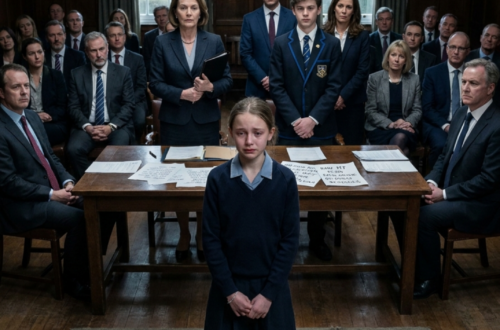
The foundation board meeting happened a week later at the country club. Eleanor had tried to remove me from the guest list, but my name still appeared on an old finance subcommittee document no one had updated properly. Small administrative mistakes are the sort of things powerful people dismiss until they bite. Marla did not sit in the room, but she waited in the hallway with her phone on. Julian did not enter either. He had provided a written statement about the reimbursement and Henry’s instruction, enough to put himself in professional danger but not enough to make him a hero. I did not need a hero. I needed records.
The boardroom smelled of polished wood, lilies, and rain on wool coats. Outside the windows, the golf course spread green and absurd beneath a gray sky. Women who had eaten lunch with me at charity events looked at me as if I were a crack in the wall. A few gave me pity. Rich pity is very light. It never dirties the hands.
Eleanor sat at the head of the table in pale blue, pearls at her neck, silver hair perfect. Grant sat to her right, avoiding my eyes. I almost felt sorry for him. Then I remembered Noah asking whether I had done something bad.
“Claire,” Eleanor said, “this is not the proper forum for private grievances.”
I placed a folder on the table. I did not throw it. I did not slam it. I just set it down. The sound of paper against wood was smaller than the gate closing, but to me, it opened a door.
“I agree,” I said. “So I won’t discuss my marriage. I’ll discuss the trust, the foundation, and company debt hidden under my name before a major sale.”
No one spoke for a few seconds. I heard the air conditioner. I heard a pen roll softly across the table.
Eleanor smiled. “You are emotional.”
“I am documented.”
I passed copies around the table. Hospital records from March 14. The transfer from Julian’s office. The reconciliation showing it matched the steel supplier payment from three years earlier. Elaine Porter’s date list. The ledger photo referencing the blue tab. Grant’s email using the North Yard Line nickname. The personal guarantees bearing my signature. And finally, screenshots of the foundation website before and after the night they removed me.
“You may believe the affair story if you want,” I said. My voice shook a little. I let it. “But that story does not explain why I was removed from the foundation before any divorce filing. It does not explain why my son’s school received concerns about my judgment. It does not explain why a trust amendment naming me and Noah is missing its signature page right before the company sale.”
A board member named Whitcomb cleared his throat. “Eleanor?”
Eleanor looked at me. Something moved in her eyes that I had never seen before. Not pure fear. Eleanor was not easily frightened. It was the deep insult of a woman who had underestimated an opponent and knew the error belonged to her.
“Claire,” she said softly, “you do not understand the cost of making family matters public.”
“I understand the cost of keeping them private.”
Grant stood. “What do you want? Money? Shares? Revenge?”
I looked at the man I had once stayed up late coaching so he would sound competent in board meetings. “I want our son to stop hearing adults call his mother a liar. I want my name restored to records where it belongs. I want the debts under my signature acknowledged. And I want anyone who tried to move Noah’s shares before the trust was reviewed to explain that under oath.”
He gave a bitter laugh. “You think you can destroy this family?”
“No,” I said. “I think this family has been doing that for a long time and making me clean up afterward.”
Eleanor rose. She placed both hands lightly on the table. “Do you think you are different from me?”
The room went still. That line had not been in her script.
She looked at me, and for a moment the mask shifted. “I spent my whole life beside men who believed their names mattered more than anything I did. I learned that if you do not control things, you are swallowed.”
It may have been the most human moment I ever saw from Eleanor Whitaker. And I hated that it made me understand her a little. Understanding is not forgiveness. Sometimes understanding only makes the wrongdoing sadder.
“So you decided to swallow other people first,” I said.
Her face closed.
After that meeting, things did not end. Real life rarely gives you one final scene with swelling music and total ruin for the villains. The company was audited. The sale was delayed. Baird withdrew from parts of the trust matter with an explanation Marla translated as, “He does not want to sink with the ship.” Eleanor resigned from two charity boards for “health reasons.” Grant was forced to produce personal debt records and bank communications. He did not go to prison. Eleanor did not lose the estate. No one stood in front of a crowd and apologized to me.
But the court stabilized Noah’s custody with me while the disputes continued. An order barred Grant and his family from discussing unproven allegations with Noah. My financial role was formally recognized in company records. Julian’s transfer was explained. The personal guarantees came into the light. And the trust amendment, even with its missing signature page, could no longer be called imaginary.
Noah moved into my apartment on a rainy Friday afternoon. He brought two bags of clothes, a box of markers, and far too many dinosaurs for the size of his room. Grant drove him over and stood by the curb under a black umbrella, looking like a man who wanted sympathy for having to face consequences. Noah hugged him quickly, then ran up the steps.
At the door, he stopped. “Mom?”
“Yes?”
“I know you didn’t lie.”
I had to hold the doorframe. “Thank you, baby.”
“Grandmother said adults keep secrets to protect family.”
I crouched to his level. The hallway smelled of new paint and someone’s dinner from the next apartment. “Some secrets protect people. Some secrets only protect the person who did something wrong.”
He thought about that. “Do we have secrets?”
I looked at his tired little face. “Yes. But not the kind that make you afraid of me.”
He nodded, as if that answer was enough for one day. Then he opened his backpack, took out the blue plastic dinosaur, and placed it on the living room windowsill. “Arthur can guard the new house.”
Our apartment had no iron gate. No gravel drive. No dining room full of portraits of dead men still deciding dinner. The window looked down on a parking lot and a young maple tree tied to a stake. When rain fell, it streaked across cheap glass, not as beautifully as it had at the Whitaker estate, but more honestly.
I stood beside Noah and looked at the dinosaur on the sill. Its head tilted toward the city, mouth open in a silent roar. I reached into my coat pocket and found two more tiny dinosaurs he had hidden there. An old habit had followed us into a new place.
The case continued. The signature page was still missing. Grant was still Noah’s father, which made everything harder than any legal victory could fix. Some nights Noah missed him and resented me for not making the world simple again. Some mornings I drank instant coffee from my chipped mug, opened my expense spreadsheet, and wondered whether I would ever stop hearing that gate close in my head.
Then I looked at the blue dinosaur on the windowsill.
No crest. No pearls. No leather ledger behind a powerful woman deciding who was allowed to belong.
Just a small apartment, rain on the glass, my son asleep in the next room, and a name that no longer needed the Whitakers’ permission to have weight.