PART 1 — The Nurse on the Floor
The first thing I remember is the smell of burnt vending-machine coffee.
Not the pain.
Not Dr. Helena Voss standing above me with her hands folded neatly at her waist, asking who had access to the medication room instead of asking whether I could breathe.
Not the cold hospital floor against my cheek.
The coffee came first.
It always did on night shifts at St. Alden.
Someone would buy it from the machine near the staff lifts around two in the morning, when hope had thinned and everyone’s body had begun to realize it had been tricked into staying awake. The coffee smelled burnt before it was poured. It tasted worse. We drank it anyway because nurses are trained to tolerate a lot of things and call it coping.
That night, I had wrapped three hair ties around my wrist so tightly they left red marks.
I remember that too.
Not because it matters.
Because pain does strange things to memory. It lets go of whole conversations and keeps the useless details. A cracked plastic cup. Rain tapping against the staff-room window. The soft beep of a patient monitor through a half-closed ward door. A junior midwife crying quietly in the sluice room because she had missed her daughter’s school play again.
My name is Elena Marlowe. I was thirty-four years old, a night-shift nurse at St. Alden Hospital in Manchester, and by the time they called me attention-seeking, I had spent ten years telling frightened women, “I believe you.”
I said it in triage.
I said it in maternity.
I said it to women gripping bed rails, to women apologizing for bleeding, to women who whispered symptoms because some doctor had already made them feel dramatic. I said it to teenage girls who could barely name what hurt, to mothers who knew something was wrong because their bodies had become rooms they did not recognize, to older women who had learned to describe pain as discomfort so they would sound more reasonable.
I believe you.
It sounded simple.
I did not understand what those words cost until I needed someone to say them to me.
The shift began badly, but not unusually.
St. Alden’s maternity ward was short by two nurses and one healthcare assistant. Bed twelve needed hourly monitoring. Bed seven’s partner kept asking questions he had already been answered because fear makes people loop. A woman in the assessment bay had been waiting too long. The phone rang constantly. The printer jammed twice. The clean linen trolley was half-empty before midnight. One of the monitors in bay three had a loose lead that made the alarm chirp whenever anyone breathed near it.
Normal chaos.
That was what we called it.
Normal chaos meant nobody died, but everyone came close to crying at least once.
I had been in pain for three weeks by then.
At first, I treated it like a bad muscle pull. Nurses are terrible patients because we know enough to minimize ourselves in professional language. I told myself it was stress. Too many night shifts. Too much lifting. Too much standing. Too much instant coffee and not enough food that had seen a vegetable in its natural form.
Then the pain changed.
It became sharper. Lower. Harder to ignore.
There were other symptoms too, the kind women hesitate to describe because the room changes when female pain becomes inconvenient. I wrote them down once in my phone, then deleted the note because it looked dramatic.
That is a stupid sentence.
But it is true.
I had learned not to be dramatic from my mother.
Margaret Marlowe could turn kidney failure into a scheduling inconvenience. She had been sick for years and proud for longer. She lived in a small council flat with mismatched takeaway containers stacked in cupboards because she said throwing away plastic was “what people with too much money did to feel clean.” Half the containers had no lids. Half the lids matched nothing. She kept them anyway.
Every Tuesday, I drove her to dialysis when my shifts allowed. When they did not, I paid for transport and felt guilty all day.
My mother needed me employed.
She would have hated that sentence.
She would have said, “I need the NHS, not your martyrdom.”
But my wages paid for the gaps. Rent top-ups. Food. Heating. Transport. The new slippers she refused to admit she needed because her feet swelled. If I lost my job, my mother would say she was fine until she wasn’t, and I would have to watch another person I loved suffer because I had failed to hold a life together.
So I worked through pain.
I swallowed tablets when I could.
I smiled at patients.
I tied my hair back tighter.
I told myself I would book a GP appointment after the rota settled.
The rota never settled.
At 11:42 that night, I asked Priya Shah if she had any paracetamol.
Priya was a junior registrar in obstetrics, twenty-nine, brilliant, anxious, and permanently hungry. She carried cereal bars in every pocket and wrote notes with such precision that consultants either loved her or wanted to break her spirit.
She looked up from the medication chart she was reviewing.
“You look terrible,” she said.
“That’s how I know you care.”
“No, seriously. Are you all right?”
“Just pain.”
“What kind?”
I waved a hand. “The annoying kind.”
“Elena.”
“I’m fine.”
She did not believe me, but someone called her from bay four before she could push. I watched her go and pressed my palm into my lower abdomen, hard enough that the pressure became its own distraction.
At midnight, I entered the medication room.
That was later used against me.
I went in because the stock count had to be checked after a discrepancy on the previous shift. I had signed for the keys from Sister Agnes at 23:55. I checked the controlled medication log. I counted what needed counting. I noted two missing blister packs of antiemetics that had already been logged by day staff. I took nothing.
The camera outside the medication room recorded me entering at 00:03 and leaving at 00:11.
It did not record me leaning against the inside counter for nearly thirty seconds because the pain had folded me in half.
It did not record me whispering, “Not now.”
Cameras rarely record what matters most.
By 1:20, the ward had become tense in a different way.
A patient I will call Mrs. K had been admitted earlier with symptoms that worried me. Not dramatically. Not enough to make everyone rush. But enough that the back of my neck tightened when I read her notes. She was pale, sweating, and saying something was wrong in the careful voice of a woman trying not to be labeled difficult.
Her observations were borderline. Her pain was “not consistent,” according to the note written before my shift.
I hated that phrase.
Not consistent with what?
With whose expectation?
Dr. Helena Voss came onto the ward just before two.
You always knew when Dr. Voss arrived because the air organized itself around her.
She was head of obstetrics and gynecology at St. Alden, fifty-two, elegant, silver-streaked dark hair cut sharply at the jaw, pearl earrings, white coat even at night though most consultants stopped pretending after midnight. She was famous in the hospital. Not just respected. Famous. She had given talks about women’s health inequality. She appeared in local media during maternity funding campaigns. She mentored junior doctors. She remembered donors’ names. She could say “patient-centered care” in a way that made trustees nod as if they had invented compassion.
I admired her once.
That is important.
Villains in real life rarely enter the story already wearing the right costume. Most of them are people you have trusted because they said the correct things when others did not.
Dr. Voss reviewed Mrs. K’s chart, asked three questions, and said, “Let’s not escalate prematurely.”
Priya shifted beside her. “Her pain has increased.”
“Pain is subjective.”
“So is dismissal,” I said.
It came out before I could stop it.
The ward quieted by one degree.
Dr. Voss turned toward me.
She did not sneer.
I have said before that she sneered, but that is not true. She never gave us anything that crude. She looked at me with soft concern, which was worse.
“Elena,” she said, “you look unwell.”
“I’m fine.”
“Are you?”
There was no kindness in the question, only opportunity.
Priya glanced at me.
I looked down at Mrs. K’s chart, ashamed suddenly of my own body. “I’m fit to work.”
Dr. Voss held my gaze a moment longer, then returned to the patient. “Continue observations. Call me if the objective picture changes.”
Objective.
I would come to hate that word.
By 3:10, my pain had become something I could not stand inside quietly.
I made it to the staff room during a lull. Rain streaked the window black. The vending machine hummed. Someone had left half a sandwich on the table, curled at the edges. I sat down and leaned forward, elbows on knees, breathing through my teeth.
Priya came in.
“You need to be seen,” she said.
“I need four more hours.”
“You’re sweating.”
“Hospital heating.”
“Elena.”
“I said I’m fine.”
She stepped closer. “You’re not.”
I wanted to tell her everything then. That I had been waking at night. That I had found myself gripping the sink at home until the wave passed. That I had searched symptoms online and closed the browser because every result frightened me or sounded like nothing. That my mother needed me. That I could not afford to become ill in a way that required time off, because time off became absence, absence became review, review became questions, and questions became bills I could not pay.
Instead I said, “Can you get me something stronger than paracetamol?”
Her face changed.
Not judgment. Worry.
But I saw what I had just done.
A nurse. In pain. Asking a doctor colleague for medication while on shift. After entering the medication room. During a difficult case.
The wrong facts were beginning to arrange themselves.
“I’m not asking for anything inappropriate,” I said quickly.
“I know.”
“Forget it.”
“No. I don’t want to forget it. I want you assessed.”
“I can’t leave the ward.”
“Yes, you can.”
“No, Priya. I can’t.”
Because that is what we believed. That leaving was failure. That pain was private unless it made you collapse where someone else had to step over you.
At 4:26, Mrs. K deteriorated.
I will not describe the clinical details. They are not mine to give. It was not the worst emergency the ward had ever seen, but it was serious enough to pull everyone into motion. Priya called for help. Dr. Voss returned. The room filled. Someone shouted for bloods. Someone else moved equipment. Mrs. K’s partner stood in the hallway with both hands pressed against his mouth.
I worked because that is what I knew how to do.
Pain became background.
My body became equipment.
A thing to be used until the crisis passed.
By 5:18, Mrs. K was stable enough to transfer.
The ward breathed again.
I walked into the corridor, meaning to sit down for one minute.
The floor rose.
Or I fell.
I remember the smell of antiseptic wipes from a cleaning trolley nearby. I remember the burnt coffee smell still clinging to my mouth. I remember a monitor beeping through a half-closed door.
Then the floor.
Cold.
Hard.
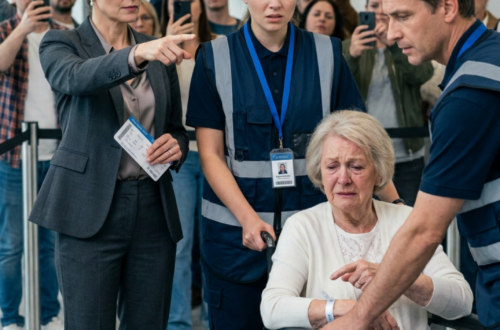
Humiliatingly public.
Someone said my name.
Priya, maybe.
Then Dr. Voss.
“Who had access to the medication room tonight?”
I opened my eyes.
For a moment, I did not understand the question.
I was on the floor.
My cheek was against hospital vinyl.
My body was doing something frightening.
And Dr. Voss was asking about medication access.
Priya said, “She needs A&E.”
Dr. Voss replied, “She needs to be assessed, yes. And the medication log needs to be secured.”
I tried to speak.
Nothing came out.
Later, I learned that Sister Agnes had found me pale, sweating, and semi-conscious. Priya insisted bloods be drawn. I was taken downstairs. Someone gave me fluids. Someone asked if I had taken anything. I said no. Someone asked again. I said no again. The question changed shape each time, but its center stayed the same.
Had I done this to myself?
At 8:35 a.m., a phlebotomist took blood.
At 9:12, an old printer near the staff clinic spat out the first copy of my results.
I did not see it then.
Priya did.
So did someone else.
That printout would later end up folded inside the spare scrub top in my locker, because Priya, in the chaos, tucked it there when she was called away.
She would not remember doing it for days.
That forgotten paper saved me.
By noon, I was officially off duty.
By 3 p.m., I was suspended pending investigation.
They did not call it punishment.
They called it a precaution.
St. Alden’s letter said there were concerns related to medication access, professional conduct, and fitness to practice following a significant clinical incident.
A significant clinical incident.
Mrs. K’s case had become attached to me like a weight.
The implication was elegant in its cruelty: maybe I had been unwell; maybe I had sought medication; maybe I had been impaired; maybe the patient’s complication was not simply a complication, but part of my instability.
Dr. Voss called me personally that evening.
I was at my mother’s flat, sitting on the edge of her sofa while she sorted plastic container lids that fit nothing. Rain tapped against the window. My suspension letter lay open on the coffee table.
“Elena,” Dr. Voss said, “I want you to understand this process is protective.”
“Of whom?”
A pause.
“Everyone.”
“My blood tests—”
“Occupational health will review your health status.”
“I want access to my chart.”
“You will receive appropriate documentation.”
“My full chart.”
“Elena, given the circumstances, it would be better for all requests to go through formal channels.”
I stared at the wallpaper above my mother’s television, a faded floral pattern she refused to replace.
“You think I took medication.”
“I think you are exhausted, in pain, and possibly not aware of how your behavior appeared.”
“I collapsed.”
“Yes,” she said gently. “And sometimes the body collapses after the mind has been asking for help in unsafe ways.”
My mother looked up.
She could not hear Dr. Voss, but she saw my face.
I said, “I did not take anything.”
“I hope that is true.”
Hope.
Not believe.
Hope.
After I hung up, my mother said, “That woman sounds expensive.”
“You heard one side of a phone call.”
“I heard your silence.”
I folded the suspension letter.
Mum reached for it, but I moved it away before I knew I was doing it.
She saw.
“Elena.”
“I’ll handle it.”
“You always say that when you are not handling it.”
“I need this job.”
“You need a doctor.”
“I am a nurse.”
“That is not the same as being cared for.”
I looked away because if I looked at her, I would cry, and she had dialysis in the morning, and I could not add my fear to her kidneys.
The next day, St. Alden told me I could not access my full medical chart while the occupational review and conduct investigation were ongoing.
“For procedural integrity,” the email said.
That phrase was the second locked door.
The first had been Dr. Voss’s question on the floor.
Who had access to the medication room?
PART 2 — Attention-Seeking
The occupational health psychiatrist had a plant on her windowsill that was dying politely.
That is what I remember.
Not the first question.
Not the clipboard.
Not the way she tilted her head when I said the pain had been real.
The plant. Brown at the tips, green at the base, still performing life because someone watered it often enough to delay the obvious.
Her name was Dr. Lennox. She was not cruel. I need to be fair about that. She did not call me a liar. She did not raise her voice. She did not accuse me directly. Like everyone else in the hospital, she used language that carried blame inside padding.
“Do you feel,” she asked, “that your physical symptoms may have been intensified by workplace stress?”
“Yes,” I said. “Stress makes pain worse. It does not invent blood results.”
She made a note.
“What blood results?”
“I don’t know. They haven’t given me my full chart.”
“But you believe something abnormal was found?”
“I collapsed.”
“That does not answer the question.”
“No. It answers a better one.”
She looked at me for a moment.
I was not helping myself.
I knew that, and still I could not stop.
That is one of the traps. When institutions describe you as unstable, every sign of distress becomes supporting evidence. If you cry, you are fragile. If you get angry, you are defensive. If you stay calm, you are manipulative. If you know too much, you are controlling the narrative. If you know too little, you are confused.
Nurses are trained to assess pain on scales.
Zero to ten.
We are not trained to defend our own.
When I told Dr. Lennox mine was an eight, she asked whether I had ever exaggerated symptoms to be taken seriously.
I laughed.
It came out wrong.
“I spend half my life telling patients not to minimize symptoms,” I said. “Then I minimized mine until I fainted at work. So no. If anything, I underperformed.”
She wrote again.
I imagined the words.
Patient uses humor defensively.
Patient displays limited insight.
Patient appears preoccupied with medical explanation.
Patient resists psychosomatic framing.
After the assessment, I sat in the corridor outside occupational health and pressed my thumb into the red marks the hair ties had left on my wrist. I had stopped wearing them there, but the habit remained. Press, release. Press, release.
My phone buzzed.
Mum.
Did you eat?
I typed: Yes.
Then deleted it.
Typed: Later.
She replied: Liar.
That made me smile despite everything.
Then another message arrived.
Unknown number.
You should stop asking questions. They’re saying you were looking for opioids.
I stared at it.
The corridor seemed to narrow.
Who is this? I typed.
No reply.
At first, coworkers sent supportive messages.
Not many. Enough to make me cry once in a Tesco car park.
Priya wrote: I’m so sorry. I’m trying to understand what happened.
Sister Agnes wrote: Keep records of everything.
A healthcare assistant named Mo wrote: You looked ill, not high. For what it’s worth.
Then the messages slowed.
Then stopped.
That was how institutional isolation worked. Rarely by decree. More often through fear moving person to person. People began taking longer to reply. They stopped using names. They wrote things like thinking of you instead of I believe you. They did not want screenshots of loyalty appearing in the wrong meeting.
I did not blame them.
I resented them anyway.
St. Alden sent me a summary of concerns four days after the collapse.
It included:
- Medication room access at 00:03 without direct patient assignment requiring controlled stock handling.
False. It had been stock check.
- Verbal request for pain relief from junior doctor during shift.
True.
- Observed shaking hands and distress during clinical activity.
True.
- Presence during complex maternity deterioration with possible lapse in escalation judgment.
Cruel. Vague. Useful.
- Subsequent collapse raising concerns about fitness to practice.
True, but turned inside out.
The medication-room footage was referenced twice.
So was Dr. Voss’s statement.
Elena appeared pale, tremulous, and emotionally heightened. She made remarks challenging clinical judgment during an active case. Given medication room access and request for analgesia, I recommended immediate protective review.
Protective.
That word again.
Protective of what?
Not me.
The hospital blocked my ID badge.
That hurt more than I expected.
A badge is ugly plastic. A photo nobody likes. A strip of access rights attached to your chest. But after ten years, the click of doors recognizing me had become part of my body. Without it, I was a visitor. Less than a visitor, actually. Visitors could enter wards if someone loved them there.
I stood one afternoon outside St. Alden’s staff entrance holding the dead badge against the reader, waiting for the light to turn green.
It stayed red.
A porter I knew opened the door from inside, saw me, and looked away.
“Elena,” he said.
“Hi, Mark.”
“You can’t come through here.”
“I know.”
He looked miserable.
I stepped back.
“Sorry,” he said.
“Don’t be.”
But I was angry with him too.
Anger became everywhere then. In my jaw. In my hands. In the way I washed dishes too hard at Mum’s flat and cracked one of her mugs. She looked at the pieces in the sink and said, “Good. Hated that one.”
“You did not.”
“It had bad balance.”
Everything she said made me want to cry.
My mother tried to help by pretending not to need help.
She sat through dialysis without complaining. She told the transport driver I was “between shifts,” not suspended. She called my landlord to ask whether the damp patch near my ceiling was illegal, because apparently she had decided to fight mold on my behalf. She sorted her plastic containers while I went through hospital emails.
“You should sleep,” she said one evening.
“I will.”
“You said that yesterday.”
“I meant tomorrow.”
She threw a lid at me. It missed by a meter.
Her hands shook more than they used to.
That was another thing my job protected: the illusion that I could keep her stable by remaining useful.
The hospital knew that too.
Not directly. Not as a villainous plan. But systems understand leverage without needing to name it. If you depend on the wage, the reference, the pension contribution, the professional registration, the sick pay, the health benefits, you will swallow more than you should. You will apologize for asking. You will sign forms quickly. You will attend meetings where people discuss your pain as though it were a workplace incident.
Ten days after the collapse, I received the digital summary of my medical results.
Most values were listed.
Some were missing.
One line read:
Inflammatory markers mildly elevated, clinically insignificant in context.
I read it five times.
Clinically insignificant.
That was possible.
Lots of results were mildly abnormal under stress, dehydration, infection, exhaustion. I knew that. I was not trying to diagnose myself from a PDF. But the phrase felt too smooth. Too final. Too useful.
I requested the full lab report.
No answer.
I requested again.
Formal channel.
I submitted through patient records.
Processing delay.
I asked occupational health.
Not within scope.
I asked Priya.
She did not reply for six hours.
When she did, her message said only: I need to speak in person.
We met in a park near the hospital because neither of us wanted a coffee shop full of staff.
It was raining, of course. Manchester rain does not fall so much as occupy the air. Priya wore a hooded coat and looked like she had not slept.
“I shouldn’t be here,” she said.
“That’s a strong start.”
“Elena.”
“Sorry.”
She glanced around. “I saw your bloods that morning.”
My body went still.
“And?”
“There was an urgent flag.”
I stopped breathing.
“What kind?”
“I don’t want to say from memory.”
“Priya.”
“No. Listen. I saw an urgent flag. I remember because I thought, finally, they’ll treat her. Then Mrs. K’s transfer happened and I got pulled away. Later, when I checked the system, it was gone.”
“Gone?”
“Downgraded. Reworded. I thought maybe I misread it.”
“You didn’t.”
“I might have.”
“You didn’t.”
She looked at me then, and I saw the fear beneath her caution.
Priya was early in her career. Dr. Voss controlled rotations, references, opportunities, conference recommendations. A consultant did not need to destroy a junior doctor loudly. She could simply stop opening doors.
“I put a printout somewhere,” Priya said.
“What?”
“That morning. The first one. I printed it near staff clinic. I had it in my hand when they called me. I think I tucked it into your spare scrub top in your locker because I was carrying too much.”
“My locker?”
“I don’t know. Maybe. I was tired.”
“My locker has been sealed.”
“By who?”
“Ward management.”
Her face changed.
We sat under a tree while rain gathered on the edge of her hood and dripped onto her lap.
Priya whispered, “I’m sorry.”
I hated that she was frightened.
I hated that I needed her anyway.
“How do I get into my locker?” I asked.
“You don’t.”
“I need that printout.”
“You’re suspended.”
“I know.”
“Elena, if you enter the ward—”
“I know.”
So I did not enter the ward.
Sister Agnes did.
I called her from Mum’s kitchen while Mum pretended to watch television and listened to every word.
Agnes said nothing for a long time after I explained.
Then she said, “Your locker has not been sealed properly.”
“What does that mean?”
“It means someone put tape on it to look official, but there is no inventory tag.”
“Can you open it?”
“I can collect personal items in the presence of another senior nurse.”
“Will you?”
Another silence.
Then: “I was on nights with you for seven years. I know what unwell looks like. I know what drug-seeking looks like. You were unwell.”
I put a hand over my eyes.
“Thank you.”
“Do not thank me yet.”
The next afternoon, Sister Agnes arrived at my mother’s flat carrying a plastic hospital belongings bag.
Inside were my shoes, a spare phone charger, half a pack of mints, a stained cardigan, three pens, and a folded navy scrub top.
My heart began beating so hard I felt sick.
I unfolded the scrub top.
At first, nothing.
Then a paper slipped from the breast pocket and fell onto my mother’s carpet.
A blood-test printout.
Old-style.
Black text, faint printer line across the top, corner slightly bent.
My name.
My hospital number.
Date.
Time collected: 08:35.
Result printed: 09:12.
One line highlighted.
URGENT REVIEW ADVISED.
I sat down on the floor.
Mum picked it up before I could.
Her hands were unsteady, but her eyes were sharp.
“What does this mean?”
“It means the digital record is wrong.”
“Wrong how?”
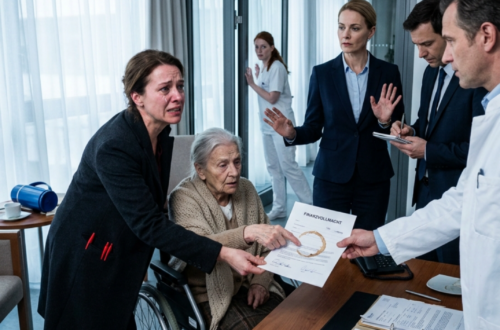
I opened the hospital PDF on my laptop and placed the two reports side by side.
Same test.
Same timestamp.
Same patient.
One said urgent.
One said clinically insignificant.
My mother leaned closer.
“Can that happen by mistake?”
“Yes,” I said.
Then I looked at the printout again.
The missing lab comment.
The changed language.
The timing.
Dr. Voss asking about medication before anyone asked about results.
“Yes,” I repeated, quieter. “But not like this.”
Mum sat back.
For once, she did not make a joke.
“Who changed it?” she asked.
I looked at the two versions of my own body.
My pain, translated into data.
My data, translated into doubt.
“I don’t know,” I said.
But for the first time since I hit the hospital floor, shame began turning into something cleaner.
Suspicion.
PART 3 — The Words They Used on All of Us
The first thing Lea Kaur asked me was whether I had touched the printout with bare hands.
“Yes,” I said.
She sighed.
“I’m sorry. I didn’t know I was in a crime drama.”
“You’re not. But chain of custody matters.”
Lea was not my lawyer at first. She was a patient advocate who used to be a nurse before retraining in health regulation after what she called “a decade of watching hospitals apologize in passive voice.” Sister Agnes gave me her number. I called expecting sympathy. Lea gave me instructions.
Scan everything.
Photograph everything.
Write down who handled what and when.
Do not accuse anyone in writing yet.
Do not post online.
Do not contact Dr. Voss directly.
Do not attend any disciplinary meeting alone.
“Also,” she said, “stop apologizing before every sentence.”
“I don’t.”
“You apologized three times during your voicemail.”
I opened my mouth.
Then closed it.
She was right.
My whole life had become one long apology for needing space in it.
The two blood tests changed the shape of the fight, but not immediately.
That is important.
Evidence does not walk into a hospital and make powerful people ashamed. Evidence has to be carried, copied, submitted, denied, re-submitted, challenged, minimized, contextualized, and sometimes leaked through the cracks between frightened people.
The hospital’s first response was clerical.
A spokesperson from records wrote:
Differences between preliminary printed laboratory outputs and validated electronic records may occur as part of standard clinical review processes.
Standard clinical review processes.
I read that sentence aloud to my mother.
She threw a container lid at the wall.
This time it hit.
“Validated by whom?” she asked.
“Exactly.”
The hospital refused to answer.
Meanwhile, the disciplinary process advanced.
I sat in a meeting room on the administrative floor three weeks after my collapse, wearing a blouse that had become too tight because pain made eating unpredictable and stress did the rest. Lea sat beside me. Across from us were HR, occupational health, a nursing director I had met twice, and Dr. Voss.
Dr. Voss wore pearl earrings.
I remember wanting to rip them from her ears.
That is an ugly thing to admit.
I did not do it, obviously. I placed my hands in my lap and pressed my thumb against the fading hair-tie marks on my wrist.
The nursing director began. “Elena, this meeting is not disciplinary in itself, but part of a formal fact-finding process.”
Lea said, “Then please ensure the notes reflect that Ms. Marlowe is attending under protest regarding incomplete medical disclosure.”
The HR woman typed.
Dr. Voss looked at me with gentle concern.
“How are you feeling?” she asked.
I almost answered automatically.
That is how deep the training goes. A consultant asks a question; a nurse answers. Even when the question is bait.
Lea touched her pen once against the table.
I said, “I would like to discuss the discrepancy in my blood-test records.”
Dr. Voss folded her hands. “We are here to discuss conduct concerns.”
“My health was made into a conduct concern.”
“Because your behavior raised safety questions.”
“My collapse raised clinical questions.”
“Both can be true.”
She was good.
I will give her that.
She never denied the reasonable sentence. She absorbed it, softened it, and placed it inside her own frame.
The medication footage was presented again.
Me entering at 00:03.
Me leaving at 00:11.
No audio. No context. No stock log visible.
The nursing director asked, “Why were you in the medication room?”
“Stock check.”
“Who assigned that?”
“Sister Agnes.”
“Documented?”
“Yes.”
“Why were you alone?”
“Because stock checks are often done alone unless controlled discrepancies require two staff. This did not.”
Dr. Voss said, “But you had asked for pain relief shortly before.”
“After.”
“Sorry?”
“I entered the medication room before I asked Priya for stronger pain relief.”
Dr. Voss paused.
Only slightly.
Lea noticed.
I noticed.
HR probably did not.
Dr. Voss recovered. “The broader concern remains that you were in distress and may not have had full insight into your own condition.”
“Then why wasn’t I treated as a patient?”
Silence.
A small one.
The kind that does not change a meeting but enters the record.
Lea placed the two blood tests on the table.
The old printout.
The digital version.
“Please explain why the same sample produced one report marked urgent and one record marked clinically insignificant,” she said.
The nursing director leaned forward.
HR stopped typing.
Dr. Voss looked at the papers.
I watched her eyes.
She did not look surprised.
That was the first answer.
“The printed output appears preliminary,” she said.
“Who validated the revised version?” Lea asked.
“That would be a laboratory governance question.”
“Who requested clinical reinterpretation?”
“I cannot answer without reviewing the full audit.”
“Has the full audit been preserved?”
“Of course.”
Lea smiled slightly.
That smile frightened me in a good way.
Then Dr. Voss said the sentence that changed everything.
“Elena’s urgent inflammatory marker, even if present on a preliminary output, would not alone explain her conduct that night.”
The room moved around me.
Not physically.
But something shifted.
Lea’s pen stopped.
I looked at the digital record in front of us.
The official digital record did not mention an urgent inflammatory marker.
It said clinically insignificant.
It did not specify what had been urgent.
I looked at Dr. Voss.
She looked back.
For the first time, her face was not perfectly soft.
Lea said, “Dr. Voss, how did you know which marker was flagged urgent if that information does not appear in the validated record you provided?”
No one spoke.
The HR woman began typing very fast.
Dr. Voss said, “I reviewed multiple clinical inputs that morning.”
“Which included the original result?”
“I do not recall.”
“Did you see the urgent version before it was altered?”
“I reject the word altered.”
“Then before it was revised.”
Dr. Voss looked at the nursing director. “I think this line of questioning exceeds the scope of today’s meeting.”
Lea leaned back.
“I agree,” she said. “It requires a broader review.”
That was the first time I saw Dr. Voss understand that my case might not stay small.
After the meeting, Priya called.
“I heard,” she said.
“How?”
“Everyone heard something.”
“Voss mentioned the marker.”
“I know.”
“You were right.”
Priya went quiet.
Then: “Elena, there’s something else.”
I sat down on the bus stop bench outside the hospital. Cold rain blew sideways under the shelter. Cars hissed through puddles.
“What?”
“That phrase in your record.”
“Clinically insignificant?”
“No. The other one. In the occupational summary. Symptoms inconsistent with clinical presentation.”
I closed my eyes.
“What about it?”
“I’ve seen it before.”
“In patient files?”
“Yes.”
“How many?”
“I don’t know. Enough that I noticed. Women with ongoing symptoms after maternity complications. Complaints closed. Notes saying anxiety, stress, inconsistent presentation.”
“Priya.”
“I can’t access files without reason.”
“I’m not asking you to.”
“I know. I’m telling you because if you request your own records only, they’ll contain it. If former patients request theirs…”
She did not finish.
She did not need to.
The first former patient contacted me by accident.
Her name was Rachel Bell.
She sent a message to my professional Facebook page, which I had forgotten existed. She wrote:
I heard you’re the nurse from St. Alden they’re saying was unstable. You probably don’t remember me. You told me once I wasn’t being dramatic. They wrote anxiety in my notes. I nearly died two weeks later. I don’t know why I’m messaging. Sorry.
I sat in my mother’s kitchen and read it six times.
Then I replied:
I remember you. You were not being dramatic.
I did remember her.
Not clearly. Not every detail. But I remembered her hands gripping the blanket. I remembered her saying something is wrong and then apologizing for saying it. I remembered Dr. Voss telling a junior doctor to avoid “feeding catastrophic thinking.”
Rachel had requested her records after her later admission to another hospital. She still had them.
We met in a community center café because Lea said my flat was too personal and hospitals were too dangerous. Rachel brought a folder. She was thirty-eight, with tired eyes and a toddler’s sticker stuck to her coat sleeve. She apologized four times before sitting down.
“I don’t want trouble,” she said.
“Neither did I.”
That made her laugh once.
Her file contained the phrase.
Symptoms inconsistent with clinical presentation.
Dated two days before discharge.
Complaint closed after review.
No further action.
Her later hospital records told a different story. A missed complication. Not necessarily malpractice by itself. Medicine is complicated. Symptoms overlap. People are human. But the language in the St. Alden notes did not read like uncertainty.
It read like containment.
Then came Samira.
Then Jo.
Then a woman named Helen who cried before opening her folder because she said she still felt stupid for having believed them when they told her she was anxious.
One by one, women arrived with documents.
Not hundreds.
Not a dramatic army.
At first, just four.
Then six.
Then nine.
Enough.
The phrase repeated.
Symptoms inconsistent with clinical presentation.
Anxiety overlay likely.
Pain response disproportionate.
Patient reassured extensively.
No objective basis for escalation.
Discharged with advice.
In some cases, those women had later required emergency care elsewhere. In others, they had simply lived for months with pain that could have been investigated earlier. Not every case was clear. Not every outcome was catastrophic. That mattered too. We were not building a conspiracy from tragedy alone.
We were building a pattern from language.
Language is where institutions hide.
Lea helped us request audit trails.
The hospital delayed.
Former patients escalated complaints.
The hospital said it took all concerns seriously.
An external women’s health advocacy group became involved.
The hospital said it welcomed dialogue.
Priya provided a written statement through her union representative confirming she had seen my original urgent flag before the digital record changed.
The hospital said preliminary records could differ from validated results.
Then the lab audit arrived incomplete.
The original lab comment attached to my test was missing.
Not deleted, they said.
Unavailable due to system migration issue.
A migration issue that affected only certain comments.
On certain files.
Around certain complaint dates.
Lea stared at the document and said, “They must think we’re stupid.”
I said, “They think we’re tired.”
She looked at me.
I knew which was worse.
By then, I had received a diagnosis.
Not a miracle. Not a clean answer that fixed everything. A serious inflammatory condition requiring treatment, monitoring, time, and a specialist who frowned at my history and said, “You should have been assessed sooner.”
I laughed when she said that.
She did not understand why.
My health did not instantly improve because I was believed by one doctor outside St. Alden. Pain still woke me. Medication made me nauseous. Fatigue sat in my bones. I had to reduce hours I was not even allowed to work. My mother tried to pretend she did not worry and failed.
One evening, she found me crying in her bathroom because the mirror made me look like someone I would have triaged.
She stood in the doorway with her walker.
“Move,” she said.
“I’m fine.”
“Move. I need the toilet.”
I laughed so hard I cried worse.
She waited, then said, “You are not a burden because you are inconvenient.”
I looked up.
She shrugged. “I am. Still lovable.”
That was my mother’s theology.
The review board was scheduled six weeks after my collapse.
Not a court.
Not yet.
A hospital review, expanded under pressure, with external observers, patient representatives, union involvement, and enough documentation that the administrative floor no longer smelled only of polish and coffee. It smelled of fear too.
Dr. Voss attended.
Of course she did.
White coat.
Pearls.
Composure.
She spoke first about patient safety, staff wellbeing, the complexity of clinical interpretation, the danger of retrospective judgment, the emotional burden of maternity care. Every sentence was true enough to survive scrutiny and false enough to make me feel sick.
Then Rachel spoke.
Her voice shook, but she read from her own notes.
Then Samira.
Then Jo.
Then Priya, pale but steady, confirmed the original urgent flag.
Then Lea presented the repeated phrase across files.
Symptoms inconsistent with clinical presentation.
The review chair asked Dr. Voss whether she recognized the wording as departmental template language.
Dr. Voss said, “It is common clinical terminology.”
Lea asked why the phrase appeared disproportionately in complaint closure notes involving women later found to have required further care.
Dr. Voss said, “Correlation is not causation.”
Lea asked who approved changes to my blood-test interpretation.
Dr. Voss said, “Laboratory validation processes are not under my direct control.”
Lea asked why she had referenced my urgent inflammatory marker before the official record disclosed it.
Dr. Voss said, “As I explained, I reviewed multiple clinical inputs in real time.”
The chair asked, “Can those clinical inputs be produced?”
Silence.
Not long.
But enough.
Dr. Voss said, “I would need to check.”
The chair looked down at the file.
“I think we all would.”
That was the moment the room changed.
Not because she confessed.
She never confessed.
But because for the first time, her polished sentences did not close the door.
They opened it.
PART 4 — The Patients Who Came Back
Dr. Helena Voss was removed from clinical duties pending inquiry on a Monday morning.
The email went out at 8:07.
By 8:12, half of St. Alden had screenshotted it.
By 8:20, someone sent it to me.
The message above the screenshot said:
Thought you should know.
No name.
I sat at my mother’s kitchen table, looking at the words.
Temporary reassignment.
Pending external review.
Maintaining confidence in departmental processes.
Staff wellbeing.
Patient safety.
No apology.
No admission.
No mention of me.
Still, I read it three times.
Then I placed the phone on the table and made tea because my hands needed something ordinary to do.
Mum looked over from the sofa. “Is she gone?”
“Temporarily.”
“Good.”
“Pending inquiry.”
“Even better. Let her wait in a corridor.”
My mother had become surprisingly bloodthirsty.
The hospital lifted my suspension two days later.
Not with warmth.
With procedure.
Dear Ms. Marlowe,
Following interim review of available evidence, your exclusion from clinical duties is no longer considered necessary at this stage. Occupational health recommendations remain ongoing. A phased return may be considered subject to medical clearance.
No apology.
No acknowledgment that the exclusion itself had damaged me.
No recognition that my pain had been treated as misconduct because misconduct was easier to manage than illness.
I should have been happy.
I was, partly.
Then I read the email again and felt nothing but exhaustion.
A job returned is not the same as trust restored.
My nursing registration remained intact. That mattered. My income, though reduced, resumed gradually. That mattered too. My mother’s transport and heating and strange plastic-container empire remained possible.
But the thought of walking through St. Alden’s staff entrance again made my chest tighten.
People imagined vindication as a door opening.
They forgot you still had to walk back into the building that locked it.
The former patients forced the larger inquiry.
That is how I think of it.
Not me alone.
Never me alone.
If the story ended with one nurse finding one printout and defeating one consultant, it would be a lie in a more flattering costume. I found a thread because my own body became inconvenient. Priya confirmed what she saw. Sister Agnes retrieved the printout. Lea knew how to make records speak. Rachel and Samira and Jo and Helen and the others returned to a hospital that had once minimized them and placed their files on the table.
They came back.
That was the part St. Alden had not planned for.
Dismissed women are supposed to go home grateful nothing worse happened.
They are supposed to doubt themselves quietly.
They are supposed to accept words like anxiety, disproportionate, inconsistent, and reassured as if those words are care.
They are not supposed to return with folders.
An external audit began.
The scope widened.
Patient complaint closures.
Lab result amendments.
Departmental outcome reporting.
Medication given before assessments.
Template language.
Missing comments.
Dr. Voss’s cases.
Not all roads led to her directly. Institutions are smarter than that. Harm spreads through habits, incentives, fear, shortcuts, targets, reputations, and people who learn which questions make senior staff annoyed. Dr. Voss did not personally write every dismissive note. She did not personally downgrade every complaint. She did not need to. She had built a department where certain symptoms became inconvenient and certain words made inconvenience disappear.
Symptoms inconsistent with clinical presentation.
It was amazing how much suffering could be hidden inside a sentence that sounded medical.
Priya stayed.
I did not understand that at first.
“Why?” I asked her when we met near the hospital café months later.
She looked thinner, older, and more certain in a way I recognized.
“Because if everyone who noticed leaves, who stays with the patients?”
“That sounds noble.”
“It’s also because I can’t afford to restart my training somewhere else.”
I laughed.
She smiled.
Truth, unlike hospital statements, often contains more than one motive.
Sister Agnes retired early.
She claimed it had nothing to do with the inquiry and everything to do with her knees. We let her have that. At her leaving gathering, she hugged me too tightly and whispered, “I should have shouted sooner.”
I said, “You opened the locker.”
She said, “Too little.”
I said, “Enough to start.”
She cried then.
So did I.
Rachel began speaking publicly before any of us were ready.
She gave an interview to a local paper, not naming every detail, but enough. Woman says St. Alden dismissed symptoms as anxiety before emergency admission. Others come forward. The hospital released a statement about commitment to patient-centered learning.
Commitment to patient-centered learning.
Lea read it aloud and said, “I hope whoever wrote that steps barefoot on a plug.”
My mother approved of Lea immediately.
I returned to St. Alden in late spring.
Phased return.
Three short shifts a week.
No nights at first.
I thought daytime would feel different. It did, but not enough. The same corridors. Same smell of antiseptic wipes. Same burnt coffee from the same machine. Same monitors beeping through half-closed doors. Same staff entrance reader turning green when I held up my badge.
The click nearly made me cry.
Not from relief.
From remembering the red light.
Some colleagues hugged me.
Some avoided me.
Some over-apologized in ways that required me to comfort them, which I refused to do. One consultant said, “Awful business,” as if discussing flooding in a basement. A healthcare assistant I barely knew touched my arm and said, “My sister was one of those women.” Then she walked away before I could answer.
The ward had changed and not changed.
Posters appeared about listening to pain.
Mandatory training modules were assigned.
A new reporting pathway was announced.
The medication room access policy was updated.
The phrase symptoms inconsistent with clinical presentation was removed from templates pending review.
Language changed faster than culture.
It always does.
The first time a patient said, “I know I’m probably being dramatic,” I froze.
She was sitting upright in bed, one hand against her side, eyes fixed on the blanket. Young. Frightened. Already apologizing.
The old me would have said, “No, no, don’t worry,” quickly, kindly, automatically.
The new me pulled a chair closer and sat down.
“Tell me what you’re feeling,” I said.
She looked surprised.
“I don’t want to be difficult.”
“I know.”
I almost said I believe you.
The words caught in my throat.
Not because I did not believe her.
Because I finally understood their weight.
Belief was not a sticker you placed over fear. It was an action. A note written properly. A call made twice. A symptom escalated even when someone senior sounded bored. A refusal to let the language become cleaner than the truth.
So I said, “We are going to take this seriously.”
Then I documented everything.
My own health remained unfinished.
I want that in the story too.
There was no miracle cure after the inquiry began. No single diagnosis that explained every symptom and made my body polite again. Treatment helped. Rest helped. A consultant outside St. Alden helped. So did learning to say no to extra shifts without sending three apologetic paragraphs.
But pain still came.
Some mornings, I woke already tired.
Some days, my hands shook when I tied my hair back.
I stopped wearing hair ties on my wrist because the red marks reminded me of the person who thought endurance was proof of virtue. Now I kept them in my pocket, where they tangled with coins, receipts, and notes from Mum telling me to buy milk.
Margaret continued dialysis.
Continued complaining.
Continued saving plastic containers with no matching lids.
One evening, I tried to throw away a cracked takeaway tub while she watched television.
Without turning her head, she said, “I can hear betrayal.”
“It has no lid.”
“Neither do you, but I kept you.”
I put it back.
We never spoke much about fear directly. That was not our style. But sometimes she would watch me too closely when I stood up from a chair, and sometimes I would find that she had written my appointment dates on her calendar in letters larger than her own.
“You don’t have to worry about me,” I said once.
She snorted. “That sentence has never worked in human history.”
Fair.
The inquiry’s interim findings came eight months after my collapse.
They were not enough.
They were more than I expected.
The report identified serious documentation failures, inappropriate amendment of clinical language, inadequate separation between clinical review and reputational risk management, delayed escalation of abnormal results, and a departmental culture in which patient complaints were sometimes reframed as emotional distress without sufficient investigation.
Dr. Voss was not named in the public summary.
Internally, she was.
She resigned before the final disciplinary panel.
For personal reasons.
That phrase did a lot of work.
Some people were furious she was allowed to resign. I was too, on certain days. Other days, I understood that institutions prefer exits that limit discovery. Personal reasons are cheaper than full accountability.
But she was gone.
Her awards came down from the departmental corridor.
Her portrait disappeared from the women’s health fundraising page.
A grant review paused.
Former patients received letters offering independent case review.
Some received apologies.
Some received compensation processes.
Some received nothing but more forms.
Rachel told me she cried when her letter arrived, then threw it across the room because it said sorry for distress but not sorry for not listening.
“I don’t even know what I wanted,” she said.
“Yes, you do.”
She looked at me.
“You wanted them to say you were right to come back.”
Her face crumpled.
“Yes,” she said.
That was what most of us wanted.
Not revenge first.
Recognition.
The hospital called my record discrepancy an “unacceptable amendment failure.”
Lea called it “cowardly wording.”
I kept both versions of the blood test in a folder at home.
The urgent printout.
The altered digital record.
Sometimes I opened the folder just to remind myself I had not imagined it.
That is another thing people do not understand about gaslighting. Proof does not instantly cure the doubt. Doubt becomes a habit in the body. Even after the evidence, even after the inquiry, even after Dr. Voss was removed, a part of me still wondered if I had made too much of it, if I had harmed my own career, if I had become exactly what they said: difficult, unstable, obsessed.
Then I would look at the two reports.
Same sample.
Same name.
Same body.
Different truth.
And I would remember that obsession is what they call attention when it refuses to disappear.
A year after the collapse, I worked my first night shift again.
I was not sure I would make it through.
At 2:13 a.m., I bought coffee from the vending machine.
It still smelled burnt.
I held the cup and laughed softly.
Mo, the healthcare assistant, looked over. “You all right?”
“No.”
He blinked.
I smiled. “But I’m here.”
He nodded as if that made sense.
It did.
Near dawn, cold Manchester rain tapped against the staff-room window. The same sound from the night everything began. I sat at the table with my coffee, a banana I had bruised in my bag, and a patient chart open in front of me. A monitor beeped somewhere down the corridor. Someone cursed at the printer. A junior nurse asked where we kept spare cannula dressings.
Ordinary chaos.
Not normal, maybe.
But ordinary.
Priya came in at 5:40, hair escaping from her clip, eyes ringed with exhaustion.
“Bed six says something feels wrong,” she said.
I stood.
“Observations?”
“Borderline.”
“Pain?”
“Six. Says maybe she’s overreacting.”
We looked at each other.
Then we moved.
Not dramatically.
No music.
No speech.
Just two tired clinicians walking toward a patient who had already apologized for needing care.
When we entered the room, the woman looked embarrassed.
“I’m sorry,” she said immediately. “I know you’re busy.”
I pulled the chair closer.
There was a time when I thought those words were comforting because they were soft.
Now I knew they were only the beginning.
“We are busy,” I said. “But you are not an interruption.”
Her eyes filled.
“What’s happening?” I asked.
She told us.
We listened.
We escalated.
We documented.
Later, after the necessary calls and reviews and plans, when she was safer than she had been when we entered, she gripped my hand.
“Thank you for believing me,” she whispered.
I looked at her fingers around mine.
For a second, I was back on the floor. Cold vinyl. Burnt coffee. Dr. Voss’s voice. My own body turned into suspicion. The red marks from hair ties around my wrist. The old printout folded in a scrub pocket, waiting.
Then I looked at the woman in the bed.
“I know what it costs to say something is wrong,” I said.
She did not know what I meant.
That was fine.
She did not need my whole story.
She needed care.
After my shift, I walked out through the staff entrance. Morning had spread gray and wet across Manchester. Buses hissed at the curb. Someone in the car park smoked under an umbrella. My body ached. My feet hurt. My phone buzzed with a message from Mum.
Bring soup. Not hospital soup. Real soup.
I smiled.
The badge reader clicked behind me as the door closed.
For months, I thought I wanted St. Alden to give me back what it had taken.
My name.
My certainty.
My trust.
My belief that good language meant good care.
It gave back only some of it.
The rest I had to rebuild in smaller ways.
A folder with two blood tests.
A patient’s hand in mine.
A mother who still saved useless containers.
A junior doctor who learned courage slowly.
A ward where the wrong phrase had been removed from the template, even if the habit behind it still needed fighting.
Partial justice is frustrating because it does not end cleanly.
But it is not nothing.
Dr. Voss did not get to keep polishing statistics over women’s pain without challenge. The patients came back. The records were opened. The urgent printout survived. The words they used on us became evidence against them.
And I returned, not because the hospital deserved me, but because patients still arrived scared, apologetic, and already half-convinced they were asking too much.
That is what they had counted on.
Not only St. Alden.
All of it.
The old lesson women are handed early and often: be reasonable, be calm, do not overstate, do not make a fuss, do not confuse pain with importance.
I had taught that lesson to myself for years.
Then my own blood test appeared in two versions, and I finally understood.
Pain is not a moral failure.
Being believed should not depend on how politely you suffer.
And refusing to disappear when your body becomes inconvenient is not attention-seeking.
Sometimes, it is the beginning of care.