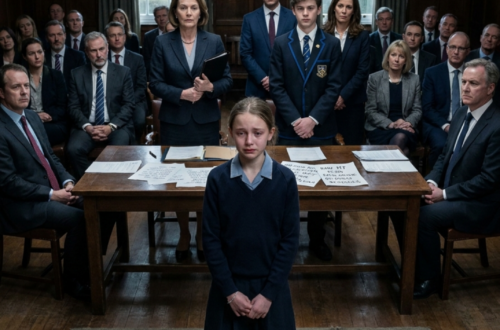
PART 1
The night everything happened, my father had asked for orange yogurt and then refused to eat it. That is one of the details I remember too clearly, maybe because it had nothing to do with Gate 17 and somehow still belongs to the story. He sat propped up in his hospital bed with a blanket folded over his knees, looking smaller than the man who used to lift crates of peaches at the market before sunrise. The room smelled of antiseptic, boiled vegetables, and the sweet chemical orange of the yogurt cup sitting unopened on his tray. Outside the window, cold rain streaked the glass until the city lights of Paris looked like they were melting.
“You work tonight?” he asked.
“Yes.”
“You look tired.”
“So do you.”
He smiled at that, but it cost him. His left hand trembled when he reached for the plastic spoon, and I pretended not to see because some dignities are built out of pretending. I had learned that in airport assistance work too. You do not stare when a passenger cannot fasten a shoe, or when a man who once traveled the world has to ask where the toilet is for the third time. You help, and you make the helping feel ordinary. At least, that was what I believed then.
I was twenty-seven and working temporary passenger assistance at Charles de Gaulle while paying what my father’s insurance did not cover. Temporary meant I wore the same uniform, pushed the same wheelchairs, answered the same radio calls, and absorbed the same insults as permanent staff, but with fewer protections and more reminders that I was lucky to be there. I kept spare hair ties wrapped around my ID badge because mine always snapped halfway through night shift. My shoes had a split in the left sole that let rain in if I stepped wrong. I knew which vending machine near the staff corridor gave two coffees if you hit the button hard enough, though both coffees tasted burned.
Airports are built to move people forward. That sounds obvious until you work inside one. Everything pushes in one direction: belts, arrows, announcements, schedules, boarding groups, tired families dragging children by the wrist, business passengers checking watches as if time were a servant failing them personally. The whole place is designed to make stopping feel like a mistake. Years later, that is what I understand best. At Charles de Gaulle, one person saying wait could seem more threatening than a hundred people rushing.
My shift began at 22:00. The terminal windows were black except where rain caught the light and ran down in silver lines. Rolling suitcase wheels hissed and clattered across the floor. Boarding announcements echoed overhead in French, English, and then French again, each one calm enough to make panic seem unreasonable. In the assistance office, the air smelled of disinfectant from wheelchair handles and burned coffee from the machine Luc Renard insisted was “still perfectly functional,” though it had been murdering coffee for at least two years.
Luc was my shift supervisor. Forty-four, square-shouldered, always clean-shaven even at three in the morning, with the weary politeness of a man who had learned to make pressure look like professionalism. He had trained me during my first week. He knew the shortcuts between terminals, which gate agents panicked early, and which airline managers would blame assistance staff before admitting their own delays. I liked him once, or at least trusted him. Those are not the same thing, but night work blurs categories.
“You’re on mobility transfers and medical assist overflow,” he said, handing me the tablet. “And try not to start a war with gate staff tonight.”
“I never start wars.”
He looked at me over his glasses. “You negotiate like a customs officer.”
“I notice things.”
“That is what worries me.”
He said it lightly, and I took it lightly. Come to think of it, he had already been warned about the numbers that night. The airline at Gate 17 was running late. Premium connections were tight. There was an operations manager in the terminal who hated visible delay. But at the time, it was only another wet night full of tired people and small emergencies.
Margaret Ellis arrived just after midnight from a hospital transfer desk, pushed by a contracted medical transport worker who looked relieved to hand her over. She was eighty-one, British, traveling to Manchester through a late service that had already been delayed once. She wore a pale blue cardigan under a coat too thin for the weather, and her gray hair had flattened on one side where she must have slept against something. Her hands trembled so badly that when she tried to hold out her passport, it tapped against the metal arm of the wheelchair.
“Mrs. Ellis?” I asked.
She looked at me, then past me. “Is this the ward?”
“No, madame. You’re at the airport.”
“My son is waiting.”
“We’ll help you with the flight.”
“No,” she said, frowning. “That is not the paper they gave me.”
I thought she meant her boarding pass. Elderly passengers often distrusted documents after long hospital discharges and transfers. People imagine airports as places of adventure, but for the old and ill they can feel like being passed between strangers who know only one piece of you at a time. I crouched beside her wheelchair so she did not have to look up.
“What paper, Mrs. Ellis?”
She touched the plastic band around her wrist. It was a hospital bracelet, still printed with a barcode, her name, date of birth, and a red alert symbol. Her finger worried the edge of it again and again. “They said someone must check.”
The assistance file clipped to the wheelchair listed her as Margaret Ellis, mobility support, fit to fly, escort to Gate 17, priority boarding. It said mild tremor, no cognitive concern, family informed. The bracelet said Margaret Anne Ellis, medical review required before travel, confusion post-discharge, medication discrepancy. The date matched. The hospital code matched the one on her discharge envelope. The clearance did not.
I remember the fluorescent lights above us better than the exact words I said then. They were too white, too steady, making every face look tired and slightly unreal. I asked the transport worker where the discharge summary was. He shrugged and said he only drove the van. I called the medical holding room. No one answered. I radioed Luc.
“Control, this is Elena at assist intake. I have passenger Ellis, Gate 17, bracelet indicates medical review required. File says fit to fly. Need clarification.”
Luc answered after a pause. “Bring her to seventeen. Gate wants eyes on passenger.”
“Negative. I need medical confirmation first.”
“Elena, do not make this personal.”
That sentence annoyed me before it frightened me. “A bracelet is not personal.”
“Move her to Gate 17. Claire is already dealing with it.”
Claire Duvall was the airline operations manager on duty that night. I had seen her only a few times before, always in motion, always carrying a phone, always speaking in the polished voice people use when they want bad news to sound like weather. She was thirty-nine, efficient, expensive-looking without being flashy. Her public face was passenger dignity and brand protection. If a delay reached passengers, she looked concerned. If a delay threatened metrics, she looked sharper.
I brought Margaret toward Gate 17 because I thought getting her near the gate would force the right people to look at her. That was my mistake, or one of them. I should have kept her in the assistance office until medical answered. But the radio was loud, the tablet was updating, two other passengers were waiting for transfer, and Margaret kept asking whether her son knew she was coming. I told myself I could stop at the gate desk and make the discrepancy impossible to ignore.
The terminal was colder near the windows. Rain ran down the glass before dawn, and beyond it the aircraft lights blinked red and green in the dark. Margaret kept touching her bracelet. “That is not the paper,” she said again.
“I know,” I told her. “I’m checking.”
“You won’t leave me?”
“No.”
She relaxed for maybe three seconds.
Gate 17 was already tense. A line had formed near the boarding desk. A wealthy-looking passenger in a dark coat stood just outside the priority lane, phone in one hand, leather carry-on beside him. I later learned his name was Adrian Vale, though to me he was simply the man who filmed too late. A gate agent glanced at Margaret, then at me, with the flat look of someone calculating delay in human units.
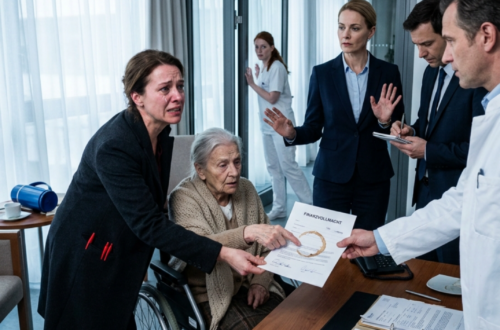
Claire was behind the desk with Luc beside her. She held a printed assistance form, the same version as the one clipped to Margaret’s chair. “There you are,” she said. “Mrs. Ellis, we’re going to get you boarded comfortably.”
Margaret’s hands tightened on the wheelchair blanket. “Hospital.”
I turned the chair slightly away from the boarding lane. “Her bracelet says medical review required.”
Claire’s smile did not move. “The official file says fit to fly.”
“The hospital bracelet says otherwise.”
“Elena,” Luc said quietly, “step aside.”
“No. Not until medical confirms.”
The gate agent announced pre-boarding for passengers requiring assistance. The words echoed overhead, clean and indifferent. Suitcase wheels rolled forward. Someone sighed loudly behind me. Margaret began to cry, not loudly, but with the frightened confusion of a person who knows she is being moved faster than she can understand.
“Please,” she said. “I don’t know where I am.”
Claire leaned closer. “Mrs. Ellis, your family is expecting you.”
“She is not going anywhere,” I said.
That was the sentence they used later. Cut from everything before it, stripped of the bracelet, the radio call, Margaret asking for the hospital, my own fear, it sounded cruel. It sounded like ownership. I hear it now and still wish I had chosen different words. At the time, I gripped the wheelchair handles because Luc had put his hand on one side as if to steer her forward, and I panicked. Not loudly, not dramatically. My body simply decided that if I let go, someone vulnerable would be pushed past the point where I could help.
Margaret sobbed. Someone said, “Are you serious?” Another passenger muttered about missing connections. Adrian Vale lifted his phone. He did not film my first call for medical. He did not film Margaret touching the bracelet and saying the paper was wrong. He filmed me with both hands on the wheelchair, Luc standing beside me with controlled concern, Claire speaking softly, and Margaret crying.
“Elena,” Luc said, louder now for the crowd, “you are distressing the passenger.”
“I am asking for a medical review.”
“She has clearance.”
“Show me who changed it.”
Claire’s face changed then. Not much. A blink, a tightening around the mouth. “That is enough.”
Security was called, though they did not remove me. Medical holding finally answered eighteen minutes later. No, I think it was twenty-two minutes. Actually, the flight was delayed twenty-four minutes from scheduled boarding, but the medical call came earlier than that. Those numbers mattered later, and for a while I carried them like stones in my pockets. What mattered in the moment was that Margaret was taken away from the boarding lane, trembling, while passengers watched me as if I had dragged her from the plane myself.
I wrote my statement in the assistance office at 02:41, hands smelling of disinfectant from the wheelchair grips. I wrote that the hospital bracelet did not match the assistance file. I wrote that Margaret appeared confused. I wrote that I requested medical review before boarding. Luc stood in the doorway for part of it, arms folded.
“Keep it factual,” he said.
“It is factual.”
“Do not speculate.”
“I’m not.”
“And do not accuse airline operations.”
I looked up. “Did Claire change the file?”
His eyes went flat. “You are tired. Finish the statement.”
By 06:00, my phone had started vibrating. I ignored it at first because phones always vibrate after airport incidents: shift messages, schedule changes, someone asking whether you took the spare blanket key. Then Youssef Benali from baggage services appeared at the assistance office door holding his phone like it had burned him. Youssef worked nights too, moving lost luggage through the hidden veins of the airport. He was quiet, funny when almost no one was listening, and knew more about airport systems than managers realized.
“Elena,” he said. “Have you seen it?”
The video was twenty-seven seconds long. It had already been shared thousands of times. The caption said an airport worker had humiliated a disabled elderly woman and refused to let her board a final flight to see her dying son. In the clip, I looked severe, almost angry. Margaret cried. Luc looked like the reasonable adult in the room. Claire appeared only briefly, one hand raised in calm intervention. My sentence landed at the center of the video like a verdict.
She is not going anywhere.
I watched it once. Then again. On the second viewing, I noticed what was missing. The beginning. The bracelet. My request. Margaret’s own words. The first thirty-six seconds, at least, were gone.
Before I could finish my statement, Luc called me into the small office behind dispatch. The coffee machine clicked behind us, burning another pot into bitterness. Cold rain streaked the terminal windows beyond the blinds.
“You are suspended pending investigation,” he said.
I stared at him. “You know why I stopped her.”
“I know what the video shows.”
“You were there.”
He looked tired. Not guilty, not yet. Tired. That made me angrier. “Go home, Elena.”
“I followed safety procedure.”
“You caused a public incident with a vulnerable passenger. Go home before this gets worse.”
I walked out through the staff corridor with my ID badge turned backward and my spare hair ties bouncing against the plastic clip. The airport kept moving around me. Boarding announcements, suitcase wheels, coffee cups, children crying, business passengers typing. Nobody stopped. Airports are built that way. Even when someone has been crushed inside the machinery, the machinery continues forward.
PART 2
By the time I reached my flat, the video had reached people I had not spoken to since school. I lived in a small studio above a pharmacy in Saint-Denis, with a radiator that clanged when it heated and a window that looked onto bins and a bakery delivery entrance. My work shoes left wet marks on the floor. I remember standing in the middle of the room still wearing my coat, scrolling through comments until the words lost their edges. Monster. Power trip. Fire her. Imagine doing this to someone’s mother. I put the phone facedown, then picked it up again thirty seconds later because shame is not logical.
The company statement came out at 09:12. I know because I had been trying to sleep and could not. It said the service provider had suspended the employee involved, that passenger dignity was its highest priority, and that internal review showed “failure to follow established boarding support protocols.” They did not use my name, but everyone in the terminal knew. By noon, someone had found my profile photo from a staff charity run and posted it with my full name.
My mother called at 09:30. I almost did not answer.
“Elena,” she said. “What have you done?”
Not “what happened.” Not “are you all right.” What have you done.
There are old wounds that do not reopen because they never closed properly. My younger brother, Thomas, died when I was sixteen. Asthma attack, summer evening, ambulance delayed. I was the one home with him. I did not find his inhaler fast enough. That is the official version in my own head, though doctors told us later it may not have changed the outcome. My mother did not care for may not. Grief needed a place to stand, and it stood on me.
“I tried to stop someone from being put on a flight unsafely,” I said.
“Then why is everyone saying you hurt that woman?”
“Because they didn’t show everything.”
She sighed, and I could see her in my mind, one hand pressed to her forehead, still wearing the same gold cross she touched whenever I disappointed her. “You always become stubborn at the wrong moment.”
I hung up before I said something unforgivable. Then I cried in the shower, quietly, because the walls were thin and the man downstairs complained about noise after ten.
Luc’s incident report arrived by email that afternoon. It described me as emotionally agitated, resistant to instruction, and physically obstructive. It said I ignored documented fit-to-fly clearance and caused distress to Mrs. Ellis. It said I had “a pattern of challenging supervisor decisions during high-pressure boarding windows.” That last part was cruel because it was built from small truths. I had challenged rushed transfers. I had asked for missing documents. I had argued when passengers were treated like luggage with pulses. Luc turned that into a flaw.
Two coworkers gave statements saying I seemed upset before the incident. One said I had mentioned my father’s hospitalization and “appeared distracted.” Another said I had raised my voice at Gate 17. Both statements were not false exactly, and that was what made them useful. I had been tired. I had raised my voice. I had gripped the wheelchair handles in public. If you arrange real details in the wrong order, you can make care look like violence.
Margaret’s family found me on the second day. Her granddaughter, Sophie Ellis, sent a message through my public account before I made it private. She wrote that her grandmother had missed the flight to see her son before he died early the next morning. She wrote that I had taken away their last chance. She wrote, “I hope you think about his empty room every time you put on that uniform.”
I read that message sitting beside my father’s hospital bed. He had finally opened the orange yogurt and eaten two spoonfuls before pushing it away. The room smelled of disinfectant and warm plastic from the meal trays. A television somewhere down the corridor played a quiz show too loudly. I should have put the phone down, but I read Sophie’s message three times.
“What is it?” my father asked.
“Nothing.”
He looked at me for a long moment. “You say nothing like your mother.”
That almost made me smile.
I did think about Margaret’s son. Of course I did. I thought about him dying while his mother sat in a medical holding room confused and frightened. I thought about Margaret asking whether her son was waiting. I thought about my own brother gasping on the floor while I searched the wrong drawer first. Guilt does not care whether blame is fair. It only asks where it can attach.
For two days, I believed I might have done the right thing badly enough that it no longer mattered. That was the worst part. I knew the bracelet had been wrong. I knew Margaret had needed review. But I had also scared her. I had gripped the chair. I had spoken harshly in a public place where dignity is already fragile. The internet called me cruel, and some hidden court inside me did not fully acquit me.
Then I remembered the file.
At Gate 17, Claire had held a printed assistance form that said fit to fly. My tablet at intake had initially loaded a different icon beside Margaret’s name. I had not understood it until later. It was a small amber triangle, used for exceptions requiring confirmation. When I reopened the cached shift list from my personal notes, the 00:17 assistance overview showed Margaret Ellis as requires medical review. The screenshot I had taken automatically for handover showed it. At 00:34, the file in the official packet said fit to fly.
I was suspended, but my access had not yet been fully cut. That was their mistake. Temporary workers are often removed quickly from schedules but slowly from systems because no one thinks we understand enough to be dangerous. I could not alter anything, but I could still view my own completed assignments for forty-eight hours. I logged in with shaking hands.
The status change appeared at 00:31.
Three minutes after Claire Duvall entered dispatch.
The entry did not show her name, only an operations override code. But the dispatch room door logs, visible on the staff movement board for supervisors and accidentally still cached in my tablet, showed Claire’s badge entering at 00:28 and leaving at 00:33. Margaret’s status changed in the middle.
I sat on my bed in my damp flat with rain ticking against the window, and shame became suspicion so quickly it felt like standing up too fast.
I called Luc. He did not answer. I called again.
“Elena,” he said finally, voice low. “Do not contact me directly.”
“You knew the file changed.”
“You need to let the process work.”
“Who changed it?”
“The official record is clear.”
“It was clear after Claire entered dispatch.”
Silence.
“Luc.”
“You are making this worse for yourself.”
“No. Someone made it worse for Margaret.”
His voice hardened. “You are suspended. Stop accessing internal systems.”
That told me enough.
Youssef met me after his shift in the airport car park, under a concrete overhang where rainwater dripped in regular beats from a crack above us. He brought two coffees from a machine that burned them even worse than ours. He handed one to me and said, “You look like you have slept in a luggage bin.”
“Thank you.”
“It was not a compliment.”
Youssef had worked baggage for eight years and knew where systems overlapped: gate logs, assistance dispatch, radio channels, transfer scans, incident uploads. “Airports record everything,” he said. “Mostly so everyone can blame everyone else later.”
“I need the status change.”
“You have it?”
“A screenshot. Maybe enough to get fired permanently.”
“You are already suspended.”
“That is comforting.”
He did not smile. “Elena, they will say you accessed data without authorization.”
“I accessed my own shift.”
“They will not care.”
“I need radio audio.”
“That is harder.”
“But it exists.”
He looked across the car park at the gray morning beyond the overhang. A shuttle bus hissed past, brakes sighing. “Everything exists for a while. Then it becomes expensive to find.”
He explained that radio channels were archived by incident category and time block. If a medical concern was raised, there should be a channel tag. If Claire spoke on operations radio, there would be a separate log. Gate footage would be retained, but passenger video was trickier. The viral clip’s metadata might show it had been trimmed before upload, but only the original phone file would prove the missing seconds.
“Adrian Vale,” I said. “The passenger who filmed.”
Youssef raised an eyebrow. “You know his name?”
“Internet people found me. I can find him.”
“That is not how we make legal strategies.”
“I don’t have a legal strategy. I have a father’s yogurt and half a paycheck.”
He sighed. “Start with Margaret’s family. They hate you, but they have the bracelet. If the hospital code proves review required, that matters.”
The thought of contacting Sophie Ellis made my stomach twist. Her message still sat in my phone like a bruise. But Youssef was right. The bracelet was the one object no corporate statement could smooth over. It had been on Margaret’s wrist before Claire touched any file. It had made Margaret afraid before I ever gripped the wheelchair.
I wrote Sophie six drafts and deleted five. The one I sent was short. I said I was sorry for her loss. I said I understood why she hated what she had seen. I said the video did not show that her grandmother’s hospital bracelet contradicted the flight clearance. I asked only whether the family still had the bracelet or discharge papers.
She replied the next morning.
Do not use my grandmother to excuse yourself.
I put the phone down and pressed both hands over my face. The radiator in my flat clicked. A motorbike coughed outside. Ordinary life kept scraping along.
The first real crack in the public story came not from Sophie, but from Claire herself. She gave a television statement outside the terminal, wearing a dark coat and controlled concern. She said Margaret’s dignity had been violated by an employee who “never raised a documented medical discrepancy before creating a distressing scene.” She said the bracelet had not been mentioned in any operational exchange before boarding.
I watched the clip in my father’s hospital room. He was asleep, orange yogurt untouched beside him. Claire looked straight into the camera and lied with the calm of someone used to being believed.
Never mentioned the bracelet.
I had mentioned it on radio at intake. Luc had heard me. Claire had been “already dealing with it,” according to Luc. If the radio audio still existed, Claire had just put her lie on record.
I called Youssef.
He answered with, “You saw it.”
“She said I never mentioned the bracelet.”
“I know.”
“Can radio logs be requested?”
“By an employee? No. By a lawyer, maybe. By an inquiry, yes.”
“I don’t have an inquiry.”
“Not yet,” he said.
That night, I opened the viral video again. I watched it not as humiliation, but as evidence. The clip began too abruptly, with Margaret already crying and my hands already on the chair. The first sound was a passenger saying, “This is unbelievable.” Adrian Vale had not started filming naturally. Or he had started earlier and cut away the part where the story became inconvenient.
At 02:00, unable to sleep, I searched his public profile. Business consultant. Frequent traveler. Premium loyalty member. He had posted a smug comment under his own video about “accountability in customer-facing roles.” Then, in the replies, someone asked why he had not filmed the beginning.
His answer was simple.
I filmed when staff told me this had become unacceptable.
Staff told me.
I leaned back in the chair and listened to the rain on the window. Luc’s report had made me the problem. Claire’s statement had erased the bracelet. Adrian’s video had started after someone told him to film. Margaret’s status changed after Claire entered dispatch.
For the first time since Gate 17, I did not feel only accused. I felt hunted. And if they had hunted me, that meant there was something behind me they were trying very hard to keep hidden.
PART 3
Youssef found the first audio reference through a friend in ground coordination who owed him a favor from a lost guitar case. He did not bring me the recording. He was careful that way, and probably smarter than I was. He brought a handwritten time range and a channel number on the back of a receipt from a kebab shop near Terminal 2. The paper smelled faintly of onions and smoke.
“Ops channel three,” he said. “Between 00:24 and 00:36. There is a tagged exchange.”
“Tagged how?”
“Medical exception cleared.”
I looked at him. “Cleared by who?”
He shook his head. “Don’t ask me to have things I should not have.”
We were sitting in a bus shelter outside the airport because my suspension made staff cafés unsafe and his break was short. Cold rain blew under the shelter roof and darkened the knees of my trousers. A boarding announcement drifted faintly from a terminal entrance whenever the sliding doors opened. Even outside, the airport sounded like a place giving instructions.
I sent a formal request for all evidence used in my suspension, including radio exchanges and original assistance logs. The company replied that internal records were confidential during investigation. I sent another request through a union adviser I barely knew because temporary staff rarely joined until something terrible happened. The adviser, a woman named Nadège, read my documents with a pen between her teeth and said, “They are counting on you being too ashamed to become administrative.”
“I can become administrative.”
“You will need to become very boring,” she said. “Boring is how records open.”
Boring meant dates, times, requests, copies, no angry adjectives. It meant asking for the original passenger assistance list before operational override. It meant requesting the full incident video chain, not “the video.” It meant writing “please preserve” in sentences where I wanted to write “please stop lying.” It meant not posting online, not defending myself in comment threads, not telling strangers that they had seen twenty-seven seconds of a night I would carry for years.
The internet did not reward my restraint. Another clip appeared from a different angle, shorter and worse. In that one, Margaret cried, “I don’t know where I am,” and I said, “Stop moving the chair.” It looked awful. It was awful, in the sense that no vulnerable woman should have been crying under fluorescent lights while strangers recorded her. But the clip did not show Luc trying to angle her toward the boarding lane. It did not show my hand blocking his, not hers. A lie does not always invent. Sometimes it crops.
Margaret’s granddaughter Sophie sent another message after Claire’s television statement. This one was shorter.
What bracelet?
I stared at it for a long time before answering. Then I sent only one line: The white hospital band on her left wrist, with the red alert mark.
Three hours later, Sophie wrote: Send me exactly what you remember.
So I did. I wrote everything, from the first time Margaret touched the bracelet to the words “medical review required,” to the mismatch between the printed assistance form and the hospital code. I admitted that I had held the wheelchair handles and that my sentence sounded harsh. I wrote that I was sorry Margaret cried, but I believed she was crying because she was frightened of being boarded while confused, not because I wanted to shame her. I did not ask Sophie to forgive me. I asked her to check the discharge envelope.
She did not reply for two days.
Those two days were some of the longest of my life. My father had a fever. My mother came to the hospital and sat on the other side of his bed without looking at me. I bought the orange yogurt again because he asked, and again he did not finish it. At one point he woke and found me staring at my phone.
“Work?” he asked.
“Work disaster.”
“Ah,” he said. “The airport eats people.”
I laughed because he had never worked in an airport and was still somehow right.
When Sophie finally replied, she sent a photograph. Margaret’s hospital bracelet lay on a kitchen table beside a discharge instruction sheet. The name and date matched. The alert code matched. The instruction said medical review before commercial flight if confusion persists. Sophie wrote: The airline file they sent us says no cognitive concern. Why?
I typed several answers and deleted them. In the end I wrote: That is what I am trying to find out.
Sophie became useful before she became kind. That distinction mattered. She contacted the hospital and confirmed that Margaret had not been cleared for travel without review. She requested records as next of kin. She also found a voicemail from the airline’s customer team, left before the viral video spread, saying there had been “a documentation discrepancy at boarding.” After the video went viral, the language changed to “staff misconduct.” Companies have moods, and those moods leave tracks.
Nadège helped me file a formal complaint with the airport contractor and a regulator. Priya, no, that was not her name in this story. It was Camille Rousseau, an investigative reporter at a French transport publication, contacted me after Sophie posted publicly that the family had questions about the official account. Camille was not interested in making me heroic. I appreciated that. Hero stories are dangerous when you have, in fact, made mistakes.
She asked, “Why did you grip the chair?”
“Because Luc was moving it.”
“Can you prove that?”
“Not from the viral angle.”
“Then we need another angle.”
The airport had gate CCTV, but the company would not release it voluntarily. Adrian Vale, however, had the original phone video. Camille messaged him. He refused. Sophie messaged him. He sent condolences and refused. Then Camille found something in his own post: the video file uploaded to his business page had creation metadata showing it was exported from an editing app twelve minutes after the incident, not uploaded directly from the phone. It did not prove what was cut, but it proved editing.
Adrian claimed he trimmed dead time.
“What dead time?” Camille asked publicly.
He blocked her.
Luc called me once during this period from a private number. I was in the supermarket comparing prices on tinned soup when my phone rang. The aisle smelled of cardboard, floor cleaner, and ripe fruit from the next section.
“You need to stop,” he said.
I gripped the shopping basket. “Hello, Luc.”
“They will ruin you.”
“They already tried.”
“You think Claire will take the fall? You don’t understand how these contracts work.”
“Then explain them.”
He breathed heavily through his nose. For a moment, I heard not a villain but a tired man who had missed too many dinners, too many school plays, too many ordinary chances to be decent. I remembered him on breaks, calling his teenage daughter and saying, “I’m sorry, ma puce, next time,” while rubbing his eyes with his thumb and forefinger.
“Margaret’s transfer was already a liability,” he said. “Hospital discharge unclear. Family pressure. Airline needed her moved. If we delayed and her son died before she got there, they blamed us. If we boarded and something happened, they blamed us. Claire wanted the file clean.”
“So she changed it.”
“I didn’t say that.”
“You didn’t have to.”
“Elena,” he said, and his voice cracked just slightly. “There are levels above us.”
“There are people below you too.”
He hung up.
I stood in the soup aisle until a woman with a pram asked if I was all right. I said yes because people say yes in supermarkets when they are absolutely not.
The radio audio came out through the regulator request, not through Youssef. It arrived as a transcript first, full of codes and clipped phrases. At 00:18, my voice: Passenger Ellis has bracelet indicating medical review required. Assistance file mismatch. Request holding. At 00:25, Luc: Ops, confirm Ellis file. At 00:29, Claire: Clear the exception. We are not creating a medical refusal at gate. At 00:31, system note: passenger status updated fit to fly. At 00:35, my voice again: I need medical confirmation. Bracelet still shows review. At 00:36, Claire: Elena, move passenger.
I read it in Nadège’s office while rain tapped against the narrow window. The room smelled of paper, coffee, and the damp wool of my coat. Nadège read it too, then looked up.
“This is good.”
“It is horrible.”
“Yes,” she said. “Good evidence is often horrible.”
The transcript did not solve everything. Claire could argue she meant clear the administrative exception because the official file supported travel. Luc could argue he believed operations had confirmed. Adrian’s edited video still lived online louder than any transcript. But Claire’s public statement had said I never mentioned the bracelet before boarding. The radio captured her acknowledging the bracelet before the boarding attempt. That contradiction had a pulse.
The uncut video chain came last. Not from Adrian’s conscience, which remained undisturbed as far as I know, but from a gate agent who had given one of the pressured statements against me. Her name was Manon. She was twenty-three, probationary, and had cried in the toilets after the incident. She contacted Nadège from a new email address and said she had heard Claire tell Adrian, “Film this if you want accountability,” after I refused to move. Manon also had a short internal clip from the gate desk monitor, recorded on her phone before the footage was restricted. It did not show everything, but it showed the thirty-six missing seconds from the side.
There I was, crouched beside Margaret, pointing to the bracelet. There was Margaret saying, “That is not the paper.” There was Claire looking at the wristband and saying, “We have the updated clearance.” There was Luc reaching for the wheelchair handle. There was me standing and blocking him. Then Adrian’s viral clip began.
I watched it only once that first day. My hands shook too badly after. I thought seeing proof would feel like release, but it felt more like grief. The truth had existed the whole time, small and ordinary, inside systems built to preserve liability, not mercy. It had been there while strangers called me cruel. It had been there while Margaret’s family hated me. It had been there while I wondered if I had failed another person who could not breathe inside the speed of the world.
Camille’s article published on a Thursday morning. Its headline asked whether the viral Gate 17 video had hidden a medical warning. It included the bracelet discrepancy, the status change timestamp, the radio transcript, the edited video metadata, and Manon’s partial clip. It did not call me a saint. It said I had acted forcefully and imperfectly after raising a legitimate medical concern. That was the fairest sentence anyone had written about me.
Claire gave another statement that afternoon. She said the company had acted based on the information available and that I had never clearly communicated the bracelet discrepancy through proper channels.
I was in my father’s hospital room when it aired. He was asleep. The orange yogurt sat unopened again. My phone buzzed with messages, but I heard only Claire’s voice.
Never clearly communicated.
I opened the radio transcript and read the line with the time stamp. Bracelet indicating medical review required. Assistance file mismatch.
For the first time, I did not feel the need to argue with the screen. She had contradicted herself in public, and the record was no longer only mine to carry.
PART 4
The inquiry took three months, which is important because public outrage moves quickly and repair moves like a tired person carrying heavy bags. During those months, the original video continued to appear in comment threads, stripped of corrections. People who had called me a monster did not line up to apologize. Some deleted posts. Some said they had only reacted to what they saw. Some insisted that even if I was technically right, I should have been nicer. I learned that people prefer a clean villain, and when denied one, they often blame the person who complicated their anger.
I did not return to work immediately. The company lifted my suspension after six weeks but placed me on administrative leave while the inquiry continued. That phrase sounded gentler than unemployment and paid less than dignity. My father’s bills did not pause out of respect for process. I took temporary cleaning work through a cousin of Youssef’s, mostly offices after hours. The irony was not lost on me: I had tried to protect a passenger and ended up emptying bins under desks belonging to people who probably watched viral videos during lunch.
Margaret Ellis survived the night at the airport. That detail became public later, though it did not undo the fact that her son died before she reached him. She was taken back for medical review and transferred the next day with a nurse escort arranged by the family, too late for the goodbye everyone wanted. There are losses no corrected timeline can repair. Sophie told me that once, not as accusation, but as fact.
She asked to meet me in a café near Gare du Nord. I arrived early and nearly left twice. The place smelled of coffee, butter, wet coats, and the sharp citrus cleaner someone had used on the tables. Sophie looked younger than her messages had sounded, maybe thirty, with red eyes and a scarf wrapped too tightly around her neck.
“I hated you,” she said after we sat.
“I know.”
“I needed someone to hate.”
“I know that too.”
She stirred her coffee without drinking it. “My dad asked for her at the end. That’s what they told me. He kept asking whether Mum was coming.”
I had no answer that would not insult the size of that grief.
“She remembers you,” Sophie said. “Not clearly. She says there was a girl with tired eyes who wouldn’t let the plane take her.”
I looked down at my hands. There was a small cut on one knuckle from cleaning work. “I frightened her.”
“Yes,” Sophie said. “You also stopped them.”
Both things could be true. I had spent months trying to make one truth erase the other, but it would not. Sophie reached into her bag and placed Margaret’s hospital bracelet on the table inside a clear plastic pouch. The red alert mark had faded a little. The barcode still showed.
“She wanted you to have a copy,” Sophie said. “Not the real one. We’re keeping that.”
I almost laughed, then almost cried. “Good.”
“She said you kept saying bracelet. She thought that was funny afterward. Like you were arguing with jewelry.”
That did make me laugh, once, badly. Sophie laughed too, and then covered her face. We sat there like that, two women joined by an airport gate, a dead son, a frightened mother, and a truth that had arrived too late to be clean.
Luc’s part in the inquiry was messy. He admitted he had downplayed my medical concern in his report but claimed he relied on Claire’s operational clearance. He said he had not understood the hospital bracelet code. That was possible. It was also convenient. He received a formal disciplinary sanction and was moved out of passenger assistance supervision. He did not lose everything. Few people do. The last I heard, he was working logistics planning, somewhere far from crying passengers and visible gates.
Claire resigned before the inquiry published its final findings. Her statement said she was stepping aside to avoid distracting from “the organization’s commitment to care.” Camille wrote a follow-up article noting that Claire had approved the file status change three minutes after entering dispatch and had later made public claims contradicted by radio audio. The airline lost part of its premium assistance contract during the review. New procedures were announced: dual confirmation for medical status overrides, protected escalation channels, automatic preservation of full gate video when passenger safety was disputed.
All of that mattered.
None of it removed my face from the internet.
The official correction came in a gray conference room with no windows. A contractor representative, an airline lawyer, a union adviser, Nadège, and I sat around a table with bottled water nobody opened. The company acknowledged that I had raised a legitimate medical discrepancy before the Gate 17 incident. They acknowledged that the viral clip did not reflect the full context. They withdrew the language about insubordination from my personnel file. They offered back pay, a role transfer, and what the lawyer called reputational support.
“Will you say publicly that I was scapegoated?” I asked.
The lawyer looked at the representative. The representative looked at the water bottle.
“We can say the initial statement was incomplete.”
“Incomplete,” I repeated.
Nadège touched her pen to the page in front of her. Not stopping me. Just reminding me to choose my next words.
I thought of my mother asking what I had done. I thought of my father’s unfinished yogurt. I thought of Thomas on the floor years earlier, the inhaler in the wrong drawer, my mother’s grief turning toward me because she could not bear it alone. I thought of Margaret touching her bracelet and saying, That is not the paper they gave me. Doing the right thing had not saved me from harm. But it had mattered. That was the difficult truth, less comforting than I wanted and stronger than I expected.
“Say it clearly,” I said. “Or I don’t sign.”
They did not say scapegoated. Lawyers live to protect certain words from daylight. But the final statement said I had acted after identifying a genuine medical documentation conflict, that the company’s initial response had unfairly characterized my conduct, and that records had been corrected. It was not enough. It was more than they wanted to give. Sometimes partial justice feels like drinking water from a cracked cup. You still drink.
My father saw the statement on television from his hospital bed. He had finally eaten half an orange yogurt that afternoon, which felt like a family event by then. He watched my name appear at the bottom of the screen and nodded once.
“You stopped,” he said.
“What?”
“At the airport. Everyone moving, and you stopped.”
I sat beside him. “I made a mess.”
“Maybe stopping is always messy.”
He fell asleep five minutes later. I stayed until visiting hours ended, listening to the machines and the soft rubber squeak of nurses’ shoes in the corridor. The hospital smelled the same as always: disinfectant, plastic, weak soup. For once, the smell did not make me feel trapped in the old story of Thomas. It made me think of people trying, imperfectly, to keep other people here.
I returned to the airport four months after Gate 17. Not to the same job. I accepted a position in passenger support auditing, which sounds more powerful than it is. Mostly I reviewed cases where assistance notes did not match medical flags, mobility requests, or boarding decisions. It was quieter work, less visible, and I missed parts of the old job in ways that surprised me. I missed helping someone find a daughter at arrivals. I missed the old man who brought chocolates every time he flew to Lisbon. I missed moving through the terminal at night when the floors shone and the whole place felt like a city pretending to sleep.
The first time I passed Gate 17 again, I stopped. The sign glowed above the desk. Passengers sat in rows, faces lit by phones. A child dragged a toy plane along the floor. Rain streaked the terminal windows beyond the glass, turning runway lights soft and distant. The air smelled of burned coffee and disinfectant from a nearby wheelchair bay.
My body remembered before my mind did. My hands tightened. I could hear Margaret crying, Luc saying my name, Claire’s calm voice, suitcase wheels rolling, strangers deciding who I was. I stood there long enough that a gate agent asked if I needed something.
“No,” I said. Then I corrected myself. “Yes. But not from you.”
I walked to the assistance desk and checked the overnight exception list. That became my habit afterward. Not obsessive, exactly, though maybe it was close. I checked names, codes, bracelets, discharge notes, mismatched initials. I annoyed managers. I delayed two boardings by eleven minutes each. I was called overcautious in three emails and thanked quietly in one. I kept the printed copy of Margaret’s bracelet code in my locker, folded inside a clear sleeve.
My mother never apologized for the first call. We are not a family that produces apologies easily. But one Sunday she came to the hospital with a bag of clean laundry for my father and placed her hand on my shoulder before leaving. It stayed there for three seconds, maybe four. I could be wrong. I remember wanting more and being grateful anyway. Families, like institutions, often correct themselves incompletely.
Margaret sent me a card through Sophie at Christmas. Her handwriting wandered downhill across the page. It said: Dear Elena, I remember the lights and being afraid. I remember you said wait. Thank you for waiting.
I kept that card in my kitchen drawer beside spare batteries, old receipts, and the hair ties I no longer needed on my badge. Ordinary places are where important things survive best, I think. Not framed. Not polished. Just kept within reach.
The internet never fully apologized. Adrian Vale deleted the original video months later and posted a statement about the danger of incomplete context, which did not mention that he had created the incomplete context. People praised him for taking responsibility. I laughed when I saw that, not because it was funny, but because the body sometimes chooses the wrong sound.
Still, the next time a passenger assistance worker stopped boarding over a medical discrepancy, no one told her to move along and stop making it personal. The system required a second review. The flight left late. The passenger stayed overnight and traveled safely the next day. I know because I read the case file. The worker had written in her note: Passenger kept touching hospital bracelet and seemed confused.
I sat at my desk for a long time after reading that. Outside the audit office, boarding announcements echoed over the roll of suitcase wheels. The airport moved forward because that is what airports do. But somewhere inside it, for once, one person had been allowed to stop.
Months later, near dawn, I was crossing the terminal after a long shift when I heard a call for Gate 17. Cold rain streaked the windows, just like that night. A wheelchair waited near the assistance point, its handles wiped clean, the disinfectant smell sharp in the air. An elderly man sat in it, staring at a document in his lap, while a young staff member checked his wristband against the file.
She looked uncertain. A supervisor was already waving from the gate.
I could have kept walking. My new role did not require me to step in unless asked. My coffee had gone cold in my hand. My father had an appointment that afternoon, and I still needed to buy his orange yogurt, the one he would request and probably not finish.
Instead I stopped.
The boarding announcement continued overhead, smooth and calm, urging passengers forward. I walked toward the wheelchair, not quickly, not dramatically, just close enough to see whether the paper matched the person. The young worker glanced at me, nervous, and I smiled in the small tired way people smile at airports when they understand that moving is not always the same as caring.
“Take your time,” I told her.
Behind us, Gate 17 waited. Ahead of us, the whole airport wanted to move. For once, I did not apologize for standing still.