A full border does not have to mean a high-maintenance border. Many gardeners make the same mistake in the beginning: they pack beds with demanding plants that need constant staking, dividing, watering, deadheading, and replacing. The result may look impressive for a few weeks, but it often becomes exhausting by midsummer.
A better approach is to build your border around plants that naturally carry their weight. The best low-maintenance border plants fill space well, return reliably, hold their shape, and still bring texture, flowers, or structure across the season. They do not ask for daily rescue. They reward steady, sensible care.
If your goal is a garden that feels generous without becoming a burden, these 11 plants are some of the smartest choices you can grow.
What makes a border plant truly low maintenance?
A good low-maintenance border plant usually does at least three things well. It covers space attractively. It handles normal weather swings without collapsing. And it still looks good even when you cannot fuss over it every day.
That means the most useful plants often share these traits:
- strong root systems
- dependable return each year
- good drought tolerance after establishment
- long seasonal interest through flowers, foliage, or seed heads
- resistance to common pests and disease problems
The goal is not a border that needs no work at all. The goal is a border where your effort goes into improvement, not constant repair.
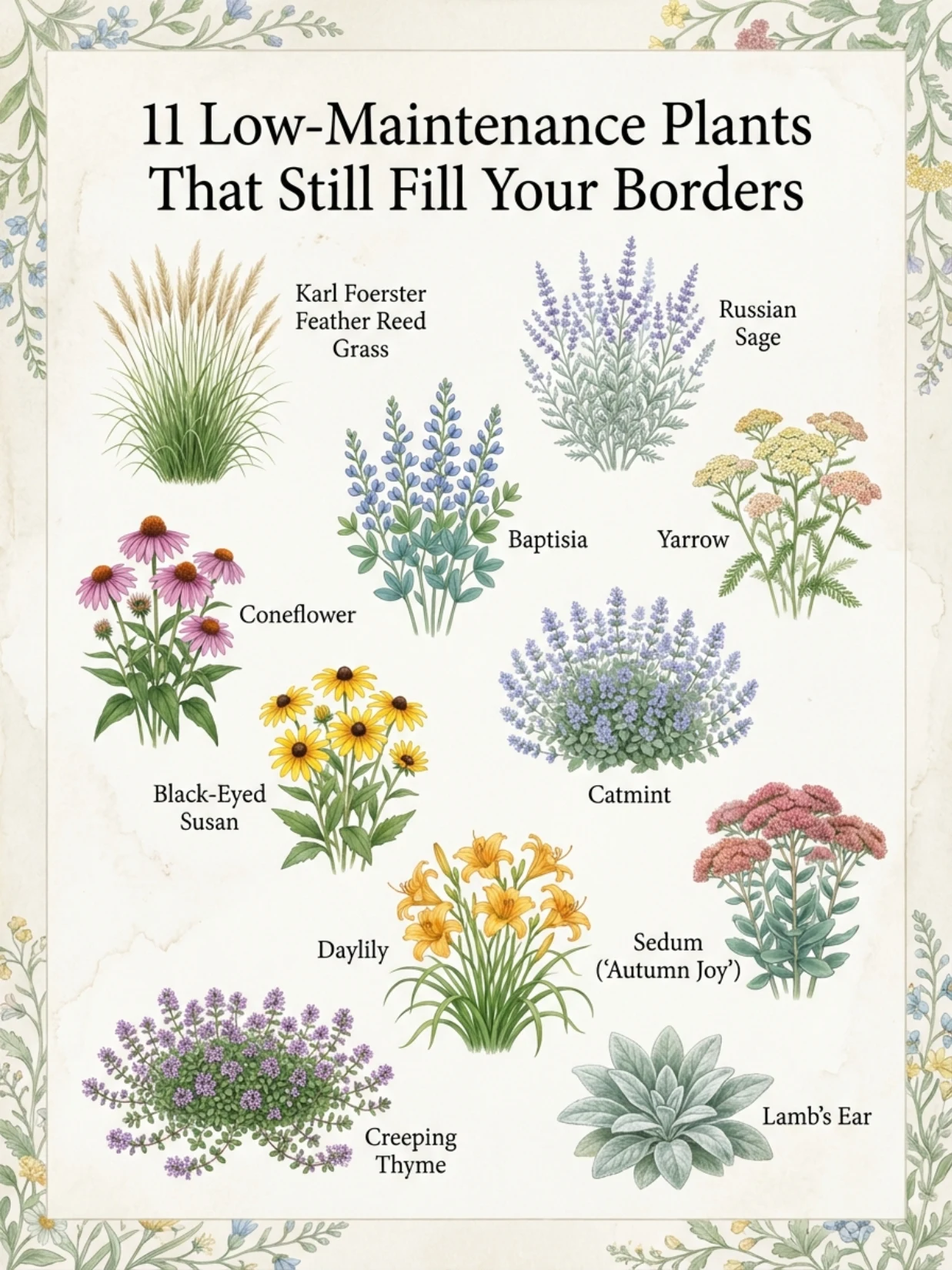
1. Karl Foerster Feather Reed Grass: vertical structure without the mess
If a border feels flat, this grass solves the problem quickly. Karl Foerster feather reed grass brings strong upright lines, movement, and seasonal structure without spreading aggressively in most gardens. It is one of the easiest ways to give a planting backbone.
Why it works so well
Its narrow footprint makes it useful even in tighter spaces, and the vertical plumes help anchor looser flowers nearby.
Practical care tip
Cut it back in late winter or very early spring before new growth starts. Do not wait too long, or you will be trimming through fresh blades.
Best role in the border
Use it at the back or mid-back of the border where you need height that stays tidy.
2. Russian Sage: airy bloom and drought resilience
Russian sage is one of the best plants for gardeners who want softness without weakness. It creates a cloud of lavender-blue color, handles heat well once established, and blends beautifully with stronger shapes like coneflowers and yarrow.
Why it earns its place
It gives long-lasting color and movement while asking for surprisingly little in return.
Practical care tip
Plant it in full sun and well-drained soil. Too much moisture or heavy, soggy ground is where this plant usually struggles.
Best role in the border
Use it where you want a hazy, pollinator-friendly layer that lightens heavier planting.
3. Baptisia: the long-lived anchor plant
Baptisia is one of the most dependable perennials for sunny borders. It develops strong roots, forms a handsome mound, and brings elegant flower spikes in season. After blooming, its shape still holds the border together.
Why it is so valuable
It behaves like a structural plant, not just a seasonal flower.
Practical care tip
Give it permanent space. Baptisia does not enjoy being moved once mature, but it becomes more impressive with time.
Best role in the border
Place it where you want a long-term anchor between softer or shorter plants.
4. Yarrow: flat-topped flowers that keep the border bright
Yarrow is one of those plants that quietly does everything well. It blooms generously, tolerates dryness after establishment, and adds a useful flower shape that contrasts with spikes and mounds.
Why gardeners keep returning to it
Its ferny foliage and broad flower heads make a border look layered and lively.
Practical care tip
Do not overfeed. Rich soil often makes yarrow taller and floppier than it needs to be.
Best role in the border
Use it in sunny mid-border positions with grasses, salvias, or black-eyed Susans.
5. Coneflower: dependable color with strong pollinator value
Coneflower is a workhorse perennial. It handles summer conditions well, returns reliably, and keeps flowering through heat when many other plants start slowing down.
Why it belongs in a low-maintenance border
Its sturdy stems and long bloom window make it productive without being needy.
Practical care tip
Leave some seed heads standing at the end of the season. They add winter interest and feed birds, which increases the border’s value beyond flowers alone.
Best role in the border
Use it in sunny beds where you want upright color and pollinator activity.
6. Black-Eyed Susan: easy brightness that fills gaps fast
Black-eyed Susan is one of the easiest plants for bringing cheerful, golden color into a border. It flowers heavily, pairs well with many other perennials, and gives a relaxed, generous look without becoming difficult.
Why it works
It creates a strong visual lift in midsummer and late summer when the border needs energy.
Practical care tip
Divide older clumps if flowering weakens or the center becomes thin. This simple reset keeps it vigorous.
Best role in the border
Plant it in sunny drifts where you want warmth and repetition.
7. Catmint: the quiet border hero
Catmint is one of the smartest filler plants in perennial design. It forms soft mounds, flowers for a long time, tolerates dry spells, and pairs beautifully with roses, salvias, and daisies.
Why it is so useful
It covers space, suppresses weeds, and softens the front or middle of the border with almost no drama.
Practical care tip
After the first heavy flush of bloom, shear it back lightly. This often brings a second wave and keeps the plant neat instead of sprawling.
Best role in the border
Use it near the front or middle where its soft shape can spill gently around stronger vertical plants.
8. Daylily: bold clumps that need very little fuss
Daylilies are classic low-maintenance border plants for a reason. They tolerate a wide range of conditions, fill space quickly, and return year after year with very little intervention.
Why they remain so popular
Their strappy foliage gives structure even before flowering, and the clumps help the border look established.
Practical care tip
Divide only when needed, usually when flowering drops or the clump becomes too crowded. There is no need to disturb healthy plants too often.
Best role in the border
Use them in sunny or lightly shaded borders where you need a reliable mid-height mass.
9. Sedum ‘Autumn Joy’: strong structure into late season
Sedum ‘Autumn Joy’ is one of the best plants for carrying the border into late summer and autumn. Its succulent leaves hold a clean shape early, and the flower heads build gradually before deepening in color.
Why it stands out
It looks good for a very long stretch of the season, not just at peak bloom.
Practical care tip
Keep it in full sun and avoid overly rich soil. Too much fertility can make stems lean or flop.
Best role in the border
Use it in the middle or front-middle of sunny borders where you want structure and late color.
10. Creeping Thyme: living mulch with beauty built in
Creeping thyme is one of the best border-edge plants for low-maintenance gardeners. It stays low, softens paving and stone, helps cover bare soil, and adds a gentle haze of flower when in bloom.
Why it matters in a border
The front edge of a border is often where things look patchy first. Creeping thyme helps solve that elegantly.
Practical care tip
Give it sharp drainage and plenty of sun. It performs best in leaner conditions than many people expect.
Best role in the border
Plant it along paths, border edges, or in sunny gaps where you want a tidy ground layer.
11. Lamb’s Ear: soft foliage that brightens the planting
Lamb’s ear is valuable because not every low-maintenance border needs another flower. Sometimes what a planting really needs is texture and contrast. Its silvery, velvety leaves brighten the border and pair especially well with pinks, purples, and blues.
Why it earns a spot
It adds foliage interest for a long season and makes neighboring blooms stand out more clearly.
Practical care tip
Avoid overly wet soil and keep the center from getting too congested. In humid conditions, good airflow helps it stay attractive longer.
Best role in the border
Use it near the front where the foliage texture can be seen and appreciated.
How to combine these plants into a border that stays full
A low-maintenance border works best when it is layered by function, not just flower color.
Use vertical structure first
Start with plants like Karl Foerster grass, Russian sage, and baptisia. These give the border height and backbone.
Add strong flowering masses
Build the middle layer with coneflower, black-eyed Susan, daylily, yarrow, and sedum. These carry the main seasonal interest.
Finish with soft front-edge plants
Use catmint, creeping thyme, and lamb’s ear to soften the base, cover soil, and reduce that patchy look many borders develop.
This simple structure makes the bed feel abundant while staying readable and manageable.
Practical care habits that keep the border looking good
Water deeply during establishment
Even drought-tolerant plants need help in their first season. Deep watering early builds roots that can handle later stress.
Mulch, but do not smother crowns
A light mulch layer helps suppress weeds and hold moisture, but keep it away from the center of perennial crowns.
Feed less, observe more
Most of these plants do better with moderate soil fertility than with constant feeding. Too much fertilizer often creates weak, floppy growth.
Edit once or twice a season
A low-maintenance border still benefits from occasional editing. Shear catmint, remove damaged daylily leaves, thin overly crowded clumps, and cut back grasses at the right time. Small corrections prevent larger messes.
A smarter border is not emptier. It is better planted.
Many gardeners think low-maintenance means sparse, simple, or dull. It does not. It means every plant in the border has been chosen because it contributes beauty and function without constantly creating work.
Karl Foerster grass gives height. Russian sage adds haze and bloom. Baptisia anchors the planting. Yarrow and coneflower keep it vibrant. Black-eyed Susan and daylily bring reliable color. Catmint, sedum, creeping thyme, and lamb’s ear make the whole thing feel finished.
That is how a border becomes easier to manage and more rewarding to live with. Not by lowering your standards, but by planting with more wisdom from the start.