If there is one gardening skill that can completely change how you build a landscape, it is learning how to root trees and shrubs from cuttings. This is where gardening becomes more than planting what you buy. It becomes the art of multiplying what already thrives in your care.
A healthy branch can become a future hedge. A favorite hydrangea can become a row of summer bloom. A productive elderberry or currant can turn into an edible screen. A well-loved rose can live on in another corner of the garden. That is powerful knowledge. It saves money, preserves plants with traits you already trust, and helps you grow with more intention.
The real secret is simple: some plants root readily in water, but many woody plants do better in a moist, airy propagation mix with steady humidity and gentle light. Once you understand that, propagation becomes less mysterious and much more reliable.
Why rooting shrubs and trees from cuttings is worth learning
Growing from cuttings gives you a plant that is genetically identical to the parent. That matters when you want to keep a certain bloom color, fruit quality, growth habit, or fragrance. It is especially useful for gardeners who want to expand a border or edible planting without buying every new plant from a nursery.
This method also helps you:
- build privacy plantings more affordably
- replace aging shrubs with younger, stronger plants
- share favorite plants with friends or family
- preserve plants with sentimental or practical value
- sharpen your understanding of stems, nodes, roots, and seasonal growth
This is not just a money-saving trick. It is a real gardening skill.
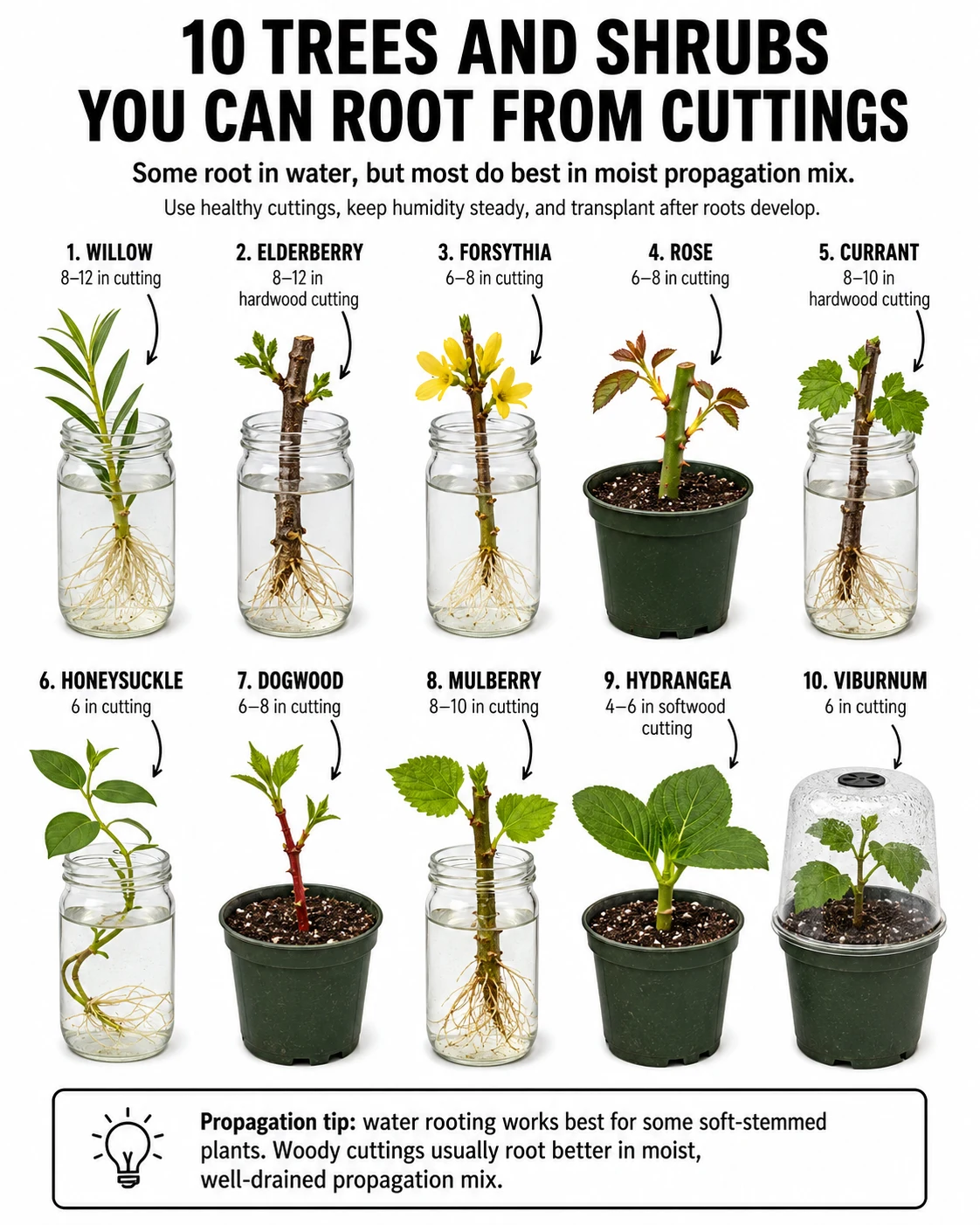
The first rule: match the cutting type to the plant
Not every plant roots the same way. In general, trees and shrubs are usually propagated from one of three cutting types:
Softwood cuttings
Taken from fresh, flexible growth in spring or early summer. These root faster but dry out more easily.
Semi-hardwood cuttings
Taken from partially matured stems in summer. These are excellent for many flowering shrubs and evergreen plants.
Hardwood cuttings
Taken from dormant woody stems in late fall or winter. These are often best for fruiting shrubs and some vigorous woody plants.
If you take the right kind of cutting at the right time, your success rate rises quickly.
1. Willow: one of the easiest woody plants to root
Willow is famous for rooting readily, which makes it one of the best starter plants for learning propagation.
Plant character
Fast-growing, moisture-loving, graceful, and often useful near water features or damp soils.
Common USDA zone range
Many willow species grow well in Zones 4–9, depending on type.
Practical propagation tip
Use healthy cuttings about 8–12 inches long. Willow often roots well in water, but it can also be started in moist propagation mix. Keep the lower nodes submerged or buried, since roots typically form there first.

2. Elderberry: excellent for edible and wildlife gardens
Elderberry is one of the most useful shrubs to propagate because it gives flowers, berries, and strong ecological value.
Plant character
Fast-growing, multi-stemmed, pollinator-friendly, fruit-bearing, and excellent for natural screens.
Common USDA zone range
Many elderberries perform well in Zones 3–8 or 3–9.
Practical propagation tip
Hardwood cuttings are often the easiest choice. Use sturdy dormant stems around 8–12 inches long, and make sure you keep the top and bottom direction correct when planting.
3. Forsythia: a classic for easy spring propagation
Forsythia is a great choice if you want a shrub that roots readily and quickly gives structure and bright spring color.
Plant character
Arching branches, early yellow blooms, vigorous growth, excellent hedge or border shrub.
Common USDA zone range
Usually reliable in Zones 5–8.
Practical propagation tip
Cuttings around 6–8 inches are often ideal. Softwood or semi-hardwood cuttings root well in moist mix. Forsythia is one of those plants that rewards consistency more than fuss.
4. Rose: beautiful, rewarding, and worth the effort
Rooting roses from cuttings can be deeply satisfying, especially when you want to preserve a favorite plant.
Plant character
Flowering shrub or climber with enormous variety in bloom form, scent, and habit.
Common USDA zone range
Varies by rose class, but many garden roses suit Zones 5–9.
Practical propagation tip
Take healthy 6–8 inch cuttings from stems that are firm but not old and woody. Remove flowers and buds so the cutting uses its energy for rooting, not blooming. Roses usually root better in moist propagation mix than in plain water.

5. Currant: practical for small edible gardens
Currants are excellent cuttings plants for gardeners who want more fruit in a compact space.
Plant character
Fruitful, shrubby, manageable, useful for small edible borders and backyard harvests.
Common USDA zone range
Often well suited to Zones 3–7 or 3–8 depending on type.
Practical propagation tip
Hardwood cuttings around 8–10 inches are a strong option. Currants usually respond well to dormant-season propagation and can become productive additions to a home food garden.
6. Honeysuckle: fast, useful, and often very willing to root
Honeysuckle can be a strong candidate for propagation, especially when you want a flowering vine or shrub for screening or fragrance.
Plant character
Vining or shrubby, often fragrant, fast-growing, useful for vertical coverage.
Common USDA zone range
Varies widely by species, but many fit Zones 4–9.
Practical propagation tip
Use cuttings around 6 inches long from healthy, vigorous growth. Keep humidity steady while rooting. Also choose species carefully, because some honeysuckles are much better garden choices than others.
7. Dogwood: slower, but very worthwhile
Dogwood is not always the easiest on the list, but it is absolutely worth trying if you want to preserve a beautiful ornamental specimen.
Plant character
Elegant branching, soft spring bloom, strong ornamental and wildlife value.
Common USDA zone range
Flowering dogwood is commonly grown in Zones 5–9.
Practical propagation tip
Take 6–8 inch softwood cuttings from strong, healthy growth. Dogwood benefits from careful humidity, clean tools, and patience. It is a good plant for gardeners ready to move beyond the easiest cuttings.

8. Mulberry: useful for fast edible expansion
Mulberry is a practical propagation plant if you want to expand a productive fruit planting.
Plant character
Fast-growing, fruitful, broad-canopied, adaptable in many landscapes.
Common USDA zone range
Many mulberries grow well in Zones 4–8.
Practical propagation tip
Use cuttings around 8–10 inches long from healthy young wood. Semi-hardwood or hardwood cuttings are often the most dependable. Avoid thin, weak stems from crowded interior growth.
9. Hydrangea: one of the best flowering shrubs to multiply
Hydrangea is one of the most rewarding shrubs to propagate because success comes relatively quickly, and the payoff is high.
Plant character
Big summer flowers, strong landscape value, broad leaves, excellent for borders and foundation planting.
Common USDA zone range
Many hydrangeas do well in Zones 5–9, depending on the variety.
Practical propagation tip
Softwood cuttings around 4–6 inches long are often ideal. Use non-flowering stems, trim off lower leaves, and keep the cutting in moist mix under high humidity until roots develop.
10. Viburnum: a smart shrub for structure and habitat
Viburnum is one of the best shrubs to propagate if you want more privacy, more bloom, or more wildlife support in the landscape.
Plant character
Dense branching, flowers, berries on many species, excellent hedge and screening value.
Common USDA zone range
Varies by species, but many are well suited to Zones 4–8.
Practical propagation tip
Cuttings around 6 inches often work well. Viburnum usually does best in moist propagation mix with stable humidity rather than open-air rooting.
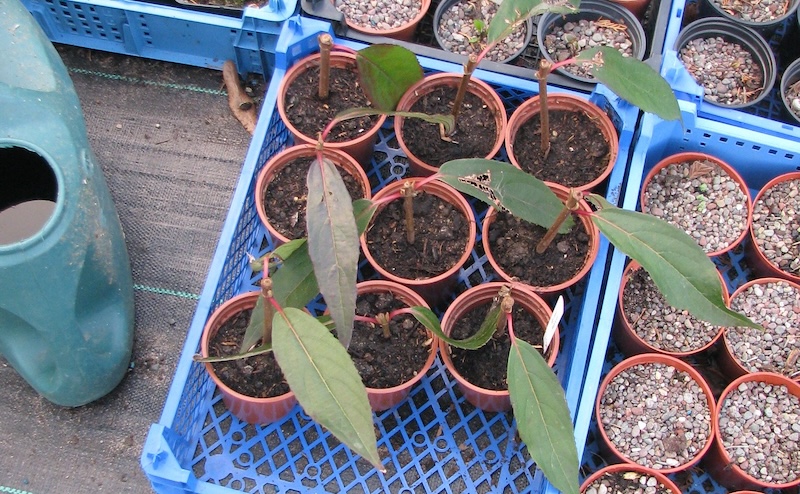
Water rooting or propagation mix?
This is where many gardeners get confused. Water rooting is appealing because you can see the roots, but woody plants do not always prefer it.
Water rooting works best for:
- some soft-stemmed cuttings
- very easy growers like willow
- quick observation and beginner practice
Moist propagation mix works better for:
- most woody shrubs
- hardwood cuttings
- plants like rose, hydrangea, viburnum, dogwood, and currant
A simple mix of perlite and potting medium, or another airy propagation blend, often gives better long-term rooting quality than a jar of water for woody plants.
How to set up your cuttings for success
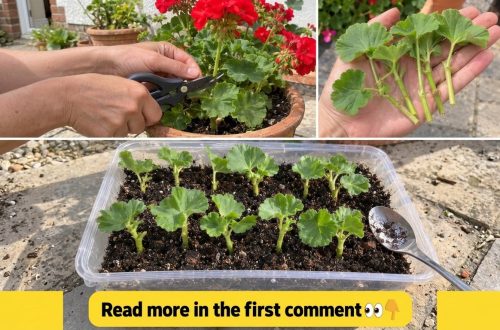
Start with clean pruners and healthy parent plants. Take cuttings in the morning when stems are fully hydrated. Cut just below a node, remove lower leaves, and reduce excess top growth if needed.
Then place the cuttings in:
- bright indirect light
- moist, not soggy medium
- steady warmth
- high humidity, especially for softwood cuttings
A humidity dome, loose plastic cover, or sheltered propagation tray can make a big difference.
Common mistakes that ruin tree and shrub cuttings
Using weak or diseased stems
Strong new plants begin with strong parent wood.
Taking flowering cuttings
Flowers drain energy the cutting needs for root development.
Letting cuttings dry out
This is especially common with softwood hydrangea, dogwood, and rose cuttings.
Keeping the mix too wet
Most failures come from rot, not from lack of water.
Potting up too early
Wait until roots are clearly formed and the cutting begins showing steady new growth.
When to transplant rooted cuttings
A rooted cutting is usually ready when:
- it resists a very gentle tug
- fresh new leaves begin developing
- roots are visible through drainage holes or around the medium
- it no longer wilts easily between checks
Move it into a small nursery pot first, not directly into a large garden space. Let it strengthen before planting it out.
Final thoughts
Learning to root trees and shrubs from cuttings changes how you garden. A single elderberry can become a hedge. A rose can become a row. A hydrangea can become a repeating border. A viburnum can become a future screen. And all of that begins with one healthy stem and a little patient care.
This is the kind of knowledge that builds real gardening confidence. It teaches timing, observation, and respect for how plants actually grow. And once you learn it, your garden no longer feels limited to what you can buy. It starts expanding from what you already know how to nurture.